

It's the first proper heatwave of the year. The phone has been ringing since seven.
One caller's air conditioning has stopped and there's an elderly parent in the house. Another wants a price on a new system. A property manager has three rooftop units throwing faults across two buildings. And somewhere in the middle of all that, the estimate you sent on Monday for a full replacement is sitting in someone's inbox, unread, while a competitor rings them back.
You can fix any of those systems. That's not the problem. You've spent years learning the trade, and you're good at it.
The problem is everything around the work. The calls you can't answer from inside an attic. The quotes nobody chases. The maintenance visits that should have been booked in spring and weren't. The reviews you meant to ask for. The customer from last year who forgot your name and Googled someone else.
I've spent most of my working life around small businesses. First in recruitment, then running a marketing agency, then building software. And I see the same pattern every time. The good operators aren't short of skill. They're short of a system.
So this is that system, written down. Whether you're about to start an HVAC business or you've been running an HVAC company for twenty years, this playbook walks through the whole thing, from your EPA certification to your hundredth maintenance agreement renewal.
And, as it happens, we've already built it.
Who this playbook is for
I've written this for three people at once. You'll probably recognise yourself in one of them.
1. The technician going it alone. You've been working for someone else. You know the trade inside out. Now you're thinking about how to start an HVAC business of your own: what to register, which licences you need, what to charge, and how on earth you find customers before the savings run out.
2. The owner-operator or small team. You've a van or two, maybe a couple of technicians, and a phone that never stops in July and January. You want to grow. But there's a nagging feeling that more customers right now would just mean more chaos, more missed calls and more late nights doing paperwork.
3. The established firm. Multiple trucks. Residential, commercial, or both. Dispatchers, an office team, service agreements with facility managers and property managers. You don't need anyone telling you how to diagnose a compressor. You need more control and less firefighting.
And there's a fourth reader I'll talk to near the end: the agency with HVAC clients. If you set up marketing and HighLevel accounts for HVAC companies, a lot of this will help you understand how your clients actually make money, which is half the battle.
How to use this playbook
It's long. On purpose. It's a playbook, not a blog post you read once and forget about.
You don't have to read it top to bottom. If you're starting out, read the setup, regulation and pricing sections first. If you're already busy, jump to the sections on urgent calls, estimates and maintenance agreements. If you're thinking about software, skip to why HighLevel fits.
There are checklists and tables throughout. Steal them. That's what they're for.
One more thing before we start. If you'd rather see the finished system first and read the reasoning after, the HVAC Snapshot for HighLevel is the playbook built out inside the platform. I'll walk through how it maps to every section later on.
The HVAC industry today
Let's start with the facts. Not the hype, not the "trades are the new gold rush" headlines. The actual numbers.
Jobs, pay and outlook
According to the US Bureau of Labor Statistics, there were 440,900 jobs for heating, air conditioning and refrigeration mechanics and installers in the US in 2025.
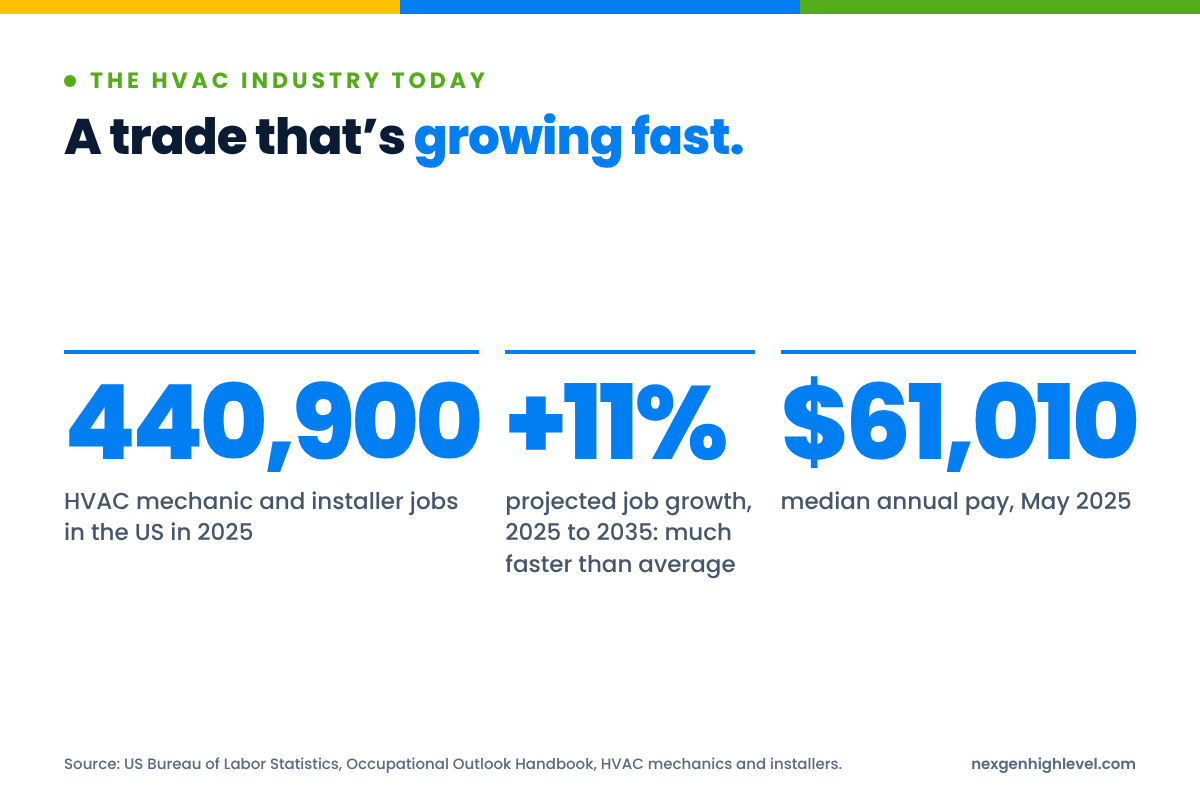
The same source puts median pay in May 2025 at $61,010 a year, or $29.33 an hour. The lowest 10% earned less than $40,050 and the highest 10% more than $95,210.
And the outlook is strong. The BLS projects employment to grow 11% from 2025 to 2035, which it calls "much faster than the average for all occupations". That's 48,200 more jobs. It also expects about 40,600 openings a year on average over that decade, mostly to replace people moving into other jobs or leaving the workforce.
| Measure | Figure | Source |
|---|---|---|
| HVAC mechanic and installer jobs (2025) | 440,900 | BLS |
| Median pay (May 2025) | $61,010 a year / $29.33 an hour | BLS |
| Projected growth, 2025 to 2035 | 11% (48,200 jobs) | BLS |
| Average openings a year, 2025 to 2035 | About 40,600 | BLS |
Who employs HVAC technicians
Here's a number I find interesting. The BLS says 68% of HVAC mechanics and installers work for plumbing, heating and air-conditioning contractors. Only 6% are self-employed.
So most people in the trade work for a business. Which means if you start an HVAC business, you're not just competing for customers. You're competing for technicians too. Keep that in mind. It'll come up again.
To give a sense of how big the contractor side is: in May 2023, the BLS counted 1,236,740 people working across all roles in plumbing, heating and air-conditioning contractors (NAICS 238220), of whom 288,160 were HVAC mechanics and installers, with a mean annual wage of $58,430 (BLS industry profile, May 2023).
Heat pumps are now a big part of the market
If you've been in the trade a while, you've felt this shift. The numbers show it.
According to AHRI's December 2025 statistical release, US shipments for the full year 2025 compared with 2024 looked like this:
| Equipment | 2025 shipments | 2024 shipments | Change |
|---|---|---|---|
| Gas warm air furnaces | 3,247,426 | 3,120,677 | Up 4.1% |
| Central air conditioners | 4,104,933 | 5,559,766 | Down 26.2% |
| Air-source heat pumps | 3,644,596 | 4,122,004 | Down 11.6% |
| Central ACs and heat pumps combined | 7,749,529 | 9,681,770 | Down 20.0% |
Do the sum from AHRI's own figures and more air-source heat pumps were shipped in 2025 than gas furnaces. That's my comparison, not AHRI's wording, and these are shipments rather than sales. But it tells you something. Heat pumps aren't a niche any more. If you're not confident installing, servicing and explaining them, your customers will find someone who is.
ENERGY STAR says an air-source heat pump "can deliver up to three times more heat energy to a home than the electrical energy it consumes", and its cold-climate models are verified to work below 5°F. It also points out that a typical household's energy bill is around $1,900 a year, and almost half of that goes on heating and cooling.
Almost half. That's the conversation your customers care about. Not SEER2 ratings. Their bills.
What the numbers mean for you
Steady demand. A real shortage of people. Equipment and rules changing under your feet.
That's a good industry to be in, if you run it properly. And a stressful one if you don't.
The trade isn't short of work. It's short of well-run businesses.
Choosing your lane: the services that make an HVAC company
Before you print a single business card, decide what kind of HVAC company you're building. Not every lane makes money the same way, and trying to do everything on day one is a fast way to do nothing well.
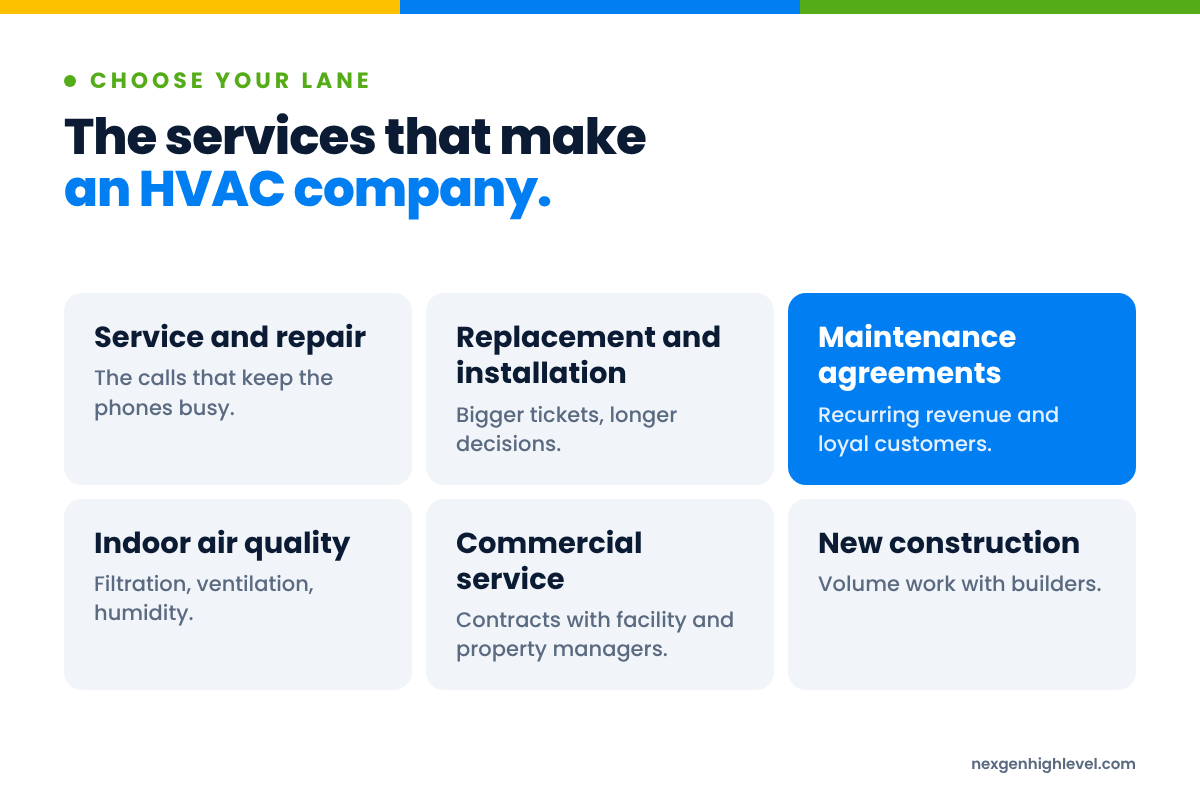
Residential service and repair
The bread and butter. No cooling, no heat, strange noises, a system short-cycling, a thermostat that's lost its mind.
- Revenue: frequent, smaller tickets, often urgent.
- What matters: answering the phone, triage, clear diagnostic fees, technicians who explain things well in someone's kitchen.
- The catch: it's lumpy. Quiet in mild weather, chaos in a heatwave or a cold snap.
Replacement and installation
New systems, change-outs, ductwork, heat pump conversions.
- Revenue: bigger tickets, fewer of them.
- What matters: a proper home assessment, good options presented clearly, estimate follow-up, financing if you offer it, permits and inspections.
- The catch: long decision cycles. The customer is comparing you with two or three others, and the one who follows up properly often wins.
Maintenance agreements and service plans
Planned visits, usually a cooling check in spring and a heating check in autumn, with whatever benefits you choose to include.
- Revenue: recurring and predictable.
- What matters: booking visits on time, renewing on time, actually delivering what you promised.
- The catch: it takes discipline and a system. Without one, agreements quietly lapse.
Indoor air quality
Filtration, purification, humidification and dehumidification, ventilation.
- Revenue: add-on sales, often during service visits or replacements.
- What matters: honest recommendations. If it's not needed, don't sell it.
Commercial service and contracts
Rooftop units, offices, retail, restaurants, schools, multi-family buildings.
- Revenue: service contracts, planned maintenance, larger repair and replacement projects.
- What matters: relationships with facility and property managers, reporting, multiple contacts per account, reliability.
- The catch: a different sales cycle, often with procurement involved, and higher licence and insurance requirements in some states.
New construction
Working with builders and general contractors on new homes or buildings.
- Revenue: volume, but often tight margins and payment terms that test your cash flow.
- What matters: reliable crews, accurate takeoffs, good relationships with builders.
Recurring versus project revenue
Here's the way I'd think about it.
| Revenue type | Examples | Strength | Weakness |
|---|---|---|---|
| Reactive | Repairs, no-cool and no-heat calls | Fast cash, high demand in peak season | Unpredictable; weather-dependent |
| Project | Replacements, installs, new construction | Big tickets | Long sales cycles; lumpy |
| Recurring | Maintenance agreements, commercial service contracts | Predictable; builds customer loyalty | Needs a system to book and renew |
Most healthy HVAC businesses end up with a mix. The reactive work brings customers in. The recurring work keeps them. And the project work is often won from customers who already trust you because you looked after their system for three years.
That last point is worth sitting with. The replacement sale usually starts with a tune-up.
Which lane should you start in?
If you're a technician going out on your own, I'd suggest starting with residential service and repair, plus maintenance agreements from day one. It's what you already know. It brings cash in quickly. And every service call is a chance to sign someone up for a plan.
Add installation once you've the people, the cash flow and the licence class to do it properly. Add commercial when you can genuinely service it, not when a big account dangles a contract in front of you.
Walk before you run.
Setting up an HVAC business properly
This is the boring bit. It's also the bit that protects your house, your savings and your family if something goes wrong. So do it properly.
A quick but important note: I'm not a lawyer or an accountant, and nothing here is legal or tax advice. Licensing and insurance rules vary by state, and often by city or county. Check with your state and get proper professional advice before you take on work.
The SBA's eight steps
The US Small Business Administration sets out eight steps to launch a business. They're a good backbone for any HVAC business plan:
- Pick your business location.
- Choose a business structure.
- Choose your business name.
- Register your business.
- Get federal and state tax ID numbers.
- Apply for licences and permits.
- Open a business bank account.
- Get business insurance.
Let's take the ones that matter most for HVAC.
Choose a business structure
The SBA lists the main structures as sole proprietorship, partnership, LLC, corporation (including C corp and S corp) and cooperative.
The difference that matters most to a tradesperson is liability. The SBA says of a sole proprietorship: "You can be held personally liable for the debts and obligations of the business". And of an LLC: "LLCs protect you from personal liability in most instances".
In a trade where you're working with electricity, gas, refrigerants and other people's homes, that difference is worth a conversation with an accountant before you start. Not after your first claim.
Register the business and get your EIN
Register your business name and structure with your state, plus any "doing business as" name if you trade under something other than your own name.
Then get your Employer Identification Number. The IRS issues EINs free online, and it's blunt about it: "You never have to pay a fee for an EIN." It also warns: "Beware of websites that charge for an EIN." You'll generally need one to hire employees or to operate as a partnership or corporation.
Free. From the IRS. Don't pay someone for it.
EPA Section 608 certification
This one isn't optional.
The EPA requires Section 608 certification for "technicians who maintain, service, repair, or dispose of equipment" that could release refrigerants into the atmosphere. There are four types:
| Certification | What it covers (EPA wording) |
|---|---|
| Type I | "For servicing small appliances" |
| Type II | "For servicing or disposing of high- or very high-pressure appliances, except small appliances and MVACs" |
| Type III | "For servicing or disposing of low-pressure appliances" |
| Universal | "For servicing all types of equipment" |
The good news: "Section 608 Technician Certification credentials do not expire."
Apprentices are exempt while a certified technician closely and continually supervises them. That matters when you start hiring and training your own people.
And there's a business angle people miss. Under the EPA's refrigerant sales restriction, "Only EPA-certified technicians are allowed to purchase" these refrigerants, "with limited exceptions". An employer can buy refrigerant if it shows the wholesaler written proof that it employs at least one properly certified technician. Section 609 (motor vehicle) technicians can't buy refrigerant intended for stationary equipment.
So if you're the business owner but not the certified tech, make sure that paperwork is in order before you need to buy.
State contractor licences
The BLS notes that "some states and localities require HVAC technicians to be licensed". And the SBA says "Local governments determine registration, licensing, and permitting requirements", listing construction as a commonly regulated activity, and noting that "Industry requirements often vary by state" (SBA).
To show how different the rules can be, here are three of the biggest HVAC states. These are examples, not a complete list, and rules change, so always check the current requirements with your state board.
California (CSLB). The C-20 classification covers a contractor who "fabricates, installs, maintains, services and repairs" warm-air heating, ventilating and air-conditioning systems, including ducts, registers, flues, controls and filters. According to the CSLB's licensing steps:
- A licence is needed for projects of "$500 or more in labor and materials combined".
- The qualifier must be at least 18 and have "at least 4 years of journeyman level work experience" in the classification within the last 10 years.
- The qualifier must pass written law and trade exams, unless a waiver applies.
- You'll need bonds and proof of workers' compensation and/or liability insurance.
- There's a mandatory criminal background check.
Texas (TDLR). In Texas, anyone who works on air conditioning, refrigeration or heating systems must hold a TDLR licence, and ACR companies must employ an ACR contractor "in each permanent location". The contractor licence comes in two classes:
- Class A "allows you to work on any size unit".
- Class B covers cooling systems of 25 tons and under and heating systems of 1.5 million BTUs an hour and under.
- Endorsements cover Environmental Air Conditioning, Commercial Refrigeration, and Process Cooling or Heating.
You'll need either "at least 48 months of practical experience in air-conditioning and refrigeration-related work" within the past 72 months, or a technician certification held for 12 months plus 36 months of experience within the past 48 months. And Texas sets minimum commercial general liability insurance:
| Licence | Per occurrence | Aggregate | Products and completed operations aggregate |
|---|---|---|---|
| Class A | $300,000 | $600,000 | $300,000 |
| Class B | $100,000 | $200,000 | $100,000 |
Applicants must finish every requirement, including the exam, "within one year of the date the application is filed".
Florida (DBPR). Florida's Construction Industry Licensing Board has air-conditioning contractor classes:
- Class A: unlimited.
- Class B: "limited to 25 tons of cooling and 500,000 BTU of heating in any one system".
- Class C: limited to servicing existing systems, and closed to new entrants since 1 October 1988.
Certified contractors can work in any Florida jurisdiction. Registered contractors "may contract only in such jurisdictions" where they meet local competency requirements.
Three states. Three completely different sets of rules. That's why "check with your state" isn't me covering myself. It's genuinely the only honest advice.
Permits
Replacements and new installations often need permits and inspections from your city or county. Build permit time into your installation schedule and your customer communication. Nothing annoys a customer like a start date that slips because a permit wasn't applied for.
Insurance
The SBA lists the common types: general liability, product liability, professional liability, commercial property, home-based business insurance and a business owner's policy.
It also states: "The federal government requires every business with employees to have the following", and lists workers' compensation, unemployment and disability insurance. It adds that "Some states also require additional insurance."
For an HVAC business, add commercial vehicle insurance for your vans and trucks, and check whether your state licence sets minimum cover (as Texas does).
Safety
This deserves more than a line.
The BLS says HVAC technicians have "one of the highest rates of injuries and illnesses of all occupations". The hazards include burns from electrical parts or chemicals, muscle strains from heavy equipment, refrigerants that need protective equipment, cramped spaces and working outdoors in all weather.
OSHA's guidance covers the big ones:
- Falls. "Falls are among the most common causes of serious work related injuries and deaths", and fall protection is required at "six feet in the construction industry" (OSHA). Rooftop units and ladders are part of the job. Plan for them.
- Electrical. "Electricity has long been recognized as a serious workplace hazard", and OSHA's standards address "electric shock, electrocution, fires, and explosions" (OSHA).
- Confined spaces. OSHA defines one as having "limited or restricted means for entry or exit" and "not designed for continuous occupancy", with equipment housings and ductwork among its examples. A permit-required space "contains or has the potential to contain a hazardous atmosphere", among other criteria (OSHA).
- Heat. "Every year, dozens of workers die and thousands more become ill while working in hot or humid conditions." But also: "Heat illness is serious, but you can prevent it" (OSHA). An attic in July is a dangerous place to work.
People are more important than money. That applies to your technicians first.
The setup checklist
| Item | Done? |
|---|---|
| Business structure chosen (with an accountant) | ☐ |
| Business and any DBA registered with your state | ☐ |
| EIN from the IRS (free) | ☐ |
| EPA Section 608 certification in place for everyone handling refrigerant | ☐ |
| Proof of certified technician ready for refrigerant purchases | ☐ |
| State and local contractor licence checked and applied for | ☐ |
| Permit process understood for your city and county | ☐ |
| General liability, vehicle and any required insurance arranged | ☐ |
| Workers' compensation and other required cover, if you have employees | ☐ |
| Safety plan, PPE, fall protection and heat illness plan | ☐ |
| Separate business bank account | ☐ |
Refrigerant and efficiency changes every HVAC owner must know
If you've been in the trade over the last few years, you'll know the rules have been moving. And some of what was true eighteen months ago isn't true now. So here's where things stand, as carefully as I can put it.
The refrigerant transition (AIM Act)
Under the EPA's Technology Transitions rules for stationary residential and light commercial air conditioning and heat pumps:
- Self-contained products have a GWP limit of 700, with a manufacture and import compliance date of 1 January 2025.
- Installed systems (such as mini-splits and unitary split systems) have a GWP limit of 700, with an installation compliance date of 1 January 2025.
- There's "No installation compliance date for systems where all specified components were manufactured or imported" "prior to January 1, 2025".
In plain terms, a whole new system built from components made after 2024 generally needs a refrigerant with a GWP under 700. That's the move to the A2L refrigerants you'll have been training on.
What happened to the R-410A deadline
This is the bit that's changed, and where a lot of older articles are now wrong.
The EPA's December 2023 interim final rule allowed inventory of "higher-GWP HFC equipment manufactured or imported before January 1, 2025" to be installed "until January 1, 2026". A reconsideration rule published in the Federal Register on 26 May 2026 removed that deadline.
ACCA put it this way: the final rule "formally lifts the January 1, 2026, prohibition on the installation of residential and light commercial R-410A AC" and heat pump systems "manufactured or imported prior to January 1, 2025." Law firm Holland & Knight gives the citation as 91 Fed. Reg. 31284.
The rule took effect in July 2026, according to ABC. ABC also reports that contractors can still service existing R-410A systems with parts labelled "for servicing existing equipment only", and can install systems made entirely from eligible pre-2025 components with no federal expiry date.
So, where does that leave you?
- Existing R-410A systems can still be repaired and serviced.
- Systems made entirely from components manufactured or imported before 1 January 2025 can still be installed, with no federal installation deadline.
- Systems with any newer components still need a refrigerant with GWP under 700.
Refrigerant prices
Here's what to watch. ACCA expects the changes to "significantly increase refrigerant prices for all contractors", because the AIM Act phasedown keeps reducing HFC supply.
ACCA, HARDI and PHCC have also filed a legal challenge to parts of the reconsideration rule, mainly around commercial refrigeration. ACCA said it "appreciates EPA eliminating the install deadline for R-410A split-system equipment". And PHCC's CEO cited EPA's own analysis, which "projects a 12- to 24-percent increase in U.S. refrigerant prices by 2029."
What does that mean for your business? Two things.
First, your pricing needs reviewing regularly. If refrigerant costs move, your flat-rate book has to move with them.
Second, your customers will have questions. "Should I repair or replace?" gets more complicated when refrigerant costs are rising. The contractor who explains it clearly and honestly wins the trust, and usually the job.
SEER2 efficiency standards
The DOE minimum standards for central ACs and heat pumps manufactured on or after 1 January 2023 are:
| Equipment | Minimum standard |
|---|---|
| Split-system air conditioners | SEER2 13.4 |
| Split-system heat pumps | SEER2 14.3 / HSPF2 7.5 |
| Single-package air conditioners | SEER2 13.4 |
| Single-package heat pumps | SEER2 13.4 / HSPF2 6.7 |
There are also regional standards for units "installed on or after January 1, 2023, in the southeast or southwest". Split ACs under 45,000 Btu/h need SEER2 14.3 (with an extra EER2 requirement in the Southwest), and split ACs of 45,000 Btu/h and over need SEER2 13.8.
The Southeast covers AL, AR, DE, FL, GA, HI, KY, LA, MD, MS, NC, OK, PR, SC, TN, TX, VA, DC and the US territories. The Southwest is AZ, CA, NV and NM.
If you work in those regions, make sure your estimates, your team and your stock all reflect it.
The 25C tax credit has ended
This one catches people out, because plenty of websites still say otherwise.
According to the IRS, under the One Big Beautiful Bill the Section 25C Energy Efficient Home Improvement Credit "will not be allowed for any property placed in service after December 31, 2025."
When it was available (for qualifying property placed in service from 2023 through 2025), the IRS describes a limit of up to $3,200 a year in total, including "$2,000 per year for qualified heat pumps, water heaters, biomass stoves or biomass boilers". It was claimed on Form 5695 for the tax year of installation.
So heat pumps installed in 2026 don't get the 25C credit. If your website, your estimates or your sales scripts still mention it, update them now. Telling a customer they'll get a credit they won't get is a fast way to lose trust, and a review you won't enjoy reading.
Rules change. Your messaging has to change with them.
Pricing and profit in an HVAC business
I'm not going to give you prices. Anyone who tells you what to charge without knowing your area, your costs and your team is guessing. What I can give you is the method.
Know your real cost per hour
Start here, before you choose a pricing model. Add up everything it costs to keep a technician and a van on the road for a year:
- Wages, taxes, benefits and overtime.
- Vehicle costs: finance, fuel, insurance, maintenance.
- Tools, equipment and diagnostic kit.
- Insurance, licences, bonds and certifications.
- Office costs, software, phones and marketing.
- Training and time spent on callbacks.
Then divide by the hours that are actually billable. Not the hours your technician is on the clock. The hours a customer is paying for. Drive time, supplier runs, paperwork and callbacks all eat into it.
That number usually surprises people. And it's the floor. Everything you charge has to sit comfortably above it, with profit added as a line, not hoped for as a leftover.
Flat rate versus time and materials
| Model | How it works | Works well for | Watch out for |
|---|---|---|---|
| Flat rate | A fixed price per task, set from a price book built on your average time, parts and overheads | Residential service and repair; customers who want to know the price before you start | Building and maintaining the price book; reviewing it when parts and refrigerant costs move |
| Time and materials | Hourly labour plus parts at a set mark-up | Complex diagnostics, commercial work, jobs with unknown scope | Customers worry about the clock running; harder to quote up front |
| Fixed project price | One price for a defined scope | Replacements and installations | Scope creep; you need a clear written scope and a change process |
| Agreement pricing | A recurring fee for planned visits and agreed benefits | Maintenance agreements and commercial service contracts | Delivering what you promised, and renewing on time |
Plenty of HVAC companies use a mix: flat rate for residential repairs, a fixed project price for installs, and time and materials for some commercial work. What matters is that you know which one you're using, why, and that the numbers underneath it are real.
Service call and diagnostic fees
Most HVAC businesses charge a fee to come out and diagnose a problem. How you handle it is up to you, but be clear:
- Say what the fee covers before the visit, not after.
- Decide whether it's credited against the repair if the customer goes ahead, and say so.
- Put it in writing in the booking confirmation.
Surprises are what create bad reviews. Not the price.
Maintenance agreements: the engine of recurring revenue
I'll come back to these in a full section, because they deserve one. But from a pricing point of view, a maintenance agreement does three things for you:
- It smooths cash flow across the year.
- It fills the quiet weeks in spring and autumn with planned work.
- It keeps you in front of the customer, so when the system finally needs replacing, you're the first call, not the third quote.
Price agreements from the real cost of delivering the visits, plus whatever benefits you include, plus profit. Don't price them as a loss leader and hope.
Seasonality and cash flow
The BLS notes that overtime and irregular schedules are common during "peak heating and cooling seasons". You already know this. July and January are mad. April and October can be very quiet.
So plan for it:
- Build a cash buffer in peak season. It's tempting to spend it. Don't.
- Book maintenance visits into the shoulder seasons. That's what spring and autumn tune-ups are for.
- Run seasonal campaigns before the season, not during it. By the time a heatwave hits, you're too busy to market.
- Watch payment terms on commercial and new construction work. A big contract that pays in 60 or 90 days can starve a small business of cash.
The numbers to watch every week
You don't need a dashboard with fifty charts. You need a handful of numbers you actually look at.
| Number | What it tells you |
|---|---|
| New enquiries, by source | Where your customers are coming from |
| Time to first response | Whether people are getting an answer |
| Booked jobs from enquiries | Whether your booking process works |
| Estimates sent, won, lost and still open | Whether your follow-up works |
| Average ticket, by job type | Whether your pricing and options are right |
| Callbacks and repeat visits | Whether quality is holding up |
| Active maintenance agreements and renewals due | The health of your recurring revenue |
| Reviews received and your average rating | Your reputation, in public |
| Gross margin by service | What actually makes you money |
Measure revenue and profit, not just bookings. A full calendar of jobs that lose money is just a very busy way to go backwards.
Does it make any money? Ask that of every service you offer.
Trucks, technicians and training
You can't grow an HVAC company without good people. And there aren't enough of them.
The shortage is real
The BLS expects about 40,600 openings a year from 2025 to 2035. ACCA's CEO, Barton James, has said: "The workforce crisis facing the skilled trades isn't something we can solve overnight" (ACCA). Back in 2019, ACCA pledged to "hire and/or educate 75,000 industry professionals" to "fill the employment gap impacting" HVACR contractors (ACCA).
You'll see plenty of shortage figures quoted online. Many of them don't have a named source, so I won't repeat them. But you don't need a statistic to tell you it's hard to hire. You've probably tried.
Hiring
A few principles that hold up:
- Hire for attitude and teach the trade. A reliable, honest person who's good with customers can learn the technical side. Teaching someone to be decent in somebody's living room is much harder.
- Be clear about the role. Service technician, installer, apprentice, dispatcher, office manager. Each one needs a different person.
- Check certifications. Section 608 for anyone handling refrigerant, plus any state or local licence.
- Respond fast to applicants. Good technicians have options. Treat applicants the way you'd treat a customer enquiry.
Apprenticeships
The BLS says "Some technicians train through an apprenticeship program, which usually lasts several years", combining paid on-the-job training with technical instruction. And remember the EPA rule: apprentices don't need Section 608 certification while a certified technician closely and continually supervises them.
Growing your own technicians takes time. But it's often the only reliable way to build a team in a tight market. And people tend to stay with the business that trained them, if it treats them well.
NATE certification
NATE (North American Technician Excellence) was founded in 1997 and calls itself "the nation's largest non-profit certification organization" for HVACR technicians. There are two routes: Core plus Specialty exams (Installation, Service or Senior), or the five-exam CHP-5 pathway. Certifications generally last two years (three for Ground Source Heat Pump Installer) and are renewed with continuing education.
It's not a legal requirement in the way Section 608 is. But it's a recognised mark of competence, and supporting your team through it tells them you're investing in them.
Keeping good people
Here's the thing I learned in nearly 23 years of recruitment. People rarely leave for money alone. They leave because they feel unappreciated, overworked, disorganised or stuck.
And a lot of what makes technicians miserable is chaos. Being sent to a job with the wrong information. Turning up to a locked gate. Not knowing which parts are needed. Getting shouted at by a customer who was promised something the office should never have promised.
Fix the system and you fix a lot of the reasons people leave.
- Give technicians the full job details before they arrive: the problem, the equipment, site access, history.
- Don't overload the schedule just because the phone is ringing.
- Pay fairly and review it regularly.
- Show a path: apprentice to technician to senior tech to lead or manager.
- Say thank you. It costs nothing.
Business is a people game disguised as a numbers game. Never more so than in a trade where your people are the product.
Vans and trucks
Your van is a rolling warehouse and a moving advert. Keep it stocked with your most-used parts so fewer jobs need a second visit. Keep it clean and branded. And track what's on it, so you know what's been used and what needs reordering.
HVAC marketing: winning customers
Here's where a lot of HVAC companies go wrong. They think marketing means ads. Then they spend money on ads, the phone rings, nobody answers it fast enough, the estimate isn't followed up, and they decide "marketing doesn't work".
Marketing is the whole journey, from someone discovering you to becoming a paying customer and then a repeat one. Systems, not just ads.
Google Business Profile and local search
When someone's air conditioning dies, they pick up their phone and search. So your Google Business Profile matters more than almost anything else you'll do.
Google says local results are "mainly based on relevance, distance, and popularity", and its page breaks that down into relevance, distance and prominence. "Prominence means how well-known a business is", based in part on "how many websites link to your business and how many reviews you have". And: "More reviews and positive ratings can help your business's local ranking."
Also worth knowing: "There's no way to request or pay for a better local ranking on Google." So ignore anyone who promises you the top spot.
What to do:
- Complete every part of your profile: services, service area, hours, photos, description.
- Choose the right categories.
- Post updates, especially before each season.
- Get reviews steadily, and reply to every one.
Local Services Ads
Google Local Services Ads are worth understanding. For US HVAC businesses, Google's checks include business and owner background checks, state-level business and owner licence checks ("Where applicable by local law") and a general liability insurance check, each marked "(Select users only)". Google adds: "HVAC professionals undergo an additional level of screening, which includes service professional background checks."
So if you plan to use them, get your licence and insurance paperwork in order first. Which you should have done anyway.
Reviews
Reviews are the shop window for an HVAC business. According to BrightLocal's 2026 Local Consumer Review Survey of 1,002 US adults:
- 97% of consumers read reviews for local businesses, and 41% always do.
- 71% use Google for reviews.
- 49% trust online reviews as much as recommendations from people they know.
- 89% expect business owners to respond to reviews, and 80% are more likely to use a business that responds to all of its reviews.
- 74% only consider reviews from the last three months.
- 68% require a rating of 4 stars or more, and 31% require 4.5 or more.
- 47% won't use a business with fewer than 20 reviews.
Read those again. Recent reviews. A good rating. Enough of them. And replies from you.
That last-three-months number is the one I'd pin to the wall. It means reviews aren't a one-off project. They're a habit. Every completed job is a chance to ask.
Referrals
Your happiest customers know other homeowners. Ask them. Make it easy: a simple message after a good job, a referral link, a thank you when someone sends a friend your way.
People buy from people. A recommendation from a neighbour still beats almost any ad.
Seasonal campaigns
The calendar does half your marketing for you, if you plan ahead.
- Late winter and spring: pre-summer cooling tune-ups, maintenance agreement sign-ups and renewals.
- Early summer: reminders before the first heatwave; replacement offers for ageing systems.
- Late summer and autumn: pre-winter heating tune-ups and safety checks.
- Winter: heating repairs, replacement planning for systems that struggled.
ENERGY STAR gives you the message: it recommends "annual pre-season check-ups" and says "it's best to check the cooling system in the spring and the heating system in the fall". It also reminds homeowners to "Inspect, clean, or change air filters once a month", because "A dirty filter can increase energy costs and damage your equipment, leading to early failure."
That's a ready-made, credible reason to get in touch with every customer twice a year.
Commercial prospecting
Commercial work doesn't usually come from a homeowner searching on their phone. It comes from relationships with facility managers, property managers, building owners and operations teams.
So go and find them:
- Build a list of buildings in your area you could genuinely service: offices, retail, restaurants, schools, apartment blocks.
- Find the person responsible for maintenance and who signs off contracts.
- Approach them with something specific to their building, not a generic brochure.
- Follow up patiently. Commercial decisions take time, and contracts come up for renewal on a cycle.
This is where the "Capture, Nurture, Close" model has a gap. Where's the prospecting? Where's the outreach? Where's the market creation? Commercial HVAC work needs all three. I'll come back to how we help with that.
Urgent calls: triage, safety and honest timings
In HVAC, a lot of your enquiries are urgent. A family without heating in January. A house at 90 degrees with a newborn in it. A server room heating up.
ACCA's advice to homeowners during the 2026 heat dome was to "schedule a professional check rather than waiting for a full breakdown" and to "Identify an HVAC contractor before an emergency hits", noting that demand for HVAC service "spikes nationwide" (ACCA). When that happens, every HVAC company is slammed at once.
How you handle urgent calls in those weeks shapes your reputation for years.
Triage properly
Not every "urgent" call is equally urgent. Have a short set of questions your team asks every time:
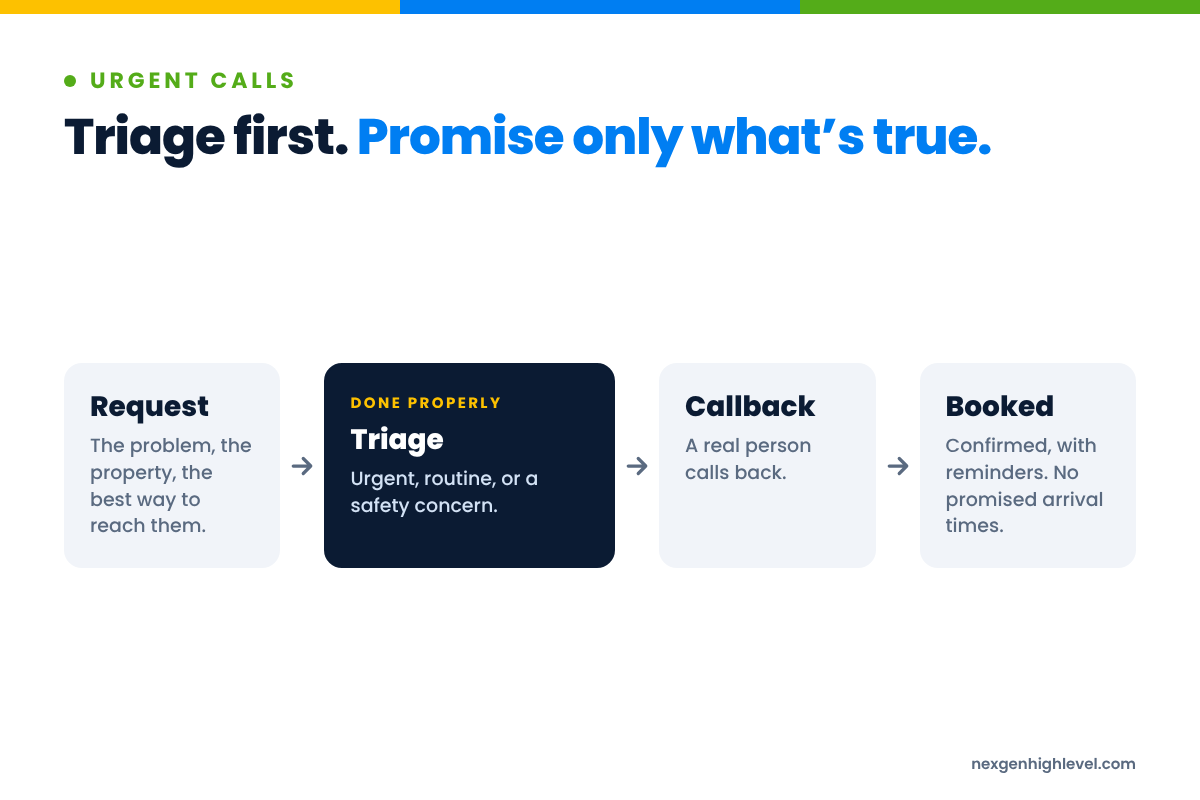
- What's happening with the system?
- Is anyone vulnerable in the property: elderly, very young, unwell?
- Is there any sign of a safety issue: a gas smell, burning smell, sparking, water near electrics, a carbon monoxide alarm?
- Residential or commercial? What's affected?
- Best number and preferred way to contact them?
Safety concerns come first
If a caller reports a gas smell, a carbon monoxide alarm or anything electrical that sounds dangerous, that needs a clear, immediate process. Your team should know exactly what to tell the caller to do for their own safety (including contacting the gas utility or emergency services where appropriate) and who in your business reviews it straight away.
Write this process down. Train everyone on it. Don't leave it to whoever happens to answer the phone.
Call people back
When you can't answer, call back. Fast. A missed call in a heatwave is a customer for someone else.
But here's the line I'd never cross: don't promise what you can't deliver.
Never over-promise arrival times
It's tempting, when someone's desperate, to say "we'll have someone with you in an hour". And then the job before runs over, and the traffic's bad, and you've a furious customer and a stressed technician.
Be honest instead. Tell them you've got their details, that their request is being reviewed, and that someone will be in touch to confirm a time. Then confirm it when you actually know.
An honest "we'll confirm a time shortly" beats a broken promise every single time.
Booking, reminders and the estimate that went quiet
This is where a lot of HVAC revenue quietly leaks away. Not in a dramatic way. Just a little bit, every week.
Booking and reminders
Once a visit is booked:
- Send a confirmation straight away, with the date, the time window, what the visit is for and any diagnostic fee.
- Send a reminder the day before.
- Make it easy to reschedule, and keep the change on the same record so nobody's working from the old time.
- Ask about site access: gate codes, pets, parking, where the equipment is.
No-shows and wasted trips cost you a technician's time. Good reminders cut them.
The estimate that went quiet
Picture a two-van HVAC company in late spring. They do a home assessment for a full replacement. Good conversation, nice customer, three options sent that evening.
Then nothing. The customer's busy. They mean to reply. The owner is out on calls all week and forgets to chase. Two weeks later, the customer goes with someone else. Not because the other company was better. Because they followed up.
Replacements are big decisions, and people need time. That's normal. But they also need someone to answer their questions, remind them gently, and make it easy to say yes.
A good estimate follow-up process:
- Same day: send the estimate with clear options and what's included.
- A couple of days later: check they received it and ask if they have questions.
- About a week later: a helpful follow-up, perhaps on financing, timing or the difference between options.
- Later: a final check-in, then park it politely if they've decided not to go ahead.
Record each step. Revisions, acceptance and payment should be separate, recorded steps, so nobody ever has to ask "did they say yes or not?"
Most estimates aren't lost. They're abandoned.
Running service and installation jobs
The job itself is where you shine. But the jobs that go wrong rarely go wrong because of the engineering. They go wrong because of information.
Before the visit
- Parts. Do you know the equipment, model and likely parts? Can you check before rolling a truck?
- Site access. Gate codes, keys, building contacts, roof access, parking, pets.
- History. What was done last time? Is it under warranty? Is there a maintenance agreement?
On the job
Scope changes are where disputes start. You open up a system and find more than you expected. Fine. It happens. But stop, explain, put the change in writing and get approval before you carry on. Record it on the job. Never let a scope change live only in a technician's memory.
Installations need their own process: permits, equipment ordering, scheduling the crew, inspections, and a clear handover.
Completion
At the end of every job:
- Walk the customer through what was done.
- Show them anything they need to know: filters, thermostat settings, warning signs.
- Record the work, the parts and any recommendations.
- Send the invoice promptly.
Aftercare and service recovery
A short check-in a few days after a job does two things. It catches any problem early, before it becomes a one-star review. And it shows you care, which is the moment to ask for that review if all's well.
When something does go wrong (and it will, sometimes), handle it quickly, own it and keep the concern linked to the original job so nothing gets lost. A problem handled well often creates a more loyal customer than a job that went perfectly.
How you behave when there's nothing in it for you tells people quite a lot about you.
Maintenance agreements: the backbone of an HVAC business
If I could only tell an HVAC owner one thing, it'd be this: build your maintenance agreements properly.
Why they matter
The DOE says "You should have a professional technician service your heat pump at least once a year", and that the difference in energy use between a well-maintained heat pump and a severely neglected one is roughly 10% to 25%. ENERGY STAR recommends a cooling check in spring and a heating check in autumn.
So maintenance isn't an upsell. It's genuinely good for the customer. Lower bills. Fewer breakdowns. Equipment that lasts longer.
For your HVAC business, service plans give you predictable revenue, planned work for the quiet months and a relationship with the customer that runs for years.
What a good service plan includes
You decide the benefits, but be specific. Customers renew what they understand.
- The number of planned visits each year, and what each visit covers.
- Any customer benefits, such as discounts on repairs or scheduling preferences. Be careful with wording here: promise only what you can genuinely deliver in a peak-season week.
- How and when it renews.
- How the customer can cancel.
Booking the visits
The most common way agreements fail? The visits don't get booked. The customer pays, then nobody calls them in spring. So they don't renew.
Book planned visits proactively, ahead of each season. Remind customers. Record each visit against the agreement, so you can see at a glance who's had their visit and who hasn't.
Renewals
Start the renewal conversation before the agreement ends, not after. Remind the customer what they've had during the year. And treat the renewal as a real decision by the customer, not an assumption.
Commercial agreements
Commercial service contracts are maintenance agreements with more moving parts: multiple sites, multiple contacts, a site contact who isn't the billing contact, a procurement team, reporting requirements. Keep those roles separate in your records. Nothing irritates a facility manager like the invoice going to the wrong person three months running.
Recurring revenue doesn't happen by accident. It happens by system.
Keeping customers with seasonal care
Winning a new customer is expensive. Keeping one is mostly about remembering them.
Pre-summer and pre-winter tune-ups
Twice a year, every customer should hear from you. Use the ENERGY STAR guidance on spring cooling checks, autumn heating checks and monthly filter changes. It's helpful, it's honest and it gives people a reason to book.
Reviews and referrals, on repeat
After every good job, ask for a review. After every glowing review, ask for a referral. Thank people who do either. Reply to every review, good or bad, properly and politely.
And keep it going all year. Remember, 74% of consumers only consider reviews from the last three months (BrightLocal). Last year's reviews aren't doing much for you now.
The quiet customer
The customer who had one repair two years ago and never heard from you again? They're not loyal to anyone. A simple seasonal message keeps your name in their head, so when their system finally gives up, they call you first.
Growing without the chaos
This is the part I care most about, because I've got it wrong myself.
In recruitment, I grew aggressively. Big offices, big overheads, lots of people. Then Covid hit, and the world just stopped. Furlough covered salaries but not the rent, the property taxes, the leases or the software licences. I had to close the business and let people go. The hardest business decision of my life.
So here's what I learned: walk before you run. And even when you're ready to run, keep walking for a little bit longer. Only run when you can see the green field stretching out in front of you.
Systems before headcount
Before you hire another technician or buy another van, ask:
- Are we answering every enquiry promptly?
- Are we following up every estimate?
- Are maintenance visits booked and renewals happening on time?
- Do technicians get the full job details before they arrive?
- Are we asking for reviews after every job?
If the answer to any of those is "not really", more trucks will just make the problem bigger. Fix the system first. Then grow.
The three personalities that get stuck
I see three types of owner get stuck. I've been all three, by the way.
- The Tinkerer buys software and spends months fiddling instead of using it.
- The Rusher switches everything on at once without testing, and annoys half their customers in a week.
- The Magic-Bullet Believer thinks the next tool will fix everything, and never learns the last one properly.
My advice to all three: know your goal, plan properly, set up properly, understand properly. Then go for it.
There's more on this in growing a small business with systems and how to measure new business growth.
Why HighLevel fits an HVAC business of any size
So, the software question. What's the best HVAC CRM or HVAC software?
I'm biased, obviously. We build on HighLevel. But I'll tell you why, and you can decide.
One platform instead of seven
Look back at everything in this playbook. Request forms. Triage. Booking and reminders. Estimate follow-up. Job tracking. Aftercare. Maintenance agreements and renewals. Reviews. Referrals. Seasonal campaigns. A website. Reporting.
In most HVAC companies that's five, six, seven tools that don't talk to each other. Someone copies details from one to another, and things fall through the gaps.
HighLevel (plenty of people still call it GoHighLevel) puts it in one place:
- CRM and contacts, with every conversation and job on the record.
- Pipelines for enquiries, estimates, jobs, installations and renewals.
- Forms and surveys that capture the property and the problem on first contact.
- Calendars and booking, with automatic confirmations and reminders.
- Email, SMS and calls in one inbox, plus WhatsApp through our app.
- Reviews and reputation management.
- Funnels and websites, so your site and your follow-up are one system.
- Workflows and automation, so follow-up happens whether or not you remember.
- AI, to help with intake, follow-up and replies, with a human in charge.
- Reporting, so you can see what's actually making money.
It grows with you
HighLevel is a flat platform model, and its plans include unlimited users. You don't pay more because you hired a dispatcher or a third technician. A solo technician can use a fraction of it on day one, and the same account can run a multi-truck residential and commercial operation later, without moving everything to a new system in the middle of July.
But remember: technology is leverage, not strategy. Leverage multiplies whatever is underneath it. That's why what's built inside the platform matters as much as the platform itself.
If you want a fuller comparison, we've written up how HighLevel compares to HubSpot.
The HVAC Snapshot for HighLevel: the playbook, already built
Here's the thing. Everything you've just read, we've already built inside HighLevel.
A HighLevel (or GoHighLevel) Snapshot is a ready-made set of pipelines, workflows, funnels, forms, templates and more that installs into a HighLevel account. Not all Snapshots are equal. Plenty are a couple of funnels and a handful of workflows. Ours isn't. The HVAC Snapshot is a complete, fully built-out business system for US residential and commercial HVAC businesses, and for the agencies that set up HighLevel for HVAC clients. It's not a starter pack.
It covers cooling and heating repairs, planned service, replacement and installation, indoor air quality, maintenance agreements and service plans, and commercial agreements. At the time of writing it includes 98 workflows, 42 funnels with 72 pages, 94 email templates (with matching text and WhatsApp copy), 8 pipelines with 75 stages, 8 knowledge bases and 5 AI agents.
The eight stages, mapped to this playbook
| Snapshot stage | What it does | Where it is in this playbook |
|---|---|---|
| 1. Enquiry and Service Request | Residential and commercial request forms record the property, the problem and preferred contact method | HVAC marketing: winning customers |
| 2. Urgent Triage and Callback | Urgent requests get a distinct staff handoff; reported safety concerns are routed for priority review | Urgent calls: triage, safety and honest timings |
| 3. Appointment Booking and Reminders | Bookings, confirmations and reminders stay linked to the current appointment, with changes on the same record | Booking and reminders |
| 4. Estimate and Decision | Estimate follow-up answers questions; revisions, acceptance and payment are separate recorded steps | The estimate that went quiet |
| 5. Service and Installation Delivery | Service jobs and installation projects through scheduling, parts, site access, scope changes and completion | Running service and installation jobs |
| 6. Aftercare and Service Recovery | Aftercare check-ins and service concerns stay linked to the completed work | Aftercare and service recovery |
| 7. Maintenance Agreements and Renewals | Planned visits and renewal conversations, plus commercial agreements | Maintenance agreements |
| 8. Reviews, Referrals and Seasonal Care | Review invitations, referral requests and seasonal follow-ups | Keeping customers with seasonal care |
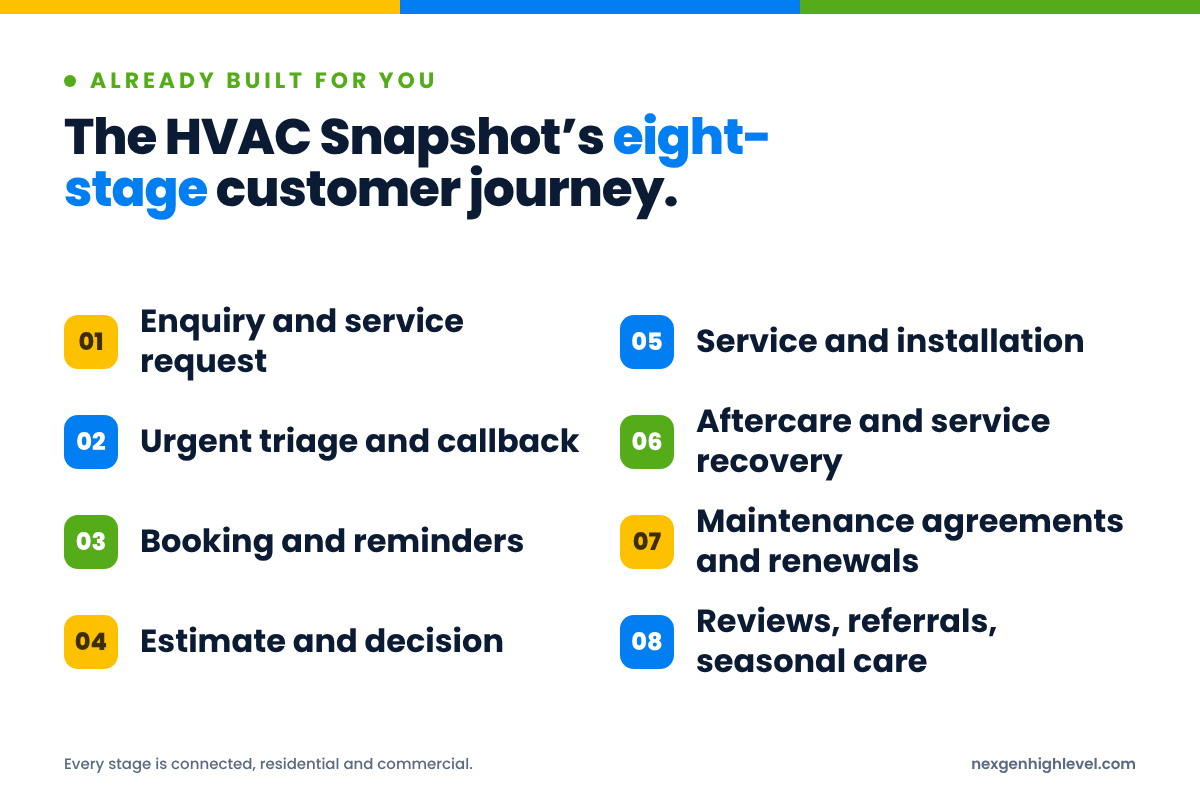
The estimate that went quiet? Stage 4. The heatwave callback? Stage 2. The spring visits nobody booked? Stage 7.
You'll find named pieces like the Service Visit Booking Funnel, the maintenance agreement workflow and the HVAC Job Pipeline. Messaging is consent-aware: service messages and marketing permissions are kept separate for email and text, and HighLevel's native Do Not Disturb settings take precedence. And no message promises a technician is on the way, for exactly the reasons I gave earlier.
How it fits every size of HVAC company
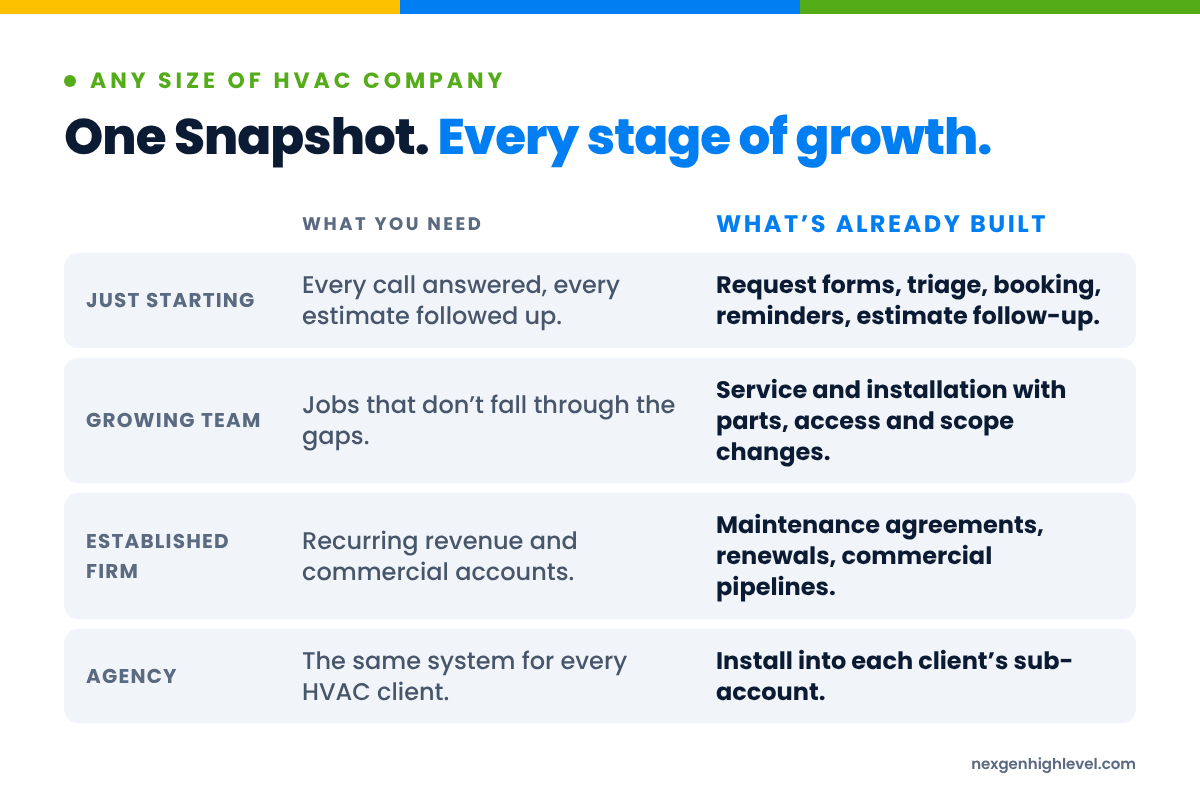
| Business | What matters most | How the Snapshot helps |
|---|---|---|
| Solo technician starting out | Answering fast, booking, estimate follow-up, first reviews | Switch on enquiry, booking, estimate and review journeys first; the rest is ready when you grow |
| Owner-operator or small team | Triage, scheduling, parts and access, maintenance agreements | Urgent triage, job delivery and service plan journeys keep everyone working from the same record |
| Established residential and commercial firm | Control, multiple contacts, commercial agreements, renewals | 8 pipelines covering residential and commercial work, with renewals handled as real decisions |
| Agency with HVAC clients | Delivering a proper system for each client | Install into multiple client sub-accounts and adapt for each one |
The honest bit about setup
It's not magic, and I won't pretend it is.
The workflows arrive as drafts with triggers off. The AI ships off until you switch it on. You add your brand, your team and your accounts, connect them in the workflow actions, test it and switch it on at your own pace.
That's deliberate. Nothing fires at your customers before you're ready.
Clients have used our Snapshots to skip months, if not years, of trial and error building a system. That's the real value. Not the counts. The years you don't have to spend building it yourself. There's more on that in why a HighLevel Snapshot is a business in a box, you can browse all of our HighLevel Snapshots, and we've written the same playbook for landscaping and lawn care.
Get HighLevel through NexGenHighLevel
If you're not on HighLevel yet, or you're about to start an HVAC business and wondering whether GoHighLevel is worth it, this is the part worth reading twice.
When you create your HighLevel account with NexGenHighLevel, you get:
- The HVAC Snapshot, free.
- A heavily discounted HighLevel account. I won't quote numbers here; see your price on the page.
- Over 200 HighLevel training courses.
- Access to all our Apps for HighLevel.
- 24/7 support and personalised onboarding.
- A full HighLevel sub-account under the NexGenHighLevel agency.
So instead of buying the platform, hunting for a system, then working it all out alone at 11pm, you start with the system installed and people to help you set it up. I've written about starting a business without starting from scratch, and this is exactly what I mean.
Apps that help HVAC companies and their agencies
HighLevel does a huge amount brilliantly. Where something's missing, that's where we build. Every one of our Apps for HighLevel is built to be part of HighLevel, not a complement to it. It works with the Workflows, Contacts, Tags and Conversations already there.
LinkedIn for HighLevel for commercial prospecting. Facility and property managers are on LinkedIn. Search LinkedIn or Sales Navigator from inside your HighLevel account, enrich the results with business email addresses, and add prospects to workflows for profile views, connection requests, messages and InMails, including video or voice notes.
WhatsApp for HighLevel for customer messaging. Plenty of customers would rather message than talk. WhatsApp conversations sit in HighLevel alongside everything else, with no pay-per-message charges and no templates to use.
For agencies with HVAC clients, two more. Custom Value Forms solves the pain of getting every detail out of a client and then filling in all the Custom Values yourself, or chasing them to do it. And the HighLevel Agency Customizer lets you brand the HighLevel experience, with different themes for different sub-accounts, SaaS plans or groups you create.
Your first 30 days and first 90 days
If you're starting an HVAC business, here's a practical plan. Established firms can use it as an audit.
First 30 days
Week 1: foundations
- [ ] Choose your lane and service area.
- [ ] Choose a business structure with an accountant and register with your state.
- [ ] Get your EIN (free, from the IRS).
- [ ] Confirm EPA Section 608 certification and your state and local licence requirements.
Week 2: protection
- [ ] Arrange general liability, vehicle and any required insurance.
- [ ] Write your safety plan: falls, electrical, confined spaces, heat.
- [ ] Open a business bank account.
Week 3: your system
- [ ] Set up HighLevel and install the HVAC Snapshot.
- [ ] Add your brand, services, team and service area.
- [ ] Connect your email, phone and calendar.
- [ ] Write your urgent triage and safety process.
- [ ] Test the request form, booking and estimate follow-up as a pretend customer.
Week 4: customers
- [ ] Complete your Google Business Profile.
- [ ] Ask every existing customer for a review.
- [ ] Set your prices and diagnostic fee from your real costs.
- [ ] Launch your maintenance agreement offer.
- [ ] Start tracking your weekly numbers.
Days 31 to 90
- Review every estimate: won, lost or open, and why.
- Check response times to new enquiries every week.
- Put every service plan customer's next visit in the calendar.
- Plan your next seasonal tune-up campaign before the season.
- Update any website or estimate copy that still mentions the 25C tax credit.
- If commercial is your goal, build a target list of local buildings and start outreach.
- Look at margin by service. Do more of what pays.
Six weeks to find out beats six months of wondering. Back yourself.
Frequently asked questions
How do I start an HVAC business?
Choose your lane and service area, pick a business structure, register with your state and get a free EIN from the IRS. Make sure you hold EPA Section 608 certification, check your state and local licence requirements, and arrange insurance. Price from your real costs, build your Google Business Profile, and put a system in place from day one.
What licences do I need to start an HVAC business?
It depends on your state. California, Texas and Florida all license HVAC contractors, with different classes, experience rules and insurance requirements. Some localities add their own. Rules vary, so check with your state board before taking on work.
Do I need EPA 608 certification?
Yes, if you maintain, service, repair or dispose of equipment that could release refrigerants. Apprentices are exempt while closely supervised by a certified technician. Certification doesn't expire.
How should I price HVAC service calls?
Work out your true cost per billable hour, then choose a model: flat rate, time and materials, or a mix. Be clear about any diagnostic fee before the visit and whether it's credited against the repair.
How do HVAC companies get more customers?
A complete Google Business Profile, steady recent reviews, fast responses, proper estimate follow-up, seasonal campaigns, referrals and, for commercial work, direct outreach to facility and property managers.
What is the best CRM for an HVAC business?
One that brings enquiries, booking, estimates, jobs, agreements, reviews and marketing into one place. HighLevel does that, with unlimited users on its plans, and the HVAC Snapshot builds the HVAC side out for you.
Can I use the HVAC Snapshot if I'm just starting?
Yes. Switch on only what you need now, such as enquiries, booking, estimates and reviews. If you get HighLevel through NexGenHighLevel, the Snapshot comes free, with training and onboarding to help you set it up.
Build the business, not just the job list
Running a great HVAC business isn't one big secret. It's a hundred small things done consistently. Answer the call. Triage properly. Be honest about timings. Follow up every estimate. Record the access notes. Book the spring visit. Ask for the review. Renew properly. Do it again next season.
None of it is hard on its own. Doing all of it, every time, in a heatwave, with three trucks out? That's hard.
That's what a system is for.
So write the playbook for your business. Or start with the HVAC Snapshot, create your HighLevel account with NexGenHighLevel and get it free.
You fix systems for a living. It's time your business had one too.