
Ask ten people what a HighLevel Snapshot is and you'll get ten different answers.
One will say it's a couple of funnels. Another will say it's a handful of workflows somebody exported on a Tuesday afternoon. Somebody else will tell you it's the thing that's going to fix their business by Friday.
None of them are completely wrong. That's the problem.
Because the word covers everything from a few loose parts in a box to a whole working business system, built around the full journey a customer takes from first hearing about you to paying you and coming back.
Those are not the same thing. Not even close.
I've spent years building marketing systems for businesses, and now we build Snapshots for HighLevel. So I want to be honest about what a fully built-out Snapshot is, what it isn't, who it's genuinely for, and the bit nobody likes to talk about: what you still have to bring yourself.
What a HighLevel Snapshot actually is
Let's start with the plain, technical answer.
A HighLevel Snapshot is HighLevel's way of packaging up a whole account setup so it can be loaded into another account. Funnels, websites, forms, surveys, workflows, pipelines, calendars, email and SMS templates, custom fields, tags, trigger links. Whatever was built in the original account can be copied across.
That's the mechanism. It's clever, and it's one of the things I've always liked about HighLevel.
But the mechanism tells you nothing about what's inside.
A Snapshot is a container. It's a box. And you can put almost anything in a box.
The box versus what's in the box
Picture two removal boxes on your doorstep.
One has a few loose cables, a kettle and a lamp with no bulb. The other has a fully fitted kitchen, flat-packed, labelled, with the instructions taped to the lid and every screw counted.
Both are boxes. Both got delivered. Only one of them lets you cook dinner tonight.
That's the difference I want you to hold on to through the rest of this.
What we mean by a business system in a box
When we talk about a Snapshot at NexGenHighLevel, we mean a complete, fully built-out system for a particular kind of business, installed into a HighLevel account.
Not a set of parts. A system.
That means the funnels, forms, workflows, pipelines, calendars, emails, texts and AI features are already connected to each other, around the whole client journey. Somebody fills in a form, and something sensible happens next. Somebody books, and they get confirmations and reminders. Somebody goes quiet, and there's a nurture path waiting for them. Somebody becomes a customer, and the review request goes out.
You don't start from a blank account. You start from a working system and make it yours.
That's the whole idea. It's not complicated. It's just a lot of work to do properly, which is exactly why most people don't.
Not all HighLevel Snapshots are equal
This is the bit I feel most strongly about.
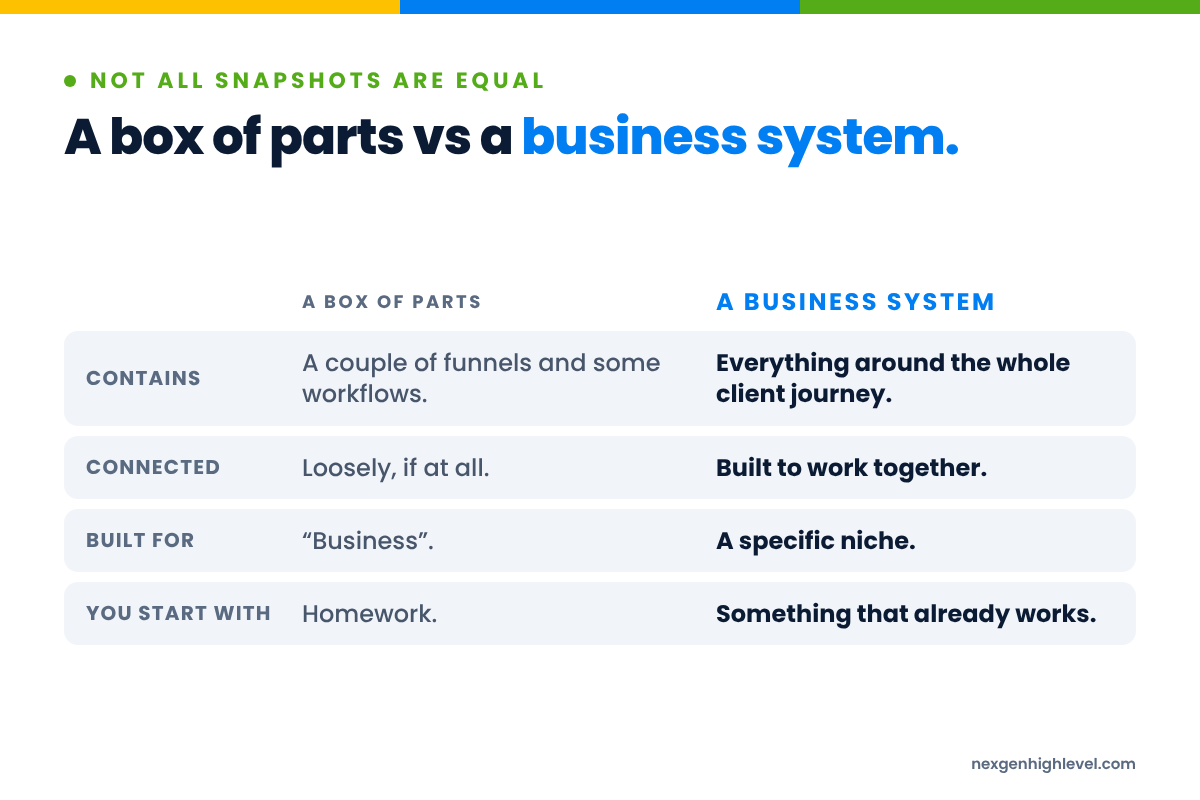
The word "Snapshot" has been stretched so far that it barely means anything on its own. A Snapshot might be two funnels, ten workflows and a couple of forms. It might be a lovely-looking website with nothing behind it. It might be a pile of automations that were built for somebody else's business, with their logic and their assumptions baked in, and nobody's explained any of it.
None of that is a crime. Some people genuinely only need a couple of funnels.
But if you're expecting a business system and you get a handful of parts, you're now the person who has to finish building the system. And that's the bit that takes months.
The parts problem
Here's what happens when you buy parts and call it a system.
You load it in. It looks busy. Lots of things in lots of folders. You feel like you've made progress.
Then you start to use it, and you realise the form doesn't feed the pipeline. The pipeline stages don't trigger anything. The emails reference a calendar that isn't there. The workflow for no-shows was never built because whoever made it never had no-shows in mind.
So you start patching. And patching. And you're back to building from scratch, only now you're doing it on top of somebody else's half-finished thinking. That's harder than starting from nothing, not easier.
It's not a system. It's homework.
Built around the whole client journey
The question I ask about any Snapshot, ours included, is simple.
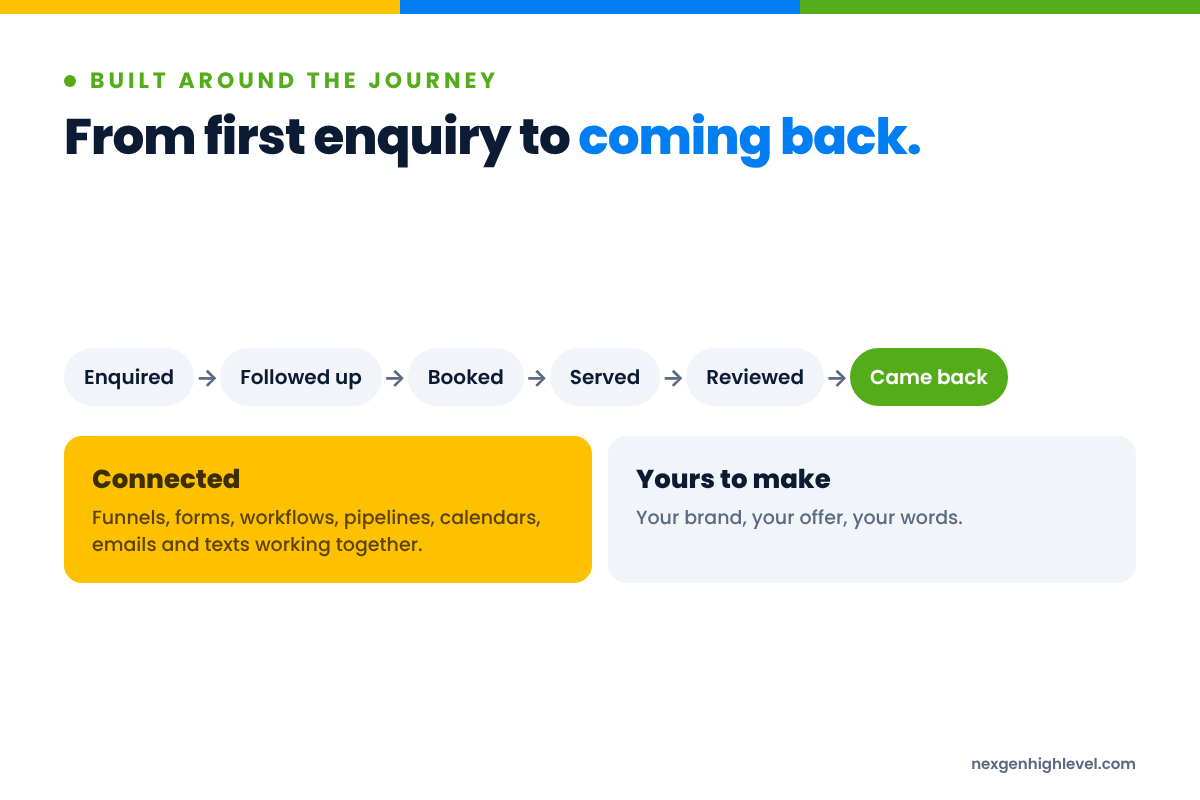
Does it take responsibility for the whole journey?
When I ran my marketing agency, mostly working with US private medical practices, we didn't just run ads. We took responsibility for everything from somebody first discovering a business to them becoming a paying customer. Because I learned the hard way that great ads still fail if the offer is weak, the website is confusing, the phone isn't answered, or the sales team takes three days to call back.
A proper Snapshot thinks the same way. It's built around stages like these.
| Stage of the journey | What a fully built-out Snapshot should already have in place |
|---|---|
| Getting found | Funnels, websites and pages built for that niche, with forms that capture the right information |
| First contact | Fast, automatic follow-up across email and SMS, so nobody waits days to hear back |
| Booking | Calendars with confirmations and reminders, and a plan for no-shows |
| Nurture | Paths for people who aren't ready yet, so they don't just disappear |
| Sale | Pipelines and opportunities that show you where every deal is |
| After the sale | Onboarding, review requests and reasons to come back |
| Knowing what works | Reporting and attribution, so you can see what's actually paying |
If a Snapshot only covers one or two of those rows, it's a few parts. Useful parts, maybe. But parts.
If it covers all of them, and they talk to each other, then you've got something that behaves like a business system.
What a Snapshot isn't
Let me clear a few things up, because I think a lot of disappointment with Snapshots comes from expecting the wrong thing.
It isn't a starter pack
A starter pack says "here's something to get you going, you'll need to build the rest". That's a fair thing to sell, as long as everybody knows that's what it is.
A fully built-out Snapshot isn't that. The point is that the rest has already been built. You're customising and launching, not constructing.
That distinction matters more than it sounds. With a starter pack, the hardest work is still in front of you. With a full system, the hardest work, which is working out how all the pieces connect around a real customer journey, has already been done.
It isn't a couple of funnels
Funnels are the bit people can see, so they get all the attention.
But funnels on their own are a shop window with no shop behind it. Somebody walks in, and then what? Who talks to them? When? What happens if they don't book? What happens if they book and don't turn up?
The value is in the connections, not the pages.
It isn't magic
This is the one I'd underline twice if I could.
A Snapshot will not fix a weak offer. It will not tell you who your customer is. It will not answer the phone, have the conversation, or do the work you were paid to do.
Most businesses don't have a technology problem. They have a thinking problem. And a Snapshot is technology. Very useful technology, when there's something good underneath it.
I've seen people install an app and uninstall it the next day. Go figure. I'm fairly sure some of them were hoping the software would do the thinking for them.
It won't. Nothing will.
The franchise operations manual, without the franchise strings
The closest comparison I can find for a fully built-out Snapshot isn't another piece of software. It's franchising.
Franchising is a proven model, and I have a lot of respect for it. When you buy into a franchise, you're not just buying a name above the door. You're buying a tested way of running the business. Somebody else has already worked out the process, the training, the order things happen in, and what good looks like.
McDonald's is the obvious piece of history here. Fred Turner, who began as a grill man in the first Des Plaines restaurant, authored the chain's first Operations and Training Manual in 1958, and in the words of Nation's Restaurant News, "codified the operational standards" the company still uses.
Think about what that manual really was. It was a business system written down, so that someone new could open a restaurant and run it the same way, without having to work it all out from scratch.
That's what a proper Snapshot is trying to be. The operations manual, except it's not written down. It's built, connected and running inside your HighLevel account.
What franchising gives you, and what it asks for in return
To be fair to franchising, it's a trade.
On one side you get a tested system, a brand people may already know, training and support. That's real value, and plenty of people choose it with their eyes open.
On the other side there are upfront fees, ongoing royalties, rules on how you operate, and less freedom to do things your own way. Again, that's fair. You're paying for the system and agreeing to run it their way.
I've written more about what the franchise model gets right about starting up, because there's a lot an independent business owner can learn from it.
Where a Snapshot sits
A Snapshot borrows the most useful part of the franchise idea, the working system, without the strings.
- It's your business, your name, your brand.
- You decide your offer and your pricing.
- You can change anything you like. Rewrite the emails. Add stages. Remove what doesn't fit.
- Nobody inspects your premises or tells you which colour the walls must be.
The flip side is also true, and I'd be lying if I didn't say it. A franchisor brings a brand and ongoing support that a Snapshot on its own does not. With a Snapshot, the system is there, but the brand, the reputation and the decisions are all yours to build.
It's not a franchise. It's the operations manual without the franchise.
For some people that's exactly the right trade. For others, the full franchise package is worth it. Know which one you are before you decide.
Who a HighLevel Snapshot is for
Here's something that gets missed a lot. A niche Snapshot isn't just for one type of buyer.
If you run a business in a particular niche on HighLevel, or you run an agency that works with clients in that niche, a fully built-out Snapshot is built with you in mind. Both of you. That matters, so let me take each in turn.
The niche business owner
This is the person who wants control.
They're already on HighLevel, or about to be. They're confident enough to run it themselves. They don't want to hand their marketing to an agency, or they've tried a few agencies and they're tired of it.
What they don't want is to spend the next six months working out how to build a follow-up sequence, wire a calendar to a pipeline, and remember to ask for reviews.
For them, a Snapshot means the system arrives built for their kind of business. Right now our live Snapshots for business owners include Credit Repair, HVAC and Landscaping & Lawn Care. Each one is built around how that kind of business actually wins and keeps customers, rather than a generic "business" that doesn't exist.
An HVAC company and a credit repair business both need follow-up. But the conversations, the timing, the reasons people go quiet and the reasons they come back are completely different. A niche system respects that.
The agency serving that niche
Now picture the agency that works with HVAC companies, or landscapers, or credit repair firms.
Every new client needs roughly the same system, adapted. Building it from nothing every time is slow, inconsistent and expensive in hours. It's also where mistakes creep in, because the fifth build is never quite as careful as the first.
A Snapshot gives that agency a consistent, complete system to load into each client's sub-account, then tailor. The agency's time goes into the client's offer, their messaging and the results, which is where it should go anyway.
I've always believed agencies should learn their craft before they sell it, and get help if they're still learning. A good Snapshot doesn't replace the craft. It means you're not spending your craft on rebuilding plumbing.
The agency itself
There's a third case. Sometimes the agency is the niche.
Our SMMA Snapshot is built for social media marketing agencies themselves. If you run an SMMA, whether you're one person, a small team or a larger one, the system is built around how an agency wins clients, onboards them and keeps them.
It's the same principle. Just pointed at a different business.
Who it probably isn't for
Being honest, a Snapshot isn't for everybody.
- If you don't yet know what you're selling or who to, a Snapshot will just help you be unclear more efficiently.
- If you love building everything yourself and the building is the fun bit, you'll probably take it apart anyway. That's fine. Know that about yourself.
- If you're hoping it'll do the work while you do something else, it won't.
What you still have to bring
This is the section I'd most like people to read, even if they skip everything else.
A Snapshot is leverage. And leverage multiplies whatever is underneath it.
Put it behind a strong offer and a business that understands its customers, and it multiplies something good. Put it behind something nobody wants, and you've found a very efficient way of telling more people about something they don't want.
If you multiply zero by a thousand, you've still got zero.
Human, Strategy, Leverage
Everything I believe about marketing comes down to three words, in a particular order.
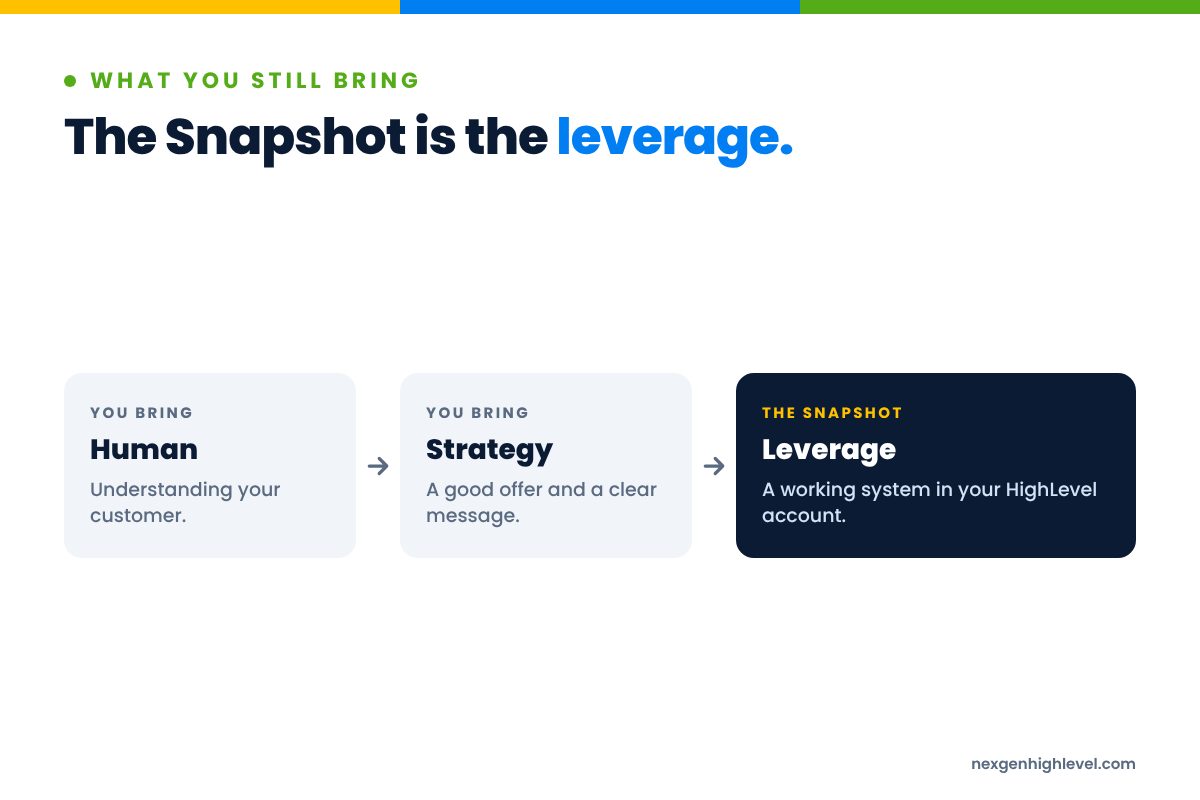
- Human. Who is your customer? What do they want? What frustrates them, worries them, stops them acting? Not what you think they should want. What they actually want.
- Strategy. How will you solve that, and how will you say it? The offer, the message, the journey from where they are to where they want to be.
- Leverage. Only then does the technology come in. Automation, AI, workflows, the whole lot.
A Snapshot lives firmly in the third word. It's the leverage. The first two are yours.
Human. Strategy. Leverage. In that order.
A good offer
The best follow-up sequence ever written won't sell a bad offer.
So before you load anything in, ask yourself honestly. Why would somebody choose you? What makes it easy to say yes? What risk are you taking away from them?
If you can't answer that in a sentence or two, that's your first job. Not the software.
Understanding your customer
The Snapshot can be built around the niche. It can't be built around your particular customers, because it hasn't met them. You have.
This is where you make it yours. The emails and texts should sound like you talking to the people you serve, in their language, about their problems. A built-out system gives you the structure and a strong first draft. Your understanding is what makes it land.
I learned this one the hard way with the medical practices we worked with. Technically, everything was excellent. Ads, funnels, follow-up, CRM. But the clinicians wouldn't supply content, because they'd gone into healthcare to help patients, not to be content creators. We ended up building an app with prompts to take away the blank page and the fear of the camera.
We weren't really solving a content-production problem. We were solving a human-friction problem.
No system would have told us that. Understanding the people did.
Doing the work
Then there's the unglamorous bit.
You still have to set it up properly. Connect your phone number and email. Put your real details, your real offer and your real voice into it. Test it as if you were a customer. Then actually launch it, and keep looking at what happens.
I'm a terrible procrastinator, and a perfectionist, which is a delightful combination for everyone who works with me. So I know the temptation. You load the Snapshot in, you tidy it, you tweak an email, you tweak it again, and three months later it's very well organised and nobody has ever been through it.
A system nobody uses isn't a system. It's a very tidy hobby.
Know your goal, plan properly, set up properly, understand properly. Then go for it.
Where a Snapshot genuinely helps
So what does a Snapshot actually save you, if you still have to bring all that?
It saves you the building. The trial and error of working out which workflow fires when, what a sensible pipeline looks like, how the reminders should run, what happens when someone doesn't turn up. That's the part that eats months.
Clients have used Snapshots to skip months, if not years, of trial and error building a system. That's the real value. Not magic. Time, and a head start that's already been thought through.
Michael Gerber's The E-Myth Revisited makes the distinction between working on your business and working in your business. A lot of business owners never get to work on theirs, because building the basic machinery takes every spare hour. Starting from a working system gives some of those hours back. What you do with them is up to you.
How to judge a HighLevel Snapshot before you trust it
Whether it's one of ours or anybody else's, here are the questions I'd ask before relying on a Snapshot to run part of your business. Not a checklist to tick in a hurry. Questions to actually think about.
Is it built for a niche, or for "business"?
Generic is a warning sign. A system built for every business is usually a system built for none of them.
Look for evidence it understands how this kind of business gets customers, the way those customers decide, and what goes wrong in that particular industry.
Does it cover the whole journey?
Go back to the table earlier. Getting found, first contact, booking, nurture, sale, after the sale, knowing what works.
Ask where each stage lives in the Snapshot. If nobody can tell you, that's an answer in itself.
Is it connected?
Parts are easy to count. Connections are what matter.
Ask what happens when a form is submitted. Where does that person go? What do they receive, and when? Who gets told? What happens if they don't reply? If the answer is "well, you'd build that bit yourself", you've found the edge of the system.
Does it fit how HighLevel actually works?
The best Snapshots use what's already in HighLevel. Contacts, tags, custom fields, Workflows, Conversations, pipelines, calendars. Things your team can see, understand and change.
That matters because you will want to change things. If you can't follow how it works, you can't make it yours.
Can you see what's paying?
A system that can't show you what's working is guessing, politely.
Bookings and clicks are nice. Revenue and profit are what keep the lights on. Bookings mean nothing if half of them don't turn up, and clicks mean nothing at all if nobody buys. Make sure the reporting and pipelines let you see the money, not just the activity.
Are you ready for it?
The last question is about you, not the Snapshot.
Do you know your offer? Do you understand your customer? Will you actually launch it in the next few weeks, rather than tidying it for the next few months?
Six weeks to find out beats six months of wondering. If the honest answer to those three is yes, you're ready. If it's no, sort that first. The Snapshot will still be there.
Why this matters when starting a business
There's a reason I keep coming back to systems when I talk about starting a business and growing a business.
The US Bureau of Labor Statistics tracks how long new business establishments survive. Of the private-sector establishments that opened in the year to March 2020, 51.4% were still operating five years later. Roughly half. And that pattern has held, give or take, for decades.
I'm not going to tell you a Snapshot changes that number. Nobody can promise that, and anybody who does is selling something other than the truth.
But I'll tell you what I've seen over and over, in recruitment, in my agency, and now with the people we work with. Businesses don't usually struggle because the owner wasn't brave enough to start. They struggle because the owner spends every ounce of energy on the basics. Answering enquiries late. Forgetting to follow up. Losing track of who's been quoted. Never quite getting round to asking for reviews.
Courage gets you through the door. Systems are what stop you burning out once you're inside.
Start from a system, not from a blank screen
The independent business owner has always had one big disadvantage against a franchise: they start from a blank page. Nothing tested. Nothing written down. Everything has to be worked out alone, usually at 11pm.
A fully built-out Snapshot doesn't take away the risk of being in business. Nothing does. What it takes away is the blank page.
You still decide the direction. You still bring the offer, the understanding and the effort. But you're not spending your first year inventing a follow-up sequence that thousands of businesses like yours already need.
That's not cheating. That's just being smart with your time. I've written more about why using templates and proven systems is how sensible businesses build, and it applies to all of this.
Walk before you run, but don't stand still
I grew my recruitment business aggressively, with heavy overheads, and never imagined the world could simply stop. Then Covid arrived, and I had to close it and let people go. It's still the hardest business decision I've ever made.
The lesson I took was to walk before you run. Build on solid ground. Only run when you can see the green field stretching out in front of you.
But walking isn't standing still. A working system is a very good way to walk. You get moving, you learn from real customers, you improve what's there, and you grow when the ground in front of you is clear.
Frequently asked questions
What is a HighLevel Snapshot?
A HighLevel Snapshot is HighLevel's way of packaging an account setup, things like funnels, forms, workflows, pipelines, calendars and email and SMS templates, so it can be loaded into another account. What's inside varies enormously. Some are a few parts. A fully built-out Snapshot is a complete business system for a niche, already connected around the whole client journey, so you start from something working and make it yours.
Is a HighLevel Snapshot the same as a template?
Sort of, but the word "template" undersells a good one. A template is usually a single thing: a page, an email, a form. A fully built-out Snapshot is lots of those things connected together so they behave like a system. The form feeds the pipeline, the pipeline triggers follow-up, the calendar sends reminders. It's the connections that make it valuable, not the individual pieces.
Who should use a niche Snapshot, a business owner or an agency?
Both. If you run a niche business on HighLevel and want control of your own marketing, a niche Snapshot gives you a system built for how your kind of business works. If you run an agency with clients in that niche, it gives you a consistent, complete system to load into each client's sub-account and tailor, so your time goes on their offer and results rather than rebuilding the same plumbing.
Will a Snapshot get me customers on its own?
No. I'd be lying if I said otherwise. A Snapshot is leverage, and leverage multiplies whatever is underneath it. You still need an offer people want, an understanding of who your customer is, and the discipline to launch it and keep improving it. What it does is save you the months of building and trial and error, so your energy goes into those things instead.
Can I change a Snapshot once it's in my HighLevel account?
Yes, and you should. Once it's loaded, it's your account. Rewrite the emails and texts in your own voice, adjust the pipeline stages to match how you sell, add or remove steps, and put your real offer and details in. The point of starting from a built system is that you're editing something that works, not inventing everything from nothing.
Do I need a HighLevel account before I use a Snapshot?
Yes. A Snapshot is loaded into a HighLevel account, or a sub-account if you're an agency setting it up for a client. If you're not on HighLevel yet, that's the first step, and then the Snapshot is installed into the account you'll run your business from.
Start from a working system
A HighLevel Snapshot can be a few loose parts in a box, or it can be the whole business system, built, connected and ready to make your own.
Know which one you're looking at. Ask about the whole journey. Ask about the connections. And be honest with yourself about what you're bringing, because the offer, the understanding and the work are still yours.
If you're curious what a complete system looks like for your kind of business, we keep all of ours in one place, with a simple way to find the HighLevel Snapshot built for your business. No pressure. Have a look, and judge it by the questions above.
Because the box was never the point.
What's inside it is.