
Somewhere along the way, most of us picked up the idea that copying is cheating.
At school, it was. Copy someone's homework and you were in trouble. Glance at the next desk during an exam and you were in bigger trouble.
The problem is that we carried that rule into business, where it doesn't belong. So people starting a business sit down in front of a blank page and try to invent everything themselves. The booking process. The follow-up. The welcome email. The way they chase an unpaid invoice. As if using business templates meant they hadn't really earned it.
I understand the instinct. I'm a perfectionist, which is delightful for everyone who has to work with me, and there's a voice in my head that says if I didn't build it, it doesn't count.
That voice is wrong. And it's expensive.
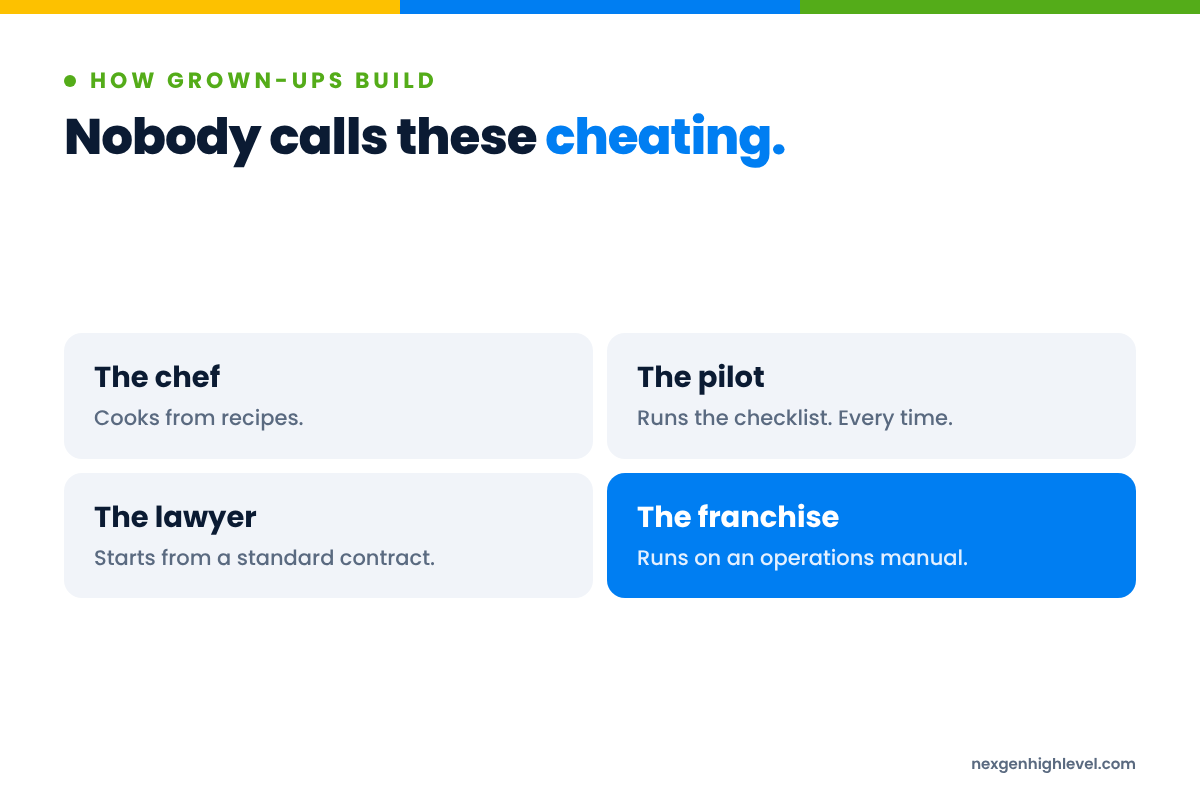
Chefs cook from recipes. Pilots run checklists. Lawyers start from standard contracts. One of the best-known restaurant chains on the planet was built on an operations manual.
None of them are cheating. They're just refusing to waste their energy on problems somebody already solved.
Where the cheating idea comes from
Let's be fair to the voice in your head for a minute. It didn't come from nowhere.
School taught us that originality is the point. Your essay, your answers, your work. Copying meant you hadn't learned anything, and that mattered, because the whole point of school was the learning.
Then there's the founder myth. The garage. The kitchen table. The person who "built it all from nothing". It makes a great story. It's also usually missing the bits that don't fit the story: the mentor, the old boss whose process they quietly borrowed, the industry standards they followed without even noticing.
So by the time someone decides to start a business, they've absorbed a quiet rule. Real entrepreneurs make it all up themselves.
What your customer actually pays for
Here's the question that breaks the rule.
What, exactly, is your customer paying you for?
They're paying for the result. The clean house. The working air conditioning. The tax return filed on time. The marketing that brings in profitable customers.
They are not paying for your originality in the plumbing behind it.
Nobody has ever left a five-star review that said, "And they designed their appointment reminder entirely from scratch."
They don't care whether you invented the reminder. They care that it arrived, it was clear, and they didn't miss their slot.
The real cost of the blank page
When you insist on building everything yourself, you pay for it in the one currency a new business can't print more of. Time.
Every hour spent working out what a good follow-up email should say is an hour not spent talking to customers. Every week spent designing a sales pipeline from first principles is a week your offer isn't being tested in the real world.
And the clock is running. According to the US Bureau of Labor Statistics, of the new business establishments that opened in the year to March 2020, 51.4% were still operating five years later. Roughly half.
I'm not quoting that to frighten anyone. Plenty of those closures will have had nothing to do with systems. But it's a reminder that the early months matter, and that spending them reinventing things that already work is a choice.
It's not a badge of honour. It's a cost.
Grown-ups build with templates
Look at almost any serious profession and you'll find templates everywhere. Not hidden away in embarrassment. Right out in the open, refined over years, treated as the sign of a professional.
The recipe
A recipe is a template. Quantities, order, timings, temperature.
Give the same recipe to two cooks and you'll still get two different dishes. One seasons a little more boldly. One plates it beautifully. One knows their guests hate coriander and quietly leaves it out.
The recipe doesn't remove the cook. It frees the cook to pay attention to the bit that actually matters: how it tastes, and who it's for.
I love big flavours. Thai, Lebanese, Mexican, Indian. I've never once sat down to a great curry and thought, "Shame they didn't invent the onion."
No good chef reinvents how to make a stock every morning. They make it the way that works, every time, so their creativity goes into the dish.
The pilot's checklist
Pilots with years of experience and thousands of flights behind them still work through a checklist before take-off. Every time.
Not because they're beginners. Because they're professionals.
The checklist doesn't fly the plane. Nobody thinks it does. What it does is make sure the boring, critical things never depend on memory, mood, tiredness or how distracting the morning has been.
That's worth thinking about for a second. In a profession where getting things wrong is about as serious as it gets, the experts chose a template over their own memory.
Now look at how most small businesses handle follow-up. "I'll remember to call her back." "I'll send the reminder on Thursday." It all lives in someone's head.
Mine's not a safe place to keep anything. I remember useless facts from years ago and forget what I was told yesterday. So I need all the help I can get.
The contract
Hardly anyone drafts a contract from a blank page. Lawyers work from standard forms and precedents that have been refined over years.
Why? Because every clause in a good standard contract is there for a reason. Usually because somebody, at some point, got burned without it.
You still read it. You still get it checked and adjusted for your situation, ideally by someone qualified. But you don't start by asking, "What even is a contract?"
That's the pattern in all three examples. A template, plus judgement.
The template handles what's been solved. The judgement handles what's unique to you.
The franchise operations manual is a business template
If you want to see business templates at full scale, look at franchising.
The McDonald's history is a good one to study, because it's really a story about writing things down.
In 1948, the McDonald brothers streamlined their restaurant around what they called the "Speedee Service System", with a nine-item menu and a 15-cent hamburger. That's a system before anyone had franchised anything.
Ray Kroc visited the brothers in 1954, which, in the company's own words, "led to him becoming their franchise agent". He opened his first McDonald's in Des Plaines, Illinois, on April 15, 1955. First-day sales came to $366.12.
Not exactly an overnight empire.
Then comes the bit I find most interesting. Fred Turner joined in 1956 as one of the first employees. He began as a grill man at Des Plaines and coined the mantra "QSC": Quality, Service and Cleanliness.
According to Nation's Restaurant News, Turner authored the chain's first Operations and Training Manual in 1958 and "codified the operational standards that the company uses in its restaurants to this day".
And in 1961, Hamburger University opened in the basement of a restaurant in Elk Grove Village, Illinois. Graduates receive Bachelor of Hamburgerology degrees.
I'd like that on my wall, to be honest. It would look better than most of my certificates.
What was really being sold
Think about what Kroc was actually selling to franchisees.
It wasn't a burger. You could get a burger anywhere.
It was a system. A way of doing things that had been worked out, tested and written down, so that somebody who wasn't there at the start could repeat it.
That's what an operations manual is. It's a template for a whole business.
Being fair to franchising
I want to be balanced here, because franchising often gets either worshipped or dismissed.
Franchising is a proven model with real strengths. You get a tested system, a recognised brand, training and support. For a lot of people, especially those who've never run a business, that's hugely valuable.
There are real trade-offs too. Upfront fees. Ongoing royalties. Rules about how you operate. Less freedom to do things your way.
Neither side of that is wrong. It's a choice about what you value.
And it's a big choice. The International Franchise Association projects around 845,000 franchise establishments in the US in 2026. That's an awful lot of people deciding that a proven system is worth paying for.
You'll sometimes hear that franchises are far safer than independent start-ups. Be careful with that. The research comparing franchise and independent survival is mixed and dated, and nobody can promise you a business will succeed because of the model it uses.
But you don't need a survival statistic to see the point. People value the system. I've written more about what the franchise model gets right about starting up if you want to go deeper.
Working on the business, not just in it
Michael Gerber made this idea famous. The publisher's description of his book The E-Myth Revisited says it draws "the vital, often overlooked distinction between working on your business and working in your business".
A template is "on the business" work that somebody has already done.
Every time you use a proven structure for your follow-up, your onboarding or your booking process, you're borrowing hours of thinking you didn't have to do yourself. Which leaves you more hours for the work only you can do.
Copy the structure, add your personality
So if templates are smart, does that mean every business should look and sound the same?
No. And this is the distinction that matters most.
There's the structure, and there's the personality.
The structure is the bones. The steps, the order, the timing. What happens when somebody fills in a form. How quickly they hear back. When the reminder goes out. What happens if they don't turn up. Which stage of the pipeline they move to.
The personality is everything a customer actually feels. Your voice. Your stories. Your offer. The way you treat people. The little touches that make someone think, "These people get me."
You copy the first. You never copy the second.
What I learned running an agency
When I ran my marketing agency, mostly working with private medical practices in the US, we had a process. The same six stages for every single client.
- Handover and alignment. What was sold, what the client expects, and what success actually means.
- Structured onboarding. Access, business information, assets, and who makes the decisions.
- Commercial discovery. How the business really makes money, and which customers and services are the most profitable.
- Baseline and audit. What's holding the business back before we change anything.
- Plan, build and launch. Sometimes smooth sailing. Sometimes back to the drawing board.
- Optimisation. Making it better and keeping it producing.
Every client went through those six stages. And no two clients came out the other side looking the same.
The process was the template. The thinking we did inside each stage was the personality.
If we'd invented a new process for every client, we'd have spent our energy on the process instead of the client. And we'd have missed things, because when you make it up each time, something always falls through the cracks.
A simple way to split it
Here's how I'd think about it in a small business.
| Copy the structure | Make it yours |
|---|---|
| The steps in your follow-up | The words, the tone, the stories in each message |
| When reminders and confirmations go out | How you greet people and what they feel when they arrive |
| Your sales pipeline stages | Your offer and why it's different |
| Your onboarding checklist | The relationship you build during it |
| How you ask for reviews | Whether you've earned them |
The left-hand column is mostly a solved problem. Plenty of people have worked out what a sensible sequence looks like.
The right-hand column is where your business actually lives.
Where originality belongs in your business
I'm not against originality. I'm against it being spent in the wrong place.
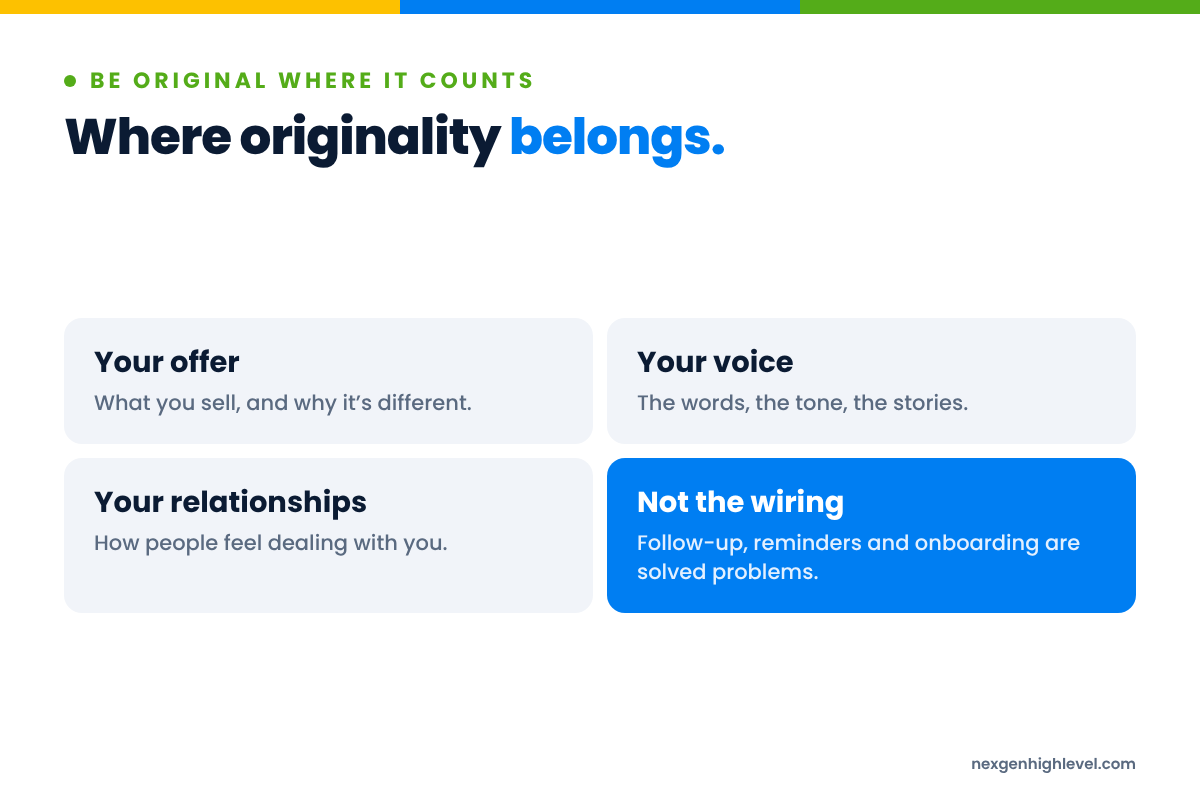
Originality belongs in:
- Your offer. What you sell, who it's for, and why it's better for them than the alternatives.
- Your message. How you explain it so the right person stops and thinks, "That's me."
- Your understanding of the customer. What they want, what frustrates them, what stops them acting.
- Your relationships. How people feel dealing with you, before, during and after they've paid.
People buy from people. That was true when I was in recruitment with a telephone, a filing cabinet and a phone directory, and it's true now.
What originality doesn't belong in is rebuilding the follow-up sequence. Or reinventing appointment reminders. Or designing a pipeline from first principles because you've decided the standard stages don't quite capture your vision.
Be original where your customer can feel it. Be boring where they can't.
Picture two people on the same day
Imagine two people opening a cleaning business on the same day.
The first decides to build everything properly. Their own booking forms, their own email sequences, their own way of tracking jobs. It takes three months. It's beautiful. By the time it's finished, they've spoken to almost no customers and they still don't know whether their prices are right.
The second starts from a proven structure. Booking, confirmations, reminders, review requests, a simple pipeline. They change the words to sound like them and get going. Then they spend those same three months talking to customers, sharpening their offer, finding out which neighbourhoods book again and which don't, and collecting reviews.
Which of them knows more about their market by the summer?
I can't promise you the second one wins. Nobody can. Business doesn't work like that. But I know which one I'd rather be.
There's a phrase I come back to a lot. Six weeks to find out beats six months.
The blank page is a human problem
This reminds me of something we ran into at the agency.
We were technically very good. Ads, funnels, follow-up, CRM, all of it. But the doctors, clinicians and practice owners we worked with wouldn't give us content. We'd get nothing at all. Or two stock photos and a 14-second video filmed from six miles away.
They hadn't gone into healthcare to be content creators. Put a camera in front of them and they froze.
So we built an app with prompts to take away the blank page and the fear of the camera. In effect, it was a template for having something to say.
It worked. Not because the technology was clever, but because of what it removed.
We weren't really solving a content-production problem. We were solving a human-friction problem.
That's what a good template does. It takes the frightening blank page away, so a person can get on with the thing they're actually good at.
Business templates inside HighLevel
This is where I'll talk about what we do, briefly, because it's a good example of the bigger point rather than the point itself.
HighLevel is built around templates. Workflows that run the same steps every time. Pipelines with stages you can reuse. Calendars with confirmations and reminders. Forms, surveys, funnels and websites you can copy and adapt. Email and SMS that go out on a schedule, rather than when somebody remembers.
And at the biggest scale, HighLevel has Snapshots. A Snapshot is HighLevel's way of packaging a whole account setup so it can be loaded into another account. It's the franchise operations manual idea, translated into software.
At NexGenHighLevel, we build complete HighLevel Snapshots for particular types of business. Funnels, forms, workflows, pipelines, calendars, emails and texts, and AI features, already connected around the whole client journey. They're built both for the business owner in that niche and for the agency that serves those businesses. Clients have used Snapshots to skip months, if not years, of trial and error building a system.
That's the last I'll say about them here.
A template is not a business
Because here's the honest bit. A template, any template, is not magic.
It won't give you a good offer. It won't tell you who your customer is. It won't do the work.
My framework for this is three words. Human. Strategy. Leverage. In that order.
- Human. Understand the person first. What do they actually want, and what stops them acting?
- Strategy. Then decide how you'll solve it and communicate it. The offer, the message, the customer journey.
- Leverage. Only then does the technology come in. Workflows, automation, templates.
Technology is leverage, not strategy. Leverage multiplies whatever is underneath it.
If you multiply zero by a thousand, you've still got zero.
A great template behind a weak offer just helps you tell more people about something they don't want, more efficiently. A great template behind a strong offer and a real understanding of your customer is a different story entirely.
If you're working out what automation a new business actually needs from the first day, I've written about marketing automation for a new business. And if you haven't got an account yet, you can create a HighLevel account through NexGenHighLevel.
When a template becomes a trap
Templates aren't foolproof. I've watched people get stuck with them in three very different ways, and they line up neatly with the three personalities I think get stuck in business generally.
I recognise myself in all three, by the way. I have ADHD. Some days I'm all over the place, other days I'm so focused you'd need a crowbar to get me off the task. So none of this is me pointing fingers.
The Tinkerer
The Tinkerer takes a perfectly good template and rebuilds it.
They change every colour. They rename every pipeline stage. They rewrite the reminder seventeen times. They add a branch to the workflow for a situation that has never happened and probably never will.
Three months later, they've got a template that's 100% theirs and 0% launched.
If this sounds familiar, it's worth asking whether the tinkering is really about quality, or whether it's a comfortable place to hide from the scary bit, which is putting it in front of customers. I've written about how planning can become a hiding place, and tinkering is its close cousin.
The Rusher
The Rusher goes the other way. They install the template and go live the same afternoon.
They haven't read the emails. They don't know what the workflow does when somebody cancels. The booking confirmation still mentions a service they don't offer.
Speed is good. Speed without understanding means your customers find the problems before you do.
The Magic-Bullet Believer
The Magic-Bullet Believer thinks the template is the business.
They install it, wait for the money to arrive, and when it doesn't, decide the template was the problem and go looking for the next one.
We see a light version of this with our own apps. Some people install an app and uninstall it the next day. Go figure.
A template is a head start. It isn't a finish line.
The advice is the same for all three
Know your goal, plan properly, set up properly, understand properly. Then go for it.
That's it. Not complicated. Just hard to do when you're excited, or nervous, or both.
How to use a business template well
So what does using a template properly actually look like? Here's how I'd approach it, whether it's a single email sequence or a whole system for a new business.
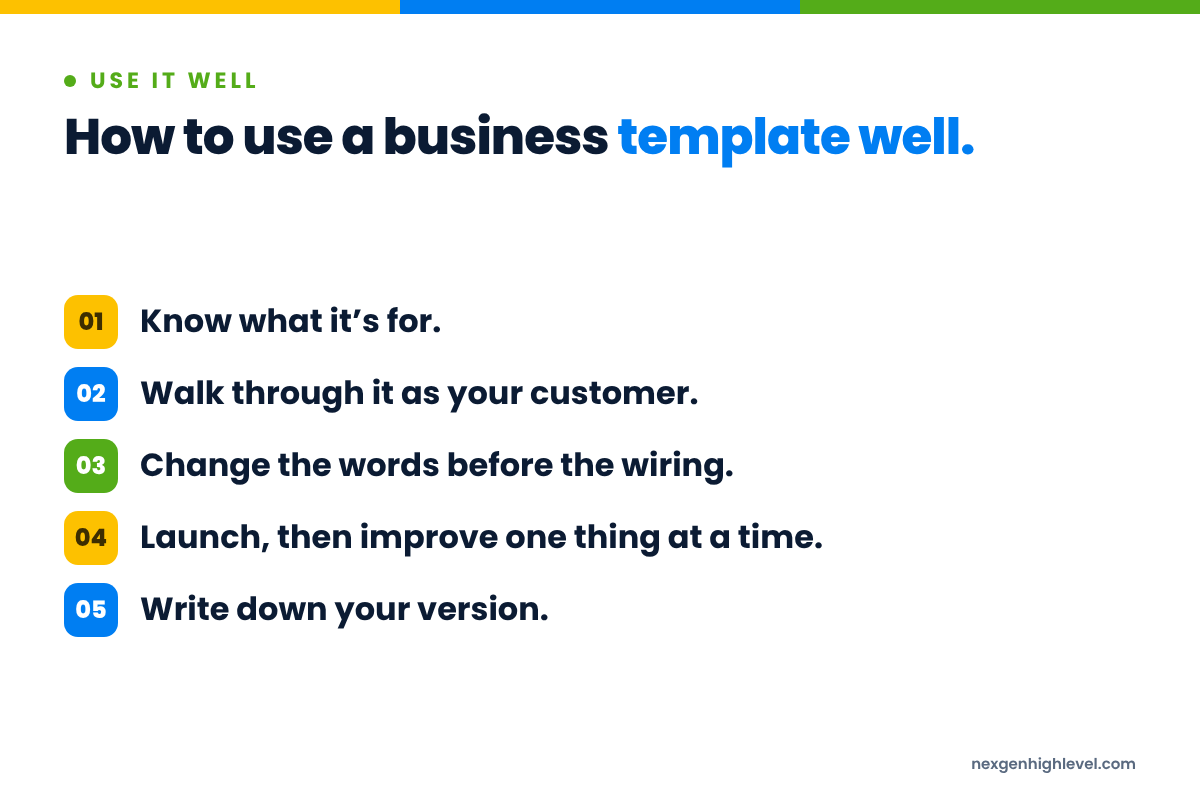
1. Know what it's for
Before you touch anything, write down what this template is meant to achieve. In one sentence.
"Make sure every new enquiry hears from us within minutes and gets booked in." That's a goal. "Set up my automations" isn't.
If you don't know what it's for, you can't tell whether it's working.
2. Walk through it as your customer
Before changing a single word, go through the whole thing as if you were the customer. Fill in the form. Get the email. Receive the text. Book the slot. Miss the slot.
You'll learn more in half an hour of doing this than in a week of reading about it.
3. Change the words before the wiring
The fastest way to make a template yours is to rewrite the words. Your voice, your stories, your offer, your name at the bottom.
The wiring (the timing, the steps, the logic) has usually been thought through for a reason. Leave it alone at first. Change it later, when you've got evidence it needs changing.
4. Launch, then improve one thing at a time
Go live with something that's good enough and honest. Then watch what happens.
When you change something, change one thing, so you know what made the difference. Walk before you run. And even when you're ready to run, keep walking for a little bit longer.
5. Write down your version
Remember Fred Turner. The real power wasn't the first restaurant. It was writing down how it worked so it could be repeated.
Every change you make that works, write it down. Over time, the template you started with becomes your own operations manual. Your recipe. The thing a new team member can pick up and follow on day one.
That's when a template stops being somebody else's and becomes yours.
Questions worth asking yourself
- Which parts of my business am I building from scratch that somebody has already solved?
- Where would a customer actually notice my originality?
- What am I avoiding by tinkering?
- If I hired someone tomorrow, could they follow how we do things, or does it all live in my head?
- Is my offer strong enough to deserve a good system behind it?
That last one is uncomfortable. It's also the most important.
Frequently asked questions
What are business templates?
Business templates are ready-made structures for the things every business has to do: booking appointments, following up with leads, onboarding customers, asking for reviews, sending invoices. They can be as small as a single email or as big as a whole operations manual. The idea is simple. Start from something that's already been worked out and tested, then adapt it to your business, instead of inventing it all from a blank page.
Is it unprofessional to use a template for my business?
No. If anything, it's the opposite. Pilots run checklists, chefs cook from recipes and lawyers start from standard contracts, and those are some of the most professional people you'll meet. What's unprofessional is sending a template with someone else's business name still in it. Use the structure, make the words yours, and make sure you understand what every step does before you switch it on.
Will using a template make my business look the same as everyone else's?
Only if you stop at the template. The structure behind your follow-up or booking process is invisible to most customers. What they notice is your offer, your voice, how quickly you respond and how you treat them. Two businesses can use the same structure and feel completely different. Copy the structure, add your personality, and put your originality where your customer can actually feel it.
What's the difference between a franchise and using a business template?
A franchise gives you a whole tested system plus a brand, training and support, in exchange for upfront fees, ongoing royalties and rules about how you operate. Using a business template gives you a proven structure while you keep your own brand and your own decisions. Neither is better for everyone. It depends how much support you want and how much freedom you're willing to trade for it.
Can I use templates in HighLevel?
Yes. HighLevel is built around reusable structures: workflows, pipelines, calendars with confirmations and reminders, forms, funnels and email and SMS campaigns. At the biggest scale, Snapshots let a whole account setup be loaded into another account, so you can start from a complete working system and make it your own. As with any template, you still need a good offer, a clear understanding of your customer, and to do the work.
Should I customise a template before I launch?
Customise the words before you launch, and leave most of the logic alone until you have evidence. Rewrite messages in your own voice, check every detail is accurate for your business, and walk through it as a customer. Then go live and improve one thing at a time. The risk with heavy customising up front is that you spend months perfecting something nobody has used yet.
The template isn't the business
Somewhere, right now, someone is sitting in front of a blank page trying to write the perfect welcome email for a business that doesn't have any customers yet.
I've been that person. Perfectionists usually have.
If that's you, here's my suggestion. Borrow the bones. Use the recipe. Run the checklist. Start from the system somebody else already tested, the way franchisees have for decades and the way every good professional does in their own field.
Then put everything you've got into the bits that only you can do. Your offer. Your understanding of the people you serve. The way they feel when they deal with you.
Back yourself. Nobody has it all figured out, and nobody is handing out prizes for building your own appointment reminder.
Copy the structure. Keep the personality.
The template isn't the business. You are.