

You probably know someone like this. You might be someone like this.
They've been working on their business for a year. The plan is beautiful. The logo has been redesigned three times. The spreadsheet has tabs for year one, year two and year five. The business planning vs taking action debate has been settled in their head for months, and planning won every round.
There's just one small problem. Nobody has bought anything. Nobody could buy anything. Nothing has launched.
I'm not saying this from a high horse. I'm a terrible procrastinator and a perfectionist, which is delightful for everyone who has to work with me. I know exactly how good it feels to tweak something one more time instead of putting it in front of a real person.
But here's what I've learned, the hard way and the easy way.
A plan feels like progress. It isn't progress until a customer touches it.
Business planning vs taking action is the wrong fight
Most of the advice out there picks a side.
One camp says you need a proper business plan before you spend a penny. The other camp says plans are for cowards, just start, figure it out as you go.
Both are wrong. Or rather, both are half right, which is worse, because half right sounds convincing.
The real question isn't "plan or act?" It's "how much planning, when, and based on what?"
Because there's planning that helps you start. And there's planning that helps you avoid starting. From the outside they look identical. Same documents. Same late nights. Same feeling of being busy.
The difference is what's on the other side of the plan.
If the plan ends with a launch date, a first offer and a list of people you're going to speak to next week, it's a plan.
If the plan ends with "and then I'll revise the plan", it's a hiding place.
The comfortable hiding place
Here's why the hiding place is so attractive.
Inside the plan, you're never wrong. Your pricing is perfect because nobody has argued with it. Your customer loves your offer because your customer is imaginary. Your funnel converts brilliantly because it doesn't exist yet.
The moment you launch, all of that gets tested. Some of it will be wrong. Maybe a lot of it.
And that's frightening. Of course it is. You've put your savings, your time, maybe your reputation on the line.
So the plan becomes a safe room. You stay in there, rearranging the furniture, telling yourself you're getting ready.
It's not preparation. It's protection.
What the research actually says about planning
I want to be fair here, because "stop planning" is lazy advice, and the evidence doesn't support it.
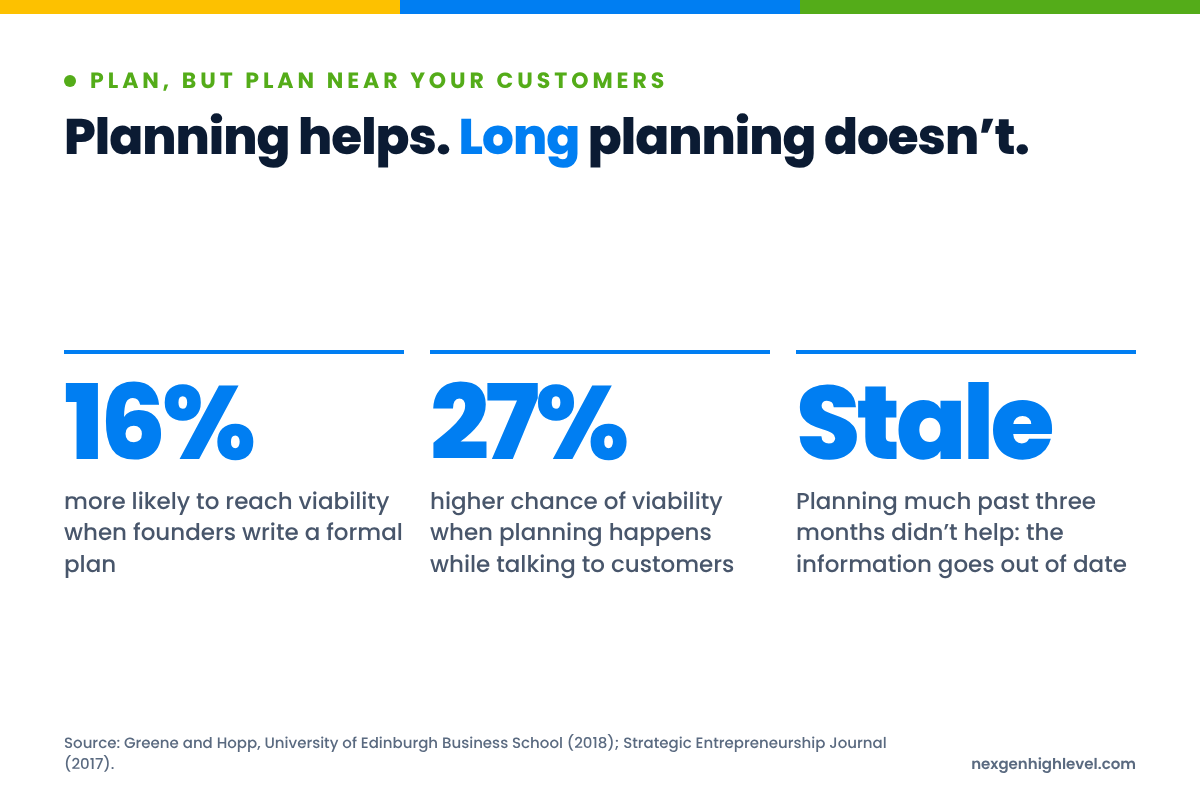
Professor Francis Greene and Christian Hopp looked at this properly. In a study of 1,088 US founders, published in the Strategic Entrepreneurship Journal in 2017, they concluded "it pays to plan". In the University of Edinburgh's own words, "entrepreneurs who write formal plans are 16% more likely to achieve viability."
So planning helps. Good. Write that down.
But the interesting bit is what came next. Their follow-up work looked at when people planned and for how long, using data on about 1,000 would-be US founders tracked between 2005 and 2011.
Here's what they found, according to the same Edinburgh summary:
- Writing the plan 6 to 12 months after deciding to start raised the probability of viability by 8%.
- Around three months of planning raised it by 12%.
- Planning for longer than that didn't help, because "the information goes stale".
- Planning around the time the venture was talking to customers and getting its products ready raised viability chances by 27%.
Read that last one again.
The biggest effect wasn't from the longest plan. It wasn't from the most detailed plan. It came from planning at the same time as talking to customers.
Harvard Business Review's one-line summary of Greene and Hopp's article on this reads: "Don't write a plan before you understand your customer."
I couldn't have put it better. So I won't try.
What this means in plain English
Planning is useful. Long planning, done in isolation, goes off like milk.
The market moves. Your competitors move. Prices change. The customer you described in month one has changed their mind by month nine, and you haven't asked them.
A plan written in a vacuum is a very well-formatted guess.
A plan written while you're talking to real people, testing a real offer and getting real answers is something else entirely. It's a working document. It gets better every week because reality keeps correcting it.
It's not a plan versus action. It's a plan fed by action.
Why planning feels so good
Let's be honest about why so many capable people get stuck here. It isn't laziness. Most world-class planners work incredibly hard.
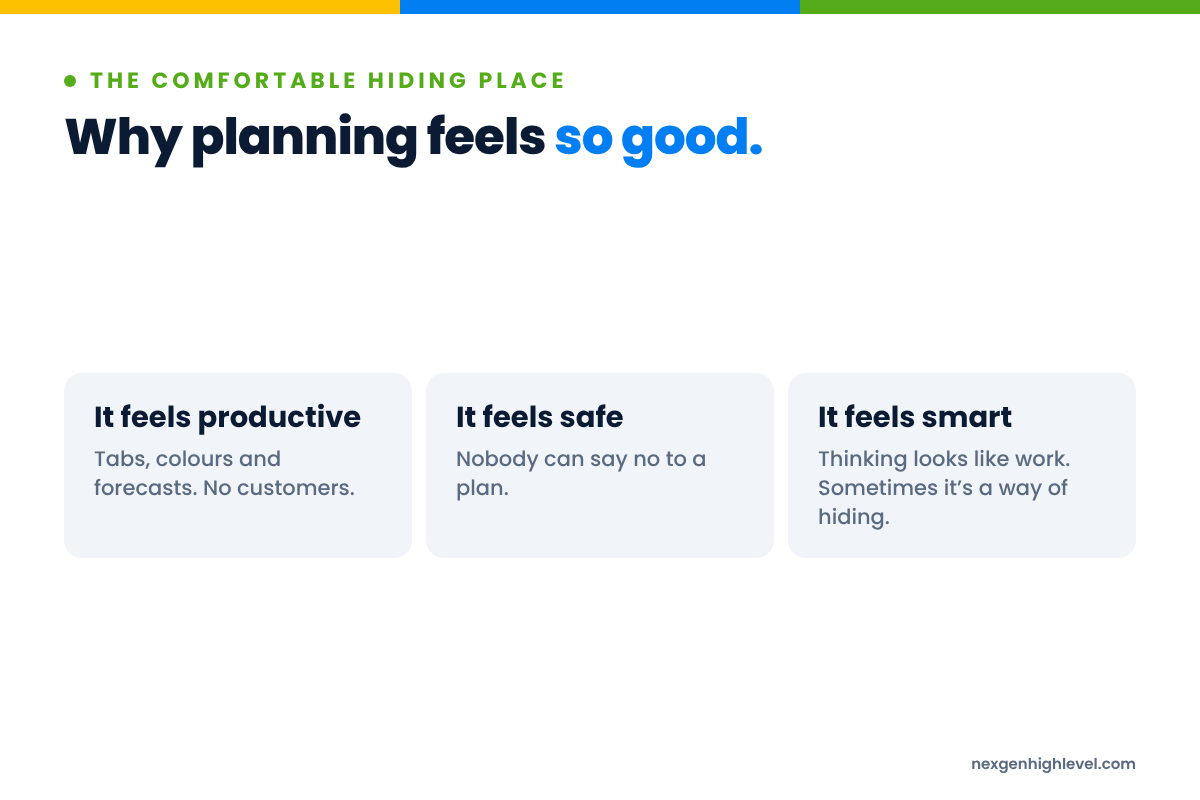
It's that planning gives you all the feelings of running a business with none of the risk.
Planning feels productive
You can spend eight hours on a business plan and go to bed feeling like you did a full day's work. You did. It just wasn't the work that makes money.
Compare that with picking up the phone to ten potential customers. That might take an hour. It might be awful. Three people might say no, five might not answer, and two might ask questions you can't answer.
Which one feels better at the end of the day? The plan, every time.
Which one taught you more? Not even close.
Planning feels safe
Nobody can reject a plan. Well, a bank can, but that's a different conversation.
Customers can't reject a plan because they never see it. So the plan protects you from the one thing every new business owner fears most: finding out that people don't want what you're selling, at the price you're selling it.
But here's the thing. If people don't want it, you need to know. The sooner the better. Finding out after six weeks is a lesson. Finding out after two years is a disaster.
Six weeks to find out beats six months. Every time.
Planning feels smart
There's a quiet status in having a thorough plan. It looks professional. It reads well. It impresses your friends at the barbecue.
And I get it. I studied Computer Science. I like a well-structured document. But I've also learned that simple isn't amateur. Simple is often what you arrive at once you actually understand something.
A 40-page plan for a business that has never spoken to a customer usually isn't sophisticated. It's just long.
Where my own perfectionism comes in
I'll put my hand up here.
I have ADHD. I'm either all over the place or completely hyper-focused, and when I'm hyper-focused on getting something "right", I can lose all sense of when right is good enough.
Perfectionism dresses itself up as high standards. Sometimes it is. But a lot of the time it's fear wearing a nice suit.
The question I've learned to ask myself is simple. Is this extra work going to change what a customer decides? If the answer is no, it's not quality control. It's procrastination with better manners.
I've written more about what procrastination really costs a business, and it's more than most people think.
Starting a business takes more than an application
Here's a number that I find fascinating.
According to the US Census Bureau, "Business Applications for September 2026, adjusted for seasonal variation, were 534,947." That's in a single month.
But an application isn't a launched business. It's paperwork. It's intent.
Some of those people will open their doors and serve customers within weeks. Some will still be "getting ready" this time next year. A few will never get past the name and the logo.
Nobody tracks the business plans sitting in drawers. If they did, I suspect it would be one of the biggest numbers in the economy.
The desire to start is clearly not the problem. Hundreds of thousands of people a month want it badly enough to fill in the forms.
The gap is between deciding and doing.
The three ways people get stuck
I believe people get stuck because of personality, not because of what industry they're in or how much money they have.
There are three personalities I see over and over. I've been all three at different times, sometimes in the same week.
The Tinkerer
The Tinkerer is the classic world-class planner. Buried in the details. Building, rebuilding, adjusting. Stuck in build mode or play mode, and slow to deploy.
They forget why they started. The plan became the project.
If you're a Tinkerer, your challenge isn't more knowledge. You probably have plenty. Your challenge is a deadline you can't move and a customer you've promised to speak to.
The Rusher
The Rusher is the opposite. Everything goes to market as fast as possible. Half built, half thought through, out the door.
It sounds like the cure for overplanning. It isn't.
We see this with our own apps. Some people install an app and uninstall it the next day. Go figure. They didn't give it a chance to work because they never decided what they wanted it to do.
Rushing isn't the same as acting. Acting is deliberate. Rushing is just planning skipped.
The Magic-Bullet Believer
The Magic-Bullet Believer thinks the next tool, the next course or the next template is the thing that will finally make it all work.
So they keep looking. More research. More comparisons. More "I'll start when I've found the right one."
That's still planning as a hiding place. It just has a shopping habit.
The cure is the same for all three
My advice to all three personalities is the same:
Know your goal, plan properly, set up properly, understand properly. Then go for it.
Notice what's in there. Planning is in there. It's just not the last step.
| Planning that helps | Planning that hides |
|---|---|
| Has a launch date | Has a "when it's ready" date |
| Names real customers to speak to | Describes an imaginary perfect customer |
| Gets shorter and sharper with use | Gets longer every month |
| Changes because a customer said something | Changes because you had another idea at 11pm |
| Fits on a few pages | Needs a contents page |
| Ends with an action | Ends with another revision |
How much business planning is enough
So if a year of planning is too much and no planning is reckless, where's the line?
Here's how I'd think about it. The Greene and Hopp findings point towards a short burst of planning, a few months at most, done alongside real customer contact. That fits with what I've seen in every business I've run.
You need enough of a plan to answer a handful of questions. You don't need more than that to start.
The questions your plan must answer
- Who exactly is this for? Not "small businesses". Which ones, where, with what problem?
- What problem are you solving for them? In their words, not yours.
- What will you sell first? One offer. Not a menu of twelve.
- How will people find out about it? One or two channels to start, not seven.
- What happens when someone shows interest? Who replies, how fast, and what's the next step?
- How will you know if it's working? Revenue and profit, not likes and clicks.
- What's your runway? How long can you go before it has to pay its way?
If you can answer those seven clearly, you have enough plan to start. Everything else gets filled in by doing.
Notice question 5. Most plans skip it entirely. They're full of how the business will attract people and almost silent on what happens when a person actually raises their hand. That's where a lot of new businesses quietly leak money.
What you can safely leave out
You don't need a five-year forecast for a business that hasn't made its first sale. Nobody, and I mean nobody, knows what year five looks like.
You don't need the perfect brand. You need a clear one.
You don't need every process documented before you have a single customer to process.
And you definitely don't need the logo redesigned a fourth time.
Act, learn, then plan again
Here's the rhythm I believe in.
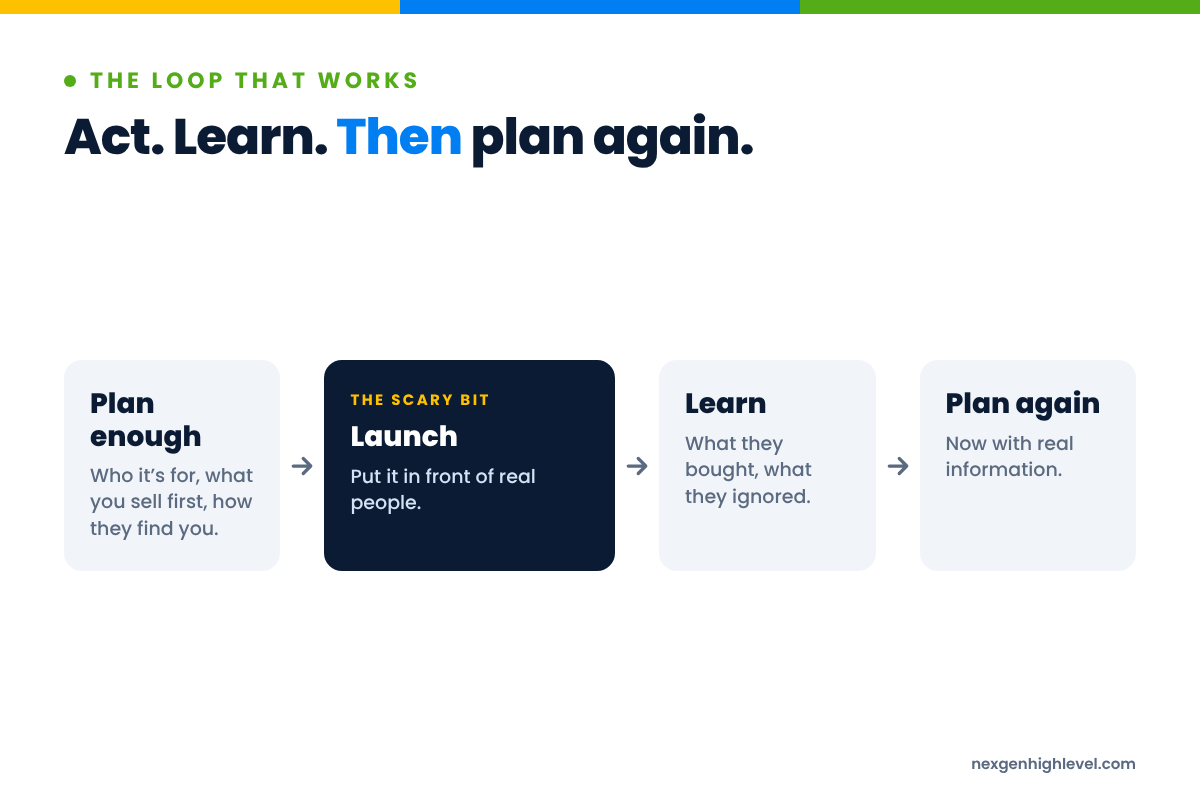
Plan a little. Act. Look at what happened. Adjust the plan. Act again.
It's not a straight line from plan to launch. It's a loop, and the loop is where the business gets built.
My LinkedIn App didn't start with a business plan
When we built our first app, the LinkedIn App, it wasn't the result of a year in a darkened room drafting a strategy document.
It was built for one client who needed it.
Other LinkedIn tools all offered the same basic outreach and didn't sit inside HighLevel. So we built something that did. Then we added email enrichment, so people could find their ideal customer, enrich their email, reach them on LinkedIn and by email, and nurture them.
Outreach went up for those first clients. So did their leads, sales, revenue and profit.
And that led to the next question. What else can we build?
That's the loop. A real need. A real customer. Something built and tested. Then a bigger plan, based on what actually happened rather than what we imagined might happen.
The plan for NexGenHighLevel got a lot better once there was something real for it to be about. You can read more about how NexGenHighLevel came about if you're curious.
Walk before you run
Now, I need to balance this, because "just act" can go wrong too.
When I ran my recruitment business, I grew it aggressively, with heavy overheads. I never foresaw the world just stopping. Then Covid arrived. Furlough covered salaries, but not the rent, the property taxes, the leases or the software licences, and no supplier cut me a break.
I had to close the business and make the team redundant. It was the hardest business decision of my life.
So when I say act, I don't mean bet the house. I mean take the next real step and learn from it.
Walk before you run. And even when you're ready to run, keep walking for a little bit longer. Only run when you can see the green field stretching out in front of you.
Acting doesn't mean being reckless. It means testing with real people at a scale you can afford to get wrong.
Picture two people starting on the same day
Imagine two people deciding to start a lawn care business on the same Monday.
The first one spends the next nine months on a detailed plan. Market analysis. Five-year projections. A full brand guide. By the time it's finished, the season has come and gone, and the assumptions about pricing are already out of date.
The second one writes a two-page plan in the first fortnight. Then they knock on doors, put a simple offer online, and take on a handful of customers. They get some things wrong. Their first price is too low. They find out which streets have the most demand. They learn that people care more about reliability and reminders than about the logo.
By month nine, the second person has a smaller plan and a much better one. Every line of it has been tested.
Who would you rather be?
Stop figuring it all out from scratch
Here's something I think gets missed in the whole business planning vs taking action conversation.
A lot of "planning" isn't really planning at all. It's working out the basics from scratch.
How should my enquiry form work? What happens after someone books? How do I remind people about appointments? What do I send to someone who enquired but didn't buy? How do I ask for a review? Where do all my leads go so I don't lose them?
These are important questions. But they're not unique to you. Thousands of businesses in your industry have already answered them.
Spending months reinventing them isn't strategy. It's the long way round.
Borrow what's already been proven
Franchising has understood this for decades. A franchise hands someone a tested system so they're not working out every process on day one. That model has real strengths, and real trade-offs too: fees, rules on how you operate, less freedom. But the core idea is sound. Don't make people reinvent what's already been worked out.
You don't need to buy a franchise to borrow that idea. I've written about how you can start a business without starting from scratch, and the thinking applies whether you're opening your first business or adding a new service to an existing one.
This is also where a platform like HighLevel earns its place. Instead of bolting together separate tools and hoping they talk to each other, you have your contacts, forms, calendars, pipelines, email, texts, reviews and workflows all in one place. That alone takes a whole chunk out of the "figure it all out first" phase.
And if you want to go further, a ready-made system can take out even more. Our HighLevel Snapshots are complete, built-out business systems for specific niches, already connected around the whole client journey, so you start from something working and make it yours. Clients have used Snapshots to skip months, if not years, of trial and error building a system.
A template isn't a substitute for thinking
But let me be clear about one thing.
A ready-made system doesn't replace the thinking. It frees you up to do the thinking that matters.
You still need a good offer. You still need to understand your customer. You still need to do the work.
That's why I always come back to the same three words. Human. Strategy. Leverage. In that order.
- Human. Who is this for, and what do they actually want?
- Strategy. What's the offer, the message, the journey from stranger to customer?
- Leverage. Only then does the technology come in: HighLevel, automation, workflows, AI.
Leverage multiplies whatever is underneath it. If you multiply zero by a thousand, you've still got zero.
So the plan still matters. It just doesn't need to include building the plumbing yourself.
What this means for agencies
If you run an agency, you've probably seen this from the other side. Clients who've been "about to launch" for a year. Clients who want everything perfect before a single ad runs.
Your job isn't only to build what they ask for. It's to get them to the point where real customers are touching the business, so the plan can start learning.
The quicker you can stand up a working system in HighLevel, the quicker that conversation moves from "what if" to "what happened".
Questions to ask yourself before you plan another week
If you suspect you've been hiding in the plan, here are some honest questions. Answer them out loud if you can. It's harder to fool yourself that way.
- When did I last speak to a potential customer about this? Not a friend. Not family. Someone who might actually pay.
- What am I waiting to find out? And can I only find it out by launching?
- What's the smallest version I could put in front of someone this month?
- If I launched next week, what's the worst realistic outcome? Usually it's embarrassment, not ruin.
- What have I changed in the plan in the last month, and why? Was it because of a customer, or because of me?
- Am I building something unique, or reinventing something that already exists?
- What would I tell a friend who'd been planning this for as long as I have?
That last one is my favourite. We're all far kinder and far clearer when we're advising somebody else.
Give yourself a deadline you can't wriggle out of
Planners are brilliant at moving deadlines. So make yours hard to move.
Tell someone the date. Book the first customer conversation. Put the launch in the diary and tell a person who'll ask you about it.
Back yourself. Nobody has it all figured out. Everyone works with incomplete information. Some people are just more comfortable deciding anyway.
Then measure what actually happens
Once you've launched, the plan's job changes. It stops being a prediction and becomes a record.
What did people buy? What did they ignore? Where did enquiries come from? Which ones turned into revenue?
This is where having everything in one place, like HighLevel, really helps, because you can see what's actually happening instead of guessing. I've written about measuring whether a new business is working, and the short version is this. Measure revenue and profit, not clicks or bookings.
Growing a business is far easier when you know which bits are working.
Frequently asked questions
How long should I spend writing a business plan?
Shorter than you think. Greene and Hopp's research found that around three months of planning helped, but planning for longer didn't, because the information goes stale. The bigger effect came from planning while talking to customers. So aim for weeks, not years, and make sure real conversations are happening at the same time. A plan that's being tested beats a plan that's being polished.
Is it better to plan or just start a business?
Neither on its own. Starting with no plan at all means you're guessing. Planning for a year with no customer contact means you're guessing more slowly. The best approach is a short, clear plan written alongside real action: talking to customers, testing an offer, getting your first sales. Then let what you learn reshape the plan as you go.
Do I need a formal business plan to start a business?
It helps. Research by Greene and Hopp found founders who wrote formal plans were 16% more likely to reach viability. But "formal" doesn't have to mean long. If you can clearly say who it's for, what problem you solve, what you'll sell first, how people will find you and how you'll know it's working, you have the bones of a useful plan.
How do I stop overplanning and actually launch?
Set a launch date and tell someone who'll hold you to it. Book a conversation with a real potential customer this week. Cut your plan back to the questions that genuinely change a decision. And stop rebuilding what already exists. Using proven systems for the basics, like follow-up, booking and reminders, takes a big chunk out of the "figure it all out" phase.
Can HighLevel help me launch a business faster?
It can remove a lot of setup work, because your contacts, forms, calendars, pipelines, email, texts and workflows live in one place. Some people go further and start from a fully built-out Snapshot for their niche. But HighLevel is leverage, not strategy. It won't fix a weak offer or a customer you don't understand. Get those right, and it multiplies what's working.
Plan enough, then launch
I'm not against planning. I'm a planner myself, and a perfectionist, and I've had to learn this lesson more than once.
But I've also learned that the market doesn't reward the best plan. It rewards the business that turns up, learns faster than everyone else and keeps improving.
The world-class planner who never launches isn't failing for lack of effort. They're failing for lack of feedback.
So write the short plan. Answer the questions that matter. Borrow what's already been proven so you're not reinventing the basics. Then put something real in front of real people, and listen hard.
Your plan isn't finished when it's perfect. It's finished when a customer has had their say.
Plan enough to start. Then let your customers finish the plan for you.