
A few weeks into starting a business, someone always asks you the same question. "So, how's it going?"
And most of us answer with whatever number feels best that day. Measuring business growth by the loudest number in the room. The post that got 400 likes. The ad that got a pile of clicks. The calendar that's finally filling up.
I used to do it too. It feels like progress. It looks like progress.
But here's the uncomfortable truth. Likes don't pay rent. Clicks don't pay wages. And a full calendar means very little if half the people don't turn up and the other half only wanted the cheap thing.
When I ran my marketing agency, we weren't judged on clicks or bookings. We were judged on our clients' revenue and profit. That changes how you look at everything.
So let's ask the question properly. Not "is it busy?" Is it working?
Busy isn't the same as working
New businesses are noisy. The website went live. The first ads are running. Somebody's cousin said they'd "definitely" send someone your way.
All of that is activity. But activity is not the same thing as a business that works.
A business that works is one where the right people find you, you respond to them properly, enough of them buy, you make more than it costs you to serve them, and there's money in the bank at the end of the month.
That's it. That's the whole game. Everything else is commentary.
Why we measure the wrong things
I don't think people chase vanity numbers because they're daft. I think there are three very human reasons.
- They're easy to see. Likes, followers and clicks are shown to you automatically, in big friendly fonts. Profit isn't. You have to go and work it out.
- They go up quickly. Revenue can take months to build. Followers can tick up in an afternoon. When you're nervous about whether you've made the right call, a number that goes up is very comforting.
- The real numbers can be scary. If you never look at profit, it can never tell you something you don't want to hear.
I'll put my hand up on that last one. I'm a terrible procrastinator, and a perfectionist, which is a delightful combination. There have been times in my career when I knew a number needed looking at and I found eleven other things to do first.
It never once made the number better.
The question I ask about everything
When somebody shows me a 47-box diagram of their marketing, or a dashboard with thirty charts on it, I ask one question.
Does it make any money?
Not "is it clever?" Not "does it look professional?" Does it make any money, cut a real cost, save real time, or make the customer's life better?
If the answer is no, it doesn't matter how good it looks. Simple isn't amateur. Simple is often what you arrive at once you actually understand something.
Measuring business growth starts with one question
Before you pick a single metric, decide what you're actually trying to achieve.
That sounds obvious. It isn't. I've lost count of the number of business owners who've told me they want "more leads". More leads for what? Which service? In which area? Worth how much? From what kind of customer?
"More leads" is too vague to measure. So it gets measured badly.
When my agency took on a new client, the first job wasn't building anything. It was handover and alignment. What was sold, what the client expected, and what success actually meant to them. Then commercial discovery: how does this business really make money? Who are the best customers? Which services are the most profitable? How long does it take someone to go from interested to paying?
Most clients didn't truly know. That's not a criticism. When you're running a business, you're usually too busy running it to stand back and look at it.
But you can't measure growth until you know what growth means for you.
Three things to write down first
Get a piece of paper. Answer these honestly.
- What does a good month look like? Not in likes. In customers, revenue and profit.
- Who is my best customer? Not the one who paid the most. The one who was profitable, easy to work with, and came back or referred someone.
- What would I need to see in six weeks to know I'm on the right track?
That third one matters. Six weeks to find out beats six months of hoping. If you know what you're looking for, you'll know much sooner whether something is working, and much sooner if it isn't.
Know your goal, plan properly, set up properly, understand properly. Then go for it. Measurement belongs in the "understand properly" bit, and it's the bit most people skip.
The numbers that feel good and pay nothing
To be fair to vanity metrics, they're not useless. Clicks, likes and followers are early signals that something caught someone's attention.
The problem starts when they become the scoreboard.
The clinics and the bookings
In my agency days we worked mostly with private medical practices in the US. A lot of them came to us after working with several other agencies, and the story was often similar.
They relied heavily on Facebook Ads. The results had been getting worse. Bookings were coming in, so on paper everything looked fine. But no-shows were rising. Cancellations were rising. And a good chunk of the people who did turn up were hunting for the low-ticket offer and had no intention of going any further.
Bookings went up. Revenue didn't.
That's the trap. If you measure bookings, you'll celebrate a week full of appointments that never become customers. If you measure revenue and profit, you'll see straight away that something in the journey is broken.
We usually ended up rebuilding from the ground up. Not just the ads, but the offer, the follow-up, the reminders, the way enquiries were handled, and the other channels that had been ignored. Systems, not just ads.
It's not about how many people raised their hand. It's about how many people paid, and whether you made money serving them.
A quick test for any number
When someone hands you a number, ask:
- If this number doubled, would my bank balance change?
- Could this number go up while my business gets worse?
- Do I know what I'd do differently if it went down?
If the answers are "not necessarily", "yes" and "no idea", it's a vanity number. Keep an eye on it if you like. Just don't steer by it.
The handful of numbers a new business should watch
Here's the good news. You don't need thirty charts. You need a handful of numbers that follow the journey from someone discovering you to money in your account.
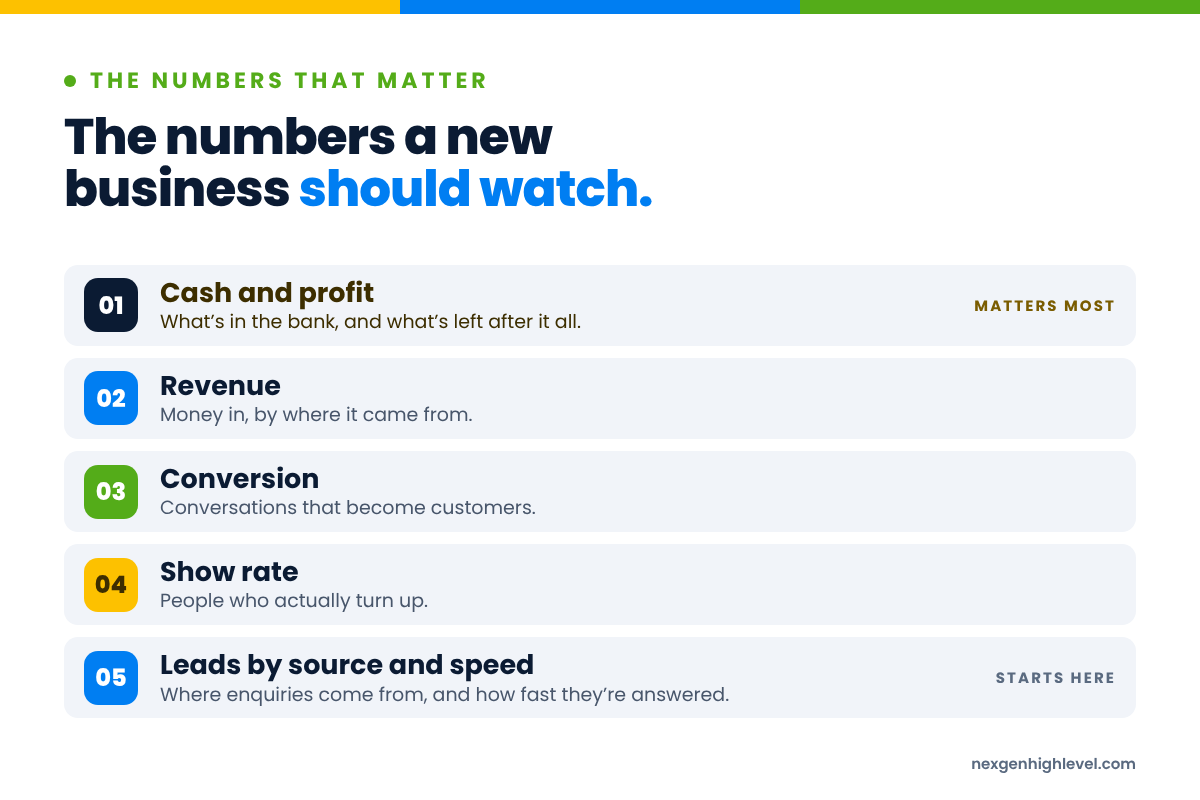
I think of it as a chain. Each link depends on the one before it. If one link is weak, everything after it suffers, and no amount of effort further down the chain will fully fix it.
| The number | The question it answers |
|---|---|
| Leads by source | Where are the right people actually coming from? |
| Speed to respond | How fast do we get back to them? |
| Show rate | Of the people who book, how many turn up? |
| Conversion | Of the people we speak to, how many buy? |
| Revenue | How much money came in? |
| Profit | How much did we keep after costs? |
| Cash | How much is actually in the bank, and when? |
Seven numbers. You could fit them on the back of a beer mat. Let's take them one at a time.
Leads by source
Not just "how many leads". Where did they come from?
This is the one that saves you the most money, because it stops you pouring budget into a channel just because it's the one you're used to.
Customers rarely arrive through one neat channel. They might see a post today, search your name next week, read your reviews, see an ad a fortnight later, and then book because a friend mentioned you. That's combination marketing, and it's how people really behave.
You won't get a perfect answer, but you can get a useful one. Ask every enquiry how they heard about you.
And the question to ask isn't "which channel brings the most leads?" It's "which channel brings the leads that become paying customers?" Those are often different answers.
Speed to respond
This is the one new businesses underestimate most.
Somebody fills in a form. They're interested right now. Maybe they've filled in three other forms too. Whoever gets back to them first, properly, usually has the best chance.
A 2011 Harvard Business Review article, "The Short Life of Online Sales Leads", put it plainly: "Our research shows that most companies are not responding nearly fast enough."
I'd go further. Most new businesses don't even know how fast they're responding. Ask yourself honestly: if an enquiry came in at 4.45pm on a Friday, when would that person hear from you?
When I started in recruitment, there was no email and no CRM. A telephone, a filing cabinet and a phone directory. If a client rang with a role and you didn't call back that afternoon, somebody else filled it. The tools have changed completely. That rule hasn't.
I've written more about this in why lead response speed matters on WhatsApp, and the thinking applies to every channel.
Show rate
If your business runs on appointments, calls or consultations, this one is huge.
Of the people who book, how many actually show up?
A low show rate quietly wrecks everything. The calendar looks full, and then you're sitting at 10am looking at an empty chair, wondering where your morning went.
Show rate is rarely about the customer being rude. It's usually about the journey. Did they get a confirmation? A reminder the day before? A reminder an hour before? Did anything make them feel this appointment mattered? Did they know what would happen when they turned up?
Small changes here can make a real difference, and they cost far less than finding more leads.
Conversion
Of the people you actually speak to or quote for, how many buy?
This is where the offer gets tested. Not the ads. Not the website. The offer and the conversation.
If lots of the right people are turning up and very few are buying, more marketing won't fix it. You'll just be paying to have more conversations that don't go anywhere. Leverage multiplies whatever is underneath it. If what's underneath isn't converting, technology will help you not convert more people, faster.
So look at it honestly. Is the price wrong? Is the offer unclear? Are you talking to the wrong people? Is the follow-up after the call non-existent? (That last one comes up a lot.)
Revenue
Money in. But look a little deeper. Revenue from which services? Which kind of customer? New or repeat?
Often one service, or one type of customer, is doing most of the heavy lifting. Worth knowing early.
Profit
Revenue is vanity, profit is sanity. You've probably heard that one. It's a bit of a cliché, but clichés usually exist for a reason.
You can grow revenue and go backwards. It happens all the time. More customers, more staff, more software, more ad spend, more overheads, and at the end of the year you've worked twice as hard to keep the same amount. Or less.
So ask, at least monthly: after everything, how much did I actually keep? And which customers made that profit, and which quietly ate it?
Some customers cost you more than they pay you. It's OK to walk away from a deal, from the money, from a new client. But you can't make that call if you don't know which ones they are.
Cash
And then there's the one that keeps people awake at night.
Profit is what you made on paper. Cash is what's in the bank. They're not the same thing, and the gap between them has closed more businesses than bad ideas ever did.
You can be profitable and still run out of cash. A big job finished but not paid for yet. Stock bought before it's sold. Bills that all land in the same week.
This one is personal for me. When Covid arrived, my recruitment business didn't survive it. Furlough would have covered salaries. But it didn't cover the rent, the property taxes, the leases or the software licences, and no supplier cut us a break. The costs kept coming while the income stopped. I had to make the team redundant to protect my family's security, and it's still the hardest business decision I've ever made.
I'd grown that business aggressively, with heavy overheads, and I never foresaw the world simply stopping. Nobody did. But it taught me to look at cash with very different eyes.
Walk before you run. And even when you're ready to run, keep walking for a little bit longer.
What the Fed survey says about cash and profit
If you're reading this and thinking "I'm the only one who finds this hard", you're not.
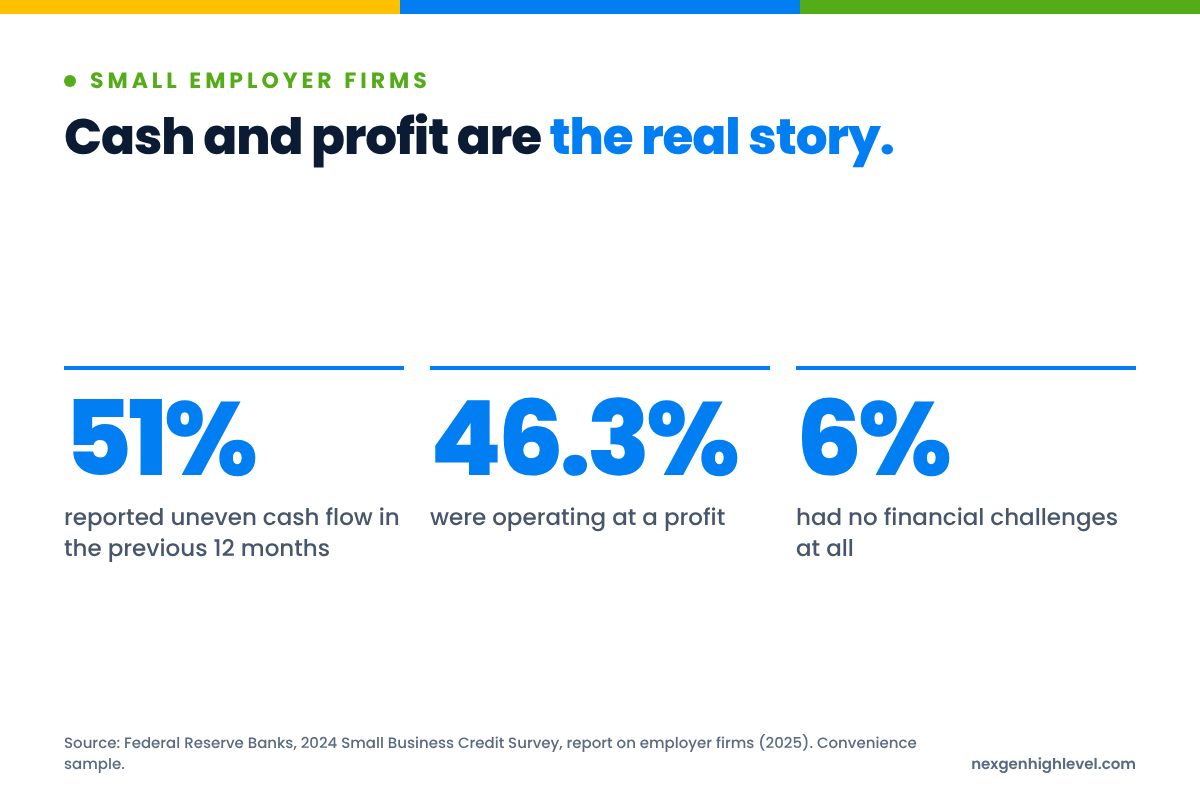
The Federal Reserve's 2024 Small Business Credit Survey, which gathered responses from 7,653 small employer firms between September and November 2024, asked about the financial challenges they'd faced in the previous 12 months.
The most common answers:
- Rising costs of goods, services and/or wages: 75%
- Paying operating expenses: 56%
- Uneven cash flow: 51%
- Weak sales: 48%
Only 6% said they hadn't experienced any financial challenges at all.
And in the same survey, 46.3% of firms were operating at a profit, and 37.7% reported revenue growth over the previous 12 months.
One fair caveat: the Fed itself describes this as a "convenience sample", so treat it as a strong signal rather than a precise picture of every business in America.
But think about what it's telling you.
What I take from those numbers
Two of the four most common challenges are about cash. Not "we couldn't get enough Instagram followers". Cash. And fewer than half the firms were operating at a profit.
So when you're measuring business growth in your first year, don't feel silly for obsessing about cash and profit. They trip up established businesses too.
It's not glamorous. Nobody posts a screenshot of their cash flow forecast. But it's the stuff that decides whether you're still here next year.
The US Bureau of Labor Statistics shows that of the private-sector establishments that opened in the year to March 2020, 51.4% were still operating five years later. Plenty close for good reasons. But staying in the game is an achievement in itself.
Measuring business growth in HighLevel
Now, the leverage bit. Human, Strategy, Leverage. In that order.
You've thought about who your customer is. You've decided what a good month looks like. You know which handful of numbers you're going to watch. Only now does technology come in.
This is where a lot of new businesses come unstuck. The numbers are scattered everywhere: leads in one inbox, bookings in another app, sales in a spreadsheet, and the owner stitching it together on a Sunday night.
That's not a measurement problem. That's a systems problem.
For us, the system is HighLevel. Here's how I think about it, number by number. Not as an instruction manual, but as a way of seeing what's possible.
Leads by source, in one place
When every enquiry lands as a Contact in HighLevel, from your forms, your funnels and websites, your calls and your messages, you've got one place to look.
Custom fields and tags can record where each person came from and what they were interested in. Reporting and attribution can show you which sources are bringing in leads, and, more importantly, which of those leads go on to become opportunities and customers.
One imperfect, joined-up view beats five perfect spreadsheets that never talk to each other.
Speed to respond, without relying on memory
HighLevel's Conversations inbox pulls messages into one place, so you're not hunting through apps to see who's waiting.
And Workflows can make sure nobody waits too long. A new enquiry comes in, and straight away they get a reply by text or email, the right person on your team gets notified, and a follow-up is lined up if nobody picks it up. Your memory doesn't have to be perfect. Mine certainly isn't. I remember useless facts from years ago and forget what I was told yesterday.
I've written about why automation belongs in a business from the very start in marketing automation for a new business, so I won't repeat it all here.
Show rate, protected by reminders
HighLevel calendars can send confirmations and reminders automatically. That alone takes care of a lot of no-shows, because many of them are people who simply forgot.
And because the booking, the reminder and the outcome all live in the same place, you can see your show rate rather than guessing at it.
Conversion, through pipelines
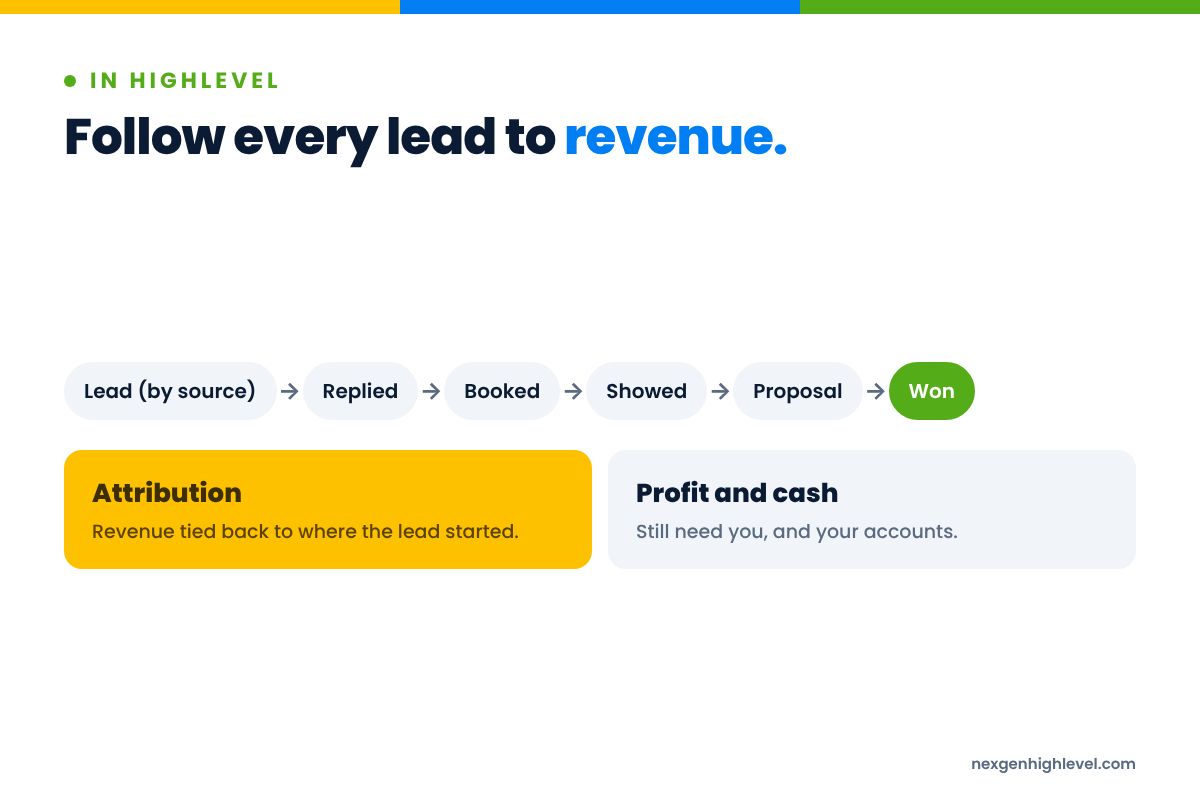
Opportunities and pipelines are where you see the journey laid out. New enquiry. Booked. Showed. Proposal sent. Won. Lost.
When you can see how many people sit at each stage, you can see where they drop off. And that tells you where to work. If lots of people book but few show, it's the reminders and the expectations. If lots show but few buy, it's the offer or the conversation. If lots get proposals and then go quiet, it's the follow-up.
That's the real value of a pipeline. It doesn't just tell you what happened. It tells you where to look.
Revenue, tied back to where it started
When an opportunity is marked as won with a value, you can start tracing revenue back to the source that brought it in. That's the moment the conversation changes from "which channel gets the most clicks?" to "which channel makes us money?"
I've written about exactly this idea for one channel in how to measure LinkedIn ROI. The principle is the same everywhere. Follow the money back to where it came from.
Profit and cash still need you
Here's where I'll be honest. A CRM can show you a lot of what drives profit: which services sell, which customers convert, where the work comes from. But your profit and your cash position still need your accounts, your bank balance and you, sitting down regularly and looking at them properly.
No piece of software replaces that. Technology is leverage, not strategy. It can put the right numbers in front of you. It can't make you look at them.
You don't have to build all of this from scratch
One more thought.
Setting up a system that tracks all of this, with the forms, pipelines, calendars, reminders, follow-up and reporting all connected, takes time if you start from a blank account. That's one of the reasons we build HighLevel Snapshots: complete, built-out systems for a particular niche, already connected around the whole client journey, so you start from something that works and make it yours. Clients have used them to skip months, if not years, of trial and error building a system.
But a system is not magic. You still need a good offer, you still need to understand your customer, and you still need to do the work. Including looking at the numbers.
A simple weekly scorecard
So what does this look like in real life, for a new business owner with too much to do?
Something like this. Once a week. Same day, same time. Thirty minutes, with a coffee. Or a Guinness, depending on the day of the week and the week you've had.
| Every week | Every month | Every quarter |
|---|---|---|
| New leads, and where they came from | Revenue by service and by source | Which channels to keep, change or drop |
| How fast we responded | Profit after all costs | Which customers to focus on, and which to let go |
| Bookings and show rate | Cash in the bank, and what's due in and out | Whether the offer needs work |
| Conversions and value won | Which customers made money, and which didn't | Whether you're ready to run, or should keep walking |
That's it. Not a 47-tab spreadsheet. A handful of honest numbers, looked at regularly.
Questions to ask in that thirty minutes
- Where are people dropping out of the journey?
- Which source brought the customers who actually paid?
- Is anyone waiting to hear from us right now?
- If I had to cut one thing, or double down on one thing, what would it be?
None of those are about the software. They're about the business.
Don't let measuring become another hiding place
One word of warning, especially for the Tinkerers among us.
It's very easy to turn measurement into a project. You build the perfect dashboard, colour-code it, rename the stages for the fourth time. Three weeks later, you've got a beautiful report and you haven't called a single lead back.
I've been there. Hyper-focused on the wrong thing for days at a time.
Planning can become a hiding place. So can measuring. The point of the numbers is to tell you what to do next. Then you go and do it.
If you want to think more about what happens once the numbers do start pointing up, I've written about growing a small business without growing the chaos.
What the numbers can't tell you
I'll finish the practical bit with a caveat, because I think it matters.
Numbers tell you what is happening. They don't always tell you why.
A drop in conversions might be the price, a competitor, or the person taking your calls having a terrible month. You'll only find out by talking to people.
Business is a people game disguised as a numbers game.
So use the numbers to know where to look. Then go and look. Ring the customer who didn't buy and ask, kindly, what put them off. Ask the customer who did buy what nearly stopped them. Ask your team what they're seeing.
People buy from people. The answers usually come from people too.
Growth that's worth having
There's one more thing worth saying.
Not all growth is good growth. More customers who don't pay on time, more staff than the work can support, more overheads than the revenue can carry. I've lived that version. It looks great right up until it doesn't.
The growth worth having is the kind where profit and cash grow alongside revenue. Where the business gets steadier, not shakier, as it gets bigger. Where you can see the green field stretching out in front of you before you start to run.
That's what measuring properly gives you. Not certainty. Nobody can promise that. But clarity, and earlier warnings, and the confidence to back yourself because you know what's actually going on.
Frequently asked questions
What are the most important metrics for a new small business?
Keep it to a handful. Leads by source, how fast you respond, show rate if you take bookings, conversion, revenue, profit and cash. Those seven follow the journey from someone discovering you to money in the bank. Likes, clicks and followers can be useful early signals, but they're not the scoreboard. If a number could double without your bank balance changing, don't steer the business by it.
How do I know if my new business is actually growing?
Look at whether profit and cash are growing alongside revenue, not just whether you're busier. More enquiries and more bookings feel like growth, but if no-shows rise and margins shrink, you can be working harder for less. Pick what a good month looks like in customers, revenue and profit, then compare month by month. Give it six weeks of honest tracking before drawing big conclusions.
How often should I review my business numbers?
Weekly for the fast-moving numbers: new leads, response times, bookings, show rate and conversions. Monthly for revenue, profit and cash. Quarterly for the bigger questions, like which channels to keep and which customers to focus on. The rhythm matters more than the tool. Thirty minutes every week, same day, same time, beats a four-hour panic every six months when something has already gone wrong.
Can HighLevel track revenue and attribution?
Yes. HighLevel brings your contacts, conversations, calendars and pipelines into one place, and its reporting and attribution can show where leads came from and which ones turned into won opportunities with a value. That lets you see which sources make money, not just which bring clicks. What it won't do is replace your accounts. Your profit and cash position still need your books and your attention.
Why is cash flow such a problem for small businesses?
Because profit and cash aren't the same thing. You can win work, finish it and still be waiting to get paid while rent, wages and suppliers are due this week. In the Federal Reserve's 2024 Small Business Credit Survey, uneven cash flow and paying operating expenses were among the most common challenges. Watch what's due in and out, not just what you've earned on paper.
Are likes and followers worth measuring at all?
They're worth glancing at, not worth steering by. Likes and followers tell you something caught people's attention, which is a fair early signal, especially when you're testing messages. But they don't tell you whether anyone paid you. Use them to learn what people respond to, then follow those people through to bookings, conversions and revenue. That's where you find out whether the attention was worth anything.
Keep score of what pays
When someone asks you how the new business is going, I hope you'll have a better answer than a follower count.
Something like: we know where our best customers come from. We get back to people quickly. Most of the people who book turn up. Enough of them buy. We make money on the work. And we know what's in the bank.
That's not a glamorous answer. But it's an honest one, and it's the answer of somebody who's building something that lasts.
You don't need thirty charts. You don't need a perfect system on day one. You need a handful of honest numbers, a regular habit of looking at them, and the courage to act on what they tell you.
Likes are applause. Profit is the encore.