
I grew my recruitment business fast. Too fast, if I'm honest.
More people. More desks. More overheads. Every month the business got bigger, and every month the fixed costs got bigger with it. It felt like growing a small business was supposed to feel. Busy. Ambitious. Going somewhere.
Then Covid arrived and the world just stopped.
Furlough covered salaries. It didn't cover the rent, the property taxes, the leases or the software licences. No supplier cut me a break. I had to close the business and let my team go. It's the hardest business decision I've ever made, and I still think about the people across the table from me that day.
I'm not telling you this so you'll feel sorry for me. Companies can be rebuilt. I'm telling you because of what it taught me.
Walk before you run. And even when you're ready to run, keep walking for a little bit longer.
Growth isn't the goal. Growth you can actually carry is the goal.
What growing a small business really means
Most people picture growth as a line on a chart going up and to the right.
It isn't. Growth is more of everything. More customers, more enquiries, more phone calls, more invoices, more questions, more things that can be forgotten, more people relying on you.
Here's a number I find interesting. The US Bureau of Labor Statistics tracks new business establishments and how many survive. Of the ones that opened in the year to March 2015, those still operating ten years later had grown from an average of 4.4 employees at opening to 11.7.
So the survivors grow. Nearly tripled, on average.
But look at the same table and you'll see the other side. Only 34.7% of that 2015 group were still operating ten years on. About two in three had closed.
I'm not quoting that to scare you. Plenty of businesses close for reasons that have nothing to do with failure. People retire, sell, move, change their minds. But it's a useful reminder that growing is one thing and lasting is another.
Growth multiplies whatever is already there
I say this about technology all the time: leverage multiplies whatever is underneath it.
Growth works exactly the same way.
If you've got a business where leads get answered quickly, customers get onboarded properly and everybody knows what happens next, growth multiplies that. Lovely.
If you've got a business where leads sit in an inbox for two days, onboarding lives in the owner's head and nobody's quite sure who's chasing the unpaid invoice, growth multiplies that too.
Chaos scales just as well as anything else. Better, sometimes.
The question nobody asks
When people talk about growing a business, the question is almost always "How do I get more customers?"
That's a good question. But there's one that should come before it.
What happens in my business when I do?
If you can't answer that clearly, more customers isn't growth. It's pressure.
Walk before you run
Let me come back to the Covid story for a minute, because the lesson isn't "don't grow". I love building. I love growth. I'm not embarrassed about wanting a business that makes good money.
The lesson is about what you grow on.
I grew the recruitment business on headcount and overheads. Every new chunk of revenue came with a new chunk of fixed cost attached. More people, more space, more commitments that had to be paid whether the phones rang or not.
That works brilliantly right up until the moment it doesn't.
Fixed costs don't care about your bad month
Here's the thing about overheads. They don't negotiate.
Revenue goes up and down. A big client leaves. A season goes quiet. A pandemic shuts the world. But the rent is still the rent. The lease is still the lease.
And you're not alone in feeling that. In the Federal Reserve's 2024 Small Business Credit Survey of small employer firms, 75% said rising costs of goods, services and/or wages had been a financial challenge in the prior 12 months. 56% struggled with paying operating expenses. 51% had uneven cash flow. Only 6% said they hadn't had any financial challenges at all. (The report calls its sample a convenience sample, so treat it as a strong signal rather than gospel.)
Uneven cash flow and fixed costs are a dangerous combination. One of them goes up and down. The other one doesn't.
The green field
So when do you run?
My answer: only when you can see the green field stretching out in front of you.
That means demand you can see, not demand you hope for. A system that already handles the volume you've got, and could handle more. Numbers you trust. And a cushion if the field turns out to have a ditch in it.
If you can't see all of that, keep walking. Walking still gets you there. It just doesn't throw you in a ditch on the way.
What breaks first when a small business grows
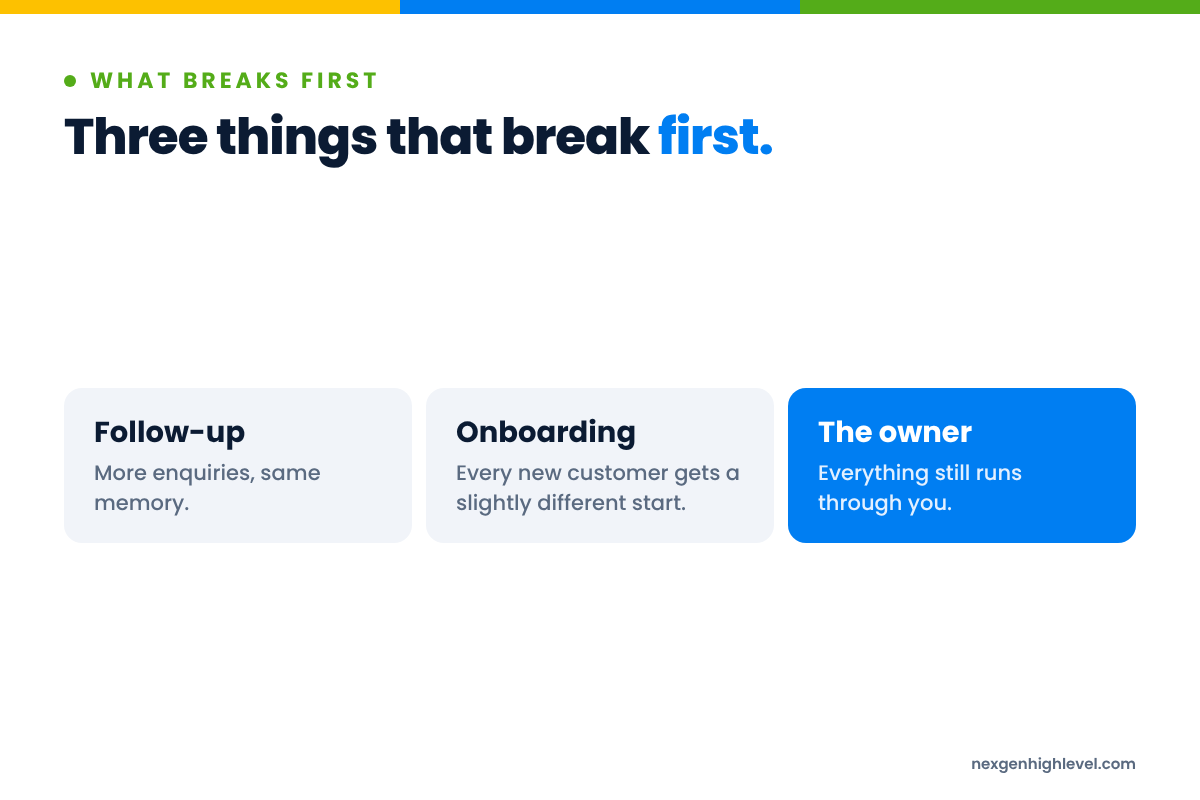
I've watched it happen in my own businesses and in the businesses of clients for years. When a small business grows, the same three things tend to crack first. Not the product. Not the website. These.
Follow-up
Follow-up is always the first casualty.
When you've got ten enquiries a week, you remember them. You ring them back. You send the quote. You chase it on Friday.
At forty enquiries a week, something gives. And it's never the urgent stuff. It's the second call. The quote that went out and nobody chased. The person who said "not right now, maybe in the spring" and never heard from you again.
Nobody decides to stop following up. It just quietly stops happening.
There's an old line from Harvard Business Review on online leads: "most companies are not responding nearly fast enough". That was 2011. I don't think it's changed much. And it gets worse as you get busier, not better, because the busier you are the less time you have to answer.
Picture two cleaning businesses getting the same enquiry on a Tuesday night. One sends an instant text, books a call for the morning and sends a reminder an hour before. The other means to reply on Wednesday, gets busy, and replies on Thursday.
Same lead. Same price. Who do you think gets the job?
I've written more about why fast lead response matters if you want to dig into that one.
Onboarding
The second crack is onboarding. The bit between "yes, let's do it" and the customer actually getting what they paid for.
In a small business, onboarding usually lives in one person's head. They know which form to send, which details to collect, what to say on the first call, what the customer is nervous about.
When my agency was working with clients, we treated onboarding as the start of delivery, not admin. Collect the access. Collect the business information. Find out who actually makes decisions. Get it right at the start and everything after it gets easier. Get it wrong and you're chasing your tail for months.
Now picture that business doubling. The person in whose head it all lives is now doing twice as many onboardings. Or worse, they've handed it to someone new with a quick "you'll pick it up".
They won't. Not consistently. And the customer feels it in the first week, which is exactly when they're deciding whether they made a good decision buying from you.
The owner
The third thing that breaks is you.
I don't mean that dramatically. Well, a little dramatically.
In most small businesses, the owner is the system. Every question comes to you. Every decision waits for you. Every exception, every price, every awkward customer. You're the glue holding the thing together, and it works because you're good and you care.
But glue doesn't scale.
Michael Gerber's The E-Myth Revisited draws what its publisher calls "the vital, often overlooked distinction between working on your business and working in your business". That distinction gets sharper the bigger you get. If you're working in the business every hour of every day, nobody is working on it.
And then you're the bottleneck. The thing slowing your own growth down is the person who wants it most.
I say this as someone who is a terrible procrastinator and a perfectionist. I know exactly what it's like to be the person everything waits for. It's not a badge of honour. It's a warning light.
Grow on systems, not headcount
So what's the alternative to growing on headcount and overheads?
Grow on systems.
It's not "hire fewer people". People are the heart of any business I'd want to run. It's "don't hire people to do what a system should be doing".
What a system actually is
A system isn't software. Let me be clear about that.
A system is a decision you only have to make once.
How do we answer a new enquiry? Decide once. How do we confirm an appointment? Decide once. What happens when somebody doesn't turn up? Decide once. What does a new customer receive in their first week? Decide once.
Then you write it down, build it, and stop deciding it every single day.
Software is just where some of those decisions get carried out automatically. The thinking comes first. Most businesses don't have a technology problem. They have a thinking problem.
The grill man who wrote the manual
One of my favourite bits of business history is about a grill man.
Fred Turner joined McDonald's in 1956 as one of its first employees and, in McDonald's own words, "began as a grill man" at the Des Plaines restaurant. He also coined the mantra QSC: Quality, Service and Cleanliness.
Then, according to Nation's Restaurant News, he authored the chain's first Operations and Training Manual in 1958, and codified the operational standards the company still uses in its restaurants.
Think about that. Before the brand was huge, before the restaurants were everywhere, somebody sat down and wrote out how the work gets done.
That's the order. Write down how it works. Then grow.
You don't need to be McDonald's. You don't need a manual the size of a phone directory. But you do need the same instinct: if it happens more than twice, it deserves a process.
Headcount versus systems
Here's a simple way to look at the difference.
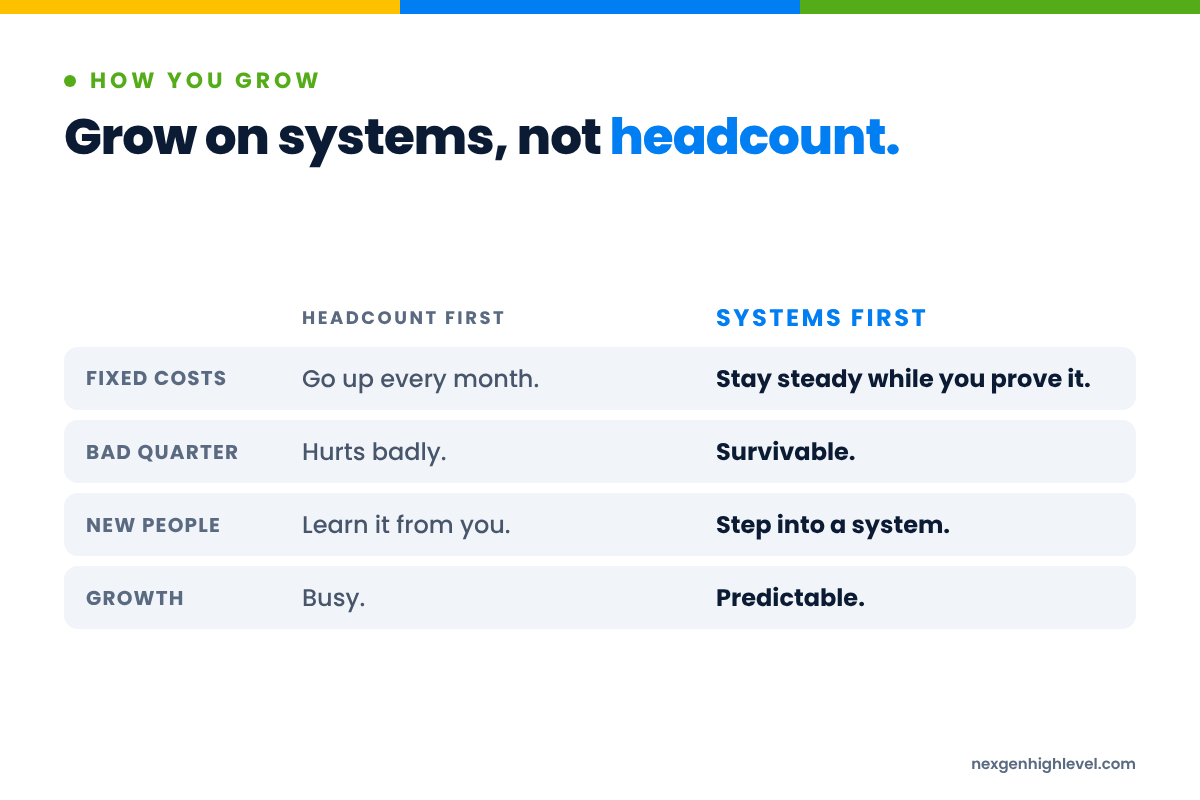
| Growing on headcount | Growing on systems |
|---|---|
| Every new customer adds work for a person | Every new customer runs through the same process |
| Knowledge lives in people's heads | Knowledge lives in the system |
| Quality depends on who's on shift | Quality is built into the steps |
| Costs rise with revenue, and stay up when revenue falls | Costs rise more slowly than revenue |
| A bad month hurts | A bad month still hurts, but less |
I want to be fair here. You'll still hire. Good businesses grow and need good people. The BLS numbers above show survivors adding staff over time.
The difference is what you hire them for. Hire people to do human work: the conversations, the judgement, the relationships, the craft. Let the system do the repeatable stuff, the reminders, the confirmations, the "just checking in" texts.
People buy from people. So put your people where people matter.
Making growth predictable
When I talk to business owners, very few of them say they want hockey-stick growth. That's the internet talking.
What they actually want is predictable growth. They want to know that if they do this, that usually happens. They want to sleep at night.
Predictability isn't luck. It comes from three things.
Know your journey
First, know your customer journey from start to finish. Every step, from somebody discovering you to becoming a paying customer, and then coming back again.
When my agency took on a client, we took responsibility for that whole journey. Because great ads still fail if the offer is weak, the website is confusing, the phone goes unanswered, or sales take three days to call back.
Write your journey down. Literally. On paper if you like. Where does someone first hear about you? What do they do next? Where do they get stuck? Where do they disappear?
You'll find gaps. Everybody does.
Make each step happen the same way every time
Second, make each step consistent.
Not robotic. Consistent. The enquiry always gets answered. The quote always gets followed up. The appointment always gets a reminder. The finished job always gets a thank you and a review request.
Consistency is the thing that turns a good week into a good month into a good year. One-off brilliance is lovely. It just doesn't compound.
Measure what pays
Third, measure it. And measure the right things.
I've always judged marketing on revenue and profit, not clicks or bookings. Bookings mean nothing if half of them don't show up or never buy.
When you can see how many enquiries came in, how many became conversations, how many became customers and what each was worth, growth stops being a mystery. You can see which lever to pull.
I've gone into the handful of numbers worth watching in how to measure whether your business is working.
A simple growth check
Before you push for more customers, ask yourself these:
- If enquiries doubled next month, would every single one get a reply the same day?
- Could someone new run your onboarding from what's written down, without asking you?
- If you took two weeks off, what would stop?
- Do you know which of your services makes the most profit, not just the most revenue?
- Are your fixed costs ones you could carry through three quiet months?
If the answers make you wince a little, good. That's where the work is. And it's much cheaper to fix now than at twice the size.
Where the system lives: HighLevel
A system needs a home. Somewhere the decisions you've made actually get carried out, every time, whether you're in the office, on a job, or on holiday.
For the businesses we work with, that home is HighLevel.
I'm not going to turn this into a manual. But it's worth showing how the three things that break first map onto what's already inside a HighLevel account.
Follow-up that doesn't depend on memory
In HighLevel, every enquiry lands as a contact, whether it came from a form, a funnel, a phone call or a message. Workflows can send the instant reply, nudge the team, chase the quote after a few days and keep nurturing the "maybe in the spring" people by email and SMS until spring actually comes.
Conversations pulls messages into one inbox, so nothing hides in somebody's personal phone. Calendars send confirmations and reminders on their own.
The point isn't that it's clever. The point is that it happens when you're busy. Which, if you're growing, is always.
Onboarding that lives outside your head
Onboarding becomes a set of steps rather than a memory. Forms and surveys collect what you need. Custom fields keep it on the customer's record. Tags and pipelines show where each customer is. Workflows send the right message at the right point in their first week.
So when you hire someone new, you don't hand them "you'll pick it up". You hand them the system.
An owner who isn't the bottleneck
And you get to step back. Not out. Back.
With Opportunities and pipelines, you can see what's moving and what's stuck without asking anyone. Reporting and attribution show you where the money actually comes from. Review requests go out after every job without you remembering to ask.
That's working on the business, not just in it.
Systems first, technology second
One honest warning. HighLevel won't fix a business that doesn't know what it's doing. Nothing will.
Technology is leverage, not strategy. Automate a confusing process and you've built a faster way to confuse people. Put it behind a weak offer and you've found a very efficient way of telling more people about something they don't want.
That's why I always come back to the same three words. Human. Strategy. Leverage. In that order.
Understand your customer. Decide how you'll serve them. Then use HighLevel to multiply it. I've written about why marketing automation belongs in a business from day one, and the same logic applies when you're growing: the earlier the system's in place, the less you'll have to untangle later.
You don't have to build it from a blank page
You also don't have to build every piece of that yourself. Plenty of good businesses grow on a structure somebody else has already tested, the way a franchisee starts with a proven operation rather than inventing one.
In HighLevel, a whole account setup can be packaged and loaded into another account. That's what a Snapshot is. Our HighLevel Snapshots are complete, built-out systems for a niche, for the business owner running it and for the agency serving that niche. Clients have used them to skip months, if not years, of trial and error building a system. You still need a good offer and you still need to do the work. But you start from a working system and make it yours.
And honestly, I've never understood why using a proven structure feels like cheating to some people. It's how grown-ups build. I've made that argument properly in why business templates aren't cheating.
The three personalities that get stuck growing
I've noticed people get stuck in growth for the same reasons they get stuck starting. It's personality, not industry. I see myself in all three of these, so nobody's getting judged here.
The Tinkerer
The Tinkerer loves building the system. Loves it a bit too much.
They'll spend six weekends perfecting a workflow for a situation that happens twice a year. They'll redesign the pipeline stages again. Meanwhile, the follow-up for this week's enquiries isn't switched on yet.
If that's you: build the simple version, switch it on, and improve it with real customers going through it. Six weeks to find out beats six months.
The Rusher
The Rusher wants to grow now. Hire now. Spend now. Open the second location now.
I was the Rusher in recruitment. I know the feeling. It's exciting and it feels like momentum.
If that's you: before you add the next fixed cost, ask whether the system could carry the extra work instead. If the answer is no, fix the system first. Then decide.
The Magic-Bullet Believer
The Magic-Bullet Believer thinks the next tool will sort it. A new app, a new platform, a new AI thing that promises to run the whole business for them.
Six months later they're paying for a pile of software they barely use, and the business is just as chaotic as before. Only now the chaos has logins.
If that's you: ask "What problem in my business will this solve?" before "What can this tool do?" Then learn one thing properly before you buy the next.
The advice for all three
It's the same advice, whichever one you are.
Know your goal, plan properly, set up properly, understand properly. Then go for it.
Questions to ask before your next hire
I want to be careful here. I'm not telling anyone not to hire. Some of the best decisions I've made were hiring good people. And people are more important than money.
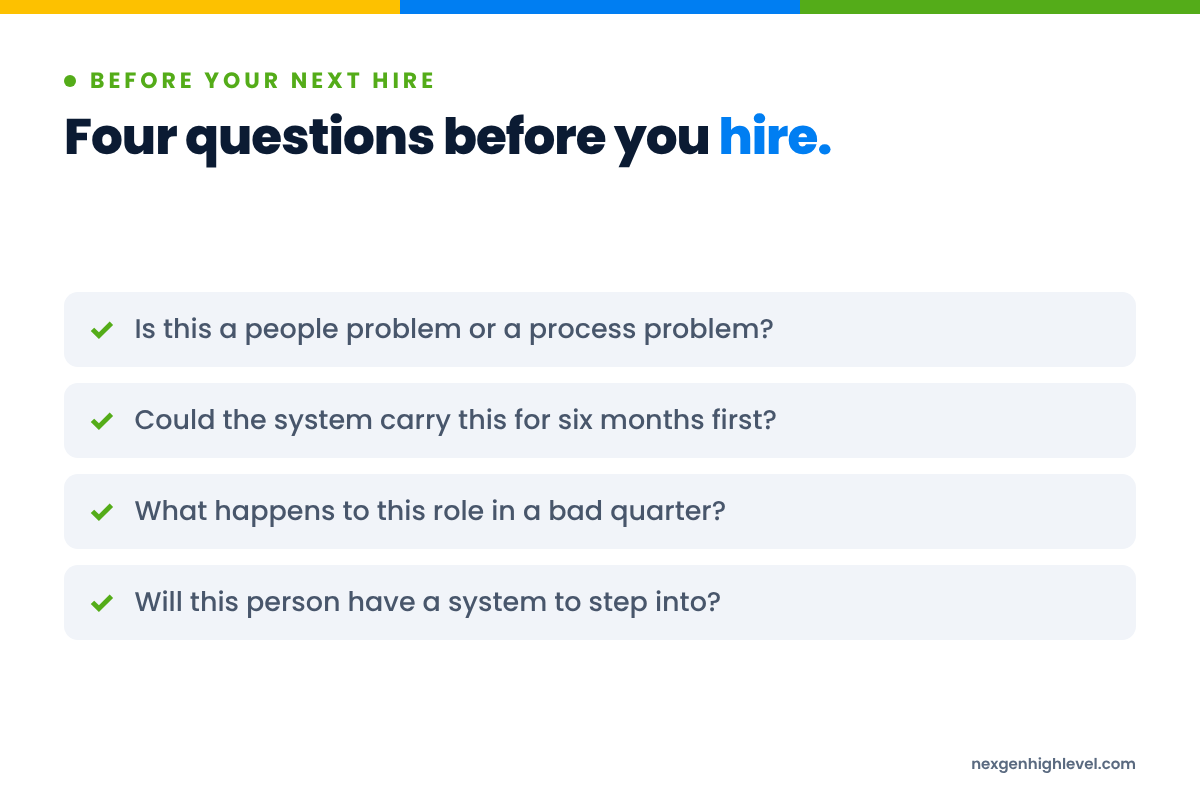
But hiring is a decision with someone's life on the other side of it. They'll take the job, maybe move, maybe turn down something else, maybe take on a mortgage because they trust the salary. I know what it feels like to have to undo that. So I think a new role deserves a few hard questions before it's created.
Is this a people problem or a process problem?
If the work is the same steps, repeated, triggered by the same event, it's probably a process problem. Hiring someone to do it means you're paying a person to be a reminder.
If the work needs judgement, conversation, empathy or craft, that's a people problem. Hire for it, and hire well.
Could the system carry this for six months first?
Try it. Build the process, run it for a while, and see what's left over. What's left over is usually the real job, and it's often a better job than the one you were about to advertise.
What happens to this role in a bad quarter?
Not a nice question. A necessary one. If revenue dropped for three months, could you still carry this cost? If the honest answer is no, you're running before you can see the green field.
Will this person have a system to step into?
The worst thing you can do to a good new hire is drop them into chaos and expect them to fix it. Give them a system to step into and they'll make it better. Give them chaos and they'll either drown or leave.
Frequently asked questions
What is the biggest mistake when growing a small business?
Growing costs faster than you grow systems. It's tempting to hire and expand the moment revenue goes up, but fixed costs stay when revenue dips. I learned that the hard way when Covid closed my recruitment business. Build the processes that handle the work first, prove they cope with more volume, then add people and overheads where human skill is genuinely needed.
How do I make growth more predictable?
Map your customer journey from first enquiry to repeat customer, make every step happen the same way every time, and measure revenue and profit rather than clicks or bookings. When you know how many enquiries turn into customers and what each customer is worth, you can see which lever to pull. Predictable growth is mostly consistency, done for long enough.
When should a small business hire its first employee or next employee?
When the work left over after you've systemised the repeatable tasks genuinely needs a person: judgement, relationships, craft, conversations. And when you could still carry the cost through a few quiet months. If the role is mostly chasing, reminding and copying information between places, a system can probably do that, and the person you hire later gets a far better job.
How does HighLevel help a growing business?
HighLevel gives your system somewhere to live. Contacts, Workflows, the Conversations inbox, calendars with reminders, pipelines and reporting mean follow-up, onboarding and tracking happen consistently without relying on anyone's memory. It won't fix a weak offer or a business that doesn't understand its customer. But once the thinking is right, HighLevel multiplies it, and it keeps working when you're busy.
What breaks first when a business grows quickly?
In my experience, three things. Follow-up, because nobody decides to stop chasing leads, it just quietly stops. Onboarding, because it usually lives in one person's head. And the owner, who becomes the bottleneck everything waits for. Fix those three before pushing hard for more customers and growth feels very different.
Do I need a franchise to grow on a proven system?
No. Franchising is a proven model with real strengths, a tested system, a brand, training and support, and real trade-offs, including fees, royalties and rules about how you operate. It suits some people very well. But the underlying idea, growing on a documented, repeatable system, is open to any independent business owner willing to build or borrow one.
Keep walking
If you take one thing from this, take this.
Growing a small business isn't about getting bigger as fast as you can. It's about getting bigger in a way you can carry. Through a good month, a bad month, and the month nobody saw coming.
Don't grow on headcount and overheads alone. Grow on systems. Decide things once. Write them down. Put them somewhere they'll happen every time, whether you're in the room or not. Then hire brilliant people to do the work only people can do.
I'd rather walk for a little longer and keep my team than sprint and have to tell people across a table that their lives are about to change. I've done the second one. I won't do it again if I can help it.
Back yourself. Build the system. Then grow.
Walk before you run. Then, when you can see the green field, run like you mean it.