
Nobody gets extra points for reinventing the wheel.
I wish somebody had told me that years ago. It would have saved me an awful lot of late nights.
When most people decide to start a business, they assume they have to build every piece of it themselves. The website. The sales process. The follow-up. How you book people in, remind them, chase them and ask for a review. All of it, from a blank page.
You don't. You can start a business without starting from scratch, and some of the smartest business owners I know do exactly that.
Starting takes courage. I'm not going to pretend otherwise. But courage spent rebuilding things that already exist is courage you don't have left for the things only you can do.
Be brave enough to start. Be smart enough to use what's already there.
Nobody gets extra points for reinventing the wheel
Picture two people opening a cleaning business on the same day.
The first one decides to do everything properly. Their way. They spend weeks on a logo. They build a website page by page. They write every email from scratch, work out how bookings should come in, design a quote form, figure out how to remind people the day before, and argue with themselves for a fortnight about what to call each stage of the sales process.
Three months later, the system is nearly ready. They've had a handful of customers, mostly friends.
The second one takes a booking process that already works. A set of emails and texts that already exist. A follow-up sequence somebody else has already tested. They change the words so it sounds like them, put their own prices in, and get on with it.
They spend those same three months talking to customers.
Who's more likely to still be trading in a year? I can't tell you for certain. Nobody can. But I know which one I'd back.
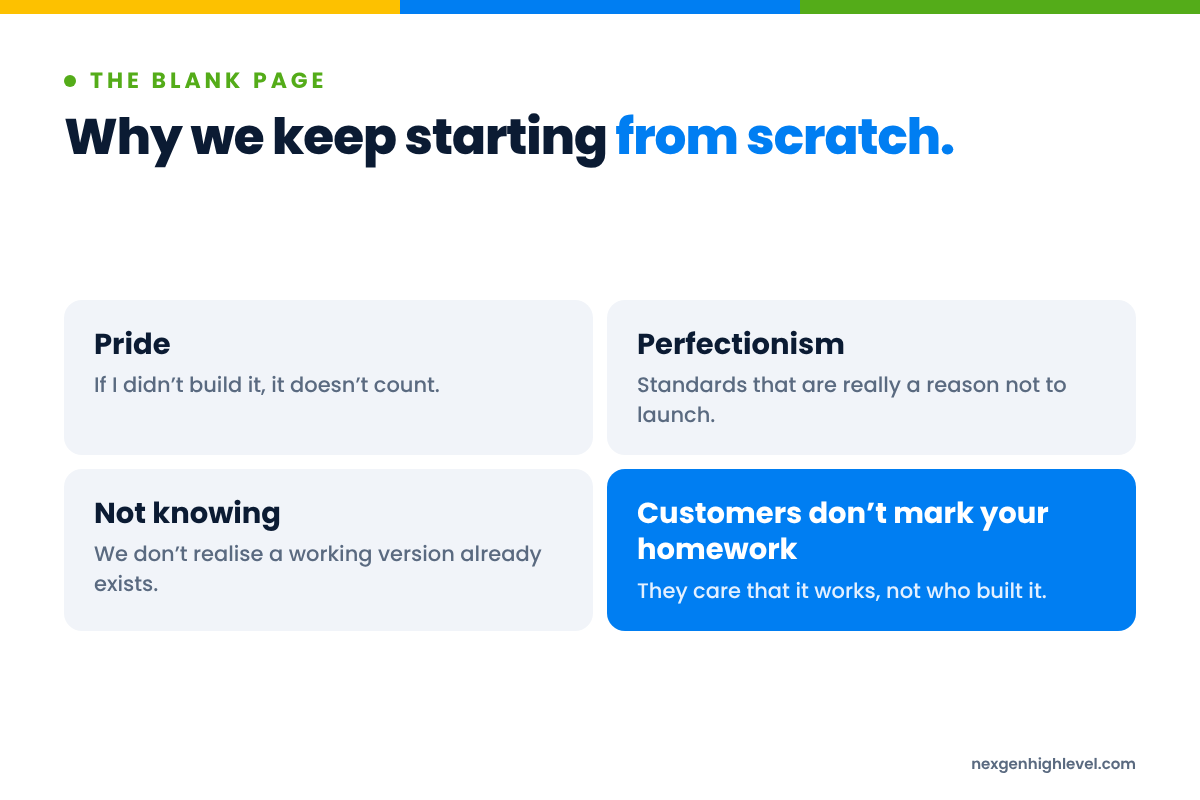
Customers don't mark your homework
Here's the thing about building everything yourself. Your customer never sees it.
They don't care whether you wrote the appointment reminder from scratch. They care that it arrived. They don't care whether your quote form was a labour of love. They care that it was easy to fill in, and that somebody got back to them quickly.
There are no extra points for originality in the plumbing. Nobody hands out a medal for the most hand-crafted follow-up email.
Originality is wonderful. Just spend it where your customer can actually see it.
Time is the thing you can't buy back
This matters more than it sounds, because the early years are hard on any new business.
The US Bureau of Labor Statistics tracks how long new business establishments survive. Of the private-sector establishments that opened in the year to March 2024, 77.9% were still operating a year later. Roughly one in five had closed within the first year. Of those that opened in the year to March 2020, 51.4% were still going five years later.
I'm not going to pretend I know why each of those closed. There are a hundred reasons a business doesn't make it, and plenty of them have nothing to do with systems.
But I do know this. In those first months, your time, your energy and your money are all finite. Every week you spend rebuilding something that already exists is a week you didn't spend finding customers, learning what they want and getting better at serving them.
That's not a small cost. That might be the whole runway.
Why we keep starting from scratch
If it makes so much sense to use what already exists, why don't more people do it?
I've thought about this a lot, partly because I'm guilty of it myself. I'm a terrible procrastinator. I'm also a perfectionist, which is delightful for everyone who has to work with me. Put those two together and you've got someone who can spend a very long time building something that didn't need building.
From what I've seen, it usually comes down to one of four things.
Pride
"If I didn't build it, it isn't really mine."
I understand that feeling. There's real satisfaction in making something yourself. I do carpentry in my spare time for exactly that reason.
But your business isn't a carpentry project. Nobody thinks less of a restaurant because the chef didn't invent the oven.
Perfectionism dressed up as standards
"I can't use somebody else's version. It won't be quite right."
Maybe it won't. But a working version you can adjust beats a perfect version that doesn't exist yet. Every time.
Perfectionism is very good at making procrastination look respectable. It feels like high standards. Often it's fear in a nicer jacket.
Not knowing what already exists
Sometimes people build from scratch because they genuinely don't realise there's another option. Nobody told them that the thing they're agonising over has been solved, tested and packaged up already.
That's not a character flaw. It's just a gap in information. And it's the easiest of the four to fix.
The Tinkerer
I talk a lot about the three personalities that get stuck: the Tinkerer, the Rusher and the Magic-Bullet Believer. I see myself in all three, which probably tells you something.
The Tinkerer is the one who builds from scratch. Buried in the tech. Forgets why they're using it. Stuck in build mode, or play mode, and slow to actually deploy anything.
The Tinkerer isn't lazy. Quite the opposite. They're often the hardest-working person in the room. They're just working hard on the wrong thing.
A lesson from Turbo Pascal
My first ever piece of software was my final-year project at Griffith College in Dublin. A sports club management system, written in Turbo Pascal. Built from absolutely nothing.
And that was the right call, because it was a college project. Its whole job was to prove I could build it.
Your business has a different job. Its job is to find customers, serve them well and make a profit. Proving you can build every piece of it yourself isn't on that list.
It's not a test of what you can build. It's a test of what you can get working.
The brave bit of starting a business
None of this means starting a business is easy, or that it doesn't take nerve.
It does. A lot of people take that step every month. The US Census Bureau reported that business applications for September 2026 were 534,947, adjusted for seasonal variation. An application isn't a launched business, of course. Some of those will never trade. But every one of them is somebody who decided to have a go.
That decision deserves respect. Leaving a salary, putting savings on the line, telling your family you're going to do your own thing. That's brave.
Back yourself
I fell into recruitment almost by accident in the 1990s, and loved it. Two years later I started my first recruitment business. I didn't have it all figured out. Nobody does.
That's one of the things I most want people starting a business to hear. The people who look like they've got it all worked out are working with incomplete information too. They're just more comfortable making decisions anyway.
Back yourself. Learn, ask, test, then decide.
And try to find out quickly. Six weeks to find out beats six months.
Brave isn't the same as reckless
But I've also learned the other side of this, and I learned it the hard way.
I grew my recruitment business aggressively, with heavy overheads. Then Covid came, and the world just stopped. Furlough covered salaries, but not the rent, the property taxes, the leases or the software licences. No supplier cut us a break. I had to close the business and make the team redundant.
It was the hardest business decision of my life. Not because a company closed. Companies can be rebuilt. Because of the people across the table whose lives were changing because of my decision.
So when I say "be brave", I don't mean "bet everything". I mean walk before you run. And even when you're ready to run, keep walking for a little bit longer. Only run when you can see the green field stretching out in front of you.
One of the best ways to walk sensibly is to not carry more weight than you need to. Building everything from scratch is a lot of extra weight.
The smart bit: use what already exists
So here's the other half of it.
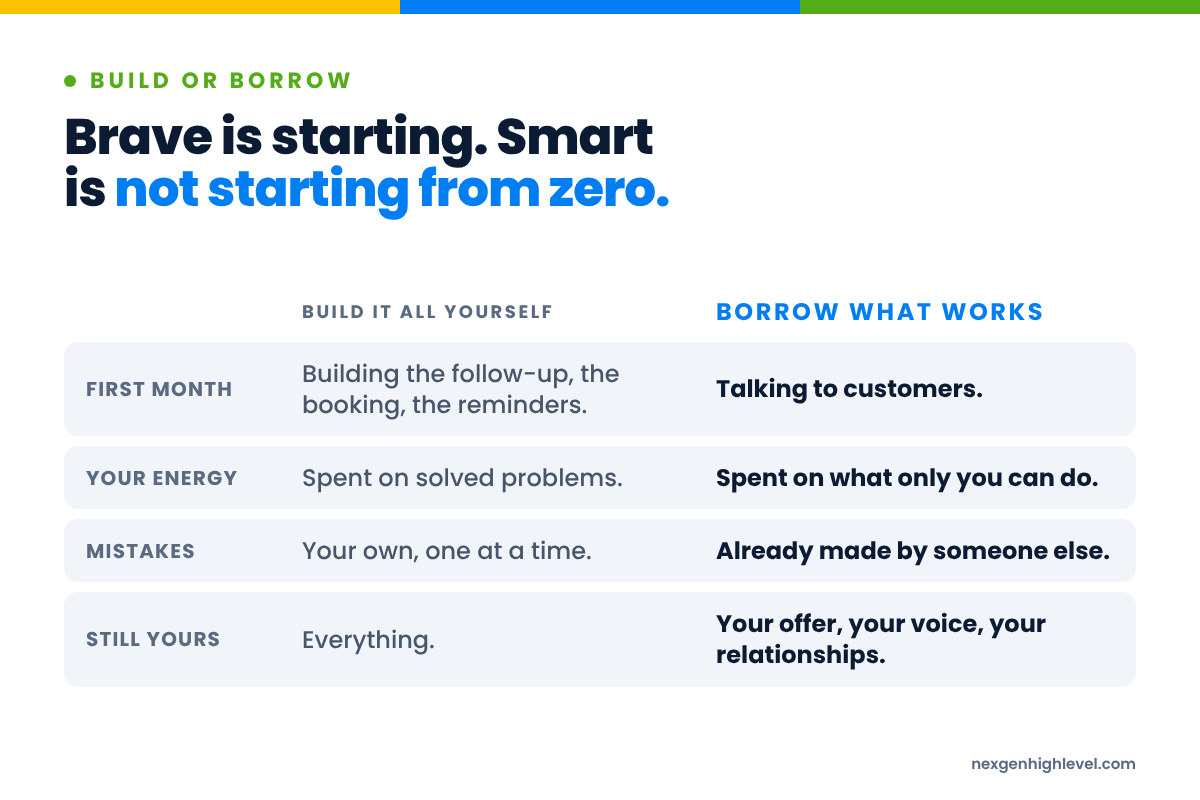
Be brave enough to start. Then be smart enough to borrow everything you reasonably can.
This isn't a new idea. It's how most of the world already works.
- A chef follows a recipe before they start improvising.
- A pilot runs through a checklist, no matter how many thousands of hours they've flown.
- A lawyer starts from a precedent, not a blank sheet.
- A builder works from plans that have been used on a hundred houses before.
None of those people are cheating. They're using what's been tested, so their skill and attention can go where it matters.
I've written more about this in why using business templates and proven systems isn't cheating. The short version: copy the structure, add your personality.
Working on it, not just in it
Michael Gerber's The E-Myth Revisited has been on a lot of business owners' bookshelves for a long time. The publisher describes it as drawing "the vital, often overlooked distinction between working on your business and working in your business".
It also makes the point that "common assumptions, expectations, and even technical expertise can get in the way of running a successful business".
I love that line about technical expertise, because it's exactly the trap. You're good at the work. So you assume being good at the work means you'll be good at building the business around it. They're different skills.
A good electrician doesn't automatically know how to build a follow-up process. A brilliant credit repair specialist doesn't automatically know how to design a sales pipeline. And there's no reason they should.
What can you borrow?
More than most people think. When you start a business without starting from scratch, the things worth borrowing usually look like this:
- How leads come in. Forms, booking pages, landing pages.
- What happens straight after. The first reply, the confirmation, the "thanks, here's what happens next".
- Follow-up. The emails and texts that go out when someone hasn't booked, hasn't replied or hasn't turned up.
- Your sales stages. The pipeline that shows where every potential customer is.
- Reminders. Appointments, quotes, renewals.
- After the sale. Review requests, referrals, rebooking.
- Reporting. What's coming in, what's converting and what it's worth.
None of that is what makes your business special. All of it is what keeps your business running.
What the franchise model gets right
If you want proof that borrowing a system works, look at the franchise industry. It's built on exactly that idea.
When somebody buys a franchise, they're not mainly buying a logo. They're buying a way of doing things that's already been worked out.
A system before a brand
The McDonald's story is the classic example, and it's worth remembering it started with a system, not a brand.
In 1948 the McDonald brothers streamlined their restaurant around what they called the "Speedee Service System", with a nine-item menu and a 15-cent hamburger. Ray Kroc visited them in 1954, which led to him becoming their franchise agent, and he opened his first McDonald's in Des Plaines, Illinois, on April 15, 1955.
Then came the bit I find most interesting. Fred Turner joined in 1956 as one of the first employees and began as a grill man at Des Plaines. He coined the mantra QSC: Quality, Service and Cleanliness. According to Nation's Restaurant News, he authored the chain's first Operations and Training Manual in 1958 and codified the operational standards the company still uses.
By 1961 there was a Hamburger University, in the basement of a restaurant in Elk Grove Village, Illinois. Graduates receive Bachelor of Hamburgerology degrees.
I love that. Somebody took burgers seriously enough to give them a degree.
But look at what's actually going on. Write down how it works. Teach it. Repeat it. That's the whole idea in one sentence.
Franchising is big, and it's still growing
It's not a niche idea either. The International Franchise Association's 2026 outlook, prepared by FRANdata, projects franchise establishments in the US will rise from 832,521 in 2025 to about 845,000 in 2026, with franchise employment expected to reach nearly 8.9 million jobs.
That's a lot of people who decided they'd rather start with a working system than invent one.
The honest trade-offs
I want to be fair here, because franchising is a proven model with real strengths. A tested system. A known brand. Training. Support. People who've already made the mistakes so you don't have to.
It also comes with real trade-offs. Upfront fees. Ongoing royalties. Rules on how you operate. Less freedom to do things your own way.
For plenty of people, that's a very good deal. For others, the rules are exactly what they started a business to get away from.
And I'll be careful about one thing. You'll sometimes hear that franchises are far safer than starting on your own. The research on franchise versus independent survival is mixed and dated, so I wouldn't make a decision on that claim alone. Nobody can promise you a business will work, franchise or not.
What I'd take from franchising is the principle, not a statistic. Start with a system that works, then put your effort into running it well.
There's more on this in what the franchise model gets right about starting up.
Borrowing a working system in HighLevel
So what does an independent business owner do? Someone who wants the head start a system gives you, but wants to keep their own name above the door?
This is where my own journey comes in.
Learning that it's all about the system
When I started a car leasing broker business in 2019, I learned very quickly that it was all about online lead generation and digital marketing. Not the cars. Getting found, getting the enquiry, and getting back to people before they went somewhere else.
The deeper I went, the more gaps I saw in how businesses handled all of that.
Then I found HighLevel in 2020, and it opened my eyes to what marketing automation could really do. Contacts, Workflows, pipelines, calendars, email and SMS, forms, funnels, review requests and reporting, all in one place. For the first time, the whole journey from enquiry to paying customer could live in one system.
But here's the catch. A platform full of possibilities is still a blank page.
HighLevel gives you the building blocks. Somebody still has to decide how they fit together for a roofing company, or a lawn care business, or a credit repair firm. And if that somebody is you, starting from nothing, you're back to the cleaning business owner arguing with themselves about pipeline stages for a fortnight.
The franchise idea, without the franchise
You don't have to start from that blank page. Inside HighLevel, you can start from a whole system that's already been thought through for your type of business: the funnels, forms, workflows, pipelines, calendars, emails and texts already connected around the client journey. Then you make it yours. Your name, your prices, your voice.
That's what our HighLevel Snapshots are: a business system in a box for a particular niche, for the business owner in that niche and for the agency serving it. Clients have used them to skip months, if not years, of trial and error building a system.
That's the franchise idea, without the franchise strings. No royalties on your revenue. No rulebook on how you run your business. Just a head start.
If you're not on HighLevel yet, you can create a HighLevel account through NexGenHighLevel. And if you'd rather not use any of this? That's fine. The principle still stands, whatever tools you use. Find what already works, and start from there.
What you still have to build yourself
Now for the honest bit. Because there's a version of this idea that goes badly wrong.
A ready-made system is not a ready-made business. A franchise isn't, and a template isn't either. None of them is magic.
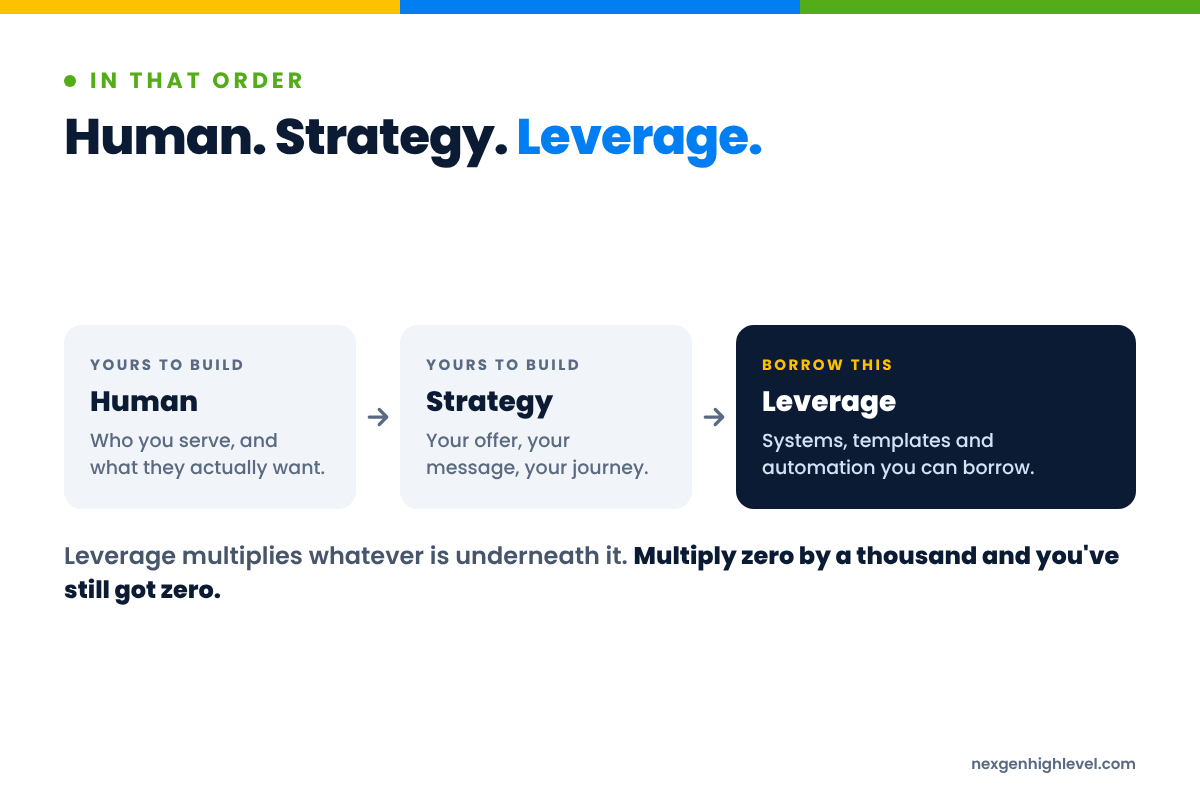
Human. Strategy. Leverage.
This is the framework I come back to for almost everything.
- Human. Start with the person. What do your customers actually want? What frustrates them, scares them, stops them from acting? Not what you think they should want.
- Strategy. Then decide how you'll solve it and talk about it. Your offer. Your message. How someone moves from "interested" to "paying".
- Leverage. Only then does technology come in. Automation, systems, templates, AI.
Leverage multiplies whatever is underneath it. Put a great system behind a great offer and it carries you a long way. Put the same system behind an offer nobody wants, and you've found a very efficient way of telling more people about something they don't want.
If you multiply zero by a thousand, you've still got zero.
Human. Strategy. Leverage. In that order.
The bits nobody can hand you
So what can't you borrow?
- Your offer. What you sell, who it's for, and why it's worth the money.
- Your understanding of your customer. You have to go and talk to them. Nobody can do that for you.
- Your judgement. Which customers to take on, which to walk away from, when to push and when to wait.
- Your reputation. Built one customer at a time.
- The work. Turning up, answering the phone, doing what you said you'd do.
A system gets you to the starting line faster. It doesn't run the race.
Beware the Magic-Bullet Believer
This is where the third stuck personality comes in. The Magic-Bullet Believer thinks every new tool is the answer, and never learns to use any of them properly.
We see it with our own apps. Some people install one and uninstall it the next day. Go figure.
It's the same with any ready-made system. If you buy a franchise, or install a ready-made system, or download a template, and expect it to do the work for you, you'll be disappointed. If you treat it as a head start, and put your effort into the parts only you can do, it's a very different story.
Most businesses don't have a technology problem. They have a thinking problem.
Before you start a business from scratch, ask this
So how do you actually decide what to borrow and what to build?
Here's what I'd ask, before you spend a single evening building anything from scratch.
Five questions for the blank page
- Has somebody already solved this? For most of the plumbing of a business (booking, follow-up, reminders, reviews), the answer is yes.
- Will my customer ever see the difference? If they won't, borrow it.
- Is this where my business is genuinely different? If it is, that's where your time goes.
- What's the cost of waiting? Every week spent building is a week not selling.
- Am I building this because it needs building, or because building feels safer than selling? Be honest with that one.
That last question is the uncomfortable one. Building is comfortable. It feels productive. Nobody can reject you while you're building. Customers, on the other hand, can say no.
Build or borrow?
A rough guide I'd use:
| Borrow it | Build it yourself |
|---|---|
| Booking and appointment reminders | Your offer and your pricing |
| Lead follow-up emails and texts | What makes you different |
| Your sales pipeline stages | Your relationships with customers |
| Review requests after a job | Your judgement on who to work with |
| Basic reporting | Your reputation |
The left-hand column is where a template, a franchise system or a ready-made setup earns its keep. The right-hand column is your business.
Plan, but plan near your customers
None of this means skip the planning. Planning matters.
Researchers Francis Greene and Christian Hopp studied 1,088 US founders and concluded "it pays to plan". Entrepreneurs who write formal plans are 16% more likely to achieve viability, according to the University of Edinburgh Business School.
But timing matters too. Planning around the time the venture was talking to customers and getting its products ready raised viability chances by 27%. And planning that dragged on too long didn't help, because the information goes stale.
Harvard Business Review's one-line summary of their work puts it neatly: "Don't write a plan before you understand your customer."
That fits everything I believe. A short plan, written alongside action and real customer conversations. Not a beautiful document polished for a year while nothing launches. I've written about that trap in the world-class planner who never launches.
My own version is simple. Know your goal, plan properly, set up properly, understand properly. Then go for it.
Borrowing a working system makes the "set up properly" step a lot shorter. Which leaves you more time for the "understand properly" step, which is the one most people rush.
Frequently asked questions
Can you really start a business without starting from scratch?
Yes. Most of what a business needs to run (taking enquiries, following up, booking, reminding, asking for reviews, reporting) has already been worked out by somebody. You can borrow that structure through a franchise, templates, or a ready-made system in HighLevel, then put your own offer, prices and personality on top. What you can't borrow is your understanding of your customer, your offer and the work itself.
Is buying a franchise better than starting a business from scratch?
It depends on what you want. A franchise gives you a tested system, a brand, training and support. In return you pay upfront fees and ongoing royalties, and you follow their rules on how to operate. Some people love that trade. Others started a business precisely to get away from rules. The research on franchise versus independent survival is mixed and dated, so decide on fit, not on a statistic.
What systems does a new business need from day one?
Fewer than you'd think, but they need to work. A way for enquiries to come in. A fast first reply. Follow-up for people who don't book or don't respond. Appointment reminders. A simple pipeline so you can see who's where. A review request after the job. And basic reporting on what's actually turning into revenue. In HighLevel all of that can live in one place, so nothing depends on your memory.
Is using a template or ready-made system cheating?
Not at all. Chefs use recipes, pilots use checklists, and franchises hand people an operations manual. Nobody calls that cheating. Using a proven structure just means your time and energy go into the things your customers actually notice. The only way it goes wrong is if you copy blindly and never make it your own. Copy the structure. Add your personality.
How do I stop procrastinating and actually start my business?
Make the first step smaller and make it about a customer, not a build. Talk to five potential customers this week. Borrow a system instead of building one, so "getting ready" can't drag on for months. Give yourself a deadline to find out whether it works: six weeks to find out beats six months. And watch for perfectionism wearing the costume of high standards. I'm speaking from experience.
Be brave. Be smart. Borrow the rest.
I've been around business a long time. IT, recruitment, a marketing agency, car leasing, and now building HighLevel apps at NexGenHighLevel. If you want the longer version, it's on our about us page.
In all of that, I've never once seen a customer care whether something was built from scratch.
I've seen plenty of them care whether somebody got back to them. Whether the appointment reminder arrived. Whether the person they spoke to understood what they needed. Whether the job was done well.
That's where your energy belongs.
So be brave. Take the step. Back yourself. It takes courage to start a business, and nobody can take that bit away from you.
But be smart about it, too. Walk before you run. Use what already exists. Let somebody else's tested system carry the weight it was built to carry, and keep your effort for the things only you can do.
Nobody gets extra points for reinventing the wheel. They get customers for knowing where to drive it.