HubSpot is the name everybody knows. HighLevel is the name a lot of small businesses and agencies only hear about once they've already been burned by something else.
So which one should you build your business on?
I've had this conversation more times than I can count. HighLevel vs HubSpot. Usually across a table, sometimes at 11pm on a call, with somebody who's just added up what their software actually costs them each month.
Here's the honest bit first. HubSpot is a much bigger company. It's public, it's well run and it's growing. I'm not going to pretend otherwise.
But bigger isn't the question. Fit is the question. Who was the platform built for, how does it charge you, and how quickly can you get a working system live?
I build apps and Snapshots that sit inside HighLevel, so I'm not neutral. I'll be fair, though. And I'll show you why, for most small businesses and agencies, HighLevel is the one I'd build on.
HighLevel vs HubSpot at a glance
Facts before opinions. Everything about HubSpot below comes from HubSpot's own website, help centre and annual report, checked in October 2026.
| HighLevel | HubSpot | |
|---|---|---|
| Who it's built for | Agencies and small and medium businesses; agencies host multiple sub-accounts, often one per client | Businesses of many sizes, with 288,706 customers in more than 135 countries at the end of 2025 |
| How it's organised | One platform: CRM, marketing, conversations, booking, reviews, payments, AI (HighLevel) | A set of hubs on a shared CRM: Marketing, Sales, Service, Content, Data, Revenue and Agent Hub (HubSpot products) |
| CRM and pipelines | CRM, sales pipelines, lead scoring, smart lists | Smart CRM, with a free CRM option |
| Email, SMS and phone | Email, SMS, WhatsApp, Messenger, Instagram DM and live chat in one stream; missed call text-back, call tracking, ringless voicemail | Email marketing, SMS marketing and VoIP calling from inside HubSpot |
| Funnels and websites | Websites, funnels, landing pages, webinar funnels, forms, surveys, quizzes | Website builder, landing page builder, form builder |
| Calendars and booking | Calendars, appointment reminders, paid calendars | Free meeting scheduler |
| Reviews and reputation | Reputation management, automated review requests, AI review reply, video reviews | No review management product on the products page; the closest is Customer Feedback Software (surveys) |
| Courses and memberships | Membership offers, courses, communities | Memberships (membership-based content) |
| AI | Voice AI, Conversation AI, Content AI, AI review replies | AI Customer Agent, AI Studio and Agent Hub |
| App marketplace | 1,500+ apps built by third-party developers, installed natively | Over 2,000 integrations and applications in the HubSpot App Marketplace |
| Whole-account templates | Snapshots copy a whole sub-account's setup and can be sold on the App Marketplace | Themes and modules for websites, plus asset copying of emails, forms, segments and workflows on Enterprise and Professional |
| White-label and reselling | Full white-label, SaaS mode, rebilling (HighLevel help centre) | No white-label option found on HubSpot's official pages; agencies join a commission-based partner programme |
| Pricing model | Flat agency price, unlimited users; usage-based phone, email and AI on top (pricing) | Priced per hub and per seat, in Free, Starter, Professional and Enterprise tiers, with onboarding fees on higher tiers (pricing) |
On paper, a lot of boxes are ticked on both sides. HubSpot even lists more marketplace apps than HighLevel.
So the difference isn't "has it or hasn't it". It's how it's packaged, who it's packaged for, and what that does to your bill and your setup time.
One platform or a set of hubs
HubSpot is built as hubs. Marketing Hub. Sales Hub. Service Hub. Content Hub. Data Hub. Revenue Hub. And now Agent Hub, which HubSpot describes as "your central home for building and managing AI agents across the platform".
Each hub sits on HubSpot's Smart CRM. You buy the hubs you need, at the tier you need, for the people who need them.
HighLevel goes the other way. One platform. The CRM, the pipelines, the funnels, the calendars, the SMS, the WhatsApp, the reviews, the courses, the invoicing and the AI all live in the same account from day one.
Neither is wrong. They suit different people.
Where HubSpot is genuinely good
Let me give HubSpot its due, because it's earned it.
HubSpot is a serious, well-run business. It reported revenue of $3.13 billion for 2025, up 19%, with customers in more than 135 countries. Its hubs go deep. If you run a larger sales team, need separate marketing, sales and service departments working from one CRM, and have the budget and the people to configure it properly, HubSpot is a strong choice. It also has a free CRM that has introduced a lot of people to the idea of a CRM in the first place. That matters, and I respect it.
Build something better. Let the customer decide.
Who HighLevel was built for
HighLevel was founded in 2018 with a mission to "transform digital marketing by giving agencies the tools to automate, scale and deliver stronger results".
It wasn't built for a department. It was built for the agency serving a plumber or a clinic, and for the plumber and the clinic themselves.
Think about a small business on a Tuesday morning. A missed call needs a text back before the lead rings somebody else. A booking needs a reminder. A finished job needs a review request. A web form needs to drop into a pipeline and start a conversation.
That's not five departments. That's one owner and a couple of staff. They don't need hubs. They need one system that does all of it, connected.
When I found HighLevel in 2020, it opened my eyes to marketing automation well beyond what I'd been using, HubSpot included. Not because HubSpot was bad. Because HighLevel was built around the small business customer journey, end to end.
It's not about which platform has more features. It's about which platform was built for the business you actually run.
Pricing models: flat platform vs hubs and seats
I won't quote prices here. They change, and you should always check the official pages. But the pricing model tells you a lot about who a platform is for.
HubSpot charges per hub and per seat. Sales Hub, for example, has a free option for up to 2 users, then Starter, Professional and Enterprise priced per seat per month, with a one-time onboarding fee on Professional and Enterprise. Marketing Hub Professional and Enterprise include a set number of Core Seats, charge for extra seats, and require an onboarding fee. HubSpot also uses HubSpot Credits for some usage.
So your bill grows with three things: the hubs you add, the tier you need, and the number of people using it.
HighLevel charges a flat agency price, with unlimited users. Every plan comes with all the core features. On top of that you pay for usage, such as phone calls, emails and AI, and there are optional add-ons, some priced per sub-account.
Here's why that matters. Hire your third salesperson on a per-seat platform and your software bill goes up. Hire them on HighLevel and you add a user. Sign your tenth agency client on HighLevel's Unlimited plan and you add a sub-account. The platform fee doesn't move.
For a growing business, or an agency adding clients, a flat model is simply easier to plan around.
That's the main reason I hear people searching for a HubSpot alternative. It's rarely because HubSpot doesn't work. It's because the bill grew faster than the business.
HighLevel as a platform you can build on
This is the bit most comparisons skip, and it's where I live.
A platform isn't just what it does out of the box. It's what other people can build on top of it. Both HighLevel and HubSpot let third parties build for them. How they do it is very different.
The HighLevel App Marketplace
The HighLevel App Marketplace lists over 1,500 apps for CRM, marketing automation and business workflows.
Developers register, create an app and publish it when it's ready, following HighLevel's review guidelines. HighLevel handles the billing, collects payment from agencies and pays developers. And as of today, HighLevel says it does not deduct any commission. That's "currently", in HighLevel's own words, but it says a lot about how HighLevel treats its developers.
Here's the bit that matters for agencies. Agencies can resell marketplace apps to their own sub-accounts with their own markup, and the base price is hidden from the client. Marketplace apps are also reviewed for white-label compatibility.
For an agency, an app on HighLevel isn't just a tool. It's something it can put its own name on and sell.
Snapshots: a whole account, not a single template
Then there are Snapshots.
HighLevel defines a Snapshot as a set of reusable templates that capture selected configuration assets from a sub-account so they can be copied into other sub-accounts. And "selected configuration assets" covers a lot: workflows and triggers, pipelines, calendars, funnels and websites, forms, surveys, email and text templates, custom fields and values, Conversation AI and Voice AI agents, memberships, dashboards, review settings, WhatsApp templates and more.
You load a Snapshot into a sub-account, choose what to import, and decide what to override or skip. Or you create a brand new sub-account straight from a Snapshot.
And third parties can sell Snapshots on the App Marketplace, with one-time, monthly or yearly pricing. Buyers push the Snapshot straight to their accounts from their HighLevel dashboard. Snapshots can also be attached to SaaS plans, so every new client on a plan starts with the system already in place.
What HubSpot offers on both points
Let me be precise, because HubSpot does have both a marketplace and templates.
Apps. HubSpot's annual report says "over 2,000 integrations and applications are available", and that tens of thousands of its customers integrate third-party apps. That's more than HighLevel's 1,500+. I'll say that plainly. Third-party developers can list apps on the HubSpot App Marketplace too.
Templates. The HubSpot Template Marketplace lists two kinds of template: themes, which are website designs, and modules, which add website functionality. There are hundreds of them, from third-party creators.
Copying assets. HubSpot also lets you copy assets to another HubSpot account. It covers automated marketing emails, forms, segments and workflows, between accounts in the same multi-account organisation. The main account needs an Enterprise subscription, and each connected account needs Professional or Enterprise. It isn't available in trial accounts.
Why HighLevel's version is stronger for this reader
HubSpot's templates are about the website. A theme, a module. Useful, but one piece.
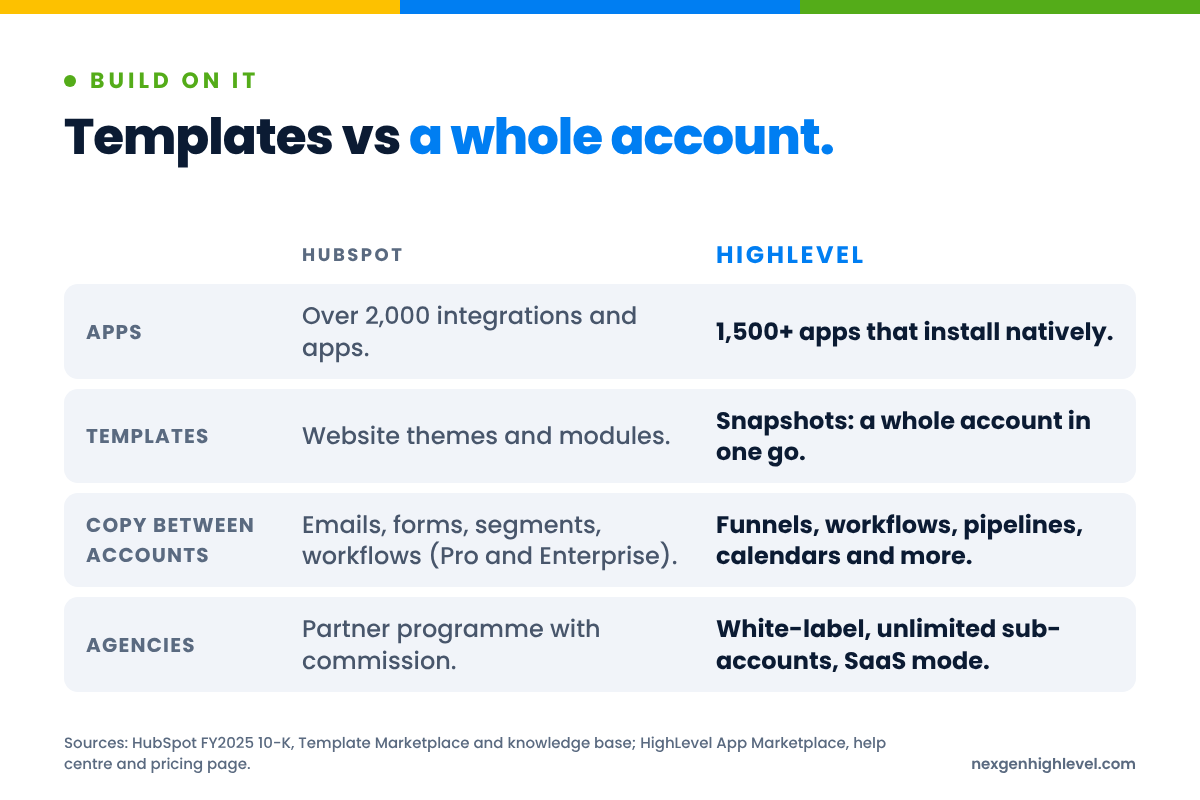
HubSpot's asset copying moves emails, forms, segments and workflows, and only between higher-tier accounts in one organisation. We couldn't find a one-click, whole-account package on HubSpot's official pages equivalent to a HighLevel Snapshot.
A HighLevel Snapshot carries the whole system: funnel, form, pipeline, calendar, workflows, emails and texts, AI agents, review settings. Any HighLevel agency can load one. Anyone can build one and sell it on the marketplace.
On apps, HubSpot has the bigger number. But a HighLevel agency can resell the apps it installs under its own brand, with its own markup, to every client it serves.
It's not one template at a time. It's a whole business system in one go.
Agencies: HighLevel white-label vs the HubSpot partner programme
"Agencies" means different things on each platform, so let's be careful here.
Agencies are a huge part of HubSpot's world. HubSpot's own annual report says its Solutions Partners and the customers they referred made up about 25% of customers and about 49% of revenue in 2025. That's a big, important partner channel, and plenty of good agencies make a living in it.
But look at what the relationship is.
HubSpot's Solutions Partner Program is "designed for service firms, consultancies, and agencies". Partners pay for a partner package (waived for partners who are also customers spending more than the fee), and they earn 20% commission for three years on deals they bring to HubSpot. HubSpot's 10-K describes partners who "on a commissioned basis, refer customers to us".
So in the HubSpot model, the agency refers and implements, and the client is a HubSpot customer on HubSpot-branded software. We found no option on HubSpot's official pages to white-label the HubSpot CRM as your own software.
HighLevel's model is built the other way round.
Agencies subscribe at the agency level, host sub-accounts for their clients, and white-label the platform under their own branding and custom domains. HighLevel's help centre says white-labelling "ensures that all traces of HighLevel branding are removed from the platform", including the login domain and desktop app. There's a white-label mobile app too, published under the agency's own Apple and Google developer accounts.
Then there's SaaS mode. In HighLevel's words, it "enables agencies to utilize the software and rebrand it as their own". Agencies build their own plans, set their own pricing, choose a trial and attach Snapshots. They can rebill phone and email usage, and on the higher plan rebill AI usage with a markup.
That's a different business. You're not earning commission on someone else's software. You're running your own software company, with your own brand and your own pricing.
I've seen what this did to the agency world. When HighLevel opened white-label up, the agencies competing in my US sector went from 10 or 20 to thousands, almost overnight. I call it the GoHighLevel Effect. It showed one thing clearly: give agencies their own platform, and they'll build businesses on it.
It's not a referral. It's ownership.
If you're an agency looking for a HubSpot alternative you can put your own name on, that's the difference that matters most.
How our apps help you get more out of HighLevel
No platform is perfect. HighLevel's original line was "Capture, Nurture, Close", and it's brilliant once someone shows interest. But I kept asking: where's the prospecting? Where's the outreach? Where's the market creation?
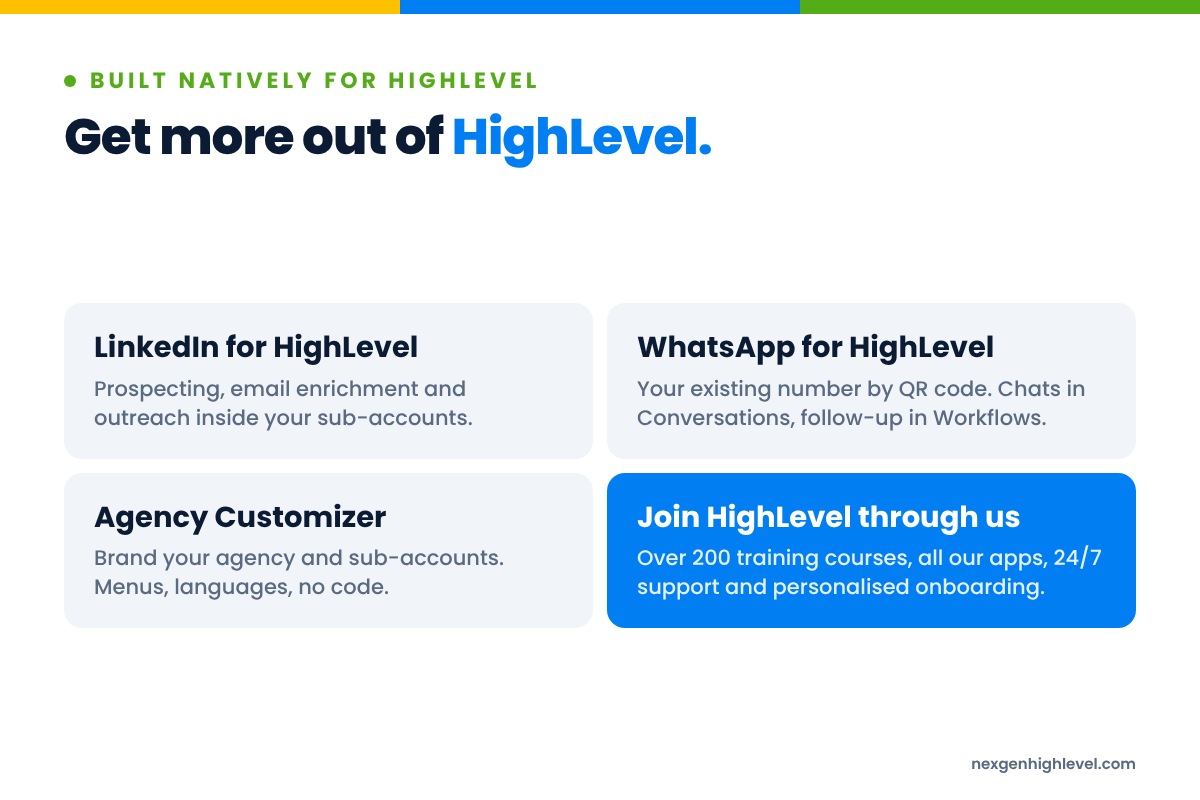
That's why we built NexGenHighLevel. Every app is built as part of HighLevel, using what's already there: Workflows, Contacts, Tags, Conversations. No API to wire up. No Zapier, Make or n8n in the middle.
We made our apps a part of HighLevel, rather than a complement to HighLevel. Here are the ones I'd point a HubSpot user to first.
LinkedIn for HighLevel
LinkedIn for HighLevel was the first app we built, for a client who needed it. It brings LinkedIn prospecting into your HighLevel sub-account: find the people you want to reach, enrich their email, import them and run outreach on LinkedIn and email, then nurture them with HighLevel workflows.
Email enrichment was the game changer, because it meant people could build reliable data for cold email as well as LinkedIn. For the first clients who used it, outreach went up, and so did leads, sales, revenue and profit.
Agencies can white-label and resell it. I've written more about LinkedIn prospecting inside HighLevel.
WhatsApp for HighLevel
WhatsApp for HighLevel connects your existing WhatsApp or WhatsApp Business number by QR code. Chats land in HighLevel Conversations, and your Workflows can send messages and follow up.
No Meta API approval to wait for. There's a standard version and an agency white-label version, and both install from the HighLevel App Marketplace.
For a lot of small businesses, WhatsApp is where their customers already are. It belongs in the same system as the pipeline and the calendar.
HighLevel Agency Customizer
For agency owners, the HighLevel Agency Customizer lets you customise your agency and your clients' sub-accounts, including branding, menus and languages, without writing code.
This is where white-label stops being "a logo swap" and starts feeling like your own product.
Custom Value Forms
Custom Value Forms is for agencies too. You send clients a branded form, and their answers save straight into Custom Values in their sub-account. No Zapier, Make or webhooks.
If you've ever spent a week chasing a client for their business hours, service areas and logo, you'll know why we built it.
You can see everything we've built on our Apps for HighLevel page.
Technology should earn its place in somebody's business. That's the test every one of these has to pass.
Why Snapshots make starting on HighLevel so much easier
Let's talk about the hardest part of any new platform. The blank screen.
You've signed up, logged in, and now you're supposed to build funnels, forms, pipelines, calendars, workflows, emails, texts and AI agents, all connected around how your customers buy.
That's where people get stuck. The Tinkerer gets lost in the settings. The Rusher launches half a system.
A Snapshot changes that.
A business system in a box
A NexGenHighLevel Snapshot is a complete, fully built-out business system for a niche, loaded into your HighLevel account. Funnels, forms, workflows, pipelines, calendars, emails and texts, and AI features, all connected around the whole client journey, from first enquiry to paying customer and beyond.
It's not a starter pack.
And not all Snapshots are equal. A typical Snapshot might be a couple of funnels, a few workflows and one pipeline, and you build the rest yourself. Ours are built out across the whole journey, because that's how I used to deliver for agency clients.
I've written more about this in the HighLevel Snapshot as a business in a box.
For the business owner and the agency
Our Snapshots are for both. The niche business owner who wants to run their own marketing, and the agency serving that niche.
If you run a heating and cooling business, the HVAC Snapshot is built around how HVAC customers enquire, book and come back. If you run an agency, the SMMA Snapshot for social media marketing agencies is the system for running the agency itself. We also have Snapshots for credit repair and landscaping, with more niches being built. You'll find them all on our HighLevel Snapshots page.
Clients have used Snapshots to skip months, if not years, of trial and error building a system.
That's the real HighLevel vs HubSpot difference for someone just getting started. On HubSpot you pick hubs, pick tiers, then configure. On HighLevel you can load a whole working system and start from there. And when you start your HighLevel account with us, a free Snapshot comes with it.
You don't need more software. You need a system that's already built.
HighLevel's growth vs HubSpot over the last five years
Let's look at the numbers. Only published figures, with their sources.
HubSpot is a public company, so it publishes its revenue every quarter. HighLevel is private and doesn't publish its own revenue, so I won't guess at it. What it does publish is customer milestones and independently ranked growth rates.
HubSpot: big and still growing
| Year | HubSpot revenue | HubSpot customers |
|---|---|---|
| 2020 | $883.0 million | 103,994 |
| 2021 | $1.30 billion | 135,442 |
| 2022 | $1.731 billion | 167,386 |
| 2023 | $2.17 billion | 205,091 |
| 2024 | $2.63 billion | 247,939 |
| 2025 | $3.13 billion | 288,706 |
HubSpot's revenue went from 883.0 million in 2020 to 3.13 billion in 2025, roughly three and a half times, and by mid-2026 it reported 306,446 customers. That's a strong, healthy business. By revenue, HubSpot is far bigger than HighLevel.
HighLevel: the momentum
| Year | HighLevel milestone (published) |
|---|---|
| 2020 | 5,000+ customers |
| 2021 | 10,000+ customers; over 15,000 agencies representing over 300,000 small businesses at the November 2021 investment |
| 2022 | Surpassed 20,000 customers |
| 2023 | Exceeded 60,000 customers |
| 2024 | "More than 5x" growth over the prior three years, while profitable |
| 2025 | About 110,000 customers and over 2 million businesses using HighLevel (October 2025) |
HighLevel went from 10,000+ customers in 2021 to about 110,000 in October 2025. That's around eleven times. HubSpot went from 135,442 customers to 288,706 over a similar stretch, a little over twice. The two companies don't define "customer" the same way, and many HighLevel customers are agencies running lots of businesses each, so treat that as a signal of momentum, not a like-for-like count.
The cleanest like-for-like comparison is revenue growth over the same three years.
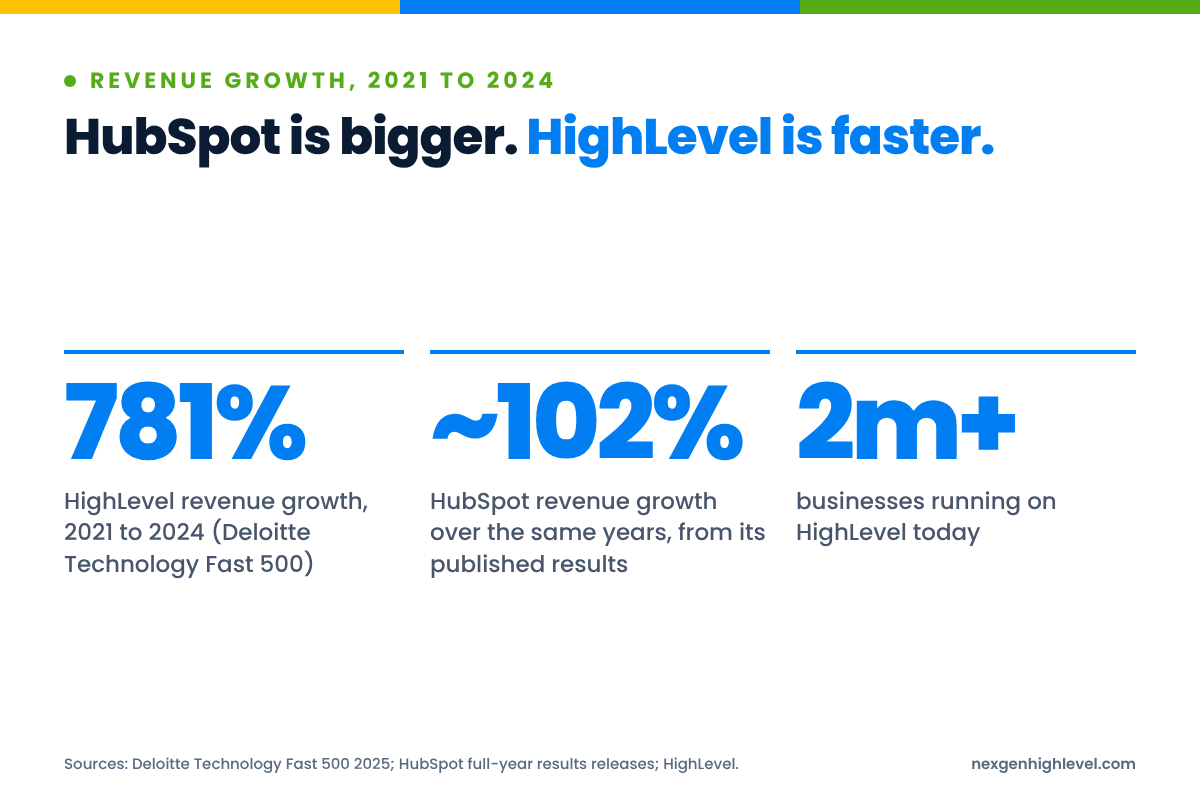
HighLevel ranked on the Deloitte Technology Fast 500 with revenue growth of 781% from 2021 to 2024. Over the same years, HubSpot's revenue went from 1.30 billion to 2.63 billion, which is growth of about 102%. Simple arithmetic: 2.63 divided by 1.30 is just over 2.
HighLevel also made the Inc. 5000 for the third year in a row in 2025.
So here's how I read it. HubSpot is the bigger company and it's still growing well. HighLevel is the smaller one, growing much faster, and focused on one market: agencies and the small businesses they serve.
Size tells you where a company has been. Momentum and focus tell you where it's going.
Who should choose HubSpot, and who should choose HighLevel
I'll keep this short and fair.
HubSpot may suit you if:
- You're a larger business with separate marketing, sales and service teams.
- You want to buy deep, specialist hubs and you're comfortable paying per seat as the team grows.
- You have, or will pay for, the people to configure and run it.
- You're an agency whose business model is implementing HubSpot for clients and earning partner commission.
HighLevel will suit you better if:
- You're a small or medium business that wants CRM, funnels, booking, SMS, WhatsApp, reviews, payments and AI in one place.
- You want a flat platform price with unlimited users, not a bill that grows with every hire.
- You want to start with a fully built Snapshot rather than a blank account.
- You're an agency that wants to white-label the platform, run it under your own brand, set your own pricing and own the client relationship.
For most of the small businesses and agencies I talk to, that second list is them.
Switching from HubSpot to HighLevel
Switching sounds scary. In practice it's four clear steps. Walk before you run.
1. Export your contacts and data
Export your contacts, companies and deals from HubSpot, import them into HighLevel and map the fields. Take the chance to tidy up.
2. Load a Snapshot or rebuild
You can rebuild your pipelines, forms, emails and workflows by hand. Or you can load a Snapshot built for your niche and adjust it. A Snapshot is the fastest way I know to stand up a working HighLevel account.
Snapshots carry configuration, not live data. Contacts, conversations and integrations don't transfer in a Snapshot, which is why step 1 matters.
3. Connect your phone, email and channels
Connect your email sending domain, phone numbers, calendars and social accounts. Add WhatsApp if your customers use it.
4. Run both for a short overlap
Don't flip the switch on a Friday afternoon. Run both side by side for a short period. Check forms submit, workflows fire and reminders go out. Then switch off the old one.
Getting HighLevel through NexGenHighLevel
If you're making the move, you can get HighLevel through NexGenHighLevel. Here's what you get when you sign up to HighLevel under our agency:
- Over 200 HighLevel training courses.
- Access to all our Apps for HighLevel, including our live apps and future releases.
- 24/7 support and personalised, one-to-one onboarding.
- A full HighLevel sub-account under our agency, plus a free Snapshot from NexGenHighLevel.
No tricks. Just a better start than staring at an empty account on your own.
If you're also weighing up other platforms, I've compared HighLevel vs Salesforce and HighLevel vs Zoho too.
Frequently asked questions
Is HighLevel better than HubSpot?
For most small and medium businesses and for agencies, I believe it is. HighLevel puts CRM, funnels, calendars, SMS, WhatsApp, reviews, payments and AI in one platform, at a flat price with unlimited users, and lets agencies white-label it. HubSpot is a bigger company with deep, specialist hubs that suit larger teams. The right answer depends on who you are, but for SMBs and agencies, HighLevel fits better.
Is GoHighLevel cheaper than HubSpot?
The pricing models are different, so check both official pricing pages for current figures. GoHighLevel charges a flat agency price with unlimited users, plus usage-based phone, email and AI, and some optional add-ons. HubSpot charges per hub and per seat, across Free, Starter, Professional and Enterprise tiers, with onboarding fees on higher tiers. As your team grows, a flat model is usually easier to plan around.
Can I migrate from HubSpot to HighLevel?
Yes. Export your contacts, companies and deals from HubSpot and import them into HighLevel. Then rebuild your pipelines, forms and workflows, or load a Snapshot built for your niche and adjust it. Connect your email domain, phone numbers and channels, and run both platforms side by side for a short overlap before switching over. Getting a Snapshot in place first saves the most time.
Does HubSpot have white-label?
We found no option on HubSpot's official pages to white-label the HubSpot CRM as your own software. HubSpot's Solutions Partner Program is a commission-based model, where agencies refer and implement for clients who become HubSpot customers. HighLevel, by contrast, lets agencies remove HighLevel's branding, use their own domains, publish a white-label mobile app and resell the platform under their own brand with SaaS mode.
What is a HighLevel Snapshot?
A Snapshot is a packaged copy of a HighLevel sub-account's setup: workflows, pipelines, funnels, forms, calendars, email and text templates, AI agents and more. You load it into another sub-account in one go. A NexGenHighLevel Snapshot is a complete, built-out business system for a niche, connected around the whole client journey. If you start your HighLevel account with us, you get a free Snapshot.
Is HighLevel a good HubSpot alternative for agencies?
Yes, if you want to own the platform rather than refer clients to someone else's. GoHighLevel lets agencies host unlimited client sub-accounts on the Unlimited plan, white-label everything, set their own prices in SaaS mode, rebill usage and resell marketplace apps with their own markup. That makes it a very different business model from earning a partner commission.
Build on the platform that's built for you
HubSpot is a great company. Bigger than HighLevel, and it will probably stay that way for a while.
But you're not choosing a share price. You're choosing the system you'll run your business on every single day.
So ask yourself the HubSpot vs HighLevel question the simple way. Who was it built for? How does it charge as I grow? How fast can I get a working system live? And can I put my own name on it?
For small businesses and agencies, those answers point to HighLevel. One platform. Flat pricing. Snapshots that load a whole system. An App Marketplace built so agencies can resell. And a white-label model that lets you own the client relationship.
If you're ready, start your HighLevel account with us, or read a bit more about who we are at NexGenHighLevel first.
Don't pick the biggest platform. Pick the one built for the business you're actually building.