Salesforce is the name everyone knows. When people ask me about HighLevel vs Salesforce, they usually say it the same way: "Salesforce is the serious one, isn't it?"
And it is serious. It's one of the biggest software companies in the world, with an app ecosystem bigger than anyone else's in this space. I'm not going to pretend otherwise.
But here's the question I always come back to. Serious for who?
If you're a global enterprise with a team of admins, developers and consultants, Salesforce was built for you. If you're a small business owner, or an agency running marketing for twenty clients, I think the picture looks very different.
You don't need the biggest platform. You need the one you'll actually use, set up properly, every day.
That's where HighLevel comes in. One platform for the CRM, the funnels, the follow-up, the calendars, the reviews and the AI. Built for small businesses and the agencies that serve them. And with Snapshots, you can load a complete business system into an account instead of starting from a blank screen.
It's not about which platform is bigger. It's about which one fits the business you actually run.
HighLevel vs Salesforce at a glance
Before the detail, here's the side-by-side. Everything on the Salesforce side comes from Salesforce's own pages and filings, linked further down.
| HighLevel | Salesforce | |
|---|---|---|
| Who it's built for | Agencies, entrepreneurs and small and medium businesses; agencies run one sub-account per client | "Organizations of any size", with a heavy enterprise focus and a separate Starter Suite for small businesses |
| CRM and pipelines | CRM, sales pipelines, lead scoring, smart lists, custom objects | Lead routing and case tracking in Starter; quoting and forecasting added in Pro Suite |
| Email, SMS and phone | Email, SMS, WhatsApp, Messenger, Instagram DM and live chat in one Conversations inbox; call tracking, missed call text-back, ringless voicemail | Starter includes a monthly allowance of marketing emails; the Starter page doesn't mention SMS or calling |
| Funnels, websites and forms | Websites, funnels, landing pages, webinar funnels, forms, surveys, quizzes | Lead-capture forms and a storefront with checkout in Starter |
| Calendars and booking | Calendars, appointment reminders, paid calendars | Not mentioned on the Starter Suite page |
| AI | Conversation AI, Voice AI, Content AI, Reviews AI, AI Studio, AI Employee | Agentforce and AI agents, with 1,000+ agents and tools in AgentExchange |
| App marketplace | HighLevel App Marketplace, 1,500+ apps that install natively | AgentExchange (formerly AppExchange), over 9,000 vetted apps |
| Whole-account templates | Snapshots: load a complete account setup into a sub-account | Managed packages, built by developers and security reviewed; sandboxes copy your own org for testing |
| White-label and reselling | White-label the platform under your brand and domain; SaaS mode to sell it as your own software | OEM licences let software vendors embed the platform, but they exclude CRM functions such as leads and opportunities |
| Pricing model | Flat agency subscription, unlimited users | Per user, per month; Pro Suite billed annually with a contract |
That last row matters more than people think. I'll come back to it.
Where Salesforce is genuinely strong
Let me give Salesforce its due, because it deserves it.
Salesforce was founded in 1999 and, as of January 2026, had 83,334 employees. It's a public company that reported revenue of $41.5 billion for its fiscal year 2026, according to its Q4 FY26 results. That's a staggering business by any measure.
Its ecosystem is bigger than HighLevel's. Full stop. The Salesforce partners page talks about "the full ecosystem of over 9,000 vetted apps". In April 2026 the AppExchange was renamed AgentExchange, bringing together the AppExchange, the Slack Marketplace and the Agentforce ecosystem, with more than 1,000 agents, sub-agents, tools and MCP servers.
Developers can build serious things on Salesforce. Software vendors package their apps as second-generation managed packages, put them through security review and sell them on the marketplace.
And Salesforce hasn't ignored small businesses. Its Starter Suite is described as "a turnkey CRM that brings sales, service, marketing, commerce, and Slack together into one application."
So who does Salesforce suit? Large organisations with complex sales processes, lots of departments, internal admins or a budget for consultants, and a need to customise almost everything. If that's you, it's a strong choice. I'd never tell you otherwise.
But most of the people I talk to aren't that business.
Why I think HighLevel fits SMBs and agencies better
This is my view, not a law of physics. But it comes from years of building marketing systems for small businesses and watching what they actually use.
Salesforce describes its own model plainly. Its 10-K says it relies on "global consulting firms, system integrators and other partners". Its partners page is built around "consulting and implementation partners" and software vendors.
That's not a criticism. When you're serving the world's largest companies, implementation partners make total sense.
But for a dental practice, an HVAC company or a five-person agency, I think it's the wrong starting point. In my experience, small businesses don't want an implementation project. They want leads coming in, followed up quickly, booked in, and turned into revenue.
One platform for the whole customer journey
HighLevel's own homepage groups its features around the journey: Capture, Nurture, Close, Evangelize, Reactivate. The feature list covers:
- CRM, sales pipelines, workflows and automations
- A single Conversations inbox for SMS, Messenger, Instagram DM, WhatsApp and live chat
- Websites, funnels, landing pages, forms, surveys and quizzes
- Calendars, appointment reminders and paid calendars
- Reputation management, automated review requests and AI review replies
- Courses, memberships and communities
- Social planner, ad manager, invoicing, text-to-pay and an affiliate manager
- Voice AI and Conversation AI
That's the whole system my agency used to stitch together for clients. In one place.
Compare that with Salesforce's Starter Suite. It includes email sends, lead routing, case tracking, lead-capture forms and a storefront. The Starter page doesn't mention landing pages, SMS, calling or booking.
I'm not saying Salesforce as a whole can't do those things. It's a huge company with a lot of products. I'm saying that, for the small business package, I couldn't find them on the page. And for a small business, that's the package that matters.
Pricing model, not just price
I won't quote prices here. They change, and HighLevel has rules about advertised pricing anyway. But the model is worth understanding.
Salesforce's small business pricing is per user, per month. Pro Suite is billed annually and needs a contract. Marketing email sends are an add-on.
HighLevel is a flat agency subscription with unlimited users and unlimited contacts. Usage like phone, email and AI is charged separately.
Why does that matter? Because per-seat pricing quietly punishes growth. Every new salesperson, every new receptionist, every VA you bring in costs you another seat. With a flat model, adding people to the account doesn't change the subscription.
For an agency, it's an even bigger deal. You're not paying per user per client. You're paying for the platform, and the sub-accounts sit underneath it.
Complexity isn't the same as sophistication
One thing I believe strongly: people confuse complexity with sophistication.
A system with forty custom objects and nine layers of automation looks impressive. But does it make any money? Does it get the phone answered? Does it follow up a lead in five minutes instead of three days?
For most small businesses I talk to, the answer to "how much CRM do I need?" is "enough to run the whole customer journey well, and not one bit more." HighLevel gives you that power without needing a consultant to switch it on.
Simple isn't amateur. Simple is often what you arrive at once you really understand something.
Building on HighLevel vs building on Salesforce
Here's where it gets interesting. Both platforms are things you can build on. Both have marketplaces. Both let third parties sell what they've built. So what's the difference?
The HighLevel App Marketplace
The HighLevel App Marketplace lists 1,500+ apps for CRM, marketing automation and business workflows.
Developers register, create an app and publish it when ready, following HighLevel's App Review Guidelines. Apps install natively into an agency or sub-account. HighLevel handles the billing, collects payment and pays developers monthly, and says it currently takes no commission.
Then there's the bit agencies love. Agencies can resell marketplace apps to their sub-accounts with their own markup, for apps that use HighLevel's payment collection. The base price is hidden from the client. Marketplace apps are also reviewed for white-label compatibility.
So an app isn't just a tool for the agency. It can become part of what the agency sells.
HighLevel Snapshots
Snapshots are the thing I wish every platform had.
HighLevel defines them as "reusable templates that capture selected configuration assets from a HighLevel sub-account" so they can be copied into other sub-accounts. And the list of what can go in is long: workflows, triggers, pipelines, calendars, custom fields and values, funnels and websites, forms, surveys, email and text templates, Conversation AI, Voice AI agents, dashboards, membership products, review settings, WhatsApp templates and more.
When you load one, you choose which assets to import, review any conflicts and decide whether to override or skip. You can even create a brand new sub-account straight from a Snapshot.
Third parties can sell Snapshots on the App Marketplace to other agencies, with one-time, monthly or yearly pricing. Buyers push the Snapshot straight to their accounts from the HighLevel dashboard.
What Salesforce offers on both points
On apps, Salesforce wins on size. Over 9,000 vetted apps versus 1,500+. I've said it once and I'll say it again: AgentExchange is the bigger ecosystem.
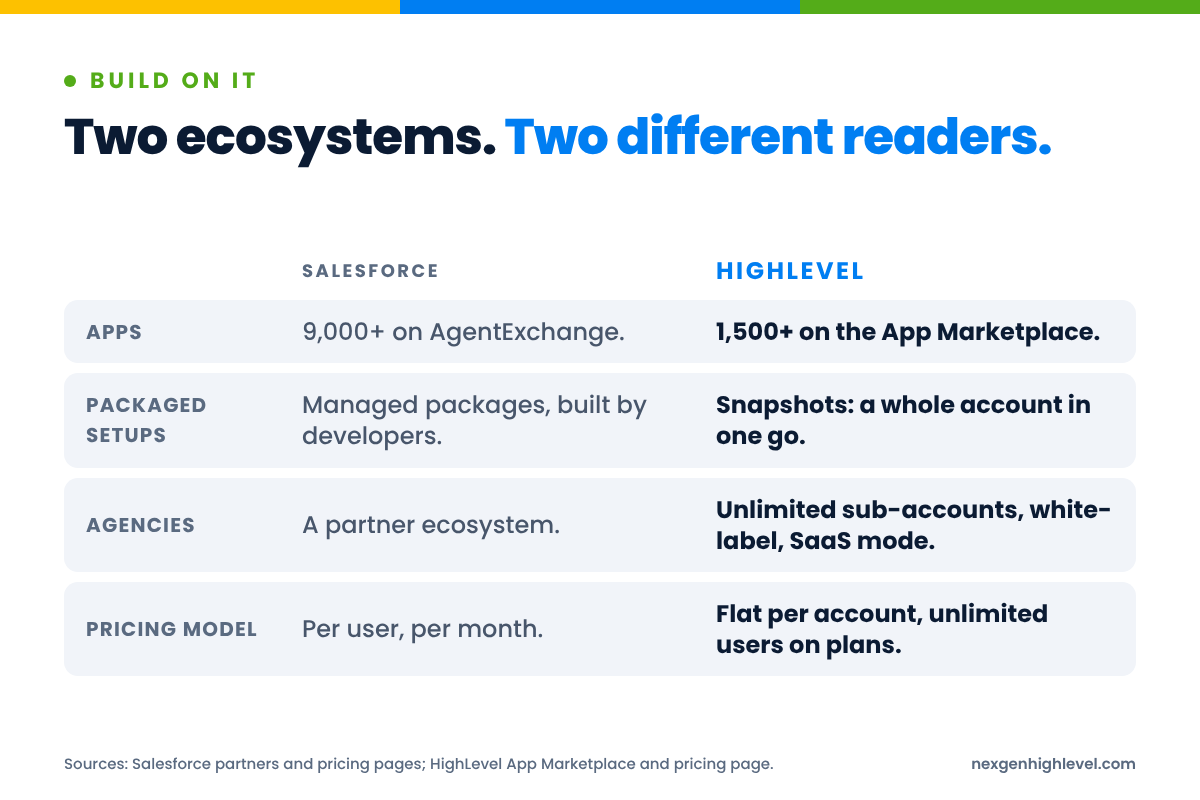
On packaged setups, Salesforce's closest equivalent is the managed package. A package "can include many different metadata components", and partners submit them for security review before listing. It's powerful. It's also a developer-led process.
Salesforce also has sandboxes, which copy your production org's metadata into a test org. Useful, but that's a copy of your own setup for testing, not a product you load into somebody else's account.
Why HighLevel's version is stronger for this reader
Bigger isn't the same as better for you. Here's why I think HighLevel's model wins for small businesses and agencies:
- A Snapshot is point-and-click. An agency or business owner can load a complete account setup themselves. No developer, no security review, no implementation partner.
- A Snapshot covers the whole journey. Funnels, forms, workflows, pipelines, calendars, messages and AI, all connected. Not one app or one component at a time.
- Apps install natively. Marketplace apps plug into HighLevel's own Workflows, Contacts and Conversations.
- Agencies can resell. Apps can be resold to sub-accounts with a markup, and Snapshots can be attached to SaaS plans. The ecosystem becomes part of the agency's offer.
Salesforce's ecosystem is built for enterprises to extend Salesforce. HighLevel's ecosystem is built for agencies and small businesses to get running and deliver results.
It's not about having the most apps. It's about having the right ones, installed in minutes, working with everything else.
How our apps help you get more out of HighLevel
This is where we come in.
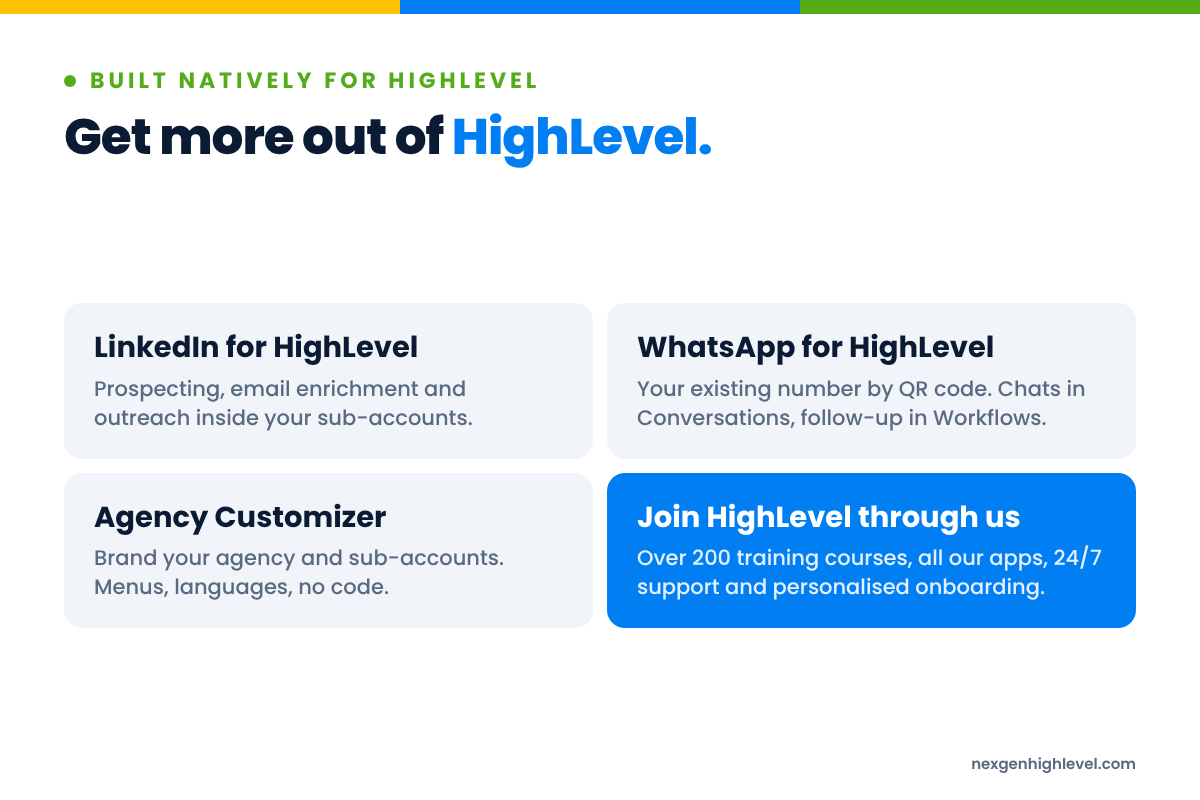
When I found HighLevel in 2020, it opened my eyes to marketing automation. But HighLevel's line was "Capture, Nurture, Close". I kept asking: where's the prospecting? Where's the outreach? Where's the market creation?
Nobody was filling that gap. So we started building.
Every app we build is designed as though it were already built into HighLevel. It uses what's already there: Workflows, Contacts, Tags and Conversations. No API work, no Make, n8n or Zapier needed. We made our apps a part of HighLevel, rather than a complement to HighLevel.
Here are the three I'd point to if you're coming from a sales-led platform like Salesforce. You can see the full list on our Apps for HighLevel page.
LinkedIn for HighLevel
Salesforce people tend to be sales people. And sales people live on LinkedIn.
LinkedIn for HighLevel brings LinkedIn prospecting into your HighLevel sub-accounts. You can find your ideal customers, enrich their email addresses, import them as contacts and run outreach, all inside HighLevel. Agencies can white-label it and resell it to clients.
This was the first app we ever built, for one client who needed it. The other LinkedIn tools all offered the same basic outreach and none of them sat inside HighLevel. Adding email enrichment meant users could reach the same person on LinkedIn and by email, then nurture them in HighLevel. For those first clients, outreach went up, and so did leads, sales, revenue and profit.
If you want the detail, I've written about LinkedIn prospecting in HighLevel.
WhatsApp for HighLevel
A lot of your customers would rather send a WhatsApp than fill in a form.
WhatsApp for HighLevel connects an existing WhatsApp or WhatsApp Business number by QR code. Chats land in HighLevel Conversations alongside SMS and email, and Workflows can send messages and follow up automatically. There's no Meta API approval to wait for.
There's a standard version and an agency white-label version. Both install from the HighLevel App Marketplace.
HighLevel Agency Customizer
If you're an agency, your clients should feel like they're logging into your platform, not someone else's.
The HighLevel Agency Customizer lets agency owners customise their agency and sub-accounts, including branding, menus and languages, without touching code.
Snapshots: the fastest way to get started on HighLevel
I want to spend a bit of time on this, because it's the biggest single reason I think small businesses should look at HighLevel as a Salesforce alternative.
The hardest part of any new platform isn't learning the buttons. It's building the system. What happens when a lead comes in? Who gets notified? What's the first message? What happens if they don't reply? How do you get the review after the job's done?
Most people start from a blank screen and try to work all of that out themselves. Months later, they're still tinkering.
What a NexGenHighLevel Snapshot actually is
A NexGenHighLevel Snapshot is a complete, fully built-out business system in a box for a specific niche, loaded straight into a HighLevel account.
Funnels. Forms. Workflows. Pipelines. Calendars. Emails and texts. AI features. All connected around the whole client journey, from the first enquiry to the paying customer and beyond.
It's not a starter pack. And honestly, not all Snapshots are equal. A typical Snapshot on the market might be a couple of funnels, a few workflows and one pipeline. That's a head start. It isn't a system.
I've written more about the idea in a HighLevel Snapshot as a business in a box.
Built for the business owner and the agency
Every one of our Snapshots works for two people: the business owner in that niche who wants to run it themselves, and the agency that serves that niche.
Here are the ones that are live today:
- Social Media Marketing Agency (SMMA) Snapshot, built for agencies to run their own business
- Credit Repair Snapshot
- HVAC Snapshot
- Landscaping and Lawn Care Snapshot
More niches are being built. You can see them all on our HighLevel Snapshots page.
Why this matters against Salesforce
Think about what getting started looks like on each side.
On Salesforce, getting a CRM shaped to your business often means configuration work, sometimes with an implementation partner. On HighLevel, an HVAC company can load a complete HVAC system into its account and start from something that already works.
Clients have used Snapshots to skip months, if not years, of trial and error building a system.
That's the real power. Not more features. Less time getting to the point where the features earn their keep.
HighLevel's growth vs Salesforce over the last five years
Let me be straight about the numbers first. Salesforce is far bigger than HighLevel. Not a bit bigger. Hugely bigger.
The two companies also publish different things. Salesforce is public and publishes its revenue, but doesn't publish a total customer count. HighLevel is private and doesn't publish its revenue, but does publish customer milestones and its revenue growth rates through independent rankings. So it's not a perfect like-for-like comparison. Here's what's on the record.
Salesforce revenue (fiscal years end 31 January)
| Fiscal year | Total revenue | Source |
|---|---|---|
| FY21 | $21.25 billion | Q4 FY22 release |
| FY22 | $26.49 billion | Q4 FY22 release |
| FY24 | $34.86 billion | Q4 FY24 release |
| FY25 | $37.9 billion | FY25 results |
| FY26 | $41.5 billion | Q4 FY26 release |
From FY21 to FY26, Salesforce's revenue went from 21.25 billion to 41.5 billion. That's almost double in five years, and FY26 includes a 399 million contribution from its Informatica acquisition. Growth has settled at around 9 to 11% a year recently. For a company that size, that's impressive.
HighLevel's published milestones
| Year | Milestone | Source |
|---|---|---|
| 2020 | 5,000+ customers | HighLevel about page |
| 2021 | 10,000+ customers | HighLevel about page |
| 2022 | 20,000+ customers | HighLevel about page |
| 2023 | 60,000+ customers | HighLevel about page |
| Oct 2025 | About 110,000 customers; over 2 million businesses use HighLevel | Dallas Innovates |
On those published figures, HighLevel went from 10,000+ customers in 2021 to about 110,000 in October 2025.
Comparing growth rates
The fairest comparison I can make is revenue growth over the same window.
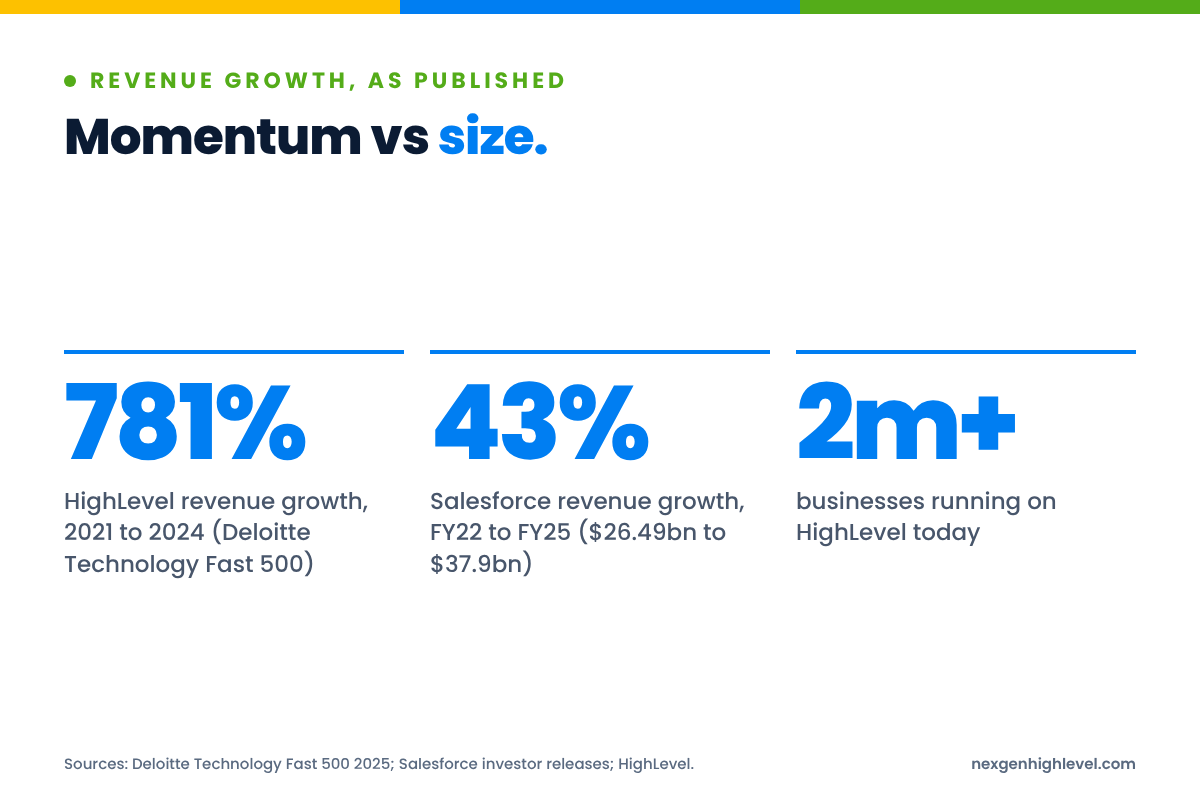
- HighLevel's revenue grew 781% from 2021 to 2024, according to the 2025 Deloitte Technology Fast 500, where it ranked No. 116 in North America.
- Salesforce's revenue went from 26.49 billion in FY22 to 37.9 billion in FY25. That's growth of about 43% over roughly the same three years.
Earlier Deloitte rankings tell the same story. HighLevel was No. 47 in 2023, with revenue growth of 3,362% from 2019 to 2022. When General Atlantic invested in April 2024, HighLevel said it had grown more than 5x over the previous three years while staying profitable. And in 2025 it ranked No. 516 on the Inc. 5000, its third year in a row on the list.
Now, a fair point. It's much easier to grow fast from a smaller base. I'm not pretending 781% means HighLevel is "beating" a company with 41.5 billion in revenue.
What it does show is momentum and focus. Salesforce is growing steadily by serving enterprises everywhere. HighLevel is growing fast by serving one group really well: agencies and the small businesses they work with. That focus is exactly why its product looks the way it does.
Who should choose Salesforce, and who should choose HighLevel
Here's my honest take on Salesforce vs HighLevel.
Choose Salesforce if
- You're a large organisation with complex, multi-department sales and service processes
- You have internal admins and developers, or a budget for implementation partners
- You need the very widest app ecosystem and deep, custom builds on top of your CRM
- Your business runs on Slack and you want everything tied into that world
Choose HighLevel if
- You're a small or medium business that wants the whole customer journey in one platform
- You want to talk to leads by SMS, WhatsApp, email, chat and phone from one inbox
- You'd rather load a complete, proven system with a Snapshot than build from scratch
- You don't want your costs rising every time you add a person to the team
- You're an agency that wants to white-label the platform, run clients in sub-accounts and resell it as your own software
For most of the businesses and agencies I talk to, that second list is them. That's why I think HighLevel is the better Salesforce alternative for SMBs and agencies.
If you're also weighing up another big name, I've compared HighLevel vs HubSpot too.
A word for agencies
This is where the gap is widest, in my view.
HighLevel was built for agencies. Its developer docs say it plainly: "Agencies subscribe to HighLevel's platform at the agency level", each agency hosts sub-accounts (often one per client), and agencies "white-label the platform under their own branding and custom domains." With SaaS mode, agencies build their own plans, set their own pricing and attach Snapshots. They can also rebill phone, email and AI usage to clients.
Salesforce has an OEM route, but it's a different thing. ISV and OEM partners can resell a restricted platform licence bundled with their own app, and those licences exclude CRM functions such as leads, opportunities, cases and campaigns. I couldn't find a programme to rebrand Sales Cloud as an agency's own CRM.
So in the GoHighLevel vs Salesforce question for agencies, it's not close. One was designed for you to resell. The other wasn't.
Switching from Salesforce to HighLevel
Moving platforms sounds scary. It doesn't need to be, if you walk before you run.
Here's what it looks like in practice:
- Get clear on what you actually use. List the pipelines, automations, forms and reports your team relies on every week. You'll probably find a lot of things you pay for and never touch.
- Export your contacts and deals. Pull your contacts, companies and open opportunities out of Salesforce as files and import them into HighLevel. Snapshots don't move customer records, so this step is always separate.
- Stand up the new account. You can rebuild your setup by hand, or load a Snapshot. A Snapshot is the fastest way, because the funnels, workflows, pipelines and calendars are already built and connected. Then you adjust it to your business.
- Connect your channels. Set up your phone numbers, email sending domain, calendars and messaging. If WhatsApp matters to you, WhatsApp for HighLevel connects your existing number by QR code.
- Run both for a short overlap. Keep Salesforce live for a few weeks while new leads flow into HighLevel. Check every automation fires the way you expect. Then switch off the old system.
The easiest way to do all of this is to get HighLevel through NexGenHighLevel, so you're not doing it alone.
What you get when you sign up with us
When you sign up to HighLevel under the NexGenHighLevel agency, you get:
- A full HighLevel sub-account under our agency
- A free Snapshot from NexGenHighLevel
- Access to all our Apps for HighLevel, including the live ones and future releases
- Over 200 HighLevel training courses
- 24/7 support and personalised, one-to-one onboarding
That onboarding matters. The biggest risk in any switch isn't the technology. It's getting stuck halfway and going back to what you know.
If you're ready, you can start your HighLevel account with us.
Frequently asked questions
Is HighLevel better than Salesforce?
For small and medium businesses and agencies, I think it is. HighLevel puts the CRM, funnels, calendars, reviews, messaging and AI in one platform, with a flat pricing model and Snapshots to get set up quickly. Salesforce is the better fit for large enterprises with complex processes, internal admins and the budget for implementation partners. It depends on the business you run.
Can I migrate from Salesforce to HighLevel?
Yes. Export your contacts, companies and open deals from Salesforce and import them into HighLevel. Then rebuild your setup or load a Snapshot, which gives you funnels, workflows, pipelines and calendars already built. Connect your phone, email and calendars, and run both systems for a short overlap until you're confident everything works.
Is GoHighLevel cheaper than Salesforce?
The pricing models are very different. Salesforce's small business suites are priced per user, per month, and Pro Suite is billed annually with a contract. GoHighLevel is a flat agency subscription with unlimited users and contacts, with usage like phone, email and AI charged separately. For growing teams and agencies, a flat model usually makes costs easier to predict.
Does Salesforce have white-label for agencies?
Not in the way HighLevel does, as far as I could find. Salesforce lets software vendors embed its platform in their own app under OEM licences, but those licences exclude CRM functions such as leads and opportunities. HighLevel lets agencies white-label the whole platform under their own brand and domain, and resell it with SaaS mode.
What is a HighLevel Snapshot?
A Snapshot is a reusable template that captures an account's setup, such as funnels, forms, workflows, pipelines, calendars, templates and AI settings, so it can be loaded into another HighLevel sub-account. A NexGenHighLevel Snapshot goes further: a complete business system for a niche. You get a free one when you sign up to HighLevel through us.
Does Salesforce have more apps than HighLevel?
Yes. Salesforce says its ecosystem has over 9,000 vetted apps, and its marketplace is now called AgentExchange. The HighLevel App Marketplace lists 1,500+ apps. HighLevel's apps install natively into sub-accounts, and agencies can resell many of them to clients with their own markup.
Final thoughts on HighLevel vs Salesforce
Salesforce is a remarkable company. Bigger ecosystem, bigger revenue, bigger everything. If you're an enterprise, it's earned its place.
But most businesses don't have a technology problem. They have a thinking problem. They don't need the biggest platform. They need a system that captures the lead, follows it up, books it in, closes it and asks for the review. Every time.
That's what HighLevel does. And with the right Snapshot and the right apps, you're not starting from scratch. You're starting from something that works.
If that sounds like your business, get HighLevel through NexGenHighLevel and we'll help you set it up properly.
Power is only useful if you can actually use it.