HighLevel vs Zoho is one of those comparisons that looks simple on paper. Both cover CRM, email, landing pages, booking, calling and AI. Both have a marketplace. Both have been around long enough to be taken seriously.
But they're built on two very different ideas.
Zoho is a suite. Dozens of separate apps, each with its own name, its own screens and its own settings, bundled together in Zoho One.
HighLevel is one platform. One login, one contact record, one set of workflows, with every channel feeding the same conversation.
That difference sounds small until you're the one running the business. Or the agency running fifty of them.
I've spent years building marketing systems for clients, and the question I always come back to is this. Do you want lots of tools that talk to each other, or one system that's already talking to itself?
Let's look at it properly. Fairly. And then I'll tell you where I land.
HighLevel vs Zoho at a glance
Here's the side-by-side. Every line about Zoho comes from Zoho's own pages, checked in October 2026.
| HighLevel | Zoho (Zoho CRM and Zoho One) | |
|---|---|---|
| Who it's for | Agencies, entrepreneurs and small businesses; agencies host clients in sub-accounts | Businesses of all sizes; Zoho CRM says it's "trusted by 300K+ businesses worldwide" |
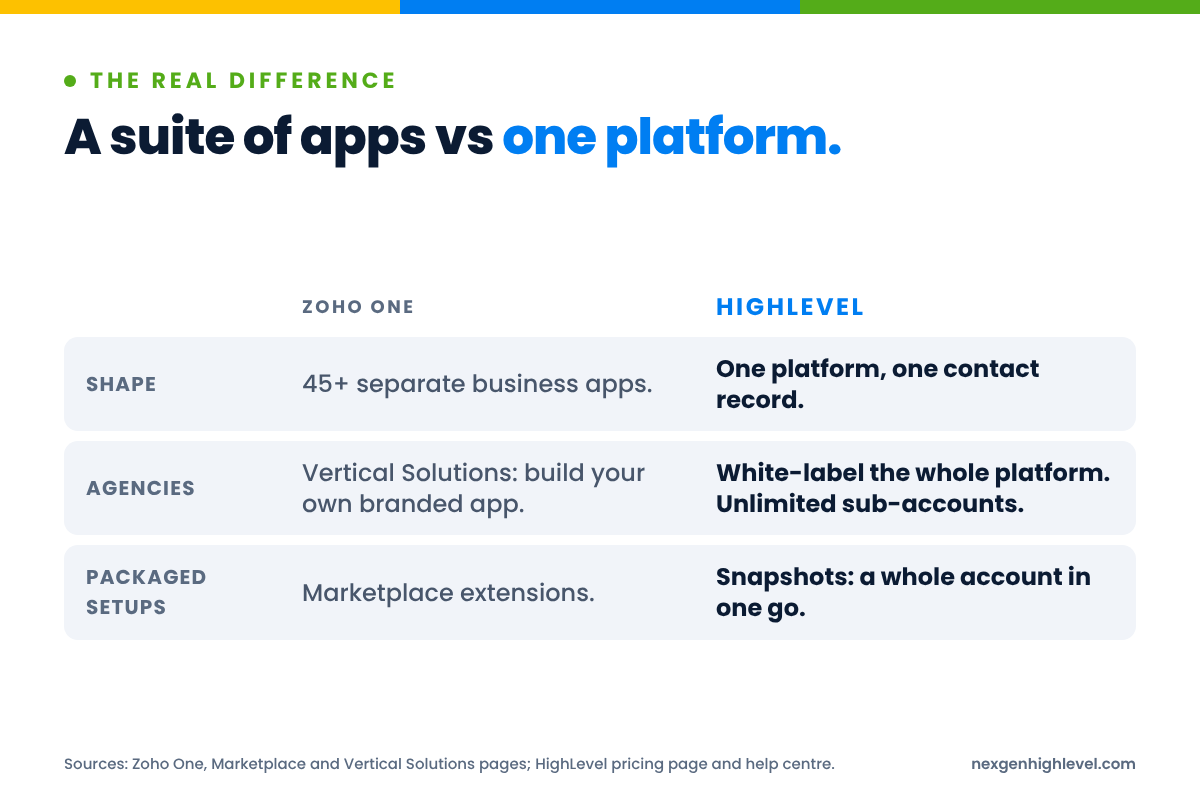
| How it's built | One platform: CRM, marketing, sales and AI in one account (HighLevel) | A suite: Zoho One bundles "45+ apps" |
| CRM and pipelines | CRM, sales pipelines, lead scoring, smart lists | Zoho CRM, included in Zoho One |
| Email, SMS and phone | One conversation stream for SMS, Messenger, Instagram DM, WhatsApp and live chat; email and SMS broadcasts; call tracking; missed call text-back | Zoho Campaigns and Marketing Automation; Zoho Voice for calling and SMS (two-way SMS in the US and Canada) |
| Funnels and websites | Websites, funnels, landing pages, webinar funnels, forms, surveys and quizzes | Zoho Sites, Zoho Forms and Zoho LandingPage |
| Calendars and booking | Calendars, appointment reminders, paid calendars | Zoho Bookings |
| Courses and memberships | Membership offers, courses and communities | TrainerCentral by Zoho for courses and live workshops |
| AI | Voice AI, Conversation AI, Content AI, AI review replies | Zia and "a multi-agent platform" in Zoho CRM |
| App marketplace | 1,500+ apps that install natively | 2,000+ extensions for Zoho products |
| Whole-account templates | Snapshots copy a whole account setup into another sub-account | No whole-account equivalent found; closest is Vertical Solutions and marketplace extensions |
| White-label for agencies | Rebrand the whole platform, SaaS mode to sell your own plans | Vertical Solutions: build and white-label your own CRM-based industry app |
| Pricing model | Flat agency price with unlimited users (pricing) | Per user, per month (Zoho CRM, Zoho One) |
Look at the middle rows.
Zoho has an answer for nearly everything. That's genuinely impressive. But almost every answer is a different app.
One platform or a suite of apps: the real difference
Zoho started life in 1996. Its own timeline says "AdventNet Inc. is born in New Jersey, USA", and the company has never taken outside money. In its words, "Since we have never taken money from investors", it's "a private company with a public vision" (Zoho, About Us).
In 2023 Zoho said it was serving 100 million users "across its 55+ business applications" (Business Wire, Sept 2023). Zoho One brings many of them together: CRM, Campaigns, Marketing Automation, Sites, Forms, Bookings, Social, Desk, Books, Invoice, Commerce and Learn are all named on the Zoho One page.
So what's the issue?
There isn't one, if you want a suite. If you run accounts, a help desk, invoicing and sales across one company, a suite makes a lot of sense.
But most small businesses I talk to don't wake up wanting a suite. They wake up wanting the phone answered, the lead followed up, the appointment booked and the review requested. All of it connected to one customer.
Why "connected" matters more than "covered"
Think about a single lead.
They fill in a form. They get a text. They book a call. They don't show up. They get a reminder, then a WhatsApp message, then they book again. They buy. Two weeks later they're asked for a review.
In HighLevel, that's one contact, one conversation and one workflow. The form, the calendar, the SMS, the WhatsApp message and the review request all live in the same account. HighLevel's own feature list groups it from capture right through to reactivation (HighLevel).
In a suite, the same journey can be built. Zoho has the pieces. But you're joining up separate apps, each with its own way of doing things.
It's not a coverage question. It's a connection question.
And here's the thing about connections. Every one of them is something you have to set up, understand and maintain. Every one is a place where something can quietly stop working at 11pm on a Friday.
Simple isn't amateur. Simple is what you arrive at once you understand how a business actually runs.
Where Zoho is genuinely good
I want to be fair here, because Zoho deserves it.
If you need software beyond sales and marketing (accounting in Zoho Books, a help desk in Zoho Desk, invoicing, commerce), Zoho One covers a lot of ground under one bill. It's been built steadily, without investor pressure, by a company that's profitable and privately held (Business Wire, Sept 2023). Zoho CRM is used by 300K+ businesses and integrates with "over 1,000+ applications" (Zoho CRM). For a company that wants one vendor across many departments, that's a real strength.
But for a small business that lives and dies on lead generation and follow-up, or an agency delivering that for clients, I think there's a better fit. That's what the rest of this article is about.
HighLevel vs Zoho for agencies: white-label and reselling
This is where the two really go separate ways.
HighLevel was built for agencies from the start. Its 2018 mission was to "transform digital marketing by giving agencies the tools to automate, scale and deliver stronger results" (HighLevel, About Us).
That shows in how it's put together.
- Agency and sub-accounts. "Agencies subscribe to HighLevel's platform at the agency level", and "each agency account can host multiple 'sub-accounts' (often one per SMB client)" (HighLevel developer docs).
- Unlimited sub-accounts on the Unlimited and Agency Pro plans (HighLevel pricing).
- White-label. "All traces of HighLevel branding are removed from the platform", with a white-labelled login domain, desktop app and API domain (HighLevel help centre).
- SaaS mode. Agencies can "rebrand it as their own", then "build your plans, set your pricing, select your trial" and attach Snapshots to each plan (same source).
- Rebilling. Agencies can rebill phone and email to clients, and on Agency Pro add a markup (HighLevel pricing).
In plain English, an agency can sell HighLevel as its own software, under its own brand, with its own plans.
What Zoho offers agencies
Zoho does offer a white-label route, and I want to describe it accurately.
It's called Zoho Vertical Solutions. Zoho describes it as "a low-code cloud platform that domain experts can leverage to build industry-specific cloud solutions." You can "white-label your solution, set your own pricing policy", map a custom domain so customers sign up from your website, and "publish your industry solution on Zoho's Marketplace for free" (Zoho Industry Solutions). Zoho handles sign-ups, billing and security.
In Vertical Studio, branding covers three logos, a theme colour, custom CSS, a sign-up email template, mobile app links and a help centre (Zoho help).
That's a genuine option. If you're a domain expert who wants to build your own industry CRM app, it's worth a look.
Zoho also has a partner programme with Consulting, Global System Integrator, Value Added Distributor and Value Added Reseller tracks, plus Affiliates and Marketplace partners. The Value Added Reseller route lets you "resell Zoho products while offering added value through localized support, training, and custom solutions" (Zoho Partners). That page doesn't mention white-label.
And in standard Zoho CRM, custom domain mapping lets you "rebrand your CRM system in alignment with the domain name of your business", but only on standalone Enterprise and Ultimate. For CRM Plus and Zoho One, it's available only for portal users (Zoho help).
Why HighLevel's model suits agencies better
So both have something. The difference is what you're rebranding.
With Zoho Vertical Solutions, you build an app. It's a low-code, build-your-own route on Zoho's CRM framework.
With HighLevel, you rebrand a whole, finished, all-in-one marketing platform: funnels, calendars, conversations, reviews, AI, the lot. Then you give each client their own sub-account inside it.
One is a toolkit to make your own product. The other is a product you can call your own on day one.
For most agency owners I know, that's the whole ballgame. They don't want to become a software company. They want to deliver results for clients, and have the platform carry their name while they do it.
It's not about who has white-label. It's about what you get to put your name on.
Building on the platform: App Marketplace and Snapshots vs Zoho
My view, plainly: a platform is only as good as what people can build on it.
HighLevel has two things that make it a proper platform to build on. The App Marketplace and Snapshots.
The HighLevel App Marketplace
The HighLevel App Marketplace says you can "browse 1500+ apps to enhance your CRM, marketing automation, and business workflows."
Developers register, create an app, and "then publish when you're ready", following HighLevel's App Review Guidelines (HighLevel app creation guide). Apps can be free, subscription, one-time or freemium, with free trials and usage-based billing (HighLevel help centre).
Two details matter for agencies.
First, HighLevel handles billing. It "handles billing directly with agencies, collects payment, then remits to you" (developer docs).
Second, agencies can resell marketplace apps to their sub-accounts with their own markup, where the app uses HighLevel's internal payment collection, and the base price is hidden from the sub-account (HighLevel help centre). Marketplace apps are also reviewed "for white-label compatibility" (HighLevel help centre).
So an app isn't just something you install. It's something an agency can put its own name and margin on.
The Zoho Marketplace
Zoho has a strong marketplace too.
The Zoho Marketplace offers "2000+ ready-to-use extensions" for Zoho products, with sections for custom apps, industry solutions and AI agents. Zoho's partners page lists "2500+ Marketplace integrations by partners" (Zoho Partners).
Third parties can build and sell. Extensions are "packaged code customized and designed to run inside Zoho apps", and "you don't have to be a Zoho partner to become a Marketplace partner" (Zoho Marketplace FAQ).
So, marketplace vs marketplace. Both are real.
Why HighLevel's is stronger for this reader
Here's the difference I keep coming back to.
A Zoho extension runs inside one Zoho app. A HighLevel app installs into the whole HighLevel account, where the contacts, conversations, workflows and calendars already sit together.
And on HighLevel, the agency sits in the middle. It can install apps across sub-accounts, resell them with a markup and keep them under its own brand. That's built for the way agencies actually make money.
Snapshots: the biggest difference of all
This is the big one.
A HighLevel Snapshot is, in HighLevel's words, a reusable template that captures "selected configuration assets from a HighLevel sub-account" so they can be copied into other sub-accounts (HighLevel help centre).
That can include workflows, AI agents, calendars, pipelines, custom fields and values, funnels and websites, forms, email and text templates, membership products, dashboards, review settings and WhatsApp templates, among others (same source).
You load it into a sub-account, choose which assets to import, review any conflicts and decide whether to override or skip. You can even create a brand-new sub-account from a Snapshot (same source).
And third parties can sell Snapshots on the App Marketplace. Buyers "can push the Snapshot directly to their locations through their HighLevel dashboard" (HighLevel Marketplace docs).
Now, what does Zoho have?
The research I did found no whole-account equivalent for Zoho CRM or Zoho One: nothing that loads pipelines, automations, sites, forms, emails and calendars into another customer's account in one go. The closest are Vertical Solutions (a developer-built app on Zoho's CRM framework) and marketplace extensions. Zoho Creator also offers "50+ pre-built app templates" (Zoho Creator pricing), but those are app templates, not a whole marketing and sales system.
That matters more than any feature list. Because the hardest part of any platform isn't buying it. It's setting it up.
One template gives you a starting point. A Snapshot gives you the whole account.
How our apps help you get more out of HighLevel
No platform is perfect. HighLevel included.
When I found HighLevel in 2020, it opened my eyes to what marketing automation could do. But its line was "Capture, Nurture, Close." And I kept asking: where's the prospecting? Where's the outreach? Where's the market creation?
That gap is why NexGenHighLevel exists. We build apps for HighLevel that fill it.
And we build them a specific way. Every app is built as if it were already part of HighLevel, using Workflows, Contacts, Tags and Conversations. No API to wire up. No Zapier, Make or n8n in the middle.
Which, if you think about it, is the same argument as HighLevel vs Zoho. Connected beats bolted together.
LinkedIn for HighLevel
LinkedIn for HighLevel brings LinkedIn prospecting into your HighLevel sub-accounts: find people, enrich their email, import them and run outreach, all landing as contacts you can follow up in workflows.
It started as an app for one client who needed it. Adding email enrichment changed things, because people could find their ideal customer, get a reliable email, reach them on LinkedIn and by email, and nurture them. For those first clients, outreach went up, and so did leads, sales, revenue and profit.
Agencies can white-label it and resell it to clients.
WhatsApp for HighLevel
WhatsApp for HighLevel connects an existing WhatsApp or WhatsApp Business number by scanning a QR code. Chats appear in HighLevel Conversations, and Workflows can send messages and follow up. No Meta API approval needed.
There's a standard version and an agency white-label version, and both install from the HighLevel App Marketplace. If you want the detail, I've written about how a WhatsApp HighLevel integration works.
HighLevel Agency Customizer
This one is for agency owners. The HighLevel Agency Customizer lets you customise your agency and your clients' sub-accounts (branding, menus, languages) without writing code.
If white-label is the reason you're choosing HighLevel over Zoho, this is how you make it feel like your platform, not just carry your logo.
Custom Value Forms
Custom Value Forms is for agencies too. You send clients a branded form, and their answers save straight into Custom Values in their sub-account. No Zapier, Make or webhooks.
Why does that matter? Because onboarding is where agencies lose weeks. Business name, phone, address, offers, opening hours. Get those into Custom Values and a Snapshot can use them across every funnel, email and text.
That's the point of all of this. We build technology that should earn its place in somebody's business.
Snapshots: the fastest way to get started on HighLevel
HighLevel can do a huge amount. That's the attraction. It's also the reason some people log in, look around and freeze.
Where do you start? Which pipeline? Which workflows? What should the first text say?
That's what a Snapshot solves. And it's where getting started on HighLevel becomes far easier than piecing together a suite of apps.
What a NexGenHighLevel Snapshot actually is
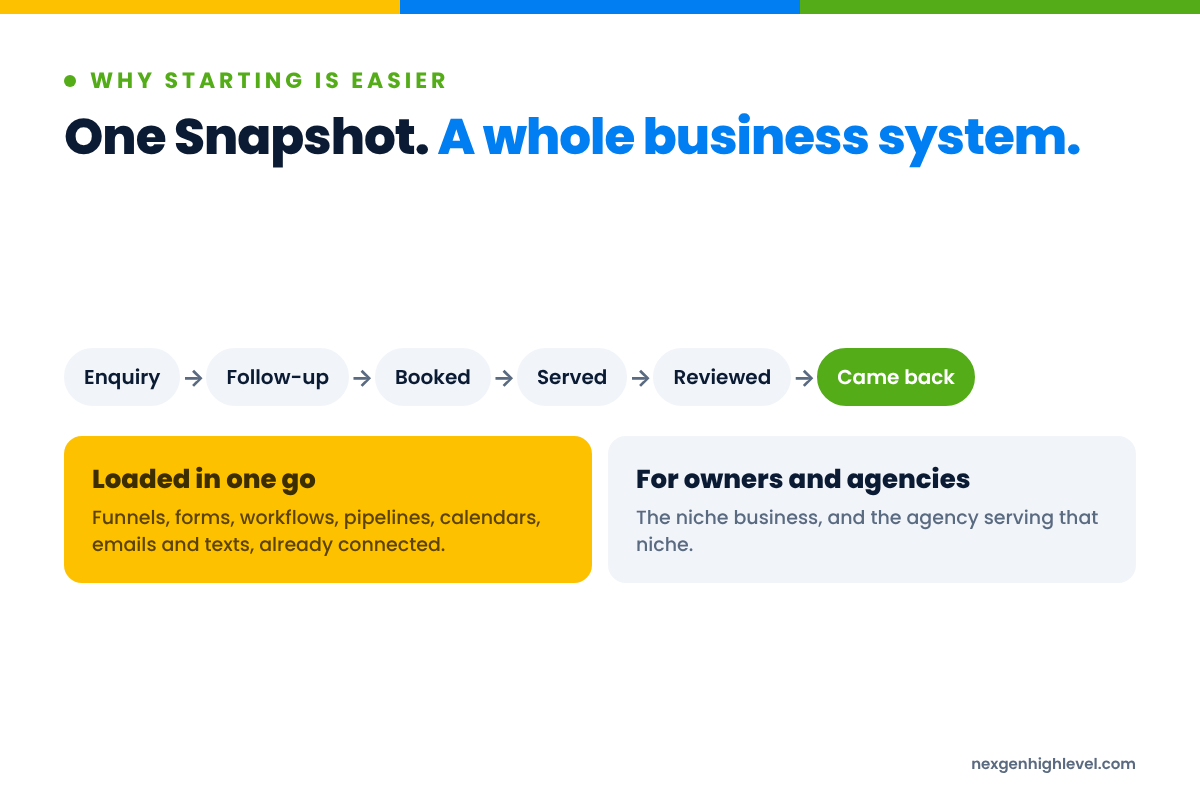
A NexGenHighLevel Snapshot is a complete, fully built-out business system for a niche. A business system in a box.
It loads into your HighLevel account with the funnels, forms, workflows, pipelines, calendars, emails, texts and AI features already built and connected around the whole client journey. From someone discovering the business to becoming a paying customer, and then coming back.
It's not a starter pack.
And not all Snapshots are equal. A typical Snapshot might be a couple of funnels, a few workflows and one pipeline. Useful, but you're still building the rest yourself. Ours are built to run the business.
I've written more about the HighLevel Snapshot as a business in a box if you want the thinking behind it.
For the business owner and the agency
Every Snapshot works for two people.
The business owner in that niche, who wants to run their own marketing and sales properly.
And the agency serving that niche, who wants to deliver the same proven system for every client.
A few that are live now:
- Social Media Marketing Agency Snapshot: built for agencies, to run their own agency on HighLevel.
- HVAC Snapshot: for heating and cooling businesses, and the agencies that serve them.
- Credit Repair Snapshot: for credit repair businesses, and agencies working in that space.
More niches are being built.
Clients have used Snapshots to skip months, if not years, of trial and error building a system.
That's the bit a feature table never shows you. Zoho gives you the apps. A Snapshot gives you the business already set up inside the platform.
HighLevel's growth vs Zoho over the last five years
First, honesty. Zoho is older and, by customer count, bigger. It's also private and doesn't publish revenue amounts. HighLevel is private too, and doesn't publish its own revenue either. So this isn't a like-for-like revenue chart. It's what each company has actually published.
HighLevel
HighLevel's own timeline (HighLevel, About Us):
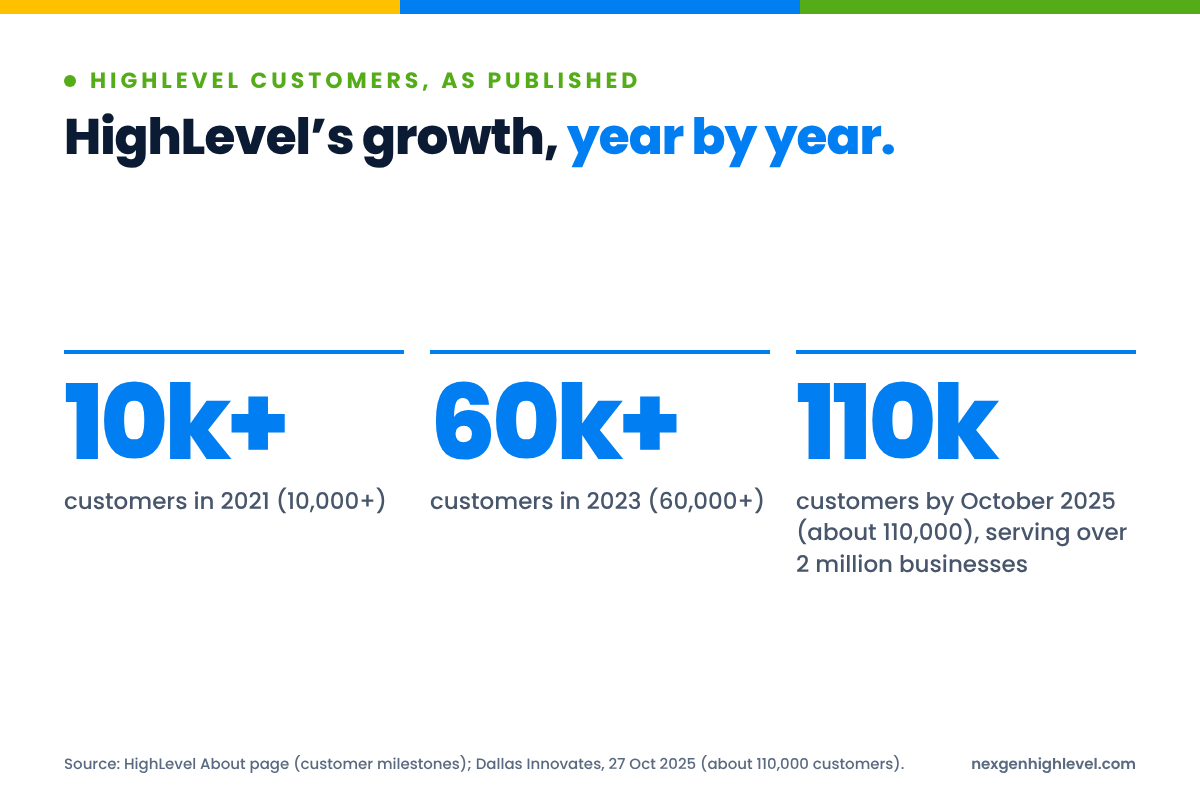
- 2021: "Grew to 10,000+ customers."
- 2022: "Surpassed 20,000 customers."
- 2023: "Exceeded 60,000 customers."
- 2025: "Powering 2.2 million businesses."
In October 2025, Dallas Innovates reported about 110,000 customers, over 2 million businesses using HighLevel and more than 1,800 employees.
So HighLevel went from 10,000+ customers in 2021 to about 110,000 in 2025. That's roughly eleven times as many customers in four years.
Independent rankings back the momentum. HighLevel was No. 47 on the Deloitte Technology Fast 500 in 2023, with revenue growth of 3,362% from 2019 to 2022. In 2025 it ranked No. 116, with 781% growth from 2021 to 2024 (European Business Magazine). And when General Atlantic invested in April 2024, HighLevel had grown "more than 5x" over the previous three years "while maintaining profitability" (Business Wire).
Zoho
Zoho publishes milestones, not revenue amounts.
- September 2023: 100 million users across 55+ business applications, "more than 700,000 customers across 150+ countries" and "more than 15,000 employees" (Business Wire, Sept 2023).
- February 2026: "more than one million paying customers", "more than 150 million users globally", 19,000 employees, and "significant YoY customer (32%) and revenue (20%) growth in 2025" (Business Wire, Feb 2026).
I couldn't find Zoho customer or user figures from Zoho itself for 2021 or 2022, so I can't give a five-year comparison for Zoho. And I won't guess.
Side by side
| HighLevel | Zoho | |
|---|---|---|
| Founded | 2018 | 1996 |
| Ownership | Private, minority investors | Private, never investor-funded |
| Customers | 10,000+ (2021) to about 110,000 (Oct 2025) | 700,000+ (Sept 2023) to 1 million+ paying (Feb 2026) |
| Businesses / users | Over 2 million businesses (2025) | 100 million users (2023) to 150 million (2026) |
| Employees | More than 1,800 (Oct 2025) | 19,000 (Feb 2026) |
| Published growth | 781% revenue growth, 2021 to 2024 (Deloitte) | Revenue up 20%, customers up 32%, in 2025 |
| Revenue amount | Not published | Not published |
One note. A HighLevel "customer" is often an agency that hosts many client businesses in sub-accounts. That's why HighLevel counts about 110,000 customers and over 2 million businesses. The two companies don't count things the same way, so read the numbers with that in mind.
What the numbers actually say
Zoho is bigger. By customers, users and staff. That's thirty years of steady work, and it deserves respect.
But look at the speed. HighLevel was founded in 2018 and was supporting over 2 million businesses by 2025. Its customer count went from 10,000+ to about 110,000 in four years.
And look at the focus. Zoho's growth is spread across dozens of apps, for every kind of company and every department. HighLevel's growth comes from one platform built for small businesses and the agencies that serve them.
Momentum and focus. That's what I'd look at if I were choosing where to build.
Who should choose Zoho, and who should choose HighLevel
Choose Zoho if
- You want one vendor across many departments: accounting, help desk, invoicing, sales and more.
- Your team mostly needs a CRM plus back-office tools, and marketing is a smaller piece.
- You're a domain expert who wants to build your own industry CRM app on Zoho's framework and sell it under your brand.
Choose HighLevel if
- You're a small or medium business whose growth depends on leads, follow-up, booking and reviews working together.
- You want one platform where every channel lands in the same conversation, without joining separate apps together.
- You're an agency and want to rebrand a complete platform, host clients in sub-accounts and sell your own plans.
- You'd rather load a fully built-out Snapshot than set up a dozen apps from scratch.
- You want a flat agency price with unlimited users, rather than paying per user.
For most small businesses and agencies I talk to, that second list is them. Which is why, for them, HighLevel is the Zoho alternative I'd recommend.
If you're also weighing up other options, I've compared HighLevel vs HubSpot too.
Switching from Zoho to HighLevel
Walk before you run.
What switching actually involves
- Export your contacts. Export your contacts and deals from Zoho CRM, then import them into HighLevel. Snapshots don't move contacts, conversations or appointments (HighLevel help centre), so this is a separate, simple step.
- Rebuild or load a Snapshot. Either rebuild your pipelines, forms, funnels and automations yourself, or load a Snapshot that already has the whole system built. A Snapshot is the fastest way to stand up the new account.
- Connect phone and email. Set up your phone numbers, sending domain and any integrations. Some items, like phone numbers, payment connections and WhatsApp approvals, need setting up after a Snapshot loads (same source).
- Run both for a short overlap. Keep Zoho running while you test the new system with real leads. When you're confident, switch over.
Know your goal, plan properly, set up properly, understand properly. Then go for it.
Getting HighLevel through NexGenHighLevel
If you're making the move, you can get HighLevel through NexGenHighLevel.
When you sign up to HighLevel under our agency, you get:
- Over 200 HighLevel training courses.
- Access to all our Apps for HighLevel, both our live apps and future releases.
- 24/7 support and personalised, one-to-one onboarding.
- A full HighLevel sub-account under our agency, and a free Snapshot from NexGenHighLevel.
Frequently asked questions
Is HighLevel better than Zoho?
For small businesses and agencies focused on sales and marketing, I believe so. HighLevel is one connected platform: CRM, funnels, calendars, conversations, reviews and AI in one account, with white-label, SaaS mode and Snapshots for agencies. Zoho is a broad suite of separate apps, which suits companies wanting one vendor across many departments, including accounting and a help desk.
Can I migrate from Zoho to HighLevel?
Yes. Export your contacts and deals from Zoho CRM and import them into HighLevel. Then rebuild your pipelines and automations, or load a Snapshot that already has the whole system built. Connect your phone and email, and run both platforms side by side for a short overlap before switching over fully.
Is GoHighLevel cheaper than Zoho?
It depends on how many people use it. Zoho CRM and Zoho One are priced per user, per month, so cost rises as your team grows. GoHighLevel uses a flat agency price with unlimited users and, on the higher plans, unlimited sub-accounts. Phone, email and AI usage are charged separately on usage. For growing teams and agencies, a flat model is usually easier to plan around.
Does Zoho have white-label?
Yes, in a specific way. Zoho Vertical Solutions lets you build an industry-specific app on Zoho's CRM framework, white-label it, set your own pricing and map a custom domain. That's a build-your-own-app route. HighLevel lets agencies rebrand the whole finished platform, host clients in sub-accounts and sell their own plans through SaaS mode.
What is a HighLevel Snapshot?
A Snapshot is a reusable template that captures an account's setup (workflows, funnels, forms, pipelines, calendars, email and text templates, AI agents and more) so it can be loaded into another sub-account. A NexGenHighLevel Snapshot goes further: a complete, fully built-out business system for a niche, connected around the whole client journey.
What do I get if I sign up to HighLevel through NexGenHighLevel?
You get over 200 HighLevel training courses, access to all our Apps for HighLevel (live and future), 24/7 support with one-to-one onboarding, and a full HighLevel sub-account under our agency with a free Snapshot from NexGenHighLevel. You can start your HighLevel account with us whenever you're ready.
One connected system, not a box of parts
Zoho vs HighLevel isn't really a fight about features. Both have most of the boxes ticked.
It's a question about how you want to work.
A suite gives you lots of good apps and leaves you to join them up. A platform gives you one system that's already joined up, then lets you build on it with apps and Snapshots, and lets agencies put their own name on the whole thing.
For small businesses and agencies, that's why I'd choose GoHighLevel as the Zoho alternative. And it's why we build everything we build inside it.
If you want to see what that looks like with a full system already loaded, get HighLevel through NexGenHighLevel and start with a Snapshot, not a blank screen. You can read more about us and why we build this way.
You don't need more apps. You need fewer joins.