

Most landscaping businesses don't struggle because the owner can't do the work.
They struggle because the phone rang while they were on a mower. Because the estimate went out on Tuesday and nobody chased it. Because it rained for four days and twelve customers needed moving, and the only place the schedule lived was in someone's head.
The work is the easy bit. Honestly. Cutting a lawn, laying a patio, fixing a sprinkler head, clearing a car park of snow at five in the morning. Hard graft, yes. But you know how to do it.
It's everything around the work that wears people down. The enquiries. The quotes. The follow-up. The reminders. The renewals. The reviews you meant to ask for and never did.
I've spent most of my working life around small businesses, first in recruitment, then running a marketing agency, then building software. And the pattern is always the same. The good operators aren't short of skill. They're short of a system.
So this is that system, written down. Whether you run a landscaping business, a lawn care business, or you're about to start one, this playbook walks through the whole thing, from registering the business to keeping commercial contracts for years.
And, as it happens, we've already built it.
Who this playbook is for
I've written this for three people at once. You'll probably recognise yourself in one of them.
1. The starter. You're thinking about how to start a landscaping business or how to start a lawn care business. Maybe you've been working for someone else for years. Maybe you've a truck, a mower and a few neighbours who already pay you. You need to know what to set up, what to charge and how to find customers without wasting money.
2. The owner-operator or small crew. You're busy. Probably too busy. You've one or two crews, a phone that never stops and a whiteboard that's lying to you by Wednesday. You want to grow, but you've a nagging feeling that more customers right now would just mean more chaos.
3. The established or commercial firm. Multiple crews. Maybe a sales person, an office manager, commercial accounts with property managers and procurement departments. You don't need someone to tell you how to mow. You need more control and less firefighting.
How to use this playbook
It's long. On purpose. It's a playbook, not a blog post you read once and forget.
You don't need to read it top to bottom. Jump to the part you need:
- Starting out? Read the industry, lanes, setup and pricing sections first, then the 30-day checklist near the end.
- Growing? Go straight to winning customers, speed and follow-up, running jobs and keeping customers.
- Established? Start with growing without the chaos, then the sections on HighLevel and the Landscaping & Lawn Care Snapshot.
Every section ends with something practical. Some have checklists. Some have tables. None of them have fluff, I hope.
A short note for agencies
If you run an agency that works with landscaping or lawn care clients, this is for you too. Everything here is what your clients are living through every season. Read it as a map of their problems. And when you get to the Snapshot section, you'll see we built the Landscaping & Lawn Care Snapshot for HighLevel so it can be installed into multiple client sub-accounts.
One more thing before we start. Rules on licences, insurance and tax vary from state to state. I'll give you the general picture and point you to the official sources, but always check with your own state before you act. I'm not a lawyer, and this isn't legal advice.
Right. Let's get into it.
The landscaping and lawn care industry today
Before you spend a cent, it's worth knowing what you're walking into. Here's the picture from the official numbers.
It's big, and it's still growing
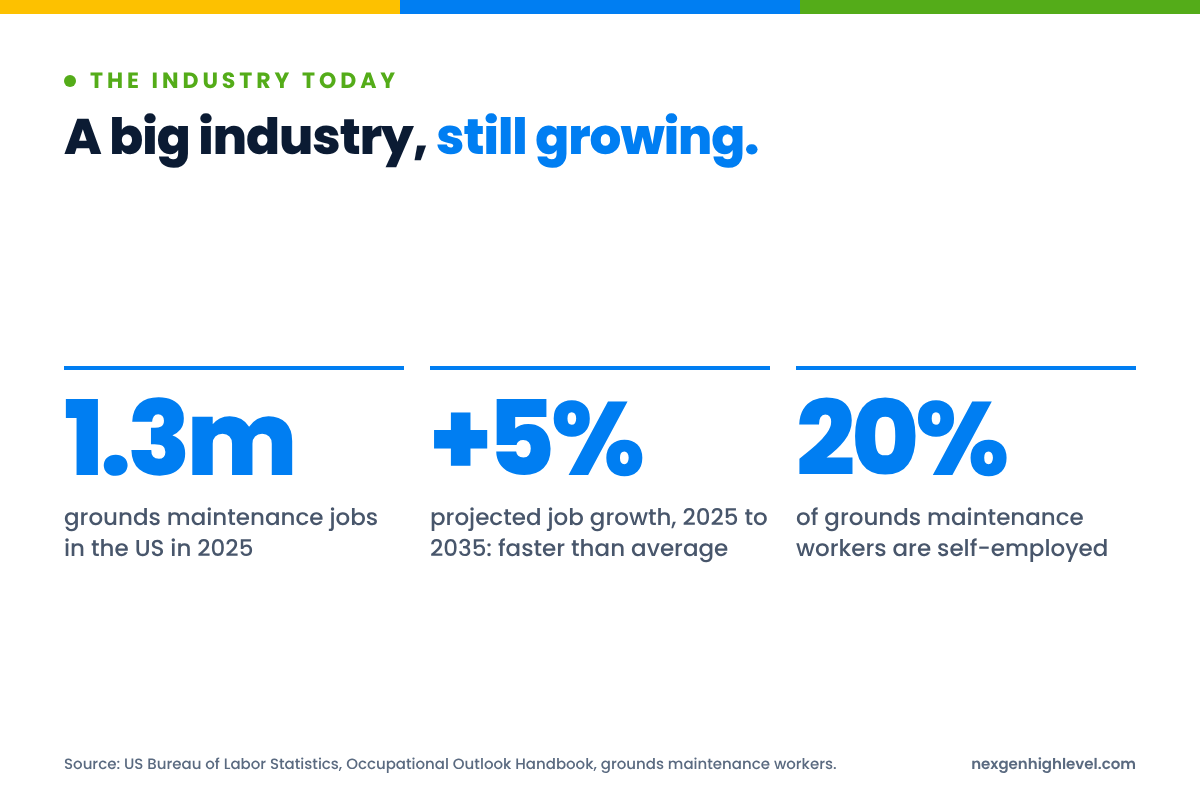
The Bureau of Labor Statistics counts 1,299,200 grounds maintenance jobs in the US in 2025, with employment projected to grow 5% between 2025 and 2035. That's "faster than average", and it works out at about 162,500 openings a year across the decade (BLS Occupational Outlook Handbook).
Narrow it down to landscaping and groundskeeping workers specifically and the BLS projections show 1,188,600 people employed in 2025, rising to a projected 1,244,200 by 2035 (BLS projections table).
On the business side, the National Association of Landscape Professionals (NALP, citing IBISWorld) puts the landscape services industry at "a market size of $188.8 billion in 2025", employing "more than 1.4 million people" across "692,777 landscaping service businesses". NALP says that's a 4.8% increase on 2024, and that the market grew "an average of 6.5 percent per year" between 2020 and 2025 (NALP industry statistics).
For a sense of how fast that's moved: NALP's careers site quotes an earlier IBISWorld report from November 2019 showing $99 billion in revenue and 513,305 businesses (NALP, citing IBISWorld, 2019). Different reports, so treat it as a rough then-and-now.
What people earn
The median pay for grounds maintenance workers was $40,080 a year, or $19.27 an hour, in 2025 (BLS OOH).
For landscaping and groundskeeping workers, the May 2025 median was $18.82 an hour, $39,150 a year. First-line supervisors of landscaping, lawn service and groundskeeping workers had a median of $28.09 an hour, $58,430 a year, with 243,300 people in that role (O*NET 37-3011; O*NET 37-1012).
Why does that matter to an owner? Because it's your labour cost. And labour is the thing that decides whether a job makes money.
Who does the work
Here's a number I find interesting. According to the BLS, 48% of grounds maintenance workers are employed in services to buildings and dwellings (that's landscaping and lawn care companies, mostly), and 20% are self-employed (BLS OOH, employers).
One in five. Self-employed.
That tells you this is an industry full of owner-operators. People with a truck, a trailer and a reputation in their area. Which is brilliant, because the barrier to entry is low. And it's hard, because the barrier to entry is low for everyone else too.
What the typical firm looks like
NALP's 2025 Financial Benchmark Study found participating firms had "a median of 355 customers and generated $14,682 per customer". The typical company reported sales growth of 8.5% (NALP).
Those are benchmark participants, so they skew towards established firms. Don't panic if you've 30 customers. But notice the shape of it. A few hundred customers, worth a meaningful amount each. That's a relationship business, not a one-off transaction business.
And the worries? NALP says it plainly: "The top concerns for landscape companies are finding qualified employees and maintaining their profit levels."
People and profit. Hold on to that. We'll come back to both.
The outlook
NALP's January 2026 Economic Forecast Report (with ITR Economics) expects "2026 will be a year of mild to moderate growth", with "significant deviation between individual markets". It also notes "the construction market is going through a soft spot with both single-unit housing and nonresidential construction" (NALP).
Read that as a design/build owner and it's a nudge. When new construction slows, recurring maintenance and existing-property upgrades become the steadier ground.
The takeaway: demand is there. The industry is growing. What separates firms isn't the market. It's how well they run.
Choosing your lane: services, niches and revenue
One of the most common mistakes I see in any service business is trying to do everything for everyone from day one.
You can. But should you?
The BLS describes landscaping workers as people who "plant flowers, shrubs, trees, and other vegetation to create new outdoor spaces or to upgrade existing ones", plus trimming, fertilising, mulching and watering. Groundskeeping covers "maintaining plants and trees, raking and mulching leaves, and laying sod", along with clearing snow and debris (BLS OOH). OSHA lists the industry's activities as landscape design, soil preparation and grading, irrigation systems, planting, hardscape construction, lawn care and maintenance, and arborist work (OSHA).
That's a lot of lanes. Here's how I'd think about them.
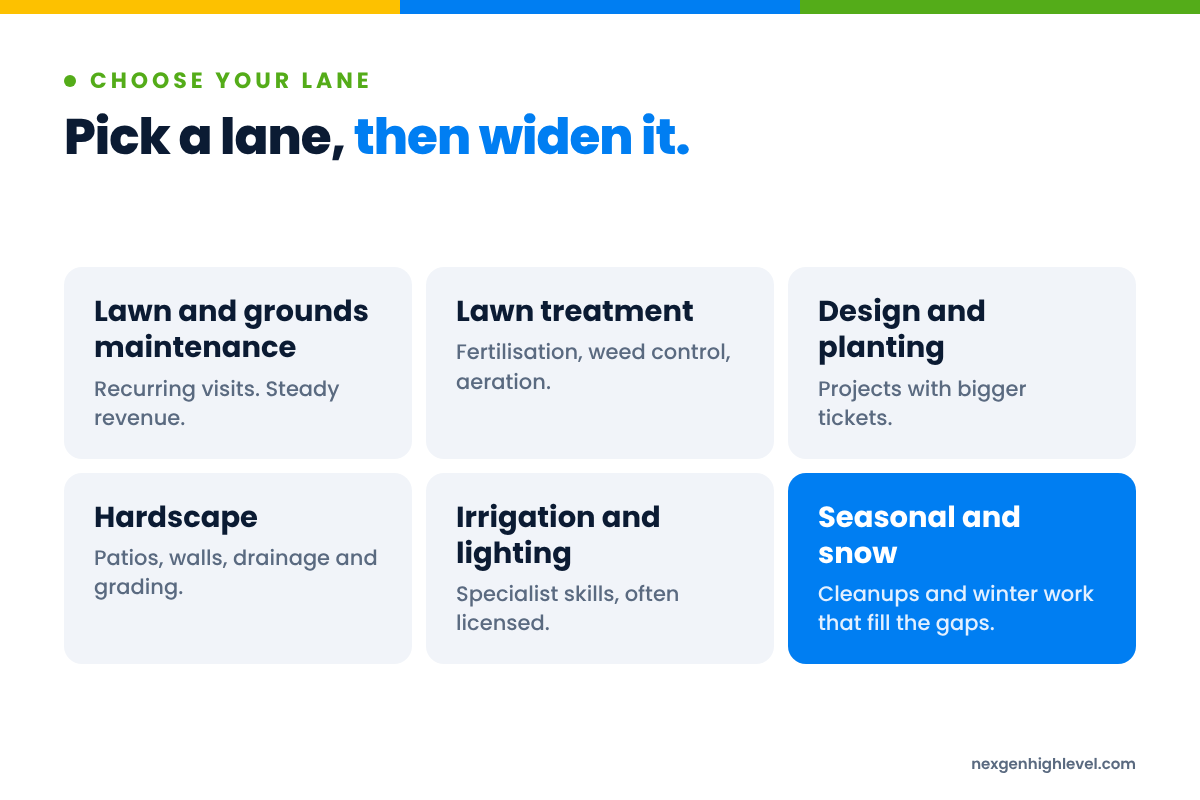
The main lanes
| Lane | What it is | Revenue shape | Watch out for |
|---|---|---|---|
| Lawn and grounds maintenance | Mowing, edging, trimming, cleanups, mulching | Recurring, weekly or fortnightly through the season | Low price per visit, route density matters enormously |
| Lawn treatment | Fertiliser, weed and pest control, aeration, overseeding | Recurring programme of applications | Pesticide licensing and certification |
| Design and build | Planting, beds, new landscapes, sod | Project-based, bigger tickets | Longer sales cycle, tied to construction and spending cycles |
| Hardscape | Patios, retaining walls, paths, drainage and grading | Project-based, high value | Contractor licensing in some states, heavier equipment, more risk |
| Irrigation | Install, maintenance, repair, seasonal start-up and shut-down | Mix of project and recurring | Licensing in some states (Texas, for example) |
| Tree and shrub care | Pruning, trimming, removals | Mix | One of the highest-injury jobs in the industry |
| Landscape lighting | Design, install, maintenance | Project plus add-on | A strong upsell, often in the off-season |
| Snow and ice | Ploughing, salting, clearing | Seasonal, often contract-based | Unpredictable volume, night work, commitments you must keep |
Residential or commercial?
Residential is usually where people start. Shorter sales cycles. Decisions made by one or two people at a kitchen table. Word of mouth travels fast, street to street.
Commercial is a different animal. Property managers, facility managers, HOA boards, procurement departments. Bigger contracts, longer relationships, more paperwork. You'll deal with site contacts who aren't the person paying the invoice, and billing people who've never seen the site.
Neither is better. But they need different handling.
Recurring versus project revenue
This is the decision that shapes everything else.
Recurring revenue (maintenance, treatment programmes, snow contracts) is the bedrock. It's predictable. It lets you plan crews. It turns a customer into a relationship.
Project revenue (design/build, hardscape, lighting, irrigation installs) brings the bigger cheques and the photos for your portfolio. But it's lumpy.
The strongest landscaping businesses I've seen tend to use recurring work as the floor and project work as the upside. Maintenance customers become your warmest project leads. The family whose lawn you've cut for two summers is far more likely to ask you about a patio than a stranger is.
Pick a lane, then widen it
My advice to a starter: pick one or two lanes you can do brilliantly, in an area you can serve tightly. Add services when you've the people, the equipment and the system to deliver them.
Walk before you run. And even when you're ready to run, keep walking for a little bit longer.
That one comes from experience. I grew my recruitment business aggressively, with heavy overheads, and never foresaw the world simply stopping. When Covid hit, it didn't survive. Closing it was the hardest business decision of my life. The lesson I took: only run when you can see the green field stretching out in front of you.
Your lane checklist:
- [ ] Which one or two services will you lead with?
- [ ] Residential, commercial, or both (and which first)?
- [ ] What's your recurring offer, even if you're mainly a project firm?
- [ ] How tight can you keep your service area?
- [ ] Which services need a licence or certification in your state?
Setting up a landscaping business properly
This is the boring bit. It's also the bit that protects your house, your savings and your family if something goes wrong.
Do it once. Do it properly. Then forget about it until renewal time.
A reminder before we go further: rules vary by state, and sometimes by county and city. Use this as a map, not a rulebook, and check with your state.
Choose a business structure
The SBA puts the trade-off clearly. In a sole proprietorship, "you can be held personally liable for the debts and obligations of the business". By contrast, "LLCs protect you from personal liability in most instances", and profits and losses "can get passed through to your personal income without facing corporate taxes", although members pay self-employment tax (SBA, choose a business structure).
Think about what your work involves. Heavy machinery near people's homes. Vehicles on public roads. Chemicals. Customers' property. Personal liability isn't a theoretical worry in this trade.
Talk to an accountant about which structure suits you. It's one of the cheapest conversations you'll ever have, relative to what it can save.
Register the business
According to the SBA, "most states require you to register your DBA if you use one", but a DBA "doesn't provide legal protection by itself". LLCs and corporations "probably need to register with any state where you conduct business activities", and "most businesses will need to file to get a federal tax ID" (SBA, register your business).
If your service area crosses a state line, that second point matters.
Get your EIN
The IRS is very clear on this: "You never have to pay a fee for an EIN." It also warns you to "beware of websites that charge for an EIN". You'll generally need one to hire employees or run a partnership or corporation, among other things. If you're forming an LLC or corporation, do that with the state first. And the online application has to be finished in one session; it times out after 15 minutes of inactivity, so have your details ready (IRS).
Licences and certifications
This is where landscaping and lawn care get specific. A few examples to show how much it varies.
Pesticide application. The EPA says "federal law requires any person who applies or supervises the use of restricted use pesticides (RUPs) to be certified". States, tribes and federal agencies run the certification programmes, and the 2017 rule set "a maximum recertification interval of 5 years for commercial and private applicators" (EPA). On top of that, the BLS notes that "most states require licensing for workers who apply pesticides" (BLS OOH).
If lawn treatment is part of your plan, this is the first thing to check.
California, pesticides and maintenance gardening. California's Department of Pesticide Regulation has said that "anyone who applies pesticides, even if it is only incidental to other maintenance gardening tasks, must have a maintenance gardening pest control business license from DPR" and "be registered with the local county agricultural commissioner's office" (California DPR). Note the word "incidental". Spraying a few weeds on a mowing round counts.
California, contractor licensing. The CSLB's C-27 Landscaping Contractor classification covers a contractor who "constructs, maintains, repairs, installs, or subcontracts the development of landscape systems and facilities" (CSLB C-27). A licence is needed when "the total cost (labor and materials) of one or more contracts on the project is $1,000 or more", and the qualifier needs "at least four full years of experience at a journey level" within the previous ten years (CSLB). That threshold was raised from $500 to $1,000 by AB 2622, effective January 1, 2025 (CSLB).
Texas, irrigation. In Texas, landscape irrigation licences come from the Texas Commission on Environmental Quality (TCEQ). The licence types are Landscape Irrigator, Irrigation Technician and Irrigation Inspector. A person may not sell, design, install, maintain or repair irrigation systems, or consult on them, "unless the person is licensed by the TCEQ", with exemptions set out in the rules, and technicians work "under the supervision of a licensed irrigator" (TCEQ).
Three states' worth of examples, three completely different sets of rules. That's the point. Look up your own.
Insurance
The SBA says "the federal government requires every business with employees to have" workers' compensation, unemployment and disability insurance, and "some states also require additional insurance". General liability "protects against financial loss as the result of bodily injury, property damage, medical expenses" and more (SBA, business insurance).
Think about what you actually do. Trucks and trailers on the road. Equipment that throws stones at windows. Crews on other people's property. Talk to a broker who knows the trade, tell them every service you offer, and make sure your vehicles are properly covered too.
And here's something people forget: commercial clients will often ask for proof of insurance before they'll even look at your proposal. Have it ready.
Safety
OSHA lists the hazards in landscape and horticultural services: cuts and amputations, electrical, ergonomics, heat and cold stress, lifting and awkward postures, motor vehicles, noise, pesticides and chemicals, and slips, trips and falls (OSHA hazards).
It isn't abstract. OSHA, citing BLS data, reported that "1,072 work-related fatalities occurred in the landscaping and groundskeeping industry" between 2011 and 2021, and that "workers struck by vehicles is typically the industry's leading cause of fatal injuries" (OSHA news release).
The BLS adds that "workers who use equipment such as lawnmowers and chain saws must wear protective clothing, eyewear, and earplugs", and that "tree trimmers and pruners have one of the highest rates of injuries and illnesses of all occupations" (BLS OOH).
People are more important than money. In this trade, that's not a slogan. It's a safety briefing.
Your setup checklist
| Item | Done? | Where to check |
|---|---|---|
| Business structure chosen (with an accountant) | [ ] | SBA |
| Business name and DBA registered | [ ] | Your state |
| EIN (free, from the IRS) | [ ] | IRS |
| State and local business registrations | [ ] | Your state, county and city |
| Pesticide applicator licence or certification (if applying) | [ ] | Your state agency |
| Contractor licence (if your state or project size requires it) | [ ] | Your state licensing board |
| Irrigation licence (if your state requires it) | [ ] | Your state (TCEQ in Texas) |
| General liability insurance | [ ] | Your broker |
| Workers' compensation and other required cover (with employees) | [ ] | Your state and broker |
| Vehicle cover for every truck and trailer | [ ] | Your broker |
| Safety plan, PPE and training records | [ ] | OSHA guidance |
| Business bank account, kept separate from personal | [ ] | Your bank |
Pricing and profit in a lawn care business
Pricing is where good operators quietly go broke.
They're busy. Every day. Booked solid. And at the end of the year there's nothing left. Sound familiar?
I'm not going to give you a magic per-visit rate. Anyone who does without knowing your area, your costs and your equipment is guessing. What I can give you is a way to think about it.
Start with your real costs
Before you price anything, know these:
- Labour. Wages, plus taxes, plus insurance, plus the time spent driving, loading and unloading. Not just the time spent mowing.
- Equipment. Purchase or finance, maintenance, repairs, replacement.
- Vehicles and fuel. Including the windshield time between jobs.
- Materials. Mulch, plants, fertiliser, stone, seed.
- Overheads. Insurance, software, phone, marketing, yard, accountant, you.
- Profit. Yes, as a line. Not whatever's left over.
Why labour first? Because NALP expects that "labor costs are expected to rise roughly 20% from now and the end of 2029" (NALP). If your prices don't move with your costs, your margin moves for you.
And it's not just landscapers feeling it. In the Federal Reserve's Small Business Credit Survey (2024 survey of employer firms), rising costs of goods, services and wages were the most common financial challenge at 75%, with 56% struggling to pay operating expenses and 51% dealing with uneven cash flows (Fed SBCS 2025 report). In the 2025 survey, 77% cited rising costs, tariff-related costs, or both (Fed SBCS 2026 report).
Pricing models
| Model | Best for | Strength | Risk |
|---|---|---|---|
| Per visit | Mowing, simple maintenance | Easy for customers to understand | Margin disappears if routes are spread out |
| Seasonal contract, billed monthly | Maintenance customers | Smooths cash flow, locks in the season | Needs a clear scope of what's included |
| Programme (per application) | Lawn treatment | Clear, repeatable, easy to schedule | Customers need to understand the full programme |
| Estimated hours (crew time) plus materials | Cleanups, planting, one-off jobs | Ties price to your real cost | Underestimate the hours and you eat it |
| Fixed project price | Design/build, hardscape, lighting | Customer knows the number up front | Scope creep, so changes need recording |
| Per event or seasonal (snow) | Snow and ice | Matches how the work arrives | Seasonal contracts carry weather risk either way |
On lawn treatment, a Nebraska Extension guide from 2017 noted that companies typically price by the number of fertiliser applications and the number and type of pesticide applications. It suggested "a reasonable price for lawn care ranges from $300 to $500 per year for fertilizer and pest control applications", excluding mowing, pruning and snow (Nebraska Extension G1617). That's old and regional, so don't use it as your price list. But it does show the programme model in action.
The same guide tells homeowners to make sure "inexpensive introductory prices aren't followed by mandatory increasing services and costs that you don't want", and to get the included services in writing. Read that from the customer's side. Clear, written scope builds trust. Surprises don't.
Minimums
Set a minimum charge. A small job twenty minutes out of your route can cost more than it earns once you count the drive, the unload and the reload. A minimum isn't greedy. It's honest about what it costs to show up.
Density is a pricing decision
Here's something people don't think of as pricing. Route density.
Ten lawns on one street and ten lawns across a whole county pay the same at the door. They don't pay the same at the end of the month. Every minute between jobs is a minute nobody's paying for.
So when you price, think about where the job is, not just what it is.
Seasonality and cash flow
The BLS puts it simply: "Some work is seasonal, available mainly in the spring, summer, and fall" (BLS OOH).
That's the cash flow problem in one sentence. Big months and lean months.
Ways owners smooth it:
- Seasonal contracts billed in equal monthly amounts.
- Pre-booking spring work (cleanups, aeration, treatment programmes) during winter.
- Adding off-season services: lighting, snow and ice, holiday work, design consultations for next spring.
- Deposits on project work.
- Keeping a cash reserve built in the good months, before you need it.
The numbers to watch
You don't need a 40-tab spreadsheet. Watch a handful of numbers, every week:
- Revenue per customer, per year. NALP's benchmark participants generated $14,682 per customer at the median (NALP). Yours will be different. Track your own and watch which way it moves.
- Gross margin by service. Which lanes actually make money?
- Estimate win rate. How many quotes become jobs?
- Time to respond to a new enquiry.
- Recurring customer renewal rate.
- Revenue per crew hour.
Revenue and profit. Not clicks, not bookings, not "we're busy". Does it make any money?
Equipment, crews and seasonal labour
Equipment you can buy. Good people you have to earn.
Equipment: buy for the work you have
Start with what your lane needs, not what looks good on the trailer. A starter on a maintenance route needs reliable mowing, trimming and blowing gear and a way to move it safely. Hardscape and design/build bring heavier, more expensive kit, and you might rent before you buy.
A few practical rules:
- Buy for the work you've got booked, rent for the work you hope to get.
- Keep a maintenance log. A breakdown in June costs you far more than the repair.
- Standardise where you can, so parts, batteries and training carry across crews.
Battery and zero-emission equipment
This is moving faster in some states than others. In California, CARB approved regulations so that for "model year (MY) 2024 and all subsequent model years, emission standards will be zero" for most small off-road engines, which includes leaf blowers and lawn mowers. Generators and large pressure washers follow from model year 2028. Importantly, the rule "applies to manufacturers and will impact new equipment (Model Year 2024 and later) only", so existing gas equipment can still be used (CARB).
CARB also notes that "incentive programs are available throughout California to help you purchase zero-emission lawn and garden equipment" (CARB SORE programme).
Outside California, check your state and your city. Local rules on noise and equipment can change what you can run, and when. And some customers, residential and commercial, will choose you because you run quieter equipment. That's a selling point, if it's true for you.
Hiring: the real constraint
Remember NALP's top concern: "finding qualified employees". NALP also says plainly that "there is a significant workforce shortage" (NALP). In its H-2B advocacy material, NALP reported that landscaping had "a record 2.3 job openings for each unemployed worker in the summer of 2021" (NALP, H-2B By the Numbers).
So treat hiring like sales. Because that's what it is. You're selling a job to someone who has other options.
- Be clear about pay, hours, season length and progression.
- Respond to applicants quickly. Good people don't wait around.
- Ask your best people who they know. Referrals work for hiring too.
- Keep a list of past seasonal staff and contact them before the season, not during it.
Training and keeping good people
I spent nearly 23 years in recruitment. If there's one thing I learned, it's that people leave managers and chaos far more often than they leave jobs.
What keeps good crew members:
- A proper first week. Safety, equipment, how you talk to customers, what "done" looks like.
- Clear schedules. Nobody likes finding out at 6am that the day has changed.
- Fewer surprises on site. Access codes, gate notes, dog warnings and scope details in their hands before they arrive.
- A path up. Crew member to crew lead to supervisor. Supervisors had a median wage of $28.09 an hour in 2025 (O*NET), so there's a real career there to point to.
- Being treated like people. Thank them. Listen to them. Fix the stuff they complain about.
Business is a people game disguised as a numbers game. Your crew is the people part.
H-2B seasonal workers: the basics
Many landscaping firms use the H-2B programme for seasonal labour. The Department of Labor describes it as letting employers "hire nonimmigrant workers to temporarily come to the U.S. to perform non-agricultural services or labor", where the employer shows the need is temporary: one-time, seasonal, peakload or intermittent (DOL H-2B).
USCIS says "Congress has set the H-2B cap at 66,000 per fiscal year", split into 33,000 for workers starting in the first half of the fiscal year (October 1 to March 31) and 33,000 for the second half (April 1 to September 30). Workers already in H-2B status who extend or change employers generally aren't counted against the cap (USCIS).
How big is landscaping in H-2B? In fiscal year 2025, Landscaping and Groundskeeping Workers was the number one H-2B occupation, with 89,013 positions certified, 38.3% of all certified positions (DOL OFLC FY2025 statistics). Bear in mind that DOL certification isn't the same as a visa being issued. The cap applies at the visa stage.
It's a regulated, time-sensitive process. If it's for you, plan well ahead of the season and take proper advice.
Winning customers for your landscaping business
Now the fun bit. Or the bit that keeps people up at night, depending on who you are.
The Fed's survey found "reaching customers and growing sales" was the most common operational challenge for small employer firms, at 57% (Fed SBCS 2025 report). You're not alone in finding this hard.
Why people hire a landscaper at all
The most recent NALP consumer data I could verify is from a 2017 NALP/Harris Poll survey, so treat it as a guide rather than gospel. It found 40% of those with a lawn or landscape had hired a professional in the last year. Of those who hired, 51% used tree care, 50% mowing, 46% lawn pest control and 42% weed prevention and control (NALP/Harris Poll).
And why did they hire? 52% wanted their property to "look better", 41% wanted to save time, and 30% wanted to enjoy their yard more (NALP).
Look at that list. Not one of those reasons is "a good price per visit". People buy a nicer-looking home, their weekends back, and a garden they actually enjoy. Sell that.
This is my core framework, by the way. Human, Strategy, Leverage. In that order. Understand the person first. Build the strategy second. Then use technology to multiply it. Never the other way around.
Google Business Profile and local search
For most local service businesses, Google is where the hunt starts. So understand how it works, from Google itself.
Google says "local results are mainly based on relevance, distance, and popularity". Relevance is "how well a Business Profile matches what someone is searching for". Distance is "how far each business is from the customer who's searching". And prominence "means how well-known a business is". Google also says "more reviews and positive ratings can help your business's local ranking", and "there's no way to request or pay for a better local ranking on Google" (Google Business Profile Help).
So what does that mean in practice?
- Relevance: complete every part of your profile. The right categories. Every service you actually offer, described in plain words. Your real service area.
- Distance: you can't move your yard, but you can be honest and clear about the areas you serve.
- Prominence: reviews, photos of real jobs, consistent business details everywhere you're listed, and a website that backs it up.
No shortcuts. Nobody can sell you a better ranking. Google says so.
Reviews: the quiet engine
BrightLocal's 2026 Local Consumer Review Survey of US consumers is worth reading slowly (BrightLocal):
- 97% of consumers read reviews, and 41% "always" do.
- 68% will only use businesses rated four stars or more.
- 74% only care about reviews from the last three months.
- 49% trust reviews about as much as personal recommendations.
- 89% expect owners to respond to reviews, and 80% are likely to use a business that responds to all its reviews.
- 42% are unlikely to use a business that never replies, and 50% are put off by generic or templated replies.
Two things jump out at me.
First, recency. Three months. A landscaping business with 200 reviews, all from 2022, looks less active than one with 40 from this season. So asking for reviews isn't a one-off project. It's a habit, every week, after every good job.
Second, replies. Not "thanks for the review!" on repeat. A real reply, from a real person, mentioning the job. Half of people are put off by the generic stuff.
Referrals and neighbourhood density
A finished lawn is an advert. A new patio is an advert. Your truck parked outside is an advert.
Neighbours watch. They talk over the fence. So use it:
- Ask happy customers for a referral at the moment they're happiest, usually right after a completion walkthrough.
- Leave a door hanger on the neighbouring houses when you finish a job ("We've just finished next door...").
- Build routes street by street. Density makes you more profitable and more visible at the same time.
- Thank referrers properly. A handwritten note goes a long way.
Commercial prospecting
Commercial work rarely walks in the door. You go and get it.
The people you're after are property managers, facility managers, HOA boards and the procurement people behind them. They care about reliability, communication, proof of insurance, and not having to chase you. Price matters, but being the contractor they never have to think about matters more.
What works:
- A clear target list. Office parks, retail centres, apartment communities, HOAs, schools, medical facilities in your area.
- Find the right person. Who manages the property? Who signs off? Who pays?
- Outreach that's specific to their site. Not "we do landscaping". "We noticed the irrigation on your north bed is overspraying the walkway."
- Patient follow-up. Contracts often come up on a cycle. Know when theirs is, and be in touch before it.
This is the bit HighLevel's own line, "Capture, Nurture, Close", doesn't cover on its own. Where's the prospecting? Where's the outreach? Where's the market creation? It's exactly the gap we built our LinkedIn app to fill, and I'll come back to it near the end.
Seasonal campaigns
Landscaping has a calendar. Use it.
- Late winter: book spring cleanups, treatment programmes and maintenance contracts.
- Spring: cleanups, mulching, planting, irrigation start-ups.
- Summer: upsell lighting, hardscape for next year, drought and watering advice.
- Autumn: aeration and overseeding, leaf cleanups, irrigation shut-downs, snow contract sign-ups.
- Winter: snow and ice, design consultations, renewals, and planning.
Each campaign goes to the people who'd actually want it, not a blast to everyone. A maintenance customer with no irrigation system doesn't need your irrigation start-up email.
Speed and follow-up: the quote that went quiet
If I could fix one thing in most landscaping businesses, it would be this.
Answer fast
Someone finds you on Google at 7pm. They fill in your form. You're having your dinner. You reply the next afternoon.
By then, who else did they contact?
I won't throw a made-up statistic at you about how many minutes you've got. There isn't a figure I'd stand behind. But you know it from your own life. When you want something sorted, you go with whoever gets back to you first and sounds like they know what they're doing.
So:
- Acknowledge every enquiry straight away, even if it's an automatic message saying when you'll call.
- Ask the questions you need (property address, service wanted, best way to contact) on the first form, so the first call is useful.
- Have a rule for how fast a human follows up, and track it.
I've written more about this in our piece on answering leads quickly on WhatsApp, because the channel your customer prefers matters as much as the speed.
The quote that went quiet
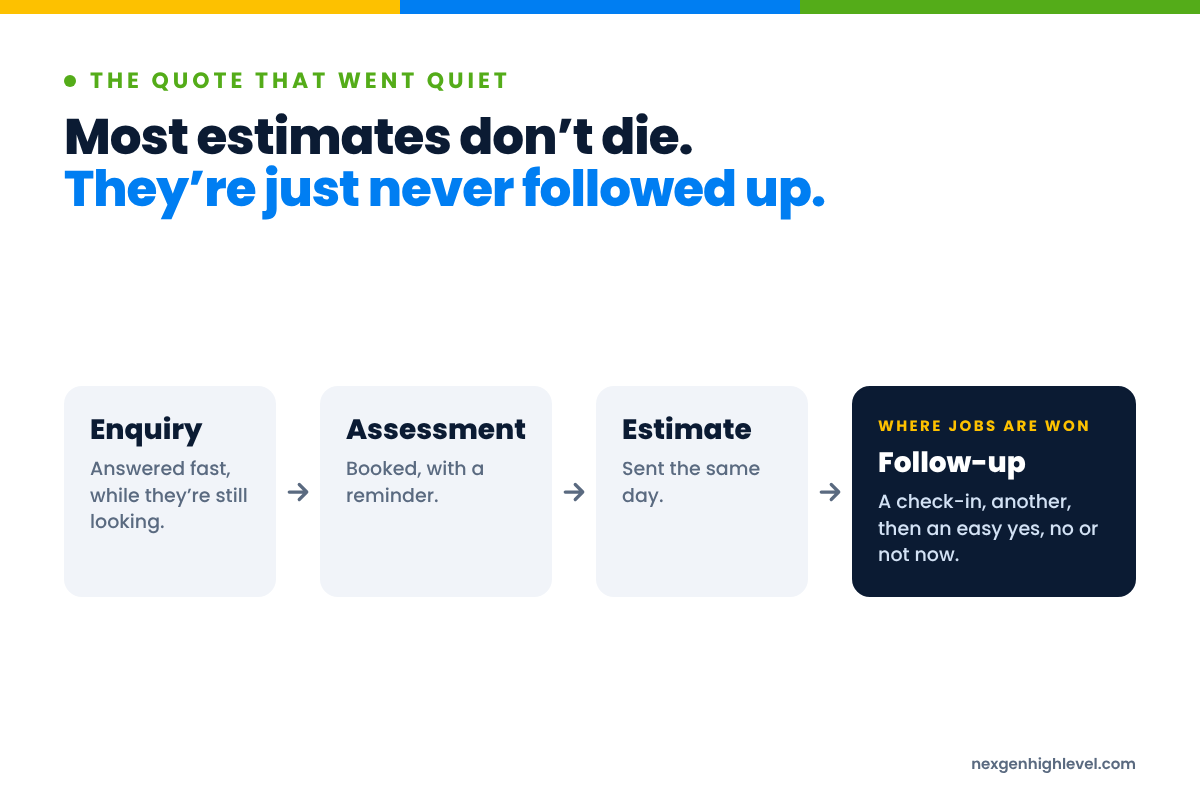
Here's the scenario. Picture a two-person lawn care crew. They walk a property on Monday. Measure up. Write a proper estimate on Tuesday night. Send it Wednesday.
And then... nothing.
No reply. No "no". Just silence. Two weeks later they've forgotten about it, and so has the homeowner. Another firm, who simply followed up, got the job.
The quote that went quiet isn't usually a "no". It's usually a "not yet", a "I meant to reply", or a "I had a question and didn't get round to asking it".
What fixes it:
- A follow-up plan for every estimate. A check-in a couple of days after sending. Another a few days later. A final one that makes it easy to say yes, no or "not now".
- Make questions easy. Every follow-up should invite questions, by text, email or a call.
- Record the outcome. Won, lost, or parked until spring. And why. Over a season, that tells you whether you've a pricing problem, a speed problem or a scope problem.
- Separate revisions from acceptance. If they want a change, revise and re-send. Don't let a revised quote float around unacknowledged.
Everyone knows they should follow up. Most don't, because it's a manual job at the end of a long day.
That's a system problem. Not a discipline problem.
Running jobs without dropping the ball
Winning the work is half of it. Delivering it, without a dozen phone calls and a crossed wire, is the other half.
Assessment
Every good job starts with a proper look at the property. Measurements, photos, access, slopes, drainage, what's there now, what the customer actually wants. And who the customer actually is. On commercial sites, the person showing you round may not be the person signing off.
Before you schedule anything, check readiness: is the scope agreed, are materials ordered, is access sorted, is the deposit paid if you take one?
Estimates
A good estimate is clear about what's included, what isn't, and what happens if something changes. Plain words. Photos where they help. And a simple way to say yes.
Scheduling, weather and access
This is where landscaping gets messy, because so much is outside your control.
Weather. Rain, heat, frost, snow. "Most grounds maintenance work is done outdoors in all weather conditions," as the BLS puts it (BLS OOH). When the weather moves your day, every affected customer needs to know, and the reschedule needs to land somewhere real, not on a sticky note.
Access. Locked gates. Dogs. A car on the drive. A commercial site with a security desk. Record it once, against the property, so every crew sees it every visit.
Scope changes. The customer meets your crew on the drive and says, "While you're here, could you...?" Lovely. But is it priced? Agreed? Recorded? Scope changes that live only in a crew member's memory become arguments at invoice time.
The trick is to handle each of these as its own path. A weather delay isn't the same as an access problem, and neither is the same as a scope change. Treat them all as "something came up" and you lose track of what actually happened.
Completion and the walkthrough
Finish every project with a walkthrough. Show the customer the work. Ask if anything's not right. Make a punch list of anything outstanding, agree when it'll be done, and close it properly.
It's also the best moment you'll ever have to ask for a review. They've just seen the finished job. They're happy. Ask.
Aftercare
Most firms stop at the invoice. Don't.
A check-in a week or two after a planting job ("How are the new shrubs doing? Here's how to water them through the heat."). A note after an irrigation install. Watering advice matters more than people think: EPA WaterSense says outdoor water use is about 30 percent of average household water use nationwide, and "as much as 50 percent of outdoor water use is wasted due to overwatering" (EPA WaterSense). Helping customers water properly protects your work and their bill.
Aftercare is cheap, it's kind, and it turns a project customer into a maintenance customer.
Keeping customers year after year
Getting a new customer is expensive. Keeping one is where the money is.
Recurring maintenance programmes
A recurring programme should be clear about:
- Scope. What's included on every visit, and what's extra.
- Frequency. Weekly, fortnightly, monthly, per application.
- The property. If a customer has two properties, or a commercial client has twelve sites, each one needs its own scope and history.
- Outcomes. What was done on each visit, and anything the crew noticed.
That last one is gold. "Noticed some grub damage on the back lawn" is the start of a treatment conversation. "Two sprinkler heads not working" is an irrigation repair. Your crews are your best salespeople, if what they see gets recorded.
Renewals
For residential maintenance, renewal is a conversation before the season, not an assumption.
For commercial, it's a process. Contracts come up for renewal on a cycle, often through procurement. A renewal is not the same as the client accepting a new price or a new contract. Treat it as a fresh decision: review the last term, show what you delivered, propose the new terms, and get it agreed properly.
Upsells by season
Upselling gets a bad name because people do it badly. Done well, it's just telling customers about something they'd want.
| Season | Natural upsell |
|---|---|
| Spring | Cleanups, mulching, bed refreshes, treatment programmes, irrigation start-up |
| Summer | Landscape lighting, hardscape planning, irrigation upgrades |
| Autumn | Aeration, overseeding, leaf cleanups, irrigation shut-down |
| Winter | Snow and ice contracts, design consultations for spring |
Irrigation upgrades are a good example of a genuinely useful upsell. EPA WaterSense says a WaterSense labelled irrigation controller "can save an average home up to 15,000 gallons of water annually" (EPA WaterSense). That's a conversation about saving the customer money, not about selling them a gadget.
Reviews and referrals, again
Every completed job, every season. Ask for the review. Reply to every one. Ask for the referral. Thank the referrer.
It's not complicated. It's just consistent. And consistent is the hard part when you're running crews.
Growing without the chaos
Here's the honest truth about growth in a landscaping or lawn care business. More customers don't fix a messy business. They expose it.
Solo to crews to commercial
Solo. Everything lives in your head and your phone. It works, until it doesn't. Usually around the time you're on a mower and three people are trying to get hold of you.
First crew. Now someone else needs to know where to go, what to do and what the customer expects. If it isn't written down, it's lost.
Multiple crews. Scheduling becomes a real job. Weather days ripple across the whole week. You need an office person, or a system that does the office work, or both.
Commercial. Site contacts, billing contacts, procurement, contract terms, renewals, proof of insurance. A different level of organisation.
Systems before headcount
At each step, the temptation is to hire your way out. Another person on the phones. Another crew. Another salesperson.
Sometimes that's right. But first, ask: is the problem that we need more people, or that the people we have are doing jobs a system should do?
Chasing quotes. Sending reminders. Asking for reviews. Rescheduling for rain. Renewal reminders. Those aren't jobs for a human to remember. They're jobs for a system to do, with a human stepping in where it matters.
I wrote about this in more depth in growing a small business with systems. The short version: build the system, then add the people. Not the other way around.
Walk before you run. Only run when you can see the green field stretching out in front of you.
The three personalities that get stuck
I see three types of owner get stuck when they try to grow. I've been all three, by the way.
- The Tinkerer buys the software and spends months fiddling with it instead of using it.
- The Rusher switches everything on at once, without testing, and annoys half their customers in a week.
- The Magic-Bullet Believer thinks the next tool will fix it, and never learns to use the last one properly.
My advice to all three: know your goal, plan properly, set up properly, understand properly. Then go for it.
Why HighLevel fits a landscaping business of any size
So, the software question. What should a landscaping business use?
You'll find plenty of landscaping CRM and landscaping software options. I'm biased, obviously. We build on HighLevel. But I'll tell you why, and you can decide.
One platform instead of seven
Look back at everything in this playbook. Enquiry forms. Booking assessments. Estimates and follow-up. Scheduling reminders. Weather messages. Reviews. Referrals. Seasonal campaigns. Renewals. A website. Reporting.
In most businesses that's five, six, seven different tools that don't talk to each other. Someone copies details from one to another. Things fall through the gaps.
HighLevel (some people still call it GoHighLevel) puts it in one place:
- CRM and contacts, with every conversation and job history on the record.
- Pipelines to track enquiries, estimates, projects and renewals stage by stage.
- Forms and surveys to capture the property brief on the first contact.
- Calendars and booking, with automatic reminders.
- Email, SMS and calls from one inbox, and WhatsApp through our app.
- Reviews and reputation management, to ask for and reply to reviews.
- Funnels and websites, so your site and your follow-up are the same system.
- Workflows and automation, so follow-up happens whether or not you remember.
- AI, to help with intake, follow-up and replies, with a human in charge.
- Reporting, so you can see what's actually making money.
It scales with you
This is the bit that matters for a landscaping business of any size. HighLevel is a flat platform model, and plans include unlimited users. You don't pay more because you hired a crew lead or an office manager.
So a starter can use a fraction of it on day one. And the same account can run a multi-crew commercial operation later, without moving everything to a new system just when you're busiest.
Technology is leverage, not strategy. Put it behind a well-run business and it multiplies what's good. That's why it matters what's built inside the platform, not just the platform itself.
If you want a fuller comparison, we've written up how HighLevel compares to HubSpot.
The Landscaping & Lawn Care Snapshot: the playbook, already built
Here's the thing. Everything you've just read, we've already built inside HighLevel.
A HighLevel (or GoHighLevel) Snapshot is a ready-made set of pipelines, workflows, funnels, forms, templates and more that installs into a HighLevel account. Most snapshots stop at a basic contact form and a follow-up. Ours doesn't. The Landscaping & Lawn Care Snapshot is a complete, fully built-out business system in a box for US residential and commercial landscaping and lawn care businesses, and for the agencies that set up HighLevel for them. It's not a starter pack.
It covers lawn and grounds maintenance, turf improvement, design and planting, tree and shrub work, patios and retaining walls, drainage and grading, irrigation, landscape lighting, seasonal cleanup, and snow and ice service coordination.
As it stands today, it includes 85 workflows, 20 funnels, 12 role-specific AI agents (for intake, estimate follow-up, scheduling and client communication), 80 email templates, 10 knowledge bases and 7 pipelines covering residential and commercial work from enquiry through renewal. Plus reusable email and SMS copy and social reply snippets.
The eight-stage journey, mapped to this playbook
Every stage is connected, so a customer moves from one step to the next without anyone re-entering details.
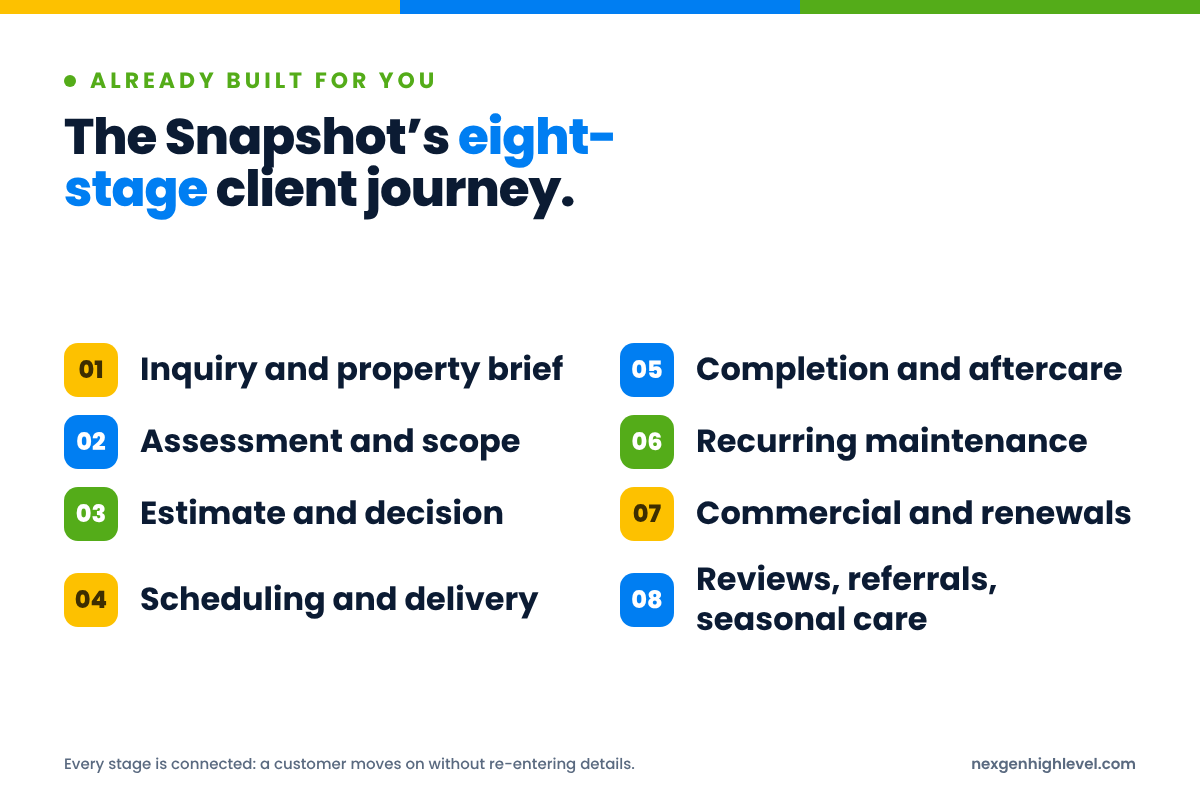
| Snapshot stage | What it does | Where it is in this playbook |
|---|---|---|
| 1. Inquiry and Property Brief | Residential, commercial and referred request forms capture the property, service needed and preferred contact method | Winning customers; answering fast |
| 2. Assessment and Scope | Site assessment booking and proposal follow-up tied to the property, with readiness checked before scheduling | Running jobs: assessment |
| 3. Estimate and Decision | Estimate follow-up, with revisions, acceptance and payment as separate, recorded steps | The quote that went quiet |
| 4. Scheduling and Delivery | Separate review paths for weather, access and scope changes, plus completion and punch-list work | Scheduling, weather and access |
| 5. Completion and Aftercare | Walkthrough and outstanding-item review close the job, with aftercare check-ins linked to the work | Completion and aftercare |
| 6. Recurring Maintenance | Maintenance scope and frequency tied to the right property, with visits and outcomes tracked | Keeping customers: recurring programmes |
| 7. Commercial Coordination and Renewals | Site contacts, billing roles and procurement kept separate; renewals don't automatically accept a new contract or price | Commercial prospecting; renewals |
| 8. Reviews, Referrals and Seasonal Care | Review invitations (with optional video testimonials), referral requests and seasonal cleanup campaigns | Reviews, referrals, seasonal campaigns |
Remember the estimate that went quiet? That's stage 3. The rain day that wrecked the week? Stage 4. The commercial renewal where the procurement team needed a proper decision? Stage 7.
You'll find named pieces like the Property Assessment Funnel, the Recurring Maintenance Workflow and the Project Scheduling Pipeline. And messaging is handled carefully: service messages and marketing permissions are kept separate for email and text, and HighLevel's native Do Not Disturb settings are respected.
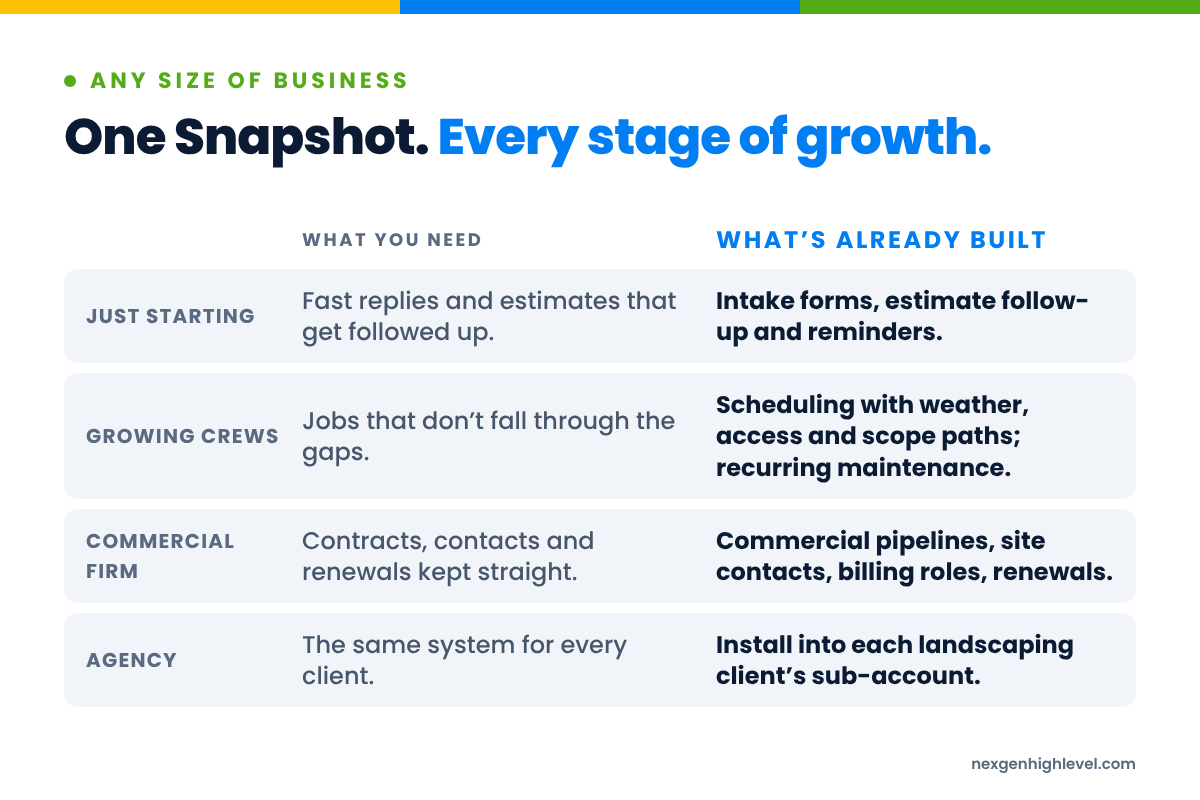
How it fits every size of business
| Business | What matters most | How the Snapshot helps |
|---|---|---|
| Solo starter | Answering fast, following up estimates, getting reviews | Switch on the enquiry, estimate and review journeys first. Everything else is ready when you grow |
| Growing owner with crews | Scheduling, weather days, access notes, scope changes, recurring work | Separate weather, access and scope paths against the job; recurring maintenance tied to each property |
| Established and commercial firm | Control, renewals, multiple contacts per account | 7 pipelines including commercial; site contacts, billing roles and procurement kept apart; renewals handled as real decisions |
| Agency with landscaping clients | Delivering a proper system for each client | Install into multiple client sub-accounts and adapt for each one |
The solo starter. You don't have to use everything. Switch on what you need now. The rest is sitting there, built and waiting, for the day you hire your first crew.
The growing owner. This is where it earns its place. The weather, access and scope paths alone save the kind of phone-call chaos that eats a Monday.
The established and commercial firm. Seven pipelines, with commercial work handled as commercial work. Site contacts aren't billing contacts. Procurement isn't the person on site. Renewals are a decision, not an assumption.
The agency. You can install it into multiple client sub-accounts, so every landscaping or lawn care client gets a proper system, not a contact form and a prayer.
The honest bit about setup
It's not magic, and I won't pretend it is.
The workflows arrive as drafts, with triggers off. The AI ships off until you switch it on. You add your brand, your team and your accounts, connect them, select them in the workflow actions, test it, and switch it on at your own pace.
That's deliberate. Nothing fires at your customers before you're ready. I'd far rather you spend a few days setting it up properly than have the Rusher in you switch on everything at once.
Clients have used our Snapshots to skip months, if not years, of trial and error building a system. That's the real value. Not the counts. The years you don't have to spend building it yourself. There's more on that idea in why a HighLevel Snapshot is a business in a box, and you can see all of our HighLevel Snapshots in one place.
Get HighLevel through NexGenHighLevel
If you're not on HighLevel yet, or you're about to start, this is the part worth reading twice.
When you create your HighLevel account with NexGenHighLevel, you get:
- The Landscaping & Lawn Care Snapshot, free.
- A heavily discounted HighLevel account. I won't quote numbers here; see your price on the page.
- Over 200 HighLevel training courses.
- Access to all our Apps for HighLevel.
- 24/7 support and personalised onboarding, one to one.
- A full HighLevel sub-account under the NexGenHighLevel agency.
So instead of buying the platform, then hunting for a system, then working it all out alone at 11pm, you start with the system already installed and people to help you set it up.
If you're starting a landscaping business, that's the difference between building from scratch and starting with the hard part done. I've written about starting a business without starting from scratch, and this is exactly what I mean.
See what's included and your price on the Get HighLevel page.
Apps that help landscaping and lawn care firms
HighLevel does a huge amount brilliantly. Where something's missing, that's where we build. Every one of our Apps for HighLevel is built to be part of HighLevel, not a complement to it: it works with the Workflows, Contacts, Tags and Conversations already there, so there's no bolting on extra tools to make it work.
Three are worth knowing about for this trade.
LinkedIn for HighLevel for commercial prospecting. Property managers and facility managers are on LinkedIn. Search for them from inside your HighLevel account, enrich the results with business email addresses, and add them to workflows for outreach: viewing profiles, connection requests, messages and InMails, including video or voice notes. More in our guide to LinkedIn prospecting in HighLevel.
WhatsApp for HighLevel for customer messaging. Plenty of customers would rather message than take a call. WhatsApp conversations sit in HighLevel alongside everything else, with no pay-per-message charges and no templates to use. Handy for "we're running late because of the rain" and "here's a photo of the finished job".
Custom Value Forms for agencies. If you onboard landscaping clients, you'll know the pain of getting every detail out of them and then filling in all the Custom Values yourself, or chasing them to do it. This app lets clients fill it in themselves.
Your first 30 days: a launch checklist
If you're starting a landscaping or lawn care business, here's a practical first month. Established firms can use it as an audit.
Week 1: foundations
- [ ] Choose your lane and your service area.
- [ ] Pick a business structure with an accountant.
- [ ] Register the business and any DBA with your state.
- [ ] Get your EIN (free, from the IRS).
- [ ] Check which licences and certifications your services need in your state.
Week 2: protection
- [ ] Arrange general liability, vehicle and any required insurance.
- [ ] Write a simple safety plan and get the right PPE.
- [ ] Open a separate business bank account.
Week 3: your system
- [ ] Set up HighLevel and install the Snapshot.
- [ ] Add your brand, services, team and service area.
- [ ] Connect your email, phone and calendar.
- [ ] Test your enquiry form and estimate follow-up yourself, as a pretend customer.
- [ ] Switch on the first journeys: enquiry, assessment booking, estimate follow-up, reviews.
Week 4: customers
- [ ] Complete your Google Business Profile in full.
- [ ] Ask every existing customer for a review.
- [ ] Door hangers on the streets you already serve.
- [ ] Set your prices and minimum charge from your real costs.
- [ ] Start tracking your weekly numbers.
Your first 90 days: a plan
Days 31 to 60: tighten
- Review every estimate sent. Won, lost or parked, and why?
- Check your response time to new enquiries every week.
- Switch on recurring maintenance tracking for every regular customer.
- Build your first seasonal campaign for the season ahead.
- Reply to every review, properly.
Days 61 to 90: grow
- Look at gross margin by service. Do more of what pays, and rethink what doesn't.
- Tighten routes for density.
- If commercial is your goal, build a target list of local properties and start outreach.
- Switch on scheduling paths for weather, access and scope changes as your crews grow.
- Plan your off-season offers before the season ends, not after.
Six weeks to find out beats six months of wondering. Back yourself.
Frequently asked questions
How do I start a lawn care business?
Pick your services and a tight service area. Choose a business structure, register with your state, get a free EIN from the IRS, and check what licences you need, especially for any pesticide application. Arrange insurance. Price from your real costs, set a minimum charge, then build a Google Business Profile and ask every early customer for a review. Put a system in place from day one, so enquiries and estimates never go quiet.
Do I need a licence to start a landscaping business?
It depends on your state and your services. The EPA requires certification for anyone applying or supervising restricted use pesticides, and the BLS notes most states license pesticide applicators. Some states license landscape contractors (California's C-27, for example) or irrigation work (TCEQ in Texas). Most businesses also need state and local registration. Rules vary, so check with your state before taking on work.
How much should I charge for lawn mowing?
There's no honest single number, because it depends on your area, your costs and your route. Work out your true cost per hour, including labour, travel, equipment, fuel, insurance and overheads, then add profit as a line, not a leftover. Estimate time per property, set a minimum charge, and price route density into it. Review prices as costs rise.
How do I get commercial landscaping contracts?
Build a list of local properties: office parks, retail centres, apartment communities and HOAs. Find the property or facility manager and who signs off. Approach them with something specific to their site, have proof of insurance ready, and follow up patiently, knowing when contracts come up for renewal. Once you win, separate site contacts, billing and procurement, and handle renewals as a fresh decision.
What software do landscapers use?
Many use separate tools for scheduling, quotes, email, reviews and their website. The problem is those tools rarely talk to each other. HighLevel brings CRM, pipelines, forms, calendars, email, SMS, reviews, websites, automation and reporting into one platform, with unlimited users on its plans. With the Landscaping & Lawn Care Snapshot, the landscaping CRM side is already built for you.
What is a HighLevel Snapshot?
A Snapshot is a ready-built set of pipelines, workflows, funnels, forms, templates and more that installs into a HighLevel account. A good one is a complete business system for a niche, not just a contact form and a follow-up. You add your brand, team and accounts, test it, then switch it on at your own pace.
Can I use the Landscaping Snapshot if I'm just starting?
Yes. Switch on only what you need now (enquiries, estimate follow-up and reviews, for example). The rest is built and ready for when you add crews, recurring maintenance or commercial work. If you get HighLevel through NexGenHighLevel, the Snapshot comes free, with training courses and onboarding to help you set it up.
Start with the system, not the blank page
Here's what I'd want you to take from all of this.
Running a great landscaping or lawn care business isn't one big secret. It's a hundred small things done consistently. Answer fast. Follow up every estimate. Record the access notes. Tell people when it rains. Walk the job with the customer. Ask for the review. Renew properly. Do it again next season.
None of it is hard on its own. Doing all of it, every time, with crews out and the phone ringing? That's hard.
That's what a system is for.
So write the playbook for your business. Or start with the Landscaping & Lawn Care Snapshot, create your HighLevel account with NexGenHighLevel and get it free.
Because you don't need to build the playbook from scratch.
As it happens, we've already built it.