


Somebody fills in your form at eleven o'clock at night. They've just been turned down for a mortgage, a car or a flat they really wanted, and there's something on their credit report they don't recognise. Or something they do recognise, and wish they didn't.
They're embarrassed. A bit scared. And they've already seen three adverts promising to "fix" their credit in 30 days.
What they need is someone honest. Someone who will look at their reports properly, tell them what can and can't be done, help them challenge what's genuinely wrong, and teach them how to build something better from here.
That's what a good credit repair business does. Not magic. Not deleting the truth. Expertise, organisation, education and support, done properly and done within the law.
And credit repair is heavily regulated in the US. Get the rules right and you can build something that genuinely changes people's lives. Get them wrong and you can lose the lot.
So this playbook is about running a legitimate, compliant credit repair company. The whole thing, from the law you must follow to the client who graduates and sends you their sister. And, as it happens, we've already built it.
Who this playbook is for
I've written this for three people at once. You'll probably see yourself in one of them.
1. The person starting out. Maybe you've worked in lending, mortgages or collections, or sorted out your own credit years ago. Now you want to start a credit repair business properly: the law, registration, charging and finding clients without cutting corners.
2. The owner-operator or small team. You've got clients. Maybe twenty, maybe a hundred. You're doing disputes, chasing documents, answering texts at the weekend and trying to remember who's due a check-in. You want to grow, but more clients right now would mean more chaos.
3. The established firm. Staff, processors, referral partners, done-for-you clients and a DIY coaching programme. You need control, consistency and a client experience that doesn't depend on who's in the office that day.
And there's a fourth reader I'll talk to near the end: the agency with credit repair clients. If you build marketing and HighLevel accounts for credit repair companies, understanding how they're regulated is not optional. It's half the job.
How to use this playbook
It's long, on purpose. Starting out? Read the law, state rules and setup first. Already running? Jump to the client journey and referral partners. Thinking about software? Skip to why HighLevel fits. The checklists and tables are there to steal.
And if you'd rather see the finished system first and read the reasoning afterwards, the Credit Repair Snapshot for HighLevel is this playbook built out inside the platform. I'll show how it maps to every section later on.
The bit I have to say up front
I'm not a lawyer. Nothing in this playbook is legal advice. It's general information, drawn from the federal statutes, the regulators and the state pages I link to, so you can check every word yourself.
Rules change and they vary by state. Before you take a single client, check your state's rules and speak to a qualified attorney who knows consumer finance law. That's not me covering myself. That's the first, cheapest and best investment you'll make in this business.
Why people need help with credit
Let's start with the facts. Not the "credit repair is a goldmine" headlines. The actual numbers, from the people who collect them.
Credit reporting is the biggest source of complaints
The Consumer Financial Protection Bureau's Consumer Response Annual Report, published in March 2026, says it received 6,635,400 complaints in 2025. More than 5.8 million of those were about credit or consumer reporting. That's 88% of everything it received.
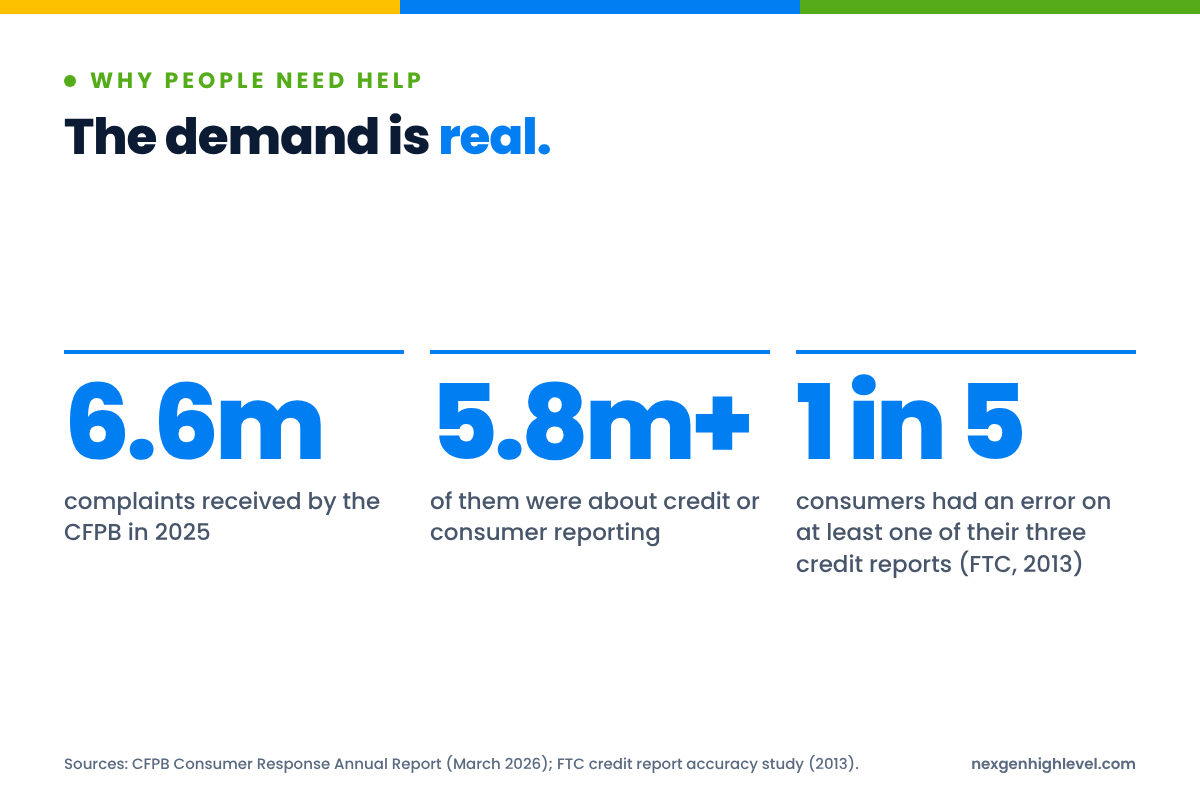
And the most common issue? "Incorrect information on your report."
There's an honest caveat in that report. The CFPB points to "the increase in third parties using the complaint process, including credit repair organizations" as one factor in the rising volume. It refers to "credit repair and other actors who are misusing the complaint process", and says companies returned around 302,200 complaints as duplicates.
So the regulator is watching how credit repair firms behave. Bulk-filing complaints or disputes on autopilot isn't a strategy. It's a red flag with your name on it.
Errors are real
The Federal Trade Commission ran a major study of credit report accuracy, released in February 2013. It involved 1,001 participants who reviewed 2,968 credit reports.
What it found:
- One in five consumers had an error on at least one of their three credit reports.
- One in four identified errors that might affect their credit scores.
- Slightly more than one in 10 saw a change in their credit score.
- Five percent had errors on one of their three major reports that could lead to less favourable terms.
Read that again. One in five had an error. Not one in five got a better score or had items removed. Errors are what a credit repair business can legitimately help people find and challenge.
Household debt is high
The New York Fed's Household Debt and Credit Report for Q2 2026, released in August 2026, puts total US household debt at $18.8 trillion. Credit card balances were $1.26 trillion, up $21 billion. And 4.7% of outstanding debt was in some stage of delinquency.
Some people barely show up at all
Then there are the people the system can't see properly. The CFPB's credit invisibles update from June 2025 estimates 2.7% of adults (7.0 million people) were credit invisible in December 2020. Another 9.8% had records that couldn't be scored, either because they were stale or because there wasn't enough on them.
Those people don't need disputes. They need education and a plan for building credit.
What the demand really is
So the need is real. But people don't actually want "credit repair". Nobody lies awake at night wanting a dispute letter.
They want the mortgage. The car. The flat. The feeling of not being judged every time they apply for something.
Start with the person, not the product. That's where every good credit repair company begins.
Human. Strategy. Leverage. In that order.
The law every credit repair business must follow
This is the longest section in the playbook. It should be.
In credit repair, the law shapes everything: your adverts, your contract, when you can take money and how. So here it is in plain English, with links to the source so you can read the original words, then read them again with your attorney.
The Credit Repair Organizations Act (CROA)
The federal law is the Credit Repair Organizations Act, at 15 U.S.C. 1679 and onwards.
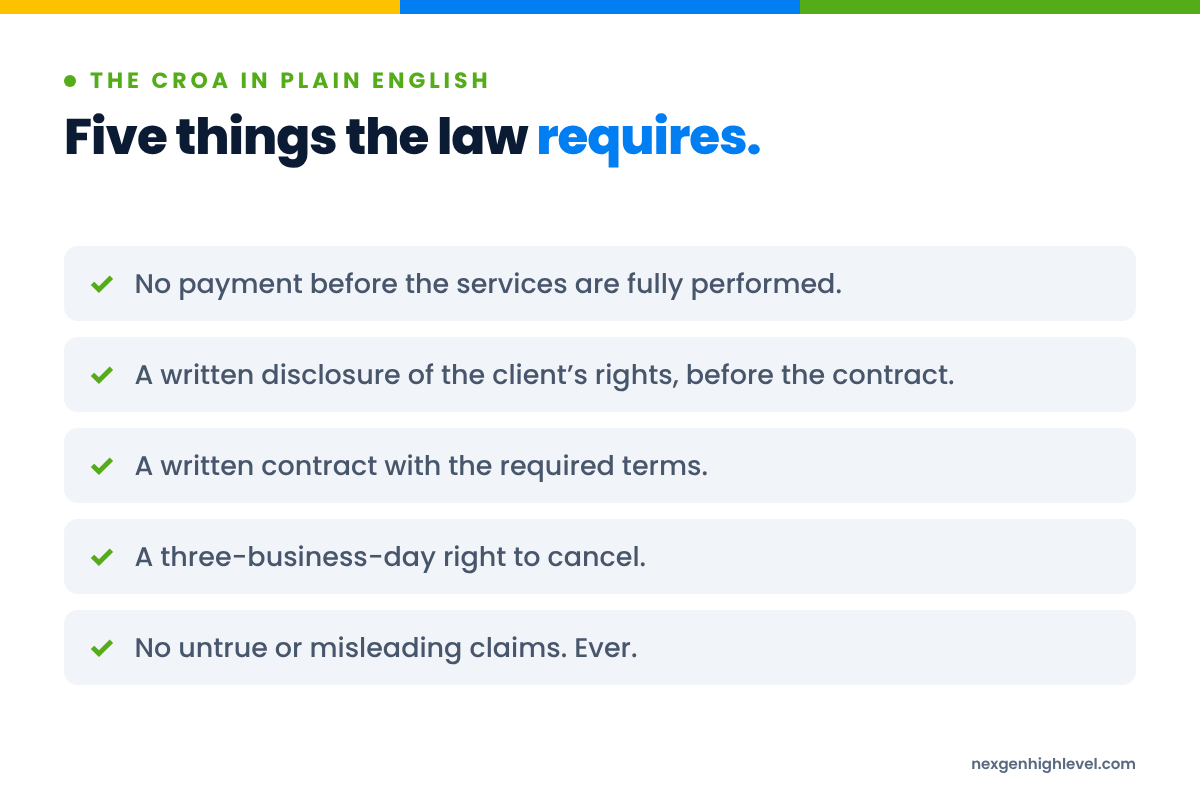
Who it covers. A "credit repair organization" is "any person who uses any instrumentality of interstate commerce or the mails to sell, provide, or perform" services aimed at "improving any consumer's credit record, credit history, or credit rating". That's broad. Nonprofits exempt under section 501(c)(3) are excluded.
No payment before the work is done. This is the big one. The Act says: "No credit repair organization may charge or receive any money or other valuable consideration for the performance of any service which the credit repair organization has agreed to perform for any consumer before such service is fully performed." You'll find it at 1679b(b).
Not "before most of it is done". Not "a small setup fee". Before it's fully performed.
No misleading statements. Under 1679b(a), nobody may make, or counsel a consumer to make, any statement "which is untrue or misleading" about the consumer's creditworthiness, credit standing or credit capacity. You can't advise anyone to alter their identification to hide accurate adverse information, or "make or use any untrue or misleading representation of the services of the credit repair organization".
The disclosure statement. Before a client signs anything, you must give them a written statement titled "Consumer Credit File Rights Under State and Federal Law" (1679c(a)). It tells them, among other things:
- "You have a right to dispute inaccurate information in your credit report by contacting the credit bureau directly."
- "Neither you nor any 'credit repair' company or credit repair organization has the right to have accurate, current, and verifiable information removed from your credit report."
- "The credit bureau may not charge any fee for this service."
It must be given "before any contract or agreement between the consumer and the credit repair organization is executed", and "separate from any written contract" (1679c(b)). The client's signed statement must be kept "in the organization's files for 2 years" (1679c(c)).
Think about that. By law, you tell every client, before they pay a penny, that they can do this themselves for free and nobody can remove accurate information. If your business can't survive that conversation, it isn't a business.
A written, dated contract. Under 1679d, you can only provide services under "a written and dated contract" signed by the client. And you can't start any services until the end of "the 3-business-day period beginning on the date the contract is signed".
The contract must include:
- The terms and conditions of payment, including "the total amount of all payments to be made by the consumer".
- "A full and detailed description of the services to be performed", including all guarantees and an estimate of the time to perform them.
- Your business name and principal business address.
- A conspicuous cancellation statement near the signature.
The right to cancel. Under 1679e, the client can cancel "at any time before midnight of the 3rd business day which begins after the date" the contract is signed. The contract must carry the bold statement that begins "You may cancel this contract, without any penalty or obligation, at any time before midnight of the 3rd day...", plus a "Notice of Cancellation" form in duplicate.
No waivers. You can't get a client to sign away these protections. Any waiver is void, and trying to get one is itself a violation (1679f).
What happens if you get it wrong. The consequences are serious:
- Civil liability (1679g). Actual damages or the amount the client paid, whichever is greater. Punitive damages in "such additional amount as the court may allow". Plus "the costs of the action, together with reasonable attorneys' fees". In class actions, the court sets the amounts, with no fixed cap.
- Enforcement (1679h). Violations are treated as unfair or deceptive practices under the FTC Act and enforced by the FTC. State attorneys general (the "chief law enforcement officer") can sue too.
- Time limit (1679i). Five years from the violation. Where an organisation materially and wilfully misrepresented required information, the clock runs from when the consumer discovers it.
The Telemarketing Sales Rule (if you sell by phone)
Here's where a lot of people come unstuck.
If you sell credit repair over the phone, the Telemarketing Sales Rule (16 CFR 310.4(a)(2)) adds a stricter test. It's an abusive practice to request or receive payment for credit repair services until:
- The time frame in which you promised to provide the services has expired, and
- You've given the person documentation, in the form of a consumer report from a consumer reporting agency, showing the promised results, issued more than six months after the results were achieved.
Read that twice. Sell by phone and you may wait a long time to be paid.
And regulators do enforce it. In the CFPB's case against Progrexion and Lexington Law, the court ruled in March 2023 that the defendants "violated the TSR's prohibition on upfront fees". In August 2023 it entered "a judgment of $2,660,926,481 for consumer redress against all defendants", civil penalties of $45,817,452 and $18,408,726, and a "10-year ban on defendants' telemarketing credit repair services". (The CFPB page was last updated in May 2024, so check it for anything since.)
I'm not quoting that to frighten you. It shows the rules are real and enforced. Design your sales process with your attorney before you design your adverts.
Your clients' rights under the FCRA
The Fair Credit Reporting Act gives every consumer the right to dispute. Know it inside out.
Disputes are free. A credit bureau must "free of charge, conduct a reasonable reinvestigation" of disputed information.
The timeline. The bureau has to do it "before the end of the 30-day period beginning on the date on which the agency receives the notice". That can be extended "for not more than 15 additional days" if the consumer sends relevant information during the period. Written results must go out "not later than 5 business days after the completion of the reinvestigation".
Furnishers too. The CFPB explains that "fixing an error generally means contacting both the credit reporting company and the company that provided the information", and that furnishers "generally must investigate and respond to your dispute within 30 days of when they receive the dispute."
Frivolous disputes. The FTC notes that a bureau can stop investigating if it considers a dispute "frivolous" or "irrelevant", though it must say why.
Free reports. The FTC says consumers can check their credit report from each bureau once a week for free at AnnualCreditReport.com.
So, plainly: your clients can dispute inaccurate information themselves, for free. The CFPB puts it this way: "Disputing errors in your credit reports is a free legal right available to you under the Fair Credit Reporting Act. You don't need to pay a credit repair organization to do it for you."
You're not selling access to a right. They already have it. You're selling expertise, organisation, time, education and support. That's an honest product, the same way people pay an accountant for something they technically could do themselves.
How long accurate negative information stays
This is the conversation you'll have more than any other. Clients want to know when the bad stuff goes away.
Under 15 U.S.C. 1681c(a):
- Bankruptcies can be reported for 10 years.
- Accounts placed for collection or charged off can be reported for seven years.
- "Any other adverse item of information" can be reported for seven years (criminal convictions are an exception).
- Those limits don't apply to reports for credit of "a principal amount of $150,000 or more", life insurance of $150,000 or more, or jobs paying "$75,000, or more".
If an item is accurate and within its reporting period, it can stay. The FTC says it clearly: "Companies that promise to repair your credit can't remove true information." And the CFPB, on removing accurate information: "No one can do this."
What the regulators warn consumers about
Your future clients are reading these pages. You should too, because they describe exactly what your business must never look like.
The FTC's credit repair FAQs say:
- "Scammers insist you pay them before they help you."
- It's illegal for these companies to "charge you before they help you".
- "If a company promises to create a new credit identity or hide your bad credit history or bankruptcy, that's also a scam."
The FTC also describes schemes that get people to apply for EINs from the IRS under false pretences to create a new credit report. However a "new credit identity" scheme is dressed up, the FTC calls it a scam. Don't sell it, don't refer anyone to it, and if a client asks, point them to the FTC's page.
The CFPB adds: "A simple rule to follow is 'Don't pay upfront'". It also warns about companies that advise disputing "all the information in your credit report, even if it is correct and timely".
Read those pages as if you were the client. If anything your business says or does would make you uneasy, change it.
The law isn't the obstacle to a good credit repair business. It's the description of one.
State registration, bonds and licensing
Federal law is the floor. Many states add registration, bonds, fees and renewal dates on top, and the rules vary and change. These are examples only, not a complete list. Check the current rules in every state where you do business. Ask your attorney whether the states your clients live in matter too.
California
The California Department of Justice says "Credit Services Organizations that operate in California are required to file a registration application" and receive a certificate of registration before doing business. There's a "$100 filing fee made payable to the Department of Justice". You must "obtain a bond in the amount of $100,000, or make a deposit in lieu of the bond", filed with the Secretary of State. Certificates "expire one year from the date it is issued", and "No renewal notice or reminder will be sent." The page cites Civil Code section 1789.25, part of the state's Credit Services Act.
That last line is worth a reminder in your calendar on day one.
Texas
The Texas Secretary of State says "before conducting business in Texas, a CSO must register with the secretary of state" (Finance Code 393.101). "The fee for an original certificate of registration or renewal is $100." The bond is "$10,000.00 for each location". "Each registration is effective for one year and may be renewed." It's governed by Finance Code chapter 393 and 1 TAC chapter 74.
Florida
Florida's statute (s. 817.7005(1)) says a credit service organisation may not charge or receive money "prior to full and complete performance of the services" unless it has "obtained a surety bond of $10,000 issued by a surety company admitted to do business in this state" and "established a trust account at a federally insured bank or savings and loan association located in this state". Money taken in advance must be held in that trust account until the services are fully performed.
Georgia
Georgia takes a very different line. The law shown on the Georgia Consumer Protection Division site (O.C.G.A. 16-9-59) says "A person commits the offense of operating a credit repair services organization when he or she owns, operates, or is affiliated with a credit repair services organization", and that it is "a misdemeanor". Some organisations are excluded, including regulated lenders, FDIC-insured banks, 501(c)(3) nonprofits and Georgia-licensed attorneys and real estate brokers acting within their licence.
The page shows the text as current through the 2007 session, so check the current code. But the point stands: in some states, the rules are very different, and you need to know them before you take on clients there.
A warning about state advance-fee rules
Some states, Texas and Florida among them, allow advance fees under state law if you have a bond (and in Florida, a trust account). The Texas FAQ itself warns that advance fees may violate the FTC's Telemarketing Sales Rule.
And the federal CROA ban on charging before services are fully performed still applies to credit repair organisations. A state bond does not switch off federal law.
So never read a state's bond rule as permission to charge upfront. Take legal advice on how state and federal rules apply to your business.
State checklist
Use this for every state you operate in or take clients from:
- [ ] Does the state require registration before doing business? With which office?
- [ ] Is a bond (or deposit, or trust account) required? How much, per location?
- [ ] What's the fee, and when does registration expire? Is there a renewal reminder (California says there isn't)?
- [ ] Are there state-specific disclosures or contract terms on top of CROA?
- [ ] Is the activity restricted or treated differently (as in Georgia)?
- [ ] Have I had all of this confirmed by a qualified attorney?
Rules vary by state. Check with your state, every time.
Choosing your credit repair business model
Once you understand the law, the next question is what you're actually going to sell. There are three broad models, and you can mix them.
Done-for-you
You do the work. You analyse the reports with the client, identify items that look inaccurate, incomplete or unverifiable, prepare and send disputes, track responses, and keep the client informed.
It suits people who are busy or overwhelmed. It's the most time-intensive model, and the one where organisation matters most. Fifty clients, three bureaus each, several rounds of disputes and deadlines. Without a system, that becomes chaos fast.
DIY coaching and education
You teach the client to do it themselves. Courses, templates, guides, group calls, one-to-one coaching. You help them understand their reports, their rights and how to build better credit habits.
It suits people who want to learn, people on tighter budgets, and the people with thin or unscored files from earlier, who need a plan for building credit rather than anything to dispute.
But be careful. CROA covers anyone who sells services aimed at "improving any consumer's credit record, credit history, or credit rating", and the statute text also covers "providing advice or assistance". Whether a pure education product falls inside CROA is a legal question, and I couldn't find regulator guidance that settles it. Don't assume coaching gets you out of the rules. Ask your attorney, and in the meantime treat it with the same care.
Hybrid
A mix. Done-for-you for clients who want it, DIY for those who don't, and often education running alongside the done-for-you work so clients understand what's happening and keep good habits after they leave.
It lets you serve more people at more price points, and it's a natural ladder: someone starts on DIY coaching, runs out of time and moves to done-for-you, or graduates and stays on a lighter education programme.
How and when you charge
This is where the law and your model meet, so let's be very clear.
- CROA's test. The only legal test the statute gives is that payment may not be charged or received "before such service is fully performed" (1679b(b)). And no services can start before the 3-business-day cancellation period ends (1679d(a)).
- Monthly billing in arrears. Some firms bill monthly for work already completed. That still has to meet the CROA test. I couldn't find any regulator page that sets out a specific safe harbour for monthly billing, so define exactly what "the service" is in your contract, and have your attorney check how you bill against it.
- Telephone sales. If you sell by telemarketing, the TSR adds its stricter test: no payment until the promised time frame has passed and the client has a consumer report, issued more than six months after the results were achieved, showing those results.
- Pay-per-deletion. Some firms charge per item removed. I couldn't find an FTC or CFPB page that addresses "pay per delete" by name. What the law does say: payment can't come before the service is fully performed, contracts must describe all guarantees, and nobody may misrepresent services. And remember the CFPB's point that no one can remove accurate information. A model that only pays when something disappears can push a business towards disputing everything, which the CFPB warns consumers about. Take advice before you go near it.
| Model | Who it suits | What you deliver | Charging questions for your attorney |
|---|---|---|---|
| Done-for-you | Busy or overwhelmed clients | Analysis, disputes, tracking, updates | What counts as "fully performed" each month? |
| DIY coaching and education | Learners, tighter budgets, thin files | Courses, templates, coaching, credit-building plans | Does CROA apply to this product as sold? |
| Hybrid | Firms serving a range of clients | Both, often with education alongside | How do both sides of the offer meet CROA? |
| Sold by phone (any model) | Any | Any | How does the TSR's stricter test apply? |
The model you choose decides your workload, your cash flow and your compliance. Choose it on paper, with advice, before you choose your logo.
Setting up a credit repair company properly
This is the boring section. It's also the one that stops you losing everything later.
Structure and registration
Choose a business structure with an accountant and your attorney. Register the business in your state, get an EIN from the IRS, and open a separate business bank account from day one. Then deal with credit repair registration and bonds in every state that needs them.
Insurance
Talk to a broker who understands financial services. Ask about professional liability (errors and omissions), general liability, and cyber or data breach cover.
Data security
Think about what your clients hand over. Photo ID. Proof of address. Credit reports. Social Security numbers. Dates of birth. Account details. Everything an identity thief could want, in one folder.
Strong data security is what your clients assume you're doing. A note on the FTC Safeguards Rule, because you'll see it mentioned. The rule's definitions name "a credit counseling service" as an example of a covered financial institution, and the FTC's guide mentions "credit counselors and other financial advisors". Credit repair isn't named. Whether it applies to you is a question for your attorney. But the guide's requirements make a good checklist either way: a written information security programme, a named person responsible for it, a written risk assessment, encrypting customer information "on your system and when it's in transit", and multi-factor authentication.
The FTC's Protecting Personal Information guide gives five simple principles: "TAKE STOCK", "SCALE DOWN", "LOCK IT", "PITCH IT" and "PLAN AHEAD". It also says: "Use Social Security numbers only for required and lawful purposes."
In practice: know what you hold and where, collect only what the service needs, use secure uploads (never email attachments), turn on multi-factor authentication everywhere, limit staff access by role, securely delete what you no longer need (keeping what you must, like the signed CROA disclosure), and write down what you'd do if something went wrong.
Contracts and disclosures
Have your attorney draft (or review) your:
- CROA "Consumer Credit File Rights Under State and Federal Law" disclosure, given separately and before the contract.
- Written, dated service agreement with payment terms, the total of all payments, a full description of the services, a time estimate, your name and principal address, and the cancellation statement.
- Notice of Cancellation form, in duplicate.
- Any state-specific disclosures.
- Privacy notice and terms for your website.
- Consent wording for texts, calls and emails (more on that in marketing).
Then build your process so these happen in the right order, every time, for every client. Disclosure first. Then the contract. Then the three business days. Then the work. No exceptions because someone's in a hurry.
Setup checklist
| Item | Done |
|---|---|
| Business structure chosen with an accountant | [ ] |
| Business registered with your state | [ ] |
| EIN from the IRS | [ ] |
| Business bank account | [ ] |
| Credit repair registration and bond in each state that requires it | [ ] |
| Renewal dates in the calendar | [ ] |
| Insurance reviewed with a broker | [ ] |
| Written data security plan, MFA, secure uploads | [ ] |
| CROA disclosure, contract and cancellation form drafted by an attorney | [ ] |
| Consent wording for texts, calls and emails | [ ] |
Pricing and profit in a credit repair business
I'm not going to give you a number to charge. I don't know your market, your costs, your model or your state's rules, and anyone who gives you a price without knowing those things is guessing.
What I can give you is the method.
Work out what a client really costs you
Start with your time. How long does a typical client take, from consultation to graduation? Count all of it:
- The consultation and analysis call.
- Collecting and checking documents.
- Reviewing three reports properly.
- Preparing, sending and tracking disputes.
- Monthly check-ins and progress updates.
- Answering questions, which always takes longer than you think.
- Admin, compliance records and renewals.
Then your costs: software, insurance, registration and bond costs, postage, any staff, your own salary. Divide by the number of clients you can realistically serve well. That gives you the floor. Below it, you're paying to work.
Choose a structure the law allows
Go back to the previous sections. Whatever you charge, you can't take it before the service is fully performed, and if you sell by phone the TSR's stricter test applies. One approach is to charge for a consultation or analysis only once it has been fully delivered, and then bill monthly for work completed. Whatever you choose, define each service clearly in your contract and get your attorney to sign off on how and when you bill.
Plan your cash flow
Because you can't take money in advance, you'll always do the work first and get paid later. You need enough cash to cover your costs while you wait.
Picture a one-person credit repair business that signs ten new clients in its first month. Every one takes time straight away, and none of it can be paid for until it's done. Without a plan for that gap, a good month can feel like a bad one.
So plan for it. Know how many months of costs you can cover. Grow at a pace your cash can support.
Retention is where the profit is
Much of the cost of a client comes at the start: finding them, the consultation, onboarding, the first analysis. The longer a client stays engaged and well served, the better the economics.
But retention in credit repair has to be honest. You keep clients by doing good work and showing them what's happening every month, not by dangling promises. When they've achieved what they came for, they should graduate, not be kept on because the direct debit is convenient.
A client who graduates happy is worth more than one who stays resentful. They'll come back if they need you, and they'll send people.
Charge for the work. Never for the promise.
Credit repair marketing done the right way
Here's an uncomfortable truth about credit repair marketing. A lot of what you see out there wouldn't pass the rules we've just been through.
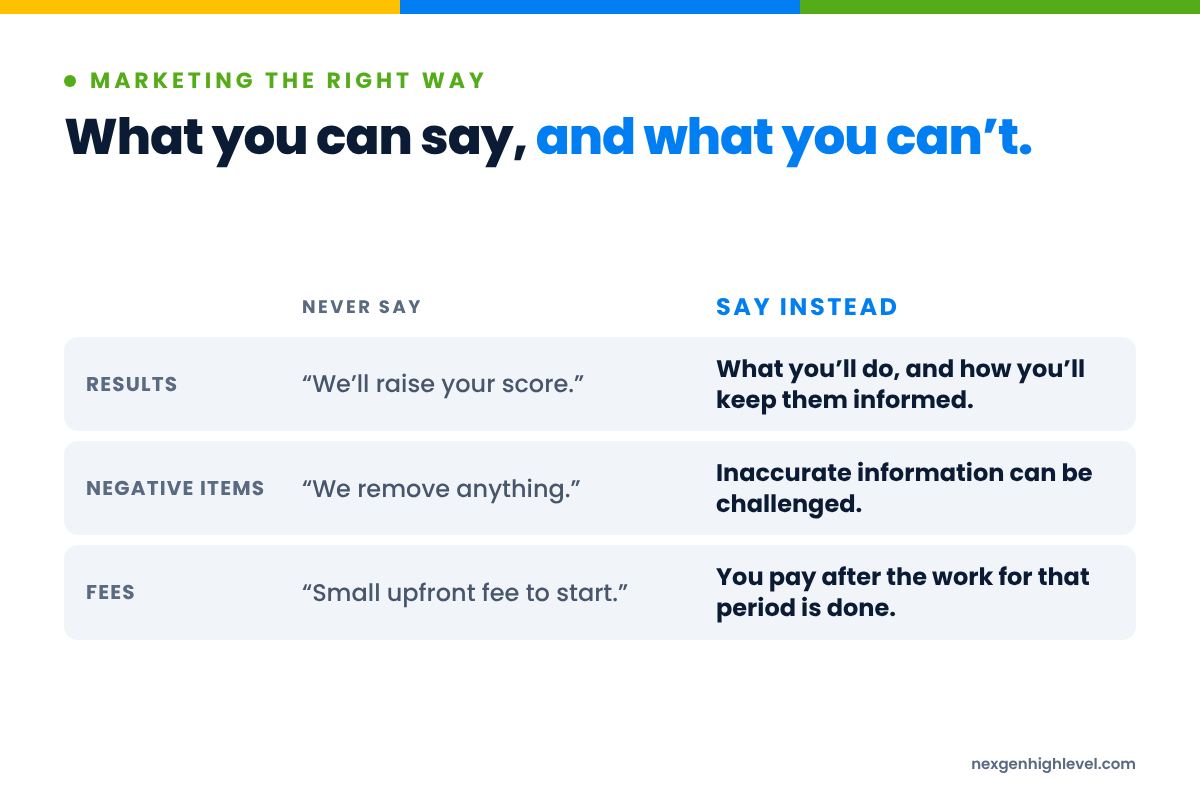
"Add 100 points in 30 days." "Delete your collections." "Guaranteed results or your money back." "Get a fresh start with a new credit file."
You can't say any of it. And you shouldn't want to. The people who respond to those promises are the ones most likely to feel cheated later. Good credit repair marketing is slower, more honest and more human.
Truth in advertising
The FTC's advertising basics are short: "Under the law, claims in advertisements must be truthful, cannot be deceptive or unfair, and must be evidence-based."
Add CROA's ban on "any untrue or misleading representation of the services of the credit repair organization", and you have your rules. In practice:
- No score promises. You can't know what will happen to anyone's score.
- No deletion promises. Accurate, current information can stay on a report, and nobody can remove it.
- No guarantees of results. Nobody controls what bureaus and furnishers decide.
- No "new credit identity" anything. The FTC calls it a scam.
- No speed claims. Bureaus and furnishers work on their own timelines.
What you can say: what you do, how you do it, who it's for, what the law gives the client, and how you'll support them. "We'll review all three of your reports with you, help you challenge anything that looks inaccurate, and teach you how to build stronger credit from here." That's honest. It's also a lot more reassuring to a nervous person than a number in a red circle.
Reviews and testimonials
Reviews matter in any local business. BrightLocal's Local Consumer Review Survey 2026, of 1,002 US adults, found:
- 97% read reviews for local businesses.
- 74% only care about reviews from the last three months.
- 47% won't use a business with fewer than 20 reviews.
- 89% expect owners to respond to reviews, and 50% are put off by templated replies.
But in credit repair, reviews and testimonials need extra care.
The FTC's Endorsement Guides say a consumer endorsement about a key attribute "will likely be interpreted as representing that the endorser's experience is representative of what consumers will generally achieve". If you can't back that up, the ad "should clearly and conspicuously disclose the generally expected performance in the depicted circumstances".
So a testimonial about a big score jump is effectively a claim that other clients will get something similar. Be very careful putting anything like that in your marketing. Testimonials about how you treated people (clear, patient, honest, organised) are a far safer and more truthful place to start.
And the FTC's Consumer Reviews and Testimonials Rule (16 CFR 465) bans fake reviews, including "AI-generated fake reviews", buying reviews conditioned on a particular sentiment, undisclosed insider reviews, company-controlled review sites, suppressing reviews through threats or intimidation, and fake social media indicators. The FTC can "seek civil penalties against knowing violators".
Ask every happy client for an honest review. Never buy one, write one, or only ask the people you know will give five stars.
Consent for texts and calls (TCPA)
Credit repair runs on communication: reminders, check-ins, updates. Get consent right from the first form.
Under the TCPA rules at 47 CFR 64.1200, telemarketing or advertising calls using an autodialer or an artificial or prerecorded voice to mobile numbers need "prior express written consent". That's an agreement in writing, signed by the person (electronic signatures count), including their number and a disclosure that signing isn't a condition of purchase.
Also:
- No telephone solicitations "before the hour of 8 a.m. or after 9 p.m." local time at the called party's location.
- People can revoke consent "using any reasonable method", such as replying "stop", and you must honour it "within a reasonable time not to exceed ten business days".
- The National Do Not Call Registry covers "all telemarketers" and "both interstate and intrastate calls".
My advice: collect clear written consent for marketing texts and calls on your forms, keep a record of it, keep service messages and marketing messages separate, and make opting out easy. Check the detail with your attorney, particularly for texts.
Email (CAN-SPAM)
The FTC's CAN-SPAM guide for marketing emails:
- No false header information and no deceptive subject lines.
- Identify the message as an ad.
- "Your message must include your valid physical postal address."
- Tell people how to opt out, and "You must honor a recipient's opt-out request within 10 business days".
- "Each separate email in violation of the CAN-SPAM Act is subject to penalties of up to $53,088."
Google Ads: not an option
Here's one that surprises people. Google Ads does not allow credit repair ads.
Google's policy is blunt: "Ads for credit repair services are not allowed." It applies to advertisers "who offer credit repair services directly" and to "those who connect consumers with third-party credit repair services", which means lead generation too. Google's financial services policy lists no country exception or certification route for credit repair. Certification exists for debt settlement and debt management, not credit repair.
So don't build your plan around paid search. Don't try to dress your ads up as something else either. Build your marketing on the channels below instead.
Meta (Facebook and Instagram)
Meta has a "Financial products and services" special ad category, introduced in October 2024 to replace the older credit category, and required for US-based or US-targeted campaigns from January 2025. Credit ads are a subset of it.
The restrictions include: age fixed at 18 to 65+, no gender targeting, no ZIP code targeting, a location radius of at least 15 miles, and no location exclusion.
Check Meta's current advertising standards yourself before running anything. The rules change.
Where your clients will really come from
If paid search is out and paid social is restricted, where do clients come from? From the things that build trust over time.
- Google Business Profile. Complete every section. Real photos of real people. Your services described honestly. Steady, recent, genuine reviews, and a real reply to every one.
- Organic search. Helpful pages answering what people actually type in: how disputes work, how long negative information stays, how to read a credit report. Link to the FTC and CFPB. Being the honest voice is an advantage.
- Content and education. Short videos, free workshops, guides, an email newsletter. Teach people. The ones who want help will ask for it.
- Referral partners. Mortgage brokers, realtors, auto dealers. People who meet your future clients at the exact moment they've been told "not yet". This deserves its own section, and it gets one shortly.
- Past clients. The most underused source in any business. Look after them and ask.
This is combination marketing. Nobody books a consultation because they saw one post. They see a video, read a guide, check your reviews, hear your name from their mortgage broker, and then fill in the form at eleven at night.
In credit repair, your marketing is a promise. Make sure it's one you can keep.
The client journey from first enquiry to graduation
Now let's walk through the client journey. This is where your business either feels organised and trustworthy, or chaotic and slightly worrying. Clients notice which one.
1. Consultation request
Someone finds you and asks for help. Maybe through a free credit audit offer, a quiz on your website, a referral partner, or a Google search.
- Respond quickly. They've often just had bad news and they're nervous.
- Verify their contact details properly. You'll be sending sensitive information.
- Capture consent for texts and calls in the right way.
- Ask a few simple questions so you know what they're trying to achieve: a mortgage, a car, a rental, or just understanding where they stand.
2. Document collection
You'll typically need photo ID, proof of address such as a utility bill, and their credit reports. Point them to AnnualCreditReport.com for free reports.
- A secure upload, never an email attachment.
- Clear instructions about exactly what you need and why.
- Polite, automatic reminders, because missing documents stall a new client faster than anything.
3. Credit analysis call
You go through the reports together. What's there. What looks inaccurate, incomplete or out of date. What's accurate and will stay, and when it's likely to age off.
This is the most important conversation in the whole journey. It's where you set honest expectations. Tell them what you can do, what you can't, and what they can do for themselves for free. If disputing won't help, say so, and talk about education and credit-building instead.
Send prep instructions and reminders so they turn up, and take good notes.
4. Service agreement
If they want to go ahead, you follow the CROA order, every time:
- Give the "Consumer Credit File Rights" disclosure, separately, before the contract.
- Get their signed acknowledgement and keep it for two years.
- Send the written, dated contract with all the required terms.
- Wait out the three business days before starting any services.
- Only then begin onboarding.
This is the stage where a system pays for itself. Get the order wrong once and you have a problem.
5. Dispute preparation
The work starts. For done-for-you clients, you prepare disputes for items you've agreed look inaccurate, incomplete or unverifiable. Specific, individual, and backed by the client's information. Not every item on the report, and never accurate information dressed up as inaccurate.
Track each dispute: which bureau or furnisher, when it was sent, when a response is due (remember the 30-day reinvestigation period, with the possible 15-day extension), and what came back.
For DIY clients, you teach them to do the same.
6. Monthly check-ins
Every month, remind the client to refresh their reports, review what's changed and talk them through it. Some items are updated, some are verified and stay. Explain each one honestly.
7. Progress and milestones
When something good happens, celebrate it. A client reaching a goal they set with you. A milestone your business has chosen to mark. Someone getting the mortgage approval they came to you for.
Just be clear that you're celebrating progress, not delivering a promised result. Milestones are markers on the client's journey. They're not something you guarantee.
8. Graduation and referrals
When the client has achieved what they came for, or there's nothing more you can usefully do, they graduate. Tell them what they've achieved and what to keep doing. Then ask for an honest review and, if they're happy, a referral. A past client who trusts you is the best marketing you'll ever have.
Keeping clients engaged and informed
In my experience of service businesses, clients rarely leave because nothing happened. They leave because they didn't know what was happening.
Silence feels like nothing. And when someone is anxious about money, nothing feels like being ripped off.
Monthly updates
Every client should hear from you on a regular rhythm, whether or not anything changed. What was sent. What came back. What's still pending and when it's due. What happens next.
"Nothing back yet from one bureau, and the response is due by the 14th" is a perfectly good update. It shows you're on it.
Education alongside the work
Use the waiting time well. Teach clients how their reports work, how to avoid new problems and how to build positive history. Short emails, short videos, a simple monthly lesson. It helps them, it shows the value of what they're paying for, and it makes it less likely they end up back where they started.
Honest expectations, again and again
Repeat the truth regularly, kindly. Accurate information can stay. Bureaus take time. Results vary from person to person. Clients who hear that from the start, and often, trust you more, not less.
And make it easy to talk to you. Email, text or WhatsApp, whatever they prefer, with every conversation in one place so anyone on your team can see the full history.
Silence is the enemy of trust. Fill it with honesty.
Building a referral partner engine
If I could only give a credit repair business one marketing channel, it would be this one.
Think about who meets your future clients at the exact moment they need you. The mortgage broker who has to tell someone "not yet". The realtor whose buyer can't get approved. The auto dealer whose customer is about to walk out without a car.
Each has a client they want to help and can't. You can be the answer.
Who to partner with
- Mortgage brokers and loan officers. The most natural fit. Their clients often want to buy in six or twelve months and need to understand their credit first.
- Realtors. Buyers who aren't ready yet are future commissions. They want someone trustworthy to send them to.
- Auto dealerships. Customers who couldn't get the finance they wanted this time.
What partners actually want
Before you approach anyone, ask: why would they care? Three reasons. Their client being looked after. Their reputation, because their name sits next to yours. And getting that client back, ready, when the time is right. So:
- Make referring easy. A simple form or link. Ten seconds, not ten minutes.
- Keep them informed. With the client's permission, let the partner know the client has started, and when they've graduated. Agree with your attorney and the client exactly what you can share.
- Protect their reputation. Honest marketing, no promises, compliant processes. A mortgage broker will not send clients to a firm that might embarrass them.
- Send clients back. When a client graduates, they go back to the partner who referred them. That's the deal.
How to build the relationships
This is relationship work. People buy from people.
In recruitment, I had a telephone, a filing cabinet and a phone directory, and every deal was done face to face. The tools have changed. The principle hasn't: find the right people, be useful, stay in touch, keep your word.
Today that means a list of local brokers, loan officers and realtors, something genuinely useful to offer them (a short guide for their clients, a talk at their team meeting), and consistent follow-up over months, not days. LinkedIn is where a lot of these people spend their professional time, which is why we built a way to do that prospecting from inside HighLevel. More on that later, and there's a full walkthrough of LinkedIn prospecting in HighLevel.
Track every partner like a client
Give every partner a record: who they've referred, where each client is, when you last spoke, what you promised. Then keep a rhythm: a monthly update, a quarterly coffee, a thank you every time.
Partners don't stay loyal to the cleverest firm. They stay loyal to the most reliable one.
Growing without the chaos
This is the part I care most about, because I've got it wrong myself.
In recruitment, I grew aggressively. Big offices, big overheads, lots of people. Then Covid hit, and the world just stopped. Furlough covered salaries but not the rent, the property taxes, the leases or the software licences. I had to close the business and let people go. The hardest business decision of my life.
What I learned: walk before you run. And even when you're ready to run, keep walking for a little bit longer. Only run when you can see the green field stretching out in front of you.
Doubly in credit repair, where you're paid after the work. Growing too fast stretches your bank account as well as your team, and that's when compliance shortcuts creep in.
Systems before headcount
Before you hire another processor or spend more on marketing, ask:
- Does every new enquiry get a fast, consistent response?
- Does every client get the CROA disclosure, the contract and the cancellation period in the right order, every time?
- Are documents collected securely without someone chasing by hand?
- Is every dispute tracked, with every response date visible?
- Does every client get a regular update, even when nothing has changed?
- Do partners hear from us without someone remembering to do it?
If the answer to any of those is "not really", more clients will just make the problem bigger. Fix the system first. Then grow.
The three personalities that get stuck
I see three types of owner get stuck. I've been all three, by the way.
- The Tinkerer fiddles with software for months instead of using it.
- The Rusher switches everything on at once without testing.
- The Magic-Bullet Believer thinks the next tool will fix everything.
My advice to all three: know your goal, plan properly, set up properly, understand properly. Then go for it.
There's more on this in growing a small business with systems.
Why HighLevel fits a credit repair business of any size
So, the software question. What's the best credit repair CRM or credit repair software?
I'm biased. We build on HighLevel. But here's why, and you can decide.
One platform for the whole journey
Look back at this playbook: forms, document requests, booking, disclosures and agreements, dispute tracking, updates, education, reviews, partners, a website, reporting. Spread across tools that don't talk to each other, things fall through the gaps. In this industry, a gap isn't just untidy. It can be a compliance problem.
HighLevel (plenty of people still call it GoHighLevel) puts it in one place:
- CRM and contacts, with every conversation, document request and note on one record.
- Pipelines for enquiries, consultations, active clients, disputes and partners.
- Forms and surveys for consultations, intake and document requests.
- Calendars and booking, with automatic confirmations and reminders.
- Email, SMS and calls in one inbox, plus WhatsApp through our app.
- Documents and agreements, so disclosures and contracts are part of the same journey.
- Funnels and websites, so your audit offer, your site and your follow-up are one system.
- Workflows and automation, so the right thing happens in the right order whether or not anyone remembers.
- Courses and memberships, for DIY coaching and client education.
- AI, to help with intake, follow-up and replies, with a human in charge.
- Reporting, so you can see where clients come from and what's actually making money.
It grows with you
HighLevel is a flat platform model, and its plans include unlimited users. You don't pay more because you hired a processor. A solo founder can use a fraction of it on day one, and the same account can run a multi-person firm with partners and a coaching programme later.
But remember: technology is leverage, not strategy. Leverage multiplies whatever is underneath it. Put it behind an honest, well-run credit repair business and it multiplies the good. Put it behind bad practices and it just does them faster.
That's why what's built inside the platform matters as much as the platform itself. If you want a fuller comparison, we've written up how HighLevel compares to HubSpot.
The Credit Repair Snapshot: the playbook, already built
Here's the thing. Everything you've just read, we've already built inside HighLevel.
A HighLevel Snapshot is a ready-made set of pipelines, workflows, funnels, forms and templates that installs into a HighLevel account. Not all Snapshots are equal. Ours isn't a couple of funnels and a handful of workflows.
The Credit Repair Snapshot is a complete, fully built-out business system for credit repair businesses and the agencies that build for them, and for credit coaching professionals and financial literacy providers. It's not a starter pack. You can install it into your own HighLevel account, no agency needed, or into agency sub-accounts.
At the time of writing it includes 101 workflows, 25 funnels with 65 pages (audit, consultation, partner and portal pages), 7 AI agents, 87 email templates, 6 knowledge bases and 5 pipelines.
The eight stages, mapped to this playbook
| Snapshot stage | What it does | Where it is in this playbook |
|---|---|---|
| 1. Consultation Request | Free credit audit landing page, quiz funnel and contact verification | Credit repair marketing; the client journey |
| 2. Document Collection | Secure upload request workflows for photo ID, utility bill and credit reports | Data security; document collection |
| 3. Credit Analysis Call | Automated booking sequences with prep instructions and SMS confirmations | The credit analysis call |
| 4. Service Agreement | CROA compliance disclosure workflows, agreement sign triggers and onboarding | The law; contracts and disclosures |
| 5. Dispute Preparation | Round 1 letter creation prompts, pipeline tracking and bureau notifications | FCRA rights; dispute preparation |
| 6. 30-Day Check-in | Automated report refresh reminders and progress check-ins | Keeping clients engaged and informed |
| 7. Score Milestone Alerts | Celebratory triggers when scores reach thresholds the business sets | Progress and milestones |
| 8. Referral Partner Engine | Turns satisfied clients into referral advocates and supports partners such as mortgage brokers | Building a referral partner engine |
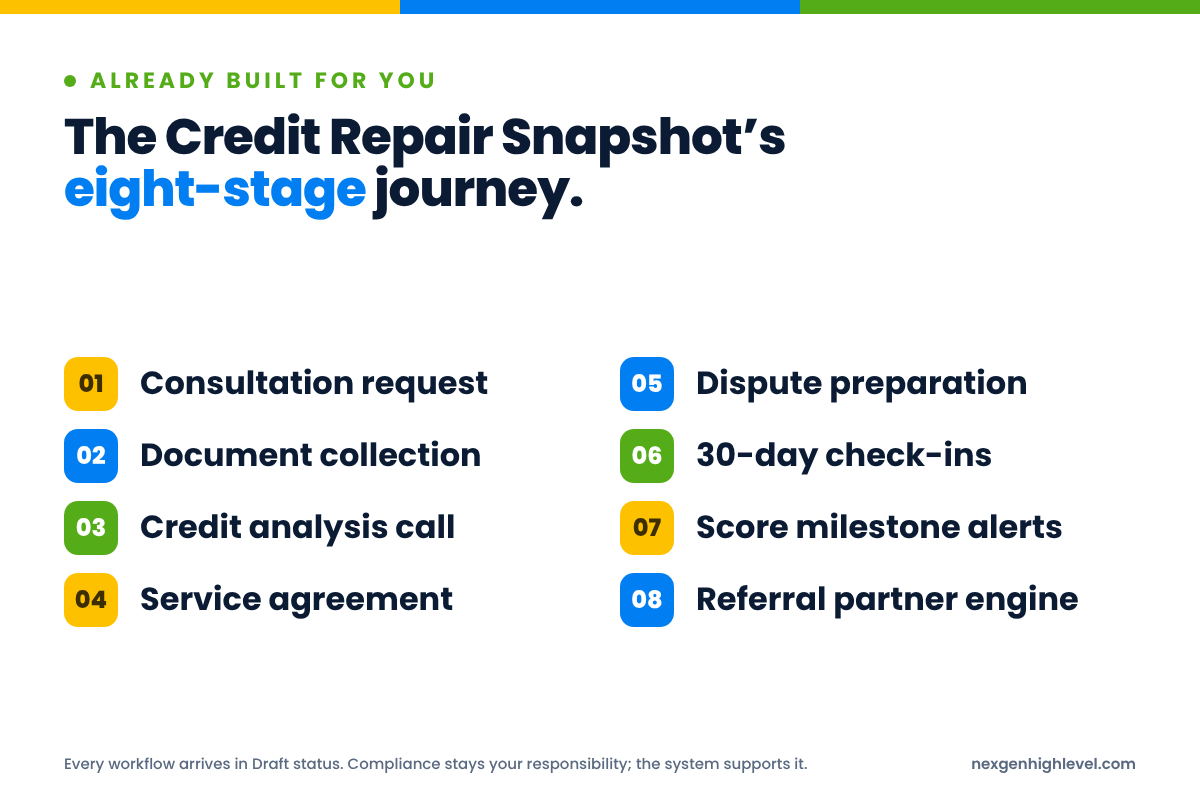
The documents nobody chased? Stage 2. The disclosure that has to come before the contract? Stage 4. The client who felt nothing was happening? Stage 6.
A word on Stage 7, because it matters. The thresholds are ones you set. It celebrates progress your client has made. It doesn't predict or promise any result, and you should never market it as if it does.
Around those stages, the features fall into four groups:
- Inquire & Audit: four consumer intake paths, free credit audit funnels, a credit score estimator and pre-qualification surveys.
- Consult & Retain: consultation booking, pre-call reminders, intake surveys and client agreement workflows.
- Deliver & Dispute: done-for-you dispute tracking, monthly progress updates and self-paced DIY coaching journeys.
- Partners & Growth: a referral partner portal and tracking for mortgage brokers, realtors and auto dealerships.
Compliance and consent support
The Snapshot is built "compliance & consent ready": structured workflows following industry disclosures and consent checks, with permission checks, compliance hold gates, consent verification and duplicate prevention across 11 dedicated modules.
That's real, built-in support for doing things in the right order. But let me be straight with you. Software can't make your business compliant. You are responsible for your disclosures, your contract, your state registrations, your billing and your marketing. Have your attorney review your wording before anything goes live.
How it fits every size of credit repair business
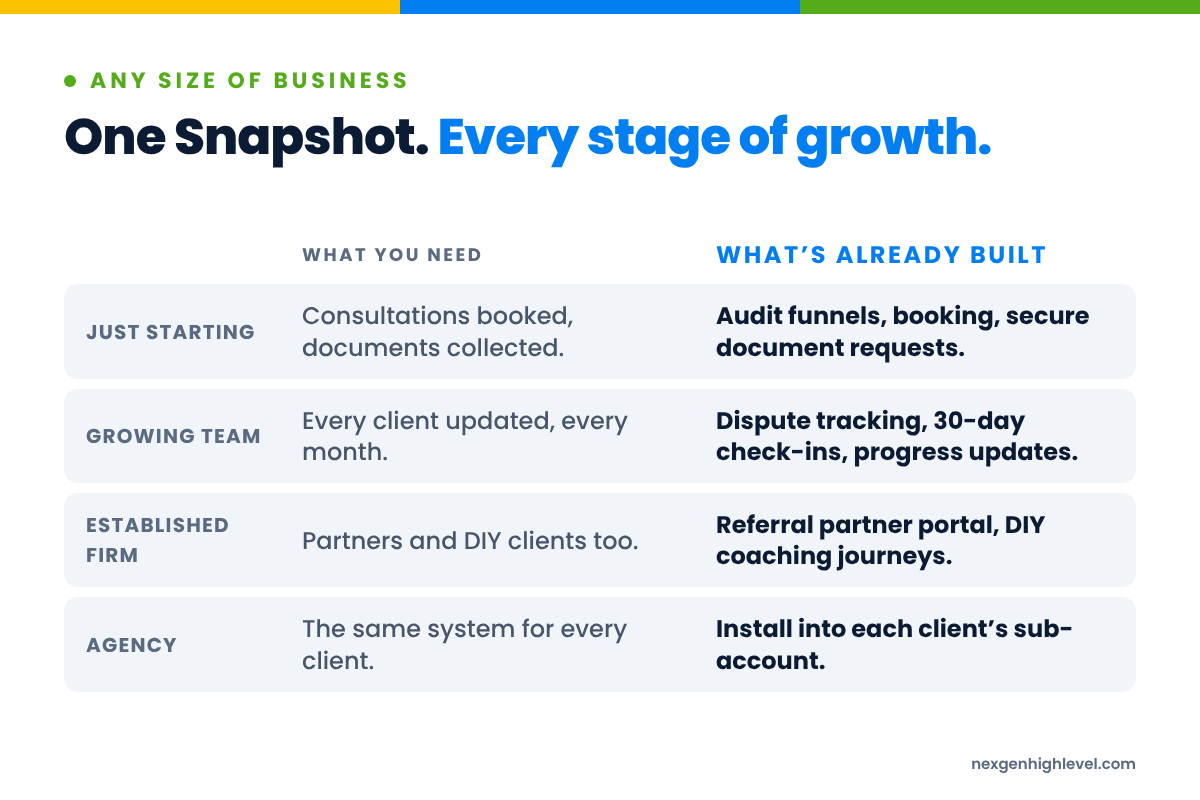
| Business | What matters most | How the Snapshot helps |
|---|---|---|
| Solo founder starting out | Consultations, documents, the agreement in the right order, first reviews | Switch on intake, document collection, analysis call and agreement journeys first; the rest is ready when you grow |
| Owner-operator or small team | Dispute tracking, monthly updates, retention | Dispute and check-in journeys keep everyone working from the same record |
| Established firm with partners and DIY coaching | Control, consistency, partners, two service models | Done-for-you and DIY journeys side by side, plus the partner portal and tracking |
| Agency with credit repair clients | A proper, compliant-minded system for each client | Install into client sub-accounts and adapt for each one |
The honest bit about setup
It's not magic, and I won't pretend it is.
Every workflow is delivered in Draft status. Nothing activates until you've configured your domain, your branding and your services. You add your own disclosures and contract (reviewed by your attorney), connect your accounts, test it all as a pretend client, then switch it on at your own pace.
That's deliberate. Nothing goes out to a client before you're ready.
Clients have used our Snapshots to skip months, if not years, of trial and error building a system. That's the real value. Not the counts. The years you don't have to spend building it yourself. There's more on that in why a HighLevel Snapshot is a business in a box. You can browse all of our HighLevel Snapshots, and we've written playbooks for other trades too, including HVAC and landscaping and lawn care.
Get HighLevel through NexGenHighLevel
If you're not on HighLevel yet, or you're about to start a credit repair business and wondering whether GoHighLevel is worth it, this is the part worth reading twice.
When you create your HighLevel account with NexGenHighLevel, you get:
- The Credit Repair Snapshot, free.
- A heavily discounted HighLevel account. I won't quote numbers here; see the page.
- Over 200 HighLevel training courses.
- Access to all our Apps for HighLevel.
- 24/7 support and personalised onboarding.
- A full HighLevel sub-account under the NexGenHighLevel agency.
Instead of buying the platform, hunting for a system and working it out alone at 11pm, you start with the system installed and people to help. I've written about starting a business without starting from scratch, and this is exactly what I mean.
Apps that help credit repair businesses and agencies
HighLevel does a huge amount brilliantly. Where something's missing, that's where we build. Every one of our Apps for HighLevel is built to be part of HighLevel, not a complement to it. It works with the Workflows, Contacts, Tags and Conversations already there.
WhatsApp for HighLevel for client messaging. Plenty of clients would rather send a quick message than take a call. WhatsApp conversations sit in HighLevel alongside everything else, for appointment confirmations, check-ins and keeping in touch, with no pay-per-message charges and no templates to use.
LinkedIn for HighLevel for building partner relationships. Mortgage brokers, loan officers and realtors are on LinkedIn. Search LinkedIn or Sales Navigator from inside your HighLevel account, enrich the results with business email addresses, and add prospects to workflows for profile views, connection requests, messages and InMails, including video or voice notes. It's for reaching partners, not consumers.
For agencies with credit repair clients, a quick note first. The marketing rules in this playbook apply to the ads, texts and emails you run for clients too. Learn your craft before you learn how to sell it. Then two apps that help. Custom Value Forms solves the pain of getting every detail out of a client and then filling in all the Custom Values yourself, or chasing them to do it. And the HighLevel Agency Customizer lets you brand the HighLevel experience, with different themes for different sub-accounts, SaaS plans or groups you create.
Your first 30 days and first 90 days
If you're starting a credit repair business, here's a practical plan. Established firms can use it as an audit.
First 30 days
Week 1: the law
- [ ] Read CROA, the TSR section and the FCRA dispute rules linked above.
- [ ] Check the rules in your state and any state you'll serve.
- [ ] Book time with a consumer finance attorney.
- [ ] Choose your model: done-for-you, DIY coaching or hybrid.
Week 2: foundations
- [ ] Choose a business structure, register, get your EIN and open a business bank account.
- [ ] Complete any state registration and bond.
- [ ] Arrange insurance.
- [ ] Have your disclosure, contract and cancellation form drafted or reviewed.
Week 3: your system
- [ ] Set up HighLevel and install the Credit Repair Snapshot.
- [ ] Add your domain, branding, services and approved legal wording.
- [ ] Set up secure document uploads and multi-factor authentication.
- [ ] Test the whole journey as a pretend client, checking the disclosure, contract and three-day order.
Week 4: clients
- [ ] Complete your Google Business Profile.
- [ ] Publish three honest, helpful articles or videos.
- [ ] List twenty local mortgage brokers, loan officers and realtors to approach.
- [ ] Set your pricing structure and have your attorney check it.
Days 31 to 90
- Review every consultation: who went ahead, who didn't, and why.
- Check that every active client got an update this month.
- Ask every graduating or happy client for an honest review.
- Meet partners in person where you can, and send each one a regular update.
- Read your marketing as if you were the FTC. Fix anything that sounds like a promise.
- Look at your cash flow every week, and grow at the pace it allows.
Six weeks to find out beats six months of wondering. Back yourself.
Frequently asked questions
How do I start a credit repair business?
Learn the law first: CROA, the TSR if you'll sell by phone, and FCRA dispute rights. Check your state's registration and bond rules, choose a structure, register, get an EIN and arrange insurance. Have an attorney draft your disclosure and contract. Then build a compliant client journey and an honest marketing plan.
Is credit repair legal?
Yes, when it's done within the law. CROA sets federal rules, and many states add their own. Some states restrict it heavily, so check yours.
Do I need a licence or bond for credit repair?
It depends on the state. California requires registration with a $100,000 bond (or deposit). Texas requires registration and a $10,000 bond per location. Rules vary, so check with your state and an attorney.
Can a credit repair company charge upfront?
Under CROA, a credit repair organisation can't charge or receive money before the service is fully performed. If you sell by phone, the TSR is stricter still. Some state laws mention advance fees with a bond, but that doesn't remove the federal ban. Take legal advice.
How do credit repair companies get clients?
Not through Google Ads, which doesn't allow credit repair ads. Through Google Business Profile, genuine reviews, organic search, education content, past clients and referral partners such as mortgage brokers, realtors and auto dealers.
What is the best CRM for a credit repair business?
One that brings intake, documents, agreements, disputes, updates, partners and marketing into one place. HighLevel does that, with unlimited users on its plans, and the Credit Repair Snapshot builds the credit repair side out for you.
Can I use the Credit Repair Snapshot if I'm just starting?
Yes. Switch on only what you need now, such as intake, document collection, the analysis call and agreements. If you get HighLevel through NexGenHighLevel, the Snapshot comes free, with training and onboarding to help you set it up.
Are credit repair results guaranteed?
No. Nobody can promise a score increase or the removal of anything, and accurate, current information can stay on a report. A good credit repair company promises honest work, clear communication and real support. Not results.
Earn the trust, then earn the fee
Running a good credit repair business isn't one big secret. It's a hundred small things done properly. Tell the truth on the first call. Give the disclosure before the contract. Wait the three days. Track every dispute. Update every client. Teach them something. Look after your partners. Do it again next month.
None of it is hard on its own. Doing all of it, every time, for every client, while staying on the right side of the law? That's hard.
That's what a system is for.
So write the playbook for your business. Or start with the Credit Repair Snapshot, create your HighLevel account with NexGenHighLevel and get it free.
Your clients are trusting you with their financial lives. Build a business that deserves it.