If you sell what you know, a course, a coaching programme or a membership, you've probably weighed up HighLevel vs Kajabi at some point. Maybe at 11pm. Maybe more than once.
Kajabi is a good platform for creators. I'll say that up front, because it's true.
But here's the thing I keep coming back to. A course isn't a business. It's a product.
The business is everything around it. Finding people. Following up. Booking the call. Answering the WhatsApp message. Chasing the person who went quiet. Asking for the review. Selling the next thing.
Kajabi was built around the product. HighLevel was built around the whole customer journey, and it lets you run courses, memberships and communities inside that journey.
So the real question isn't which one hosts a course better. It's which one runs your business.
HighLevel vs Kajabi at a glance
Here's the side-by-side. Everything in the Kajabi column comes from Kajabi's own pages or reputable press, and I've linked the sources further down. Where Kajabi's homepage doesn't describe something, I've said exactly that, rather than guessing.
| HighLevel | Kajabi | |
|---|---|---|
| Who it's for | Agencies, entrepreneurs and small and medium businesses; agencies can white-label it for clients | Creators and knowledge entrepreneurs: courses, coaching, communities, memberships, podcasts |
| CRM and pipelines | Full CRM, sales pipelines, lead scoring, smart lists | Contact CRM; sales pipelines not described on the homepage |
| Email, SMS and phone | Email, SMS, WhatsApp, Messenger, Instagram DM and live chat in one inbox; call tracking, missed call text-back, ringless voicemail | Email marketing and newsletters; SMS and phone calling not described on the homepage |
| Funnels and websites | Websites, funnels, landing pages, webinar funnels, forms, surveys, quizzes | Website builder, funnels and automations |
| Calendars and booking | Calendars, appointment reminders, paid calendars | Built-in scheduling for coaching; a standalone booking calendar isn't described |
| Reviews and reputation | Reputation management, automated review requests, AI review replies, video reviews | Not described on the homepage |
| Courses, memberships and communities | Membership offers and courses, communities, certificates, webinars | Courses, communities, memberships, coaching, podcasts, digital downloads |
| AI | Voice AI, Conversation AI, Content AI, Reviews AI and the AI Employee | Cofounder, Kajabi MCP and Expert Agents |
| App marketplace | HighLevel App Marketplace with 1,500+ apps that install natively | Integrations page; no third-party developer marketplace described |
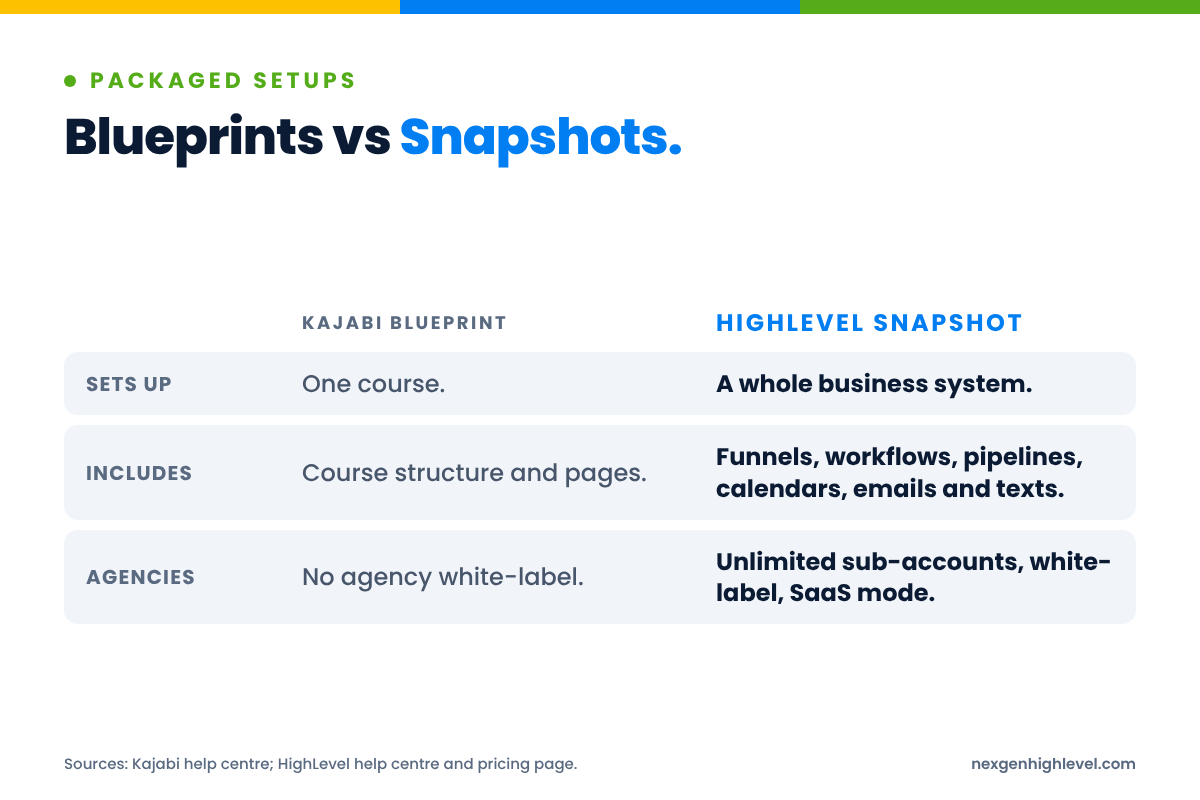
| Whole-account templates | Snapshots load a full account setup into a new or existing sub-account | Product Blueprints (one course at a time) and a Templates store for pages, funnels and website designs |
| White-label and reselling | White-label the platform, unlimited sub-accounts on higher plans, SaaS mode, rebilling | No white-label or reseller programme mentioned; a partner (affiliate) programme |
| Pricing model | Flat agency subscription, not per seat, unlimited users; usage-based phone, email and AI charges | Flat tiers per account with limits on products, contacts, admin users and websites; no revenue share |
That table tells most of the story. But not all of it. So let's go through it properly.
What Kajabi is built for, and where it's genuinely good
Kajabi was founded in 2010 by Kenny Rueter and Travis Rosser, and it's based in Newport Beach, California.
Its homepage is clear about who it's for. Kajabi is for creators: courses, communities, coaching, newsletters, digital downloads, memberships, podcasts, a branded mobile app, email marketing, a website builder, funnels, payments and analytics.
And credit where it's due. Kajabi has been doing this for a long time, and it's done it well.
In August 2025 Kajabi said its creators had passed over $10 billion in creator revenue, with nearly 1,800 millionaire creators. That's not nothing. That's a lot of people making a living from what they know.
Its pricing page also says "No hidden fees. No revenue sharing." I like that. Plain and honest.
If you're a solo creator, your whole business is one flagship course and an email list, and you want everything to look polished with very little setup, Kajabi suits you. It's focused. Focus is a strength.
But focus cuts both ways.
When I look at Kajabi's homepage, there are things it simply doesn't describe. An SMS marketing product. Phone calling. Reputation and review management. A social planner. A standalone booking calendar. Sales pipelines.
None of that matters much if you're selling a small digital product to an audience who already loves you.
It matters a great deal the moment you sell anything that needs a conversation.
Courses are only part of the business
Let me walk you through a coaching business. Not a fantasy one. A normal one.
Someone sees your post on Instagram. They download your guide. They don't buy anything. Two weeks later they open an email, click through and book a discovery call. They don't turn up.
Now what?
On most creator platforms, that's where the trail goes cold. On HighLevel, that's where the system does its job.
Here's what that same journey looks like on HighLevel, using features from its own homepage:
- The guide sits behind a form on a funnel, and the contact lands in the CRM with the right tags.
- A workflow starts the follow-up by email and SMS.
- They book through a calendar, and appointment reminders go out automatically.
- They miss the call. Missed call text-back and a workflow follow up, on whichever channel they actually reply to.
- Every reply, whether it's SMS, WhatsApp, Messenger, Instagram DM or live chat, lands in one consolidated conversation stream.
- They buy. Invoicing, Text-2-Pay or an order form with upsells takes the money.
- They get access to your course or membership, and join your community.
- A few weeks in, an automated review request goes out.
- Happy clients can join your affiliate programme through the Affiliate Manager.
That's one account. One login. One record of the person, from the first click to the review.
It's not a course platform with marketing bolted on. It's a business system with courses built in.
I learnt this the hard way with my old agency. We worked mostly with US private medical practices. The ones that struggled were nearly always relying on one channel, usually Facebook Ads, while bookings turned into no-shows and cancellations. Agency after agency tried to fix the ads.
The ads were never really the problem. The system around them was.
The same is true for creators. Your course might be brilliant. But if a person books a call and nobody follows up, the course never gets the chance to be brilliant for them.
This is why I measure revenue and profit, not clicks or bookings. A booking is a promise. It isn't money.
If you're new to all of this, I've written a plain guide to marketing automation for new businesses that walks through the basics.
And if you're also weighing up a funnel-first platform, I've compared HighLevel vs ClickFunnels too. Same principle. Funnels, like courses, are one piece.
What about courses on HighLevel?
Fair question. If you're a creator, you're not going to give up a decent course experience just to get a better CRM.
You don't have to. HighLevel's homepage lists Membership Offers and Courses (paid content access) and Communities. Its Snapshot documentation also lists Certificates, Membership Offers, Membership Products and Webinars as assets you can package and copy between accounts.
So you can run the course, the community and the webinar, and the whole sales and marketing system that feeds them. In the same place.
That's the point of this whole comparison, really. With Kajabi, the course is the centre and the rest has to fit around it. With HighLevel, the customer is the centre and the course is one of the things you sell them.
HighLevel as a platform you can build on, and what Kajabi offers
This is the bit most comparisons skip. And it's the bit I care about most, because it's what my business is built on.
HighLevel isn't just software. It's a platform other people build on. Two ways in particular.
The HighLevel App Marketplace
The HighLevel App Marketplace says you can "browse 1500+ apps to enhance your CRM, marketing automation, and business workflows."
These aren't just integrations that pass data back and forth. Third-party developers register, create an app and publish it under HighLevel's App Review Guidelines. Once installed, an app works inside the account.
HighLevel also handles the billing. It collects payment and pays developers monthly, and says it currently doesn't deduct any commission.
And for agencies, there's a detail that matters a lot. Agencies can resell marketplace apps to their own sub-accounts with their own markup, for apps that use HighLevel's payment collection.
So the platform keeps getting better without HighLevel having to build every feature itself. Developers see a gap. They fill it. Everyone on HighLevel benefits.
Snapshots
The second way is Snapshots.
HighLevel's own definition: "Snapshots are reusable templates that capture selected configuration assets from a HighLevel sub-account" so they can be copied into other sub-accounts.
The list of what a Snapshot can carry is long. Funnels and websites. Forms, surveys and quizzes. Workflows and triggers. Pipelines, tags and custom fields. Calendars. Email and text templates. Conversation AI and Voice AI agents. Membership offers and products. Dashboards and reports. Review settings. WhatsApp templates.
You can load a Snapshot into an existing sub-account, choosing which assets to import, or create a brand-new sub-account from one.
Third parties can also sell Snapshots on the App Marketplace. Once bought, buyers can push the Snapshot straight to their locations from their HighLevel dashboard. Agencies can even attach Snapshots to SaaS plans, so every new client starts with a ready-made setup.
What Kajabi offers on both points
I want to be precise here, because it's easy to be unfair.
Apps. Kajabi has an integrations page showing a set of integration cards, including Stripe, PayPal, Meta Pixel, Google Analytics, Google Tag Manager and several email tools. It doesn't describe a third-party developer marketplace or app store. Kajabi's Pro plan mentions having "your own app in the App Store", but that's a branded mobile app for your audience, not a marketplace of apps for your business. Kajabi also offers a Kajabi MCP and AI Expert Agents, though the homepage doesn't go into detail.
Templates. Kajabi does have templates, and they're useful. In 2017 it launched Product Blueprints, pre-built course templates that "set up any online course you want to create with just a few clicks." There's also a Kajabi Templates store where third-party vendors sell landing pages, funnels, website templates, product templates and bundles, and you can apply to become a Template Provider.
That's a real ecosystem. I'm not going to pretend otherwise.
But look at the scope. A Blueprint sets up one product at a time. The Templates store sells design and page assets. We found no Kajabi feature that packages a whole account, the pipelines, automations, pages, forms, emails and calendars, and loads it into another account.
Why HighLevel's version is stronger
It comes down to three things.
- Depth of apps. A marketplace of 1,500+ apps that install into HighLevel, versus an integrations page. One lets the platform grow in any direction. The other connects you to a handful of outside tools.
- Scope of templates. A Snapshot loads a whole account in one go. A Blueprint loads a course. A page template loads a page. If you want a business running, not just a product page, that difference is everything.
- The agency model. On HighLevel, agencies can white-label the platform, host multiple sub-accounts, often one per client, resell apps and attach Snapshots to their own SaaS plans. Kajabi's homepage and pricing page don't mention any white-label or reseller programme. Its partner programme is an affiliate programme: you earn commission for referring members.
It's not "templates vs no templates". It's a template for a page versus a template for a business.
If you're comparing another all-in-one that also packages templates, I've looked at HighLevel vs Kartra as well.
How our apps help you get more out of HighLevel
This is where NexGenHighLevel comes in. And it's where I'll be honest about HighLevel too.
No platform is perfect. HighLevel does a huge amount brilliantly. Its own line was "Capture, Nurture, Close". When I first got into it in 2020, my question was simple.
Where's the prospecting? Where's the outreach? Where's the market creation?
Nobody was filling that gap properly. So we started building.
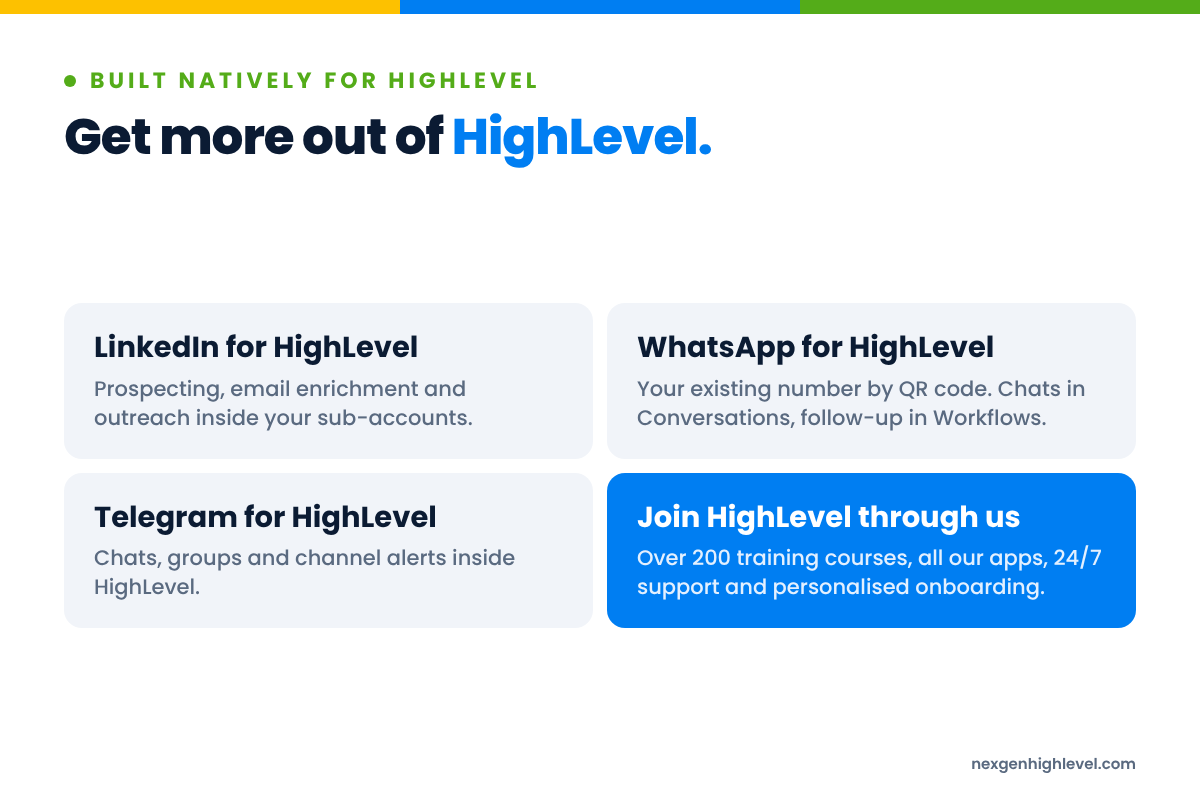
One rule runs through everything we make. We build our apps as part of HighLevel, not as a complement to it. They use what's already there: Workflows, Contacts, Tags and Conversations. No API to wire up. No Zapier, Make or n8n in the middle.
For creators, coaches and the agencies who serve them, three of our apps matter most.
LinkedIn for HighLevel
A lot of coaches and consultants sell to businesses. That means LinkedIn.
The LinkedIn for HighLevel app brings LinkedIn prospecting into your HighLevel sub-account, with email enrichment, imports and outreach.
It was the first app we built, for one client who needed it. Every other LinkedIn tool offered the same basic outreach, and none of them sat inside HighLevel. Adding email enrichment changed things: you could find your ideal customer, enrich their email, reach them on LinkedIn and email, and then nurture them in HighLevel.
For those first clients, outreach went up. So did leads, sales, revenue and profit.
Agencies can white-label it and resell it to their own clients.
WhatsApp for HighLevel
Your students and clients don't all live in email. Plenty of them would rather send you a WhatsApp.
The WhatsApp for HighLevel app connects your existing WhatsApp or WhatsApp Business number by QR code. Chats appear in HighLevel Conversations, and your Workflows can send messages and follow up. There's no Meta API approval to wait for.
There's a standard version and an agency white-label version, and both install from the HighLevel App Marketplace.
Think back to the no-show on the discovery call. A friendly WhatsApp an hour later often lands where the fourth email doesn't.
Telegram for HighLevel
Plenty of creators run communities and announcement channels on Telegram.
The Telegram for HighLevel app brings Telegram chats, groups and channel alerts into HighLevel Conversations and Workflows. It installs from the HighLevel App Marketplace, and agencies can white-label it.
So the community conversation and the sales conversation stop living in two different worlds.
You can see the full range on our Apps for HighLevel page.
None of this is possible on a platform without a marketplace to build on. That's not a dig at anyone. It's just how ecosystems work.
Snapshots make starting on HighLevel much easier
Let's be honest about HighLevel's one real hurdle.
It does a lot. And a blank HighLevel account can feel like walking into a warehouse full of tools with no instructions.
That's exactly the problem Snapshots solve.
A NexGenHighLevel Snapshot is a complete, fully built-out business system in a box for a niche. It loads into your HighLevel account with the funnels, forms, workflows, pipelines, calendars, emails and texts, and AI features already built and connected around the whole client journey.
It's not a starter pack. It's the whole system.
And not all Snapshots are equal. A typical Snapshot might be a couple of funnels, a few workflows and one pipeline. That's a start. It isn't a business.
I've written more about this idea in the HighLevel Snapshot as a business in a box.
Our Snapshots are built for two people at once:
- The business owner in that niche, who wants a proven system running in their own account.
- The agency serving that niche, who wants to deliver the same system for every client without rebuilding it each time.
If you run a social media marketing agency, for example, the SMMA Snapshot gives you the whole system to find, win and serve clients. If you're in credit repair, the Credit Repair Snapshot does the same for that journey. You'll find every niche we've built on our HighLevel Snapshots page, and more are on the way.
Clients have used Snapshots to skip months, if not years, of trial and error building a system. And when you get HighLevel through NexGenHighLevel, a free Snapshot comes with the account.
Compare that with what Kajabi gives you on day one. A Blueprint sets up your course. A Snapshot sets up your business.
There's a lesson I learnt from closing my recruitment business at the start of Covid. Walk before you run. A Snapshot is how you walk properly on HighLevel, with the system already in place, instead of sprinting into a blank account and hoping.
HighLevel's growth vs Kajabi over the last five years
Both companies are private. Neither publishes its own revenue. So I'm only going to use figures each company has published, with the year and the source, and I'm not going to estimate anything.
Here's what's on the record.
| Year | HighLevel | Kajabi |
|---|---|---|
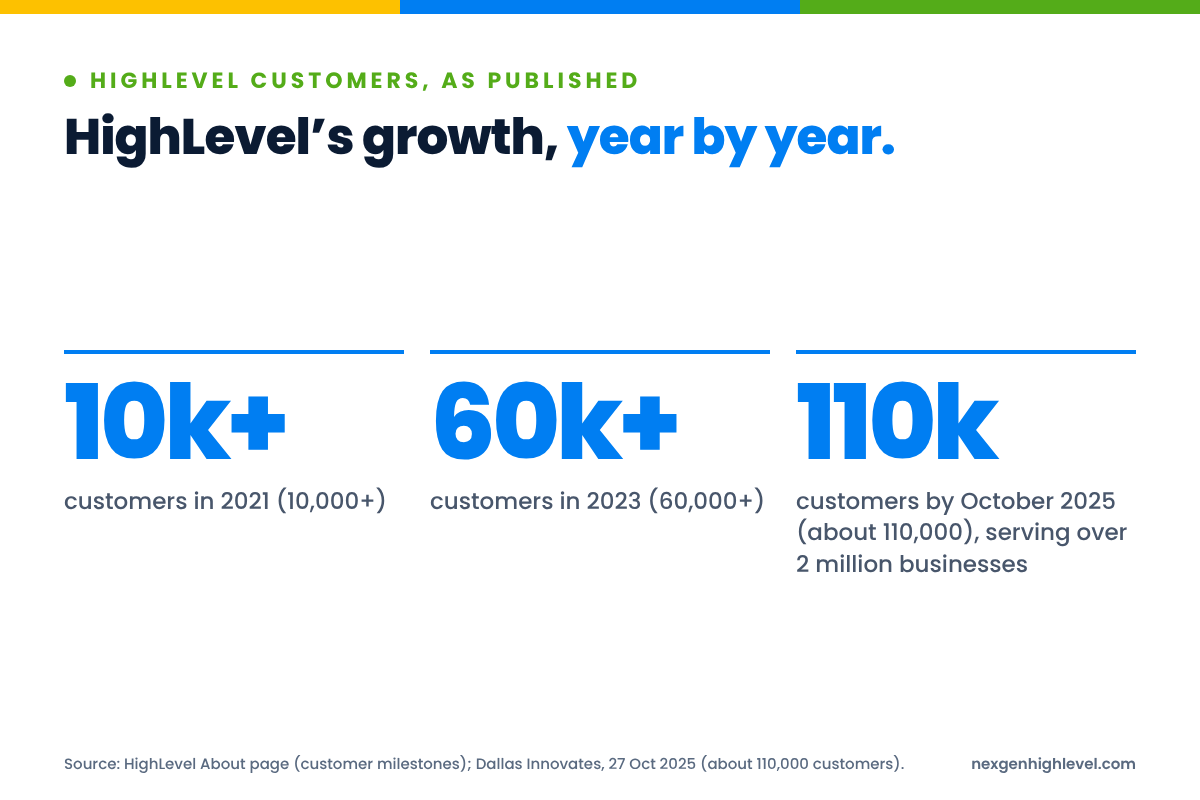
| 2021 | 10,000+ customers; PeakEquity-led investment of over $60 million, serving 15,000+ agencies representing 300,000+ small businesses | Raised $550 million at a valuation over 2 billion; over $1.5 billion in annual GMV |
| 2022 | Surpassed 20,000 customers | No figure published |
| 2023 | Exceeded 60,000 customers; No. 47 on the Deloitte Technology Fast 500, 3,362% revenue growth (2019 to 2022) | 60,000 creators and $5 billion in lifetime GMV |
| 2024 | General Atlantic investment; grown more than 5x in three years while profitable | No figure published |
| 2025 | About 110,000 customers and over 2 million businesses; 781% revenue growth (2021 to 2024), Inc. 5000 No. 516 | Over 100 thousand creators and entrepreneurs; over $10 billion in creator revenue |
A few honest notes on reading that table.
Customers. This is the closest like-for-like. In 2023, HighLevel said it had exceeded 60,000 customers, and Kajabi had 60,000 creators. Level pegging. By 2025, HighLevel was at about 110,000 customers, and Kajabi at over 100 thousand creators and entrepreneurs.
So on headline customer numbers, they're close. I'm not going to pretend otherwise.
But who those customers are is different. A lot of HighLevel's customers are agencies, and each agency runs many sub-accounts. That's why HighLevel's customers translate into over 2 million businesses using the platform. Back in 2021, HighLevel's 15,000+ agencies already represented over 300,000 small businesses.
On HighLevel, one customer often means many businesses. On Kajabi, one customer is usually one creator.
Momentum. HighLevel went from 10,000+ customers in 2021 to about 110,000 in 2025. Deloitte measured its revenue growth at 3,362% from 2019 to 2022, and 781% from 2021 to 2024. General Atlantic's 2024 announcement said HighLevel had grown more than 5x over three years while staying profitable.
Kajabi doesn't publish its revenue, or its revenue growth. What it publishes is creator revenue, which is money its creators earned, not money Kajabi earned. That's a genuine achievement for those creators. It just isn't the same measure, so I won't compare it with HighLevel's revenue growth.
Money raised. Kajabi raised much more in 2021: $550 million, against HighLevel's $60 million plus. HighLevel has grown on a smaller raise, and says it did so profitably.
My read? Kajabi is a strong, well-funded business serving creators. HighLevel is growing faster on the measures it publishes, and it's growing across a much wider base: agencies and the businesses they serve.
Who should choose Kajabi, and who should choose HighLevel
I'll keep this short and fair.
Kajabi may suit you if:
- You're a solo creator whose business is mainly digital products and an email list.
- You don't need SMS, phone calls, sales pipelines or review management.
- You want a polished course experience with very little setup, and you're happy for the course to be the centre of everything.
HighLevel is the better choice if:
- You sell coaching, consulting, high-ticket programmes or services, where people need to talk to you before they buy.
- You want email, SMS, WhatsApp, calls, calendars, reviews, funnels, payments, AI and courses in one account.
- You run an agency, or want to, and need to white-label the platform, run client sub-accounts and resell it.
- You want a marketplace of apps that install natively, and Snapshots that load a full system in one go.
For most small businesses and coaches I talk to, the course isn't where they're stuck. They're stuck on follow-up, booking and turning interest into revenue. That's HighLevel's home ground.
And for agencies, it's not close. Kajabi isn't built for you to resell. HighLevel was built for exactly that.
If you're looking for a Kajabi alternative that grows with the whole business, not just the product, that's HighLevel.
Switching from Kajabi to HighLevel
Switching sounds bigger than it is. Here's what it involves in practice.
- Export your contacts. Pull your contact list out of Kajabi and import it into HighLevel, with tags so you know who bought what.
- Stand up the new account. Either rebuild your funnels, emails and automations by hand, or load a Snapshot. A Snapshot is the fastest way, because the funnels, forms, workflows, pipelines and calendars arrive already connected.
- Move your course and community. Recreate your course, membership offers and community in HighLevel's memberships area, then give existing students access.
- Connect phone and email. Set up your sending domain and a phone number so SMS, calls and email work from day one. If your clients talk to you on WhatsApp or Telegram, add the app for that channel.
- Run both for a short overlap. Keep Kajabi live for a few weeks while new leads go into HighLevel. Once you're happy everything's firing, switch off the old one.
Know your goal, plan properly, set up properly, understand properly. Then go for it.
What you get when you start your HighLevel account with us
When you get HighLevel through NexGenHighLevel, you sign up to HighLevel under our agency. Here's what that includes:
- Over 200 HighLevel training courses.
- Access to all our Apps for HighLevel, both our live apps and future releases.
- 24/7 support and personalised, one-to-one onboarding.
- A full HighLevel sub-account under our agency, plus a free Snapshot from NexGenHighLevel.
That's it. No fuss. You get a working account, a system to start from, and people to ask when something doesn't make sense at 11pm. If you'd like to know who's behind all this first, here's a bit about us at NexGenHighLevel.
Frequently asked questions
Is HighLevel better than Kajabi?
For most coaches, service businesses and agencies, yes. Kajabi is strong for creators selling courses and digital products. HighLevel includes courses, memberships and communities, plus CRM, pipelines, SMS, WhatsApp, calls, calendars, review management, AI and white-label for agencies. If your business needs conversations before people buy, GoHighLevel covers far more of the journey in one account.
Can I migrate from Kajabi to HighLevel?
Yes. Export your contacts from Kajabi and import them into HighLevel with tags. Then rebuild your funnels and automations, or load a Snapshot to stand the account up quickly. Recreate your course and community in HighLevel's memberships area, connect your phone and email, and run both platforms for a short overlap before switching off Kajabi.
Is GoHighLevel cheaper than Kajabi?
The pricing models are different. HighLevel charges a flat agency subscription, not per seat, with unlimited users, plus usage-based charges for phone, email and AI. Kajabi charges flat tiers per account, with limits on products, contacts, admin users and websites, and extra charges for more contacts. Which works out cheaper depends on how many contacts, users and clients you have.
Does Kajabi have white-label?
We found no white-label or reseller programme on Kajabi's homepage or pricing page. Kajabi has a partner programme, which pays affiliate commission for referring members. HighLevel lets agencies white-label the platform under their own brand and domain, run client sub-accounts and, on the higher plan, use SaaS mode to sell it as their own software.
What is a HighLevel Snapshot?
A Snapshot is a reusable template that captures a HighLevel sub-account's setup, such as funnels, forms, workflows, pipelines, calendars, email and text templates, memberships and AI agents, so it can be loaded into another account. A NexGenHighLevel Snapshot goes further: a complete, fully built-out business system for a niche, connected around the whole client journey.
What do I get if I sign up to HighLevel through NexGenHighLevel?
When you start your HighLevel account with us, you get over 200 HighLevel training courses, access to all our Apps for HighLevel (live and future), 24/7 support with one-to-one onboarding, and a full sub-account under our agency with a free Snapshot from NexGenHighLevel. It's a straightforward way to start on GoHighLevel with help on hand.
The bottom line on HighLevel vs Kajabi
Kajabi vs HighLevel isn't really a fight about courses. Both can host one.
It's about what surrounds the course. The follow-up. The booking. The WhatsApp message. The review. The agency that wants to resell the whole thing under its own brand. The developer who builds the app you didn't know you needed. The Snapshot that hands you a working system on day one.
That's where HighLevel pulls ahead, and it's why I've built my business on it.
If you're looking for a Kajabi alternative that runs the whole business, start your HighLevel account with us and begin with a system, not a blank page.
Kajabi helps you sell a course. HighLevel helps you build the business the course lives in.