
WhatsApp ROI: Blue Ticks Don't Pay the Bills
Two blue ticks. They read it.
Then a reply. Then another. Your phone is buzzing, the chats are stacking up, the team is flat out, and it all feels like business is booming.
But here's the question nobody likes asking about WhatsApp marketing ROI. How much of that turned into money?
Not "engagement". Not "conversations". Money. In the bank. With the cost of getting it taken off.
Most business owners can tell you how many WhatsApp chats they had last month. Very few can tell you what those chats were worth. And if you can't answer that, you're not measuring WhatsApp. You're just watching it.
Blue ticks feel like progress. They're not. They're proof somebody looked at their phone.
Blue ticks are not a business metric
I've always had a slightly awkward relationship with "metrics".
When I ran the agency, we built whole marketing systems for private medical practices. Ads, Google, local SEO, social, content, nurture, reputation, booking follow-up. And we learned very quickly that almost every number a platform hands you is designed to make you feel good about the platform.
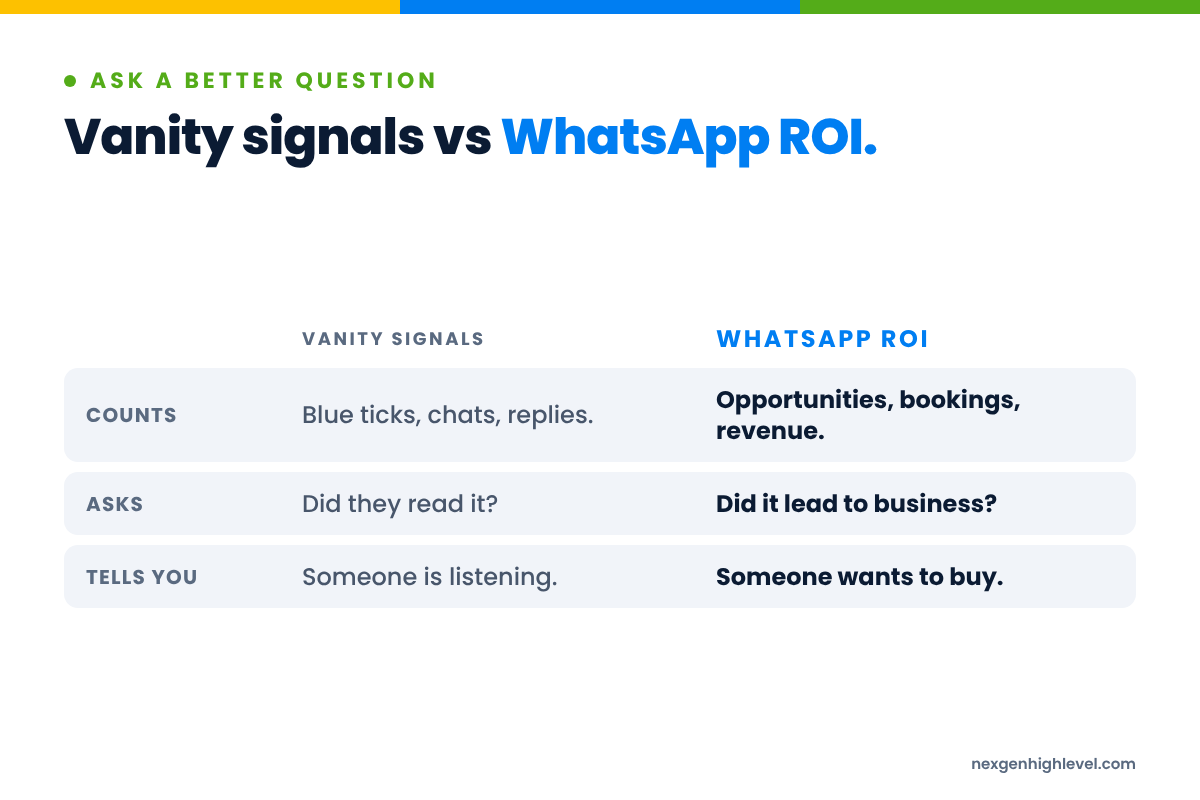
Clicks. Impressions. Bookings.
Bookings sound like money. They're not. A booking that turns into a no-show is worth nothing. A cancellation is worth nothing. A low-ticket offer hunter who books, turns up, takes the discount and never comes back can be worth less than nothing once you count the staff time.
So we stopped judging ourselves on clicks or bookings. We judged ourselves on client revenue and profit. It's a harder scoreboard. It's also the only honest one.
WhatsApp has its own versions of the feel-good numbers.
The vanity signals on WhatsApp
- Blue ticks. Someone opened the chat. That's it. It doesn't mean they cared. And plenty of people switch read receipts off anyway, so you're not even seeing the full picture.
- Reply counts. A reply that says "Thanks!" and a reply that says "Can you do Thursday at 10?" both count as one reply. One of them is worth a lot more.
- Number of chats. A busy inbox can mean demand. It can also mean confusion, a website that doesn't answer basic questions, or a pricing page that sends everyone to WhatsApp to ask "how much?"
- Contacts added. A list isn't an asset until the people on it buy something.
- Response time on its own. Fast is good. I'll come back to that. But fast replies to people who never buy are still not revenue.
None of these are bad numbers. Some of them are genuinely useful early warnings. The problem comes when they become the goal.
When chats become the goal, you get more chats. When revenue becomes the goal, you start asking better questions.
The question I ask about every number
"Does it make any money?"
I ask it about diagrams with 47 boxes. I ask it about AI agents. I ask it about every shiny tool somebody wants to sell me. And I'd ask it about every number on your WhatsApp dashboard.
If a number goes up and your revenue doesn't move, it's not a business metric. It's a hobby.
What WhatsApp marketing ROI actually means
ROI sounds like a finance word. It isn't complicated.
You put something in. You get something back. Was what you got back worth more than what you put in?
For WhatsApp, the "something back" is revenue (better still, profit) from customers whose journey ran through WhatsApp. The "something in" is everything it costs you to run it properly.
And that second part is where most people kid themselves.
The costs people forget
WhatsApp feels free. The app is on your phone. Messages don't cost anything to send from your own number.
But running WhatsApp as a business channel is never free:
- Time. Every chat is somebody's time. If that somebody is you, it's the most expensive time in the business.
- Staff. If you've got a team answering chats, you're paying for those hours, whether the chats turn into money or not.
- Tools and systems. Your CRM, any apps you use, the setup and the training.
- Content. The voice notes, the photos, the follow-up messages somebody has to write and keep fresh.
- Risk. This one never makes it onto a spreadsheet, and it should.
Let me explain that last one.
The risk cost: your number
WhatsApp's Terms of Service forbid "sending illegal or impermissible communications such as bulk messaging, auto-messaging, auto-dialing, and the like."
And the WhatsApp Business Messaging Policy is clear: "If content or actions violate our terms or policies, we may limit or remove your access to our services."
So picture a business that decides to "improve its WhatsApp ROI" by blasting a promotion to every number it has. Including the old ones. Including people who never asked to hear from it.
For a week, the numbers look great. More chats. More replies. A few sales.
Then people start blocking and reporting. And the number that held every customer conversation the business has had for three years gets restricted, or banned.
What was the return on that campaign? You'd need a very big sale to cover losing the channel.
That's why I keep saying the same thing across these articles. WhatsApp is for people who chose to talk to you. They gave you their number and agreed to hear from you. Cold prospecting belongs on LinkedIn and email, where that's the norm. I wrote about how LinkedIn and email outreach work together inside HighLevel if that's the part you're trying to grow.
And no tool, ours included, makes a number "ban-proof". Anyone telling you otherwise is selling you something.
The cheapest way to protect your WhatsApp ROI is to behave like a guest. I went into that properly in You're a Guest on WhatsApp. Act Like One.
Why WhatsApp is so hard to measure
Here's the honest bit. WhatsApp is one of the hardest channels in a business to put a number on, for three reasons.
It's a continuation channel, not a starting one. Someone saw a Facebook ad, found you on Google Maps, or met you on LinkedIn. Then, somewhere along the way, they gave you their number and said "yes, message me here." The chat that closes the sale isn't the thing that created the customer. That's combination marketing: customers don't live inside one channel.
It lives on phones. In a lot of businesses, the conversations sit on one person's phone, under a contact saved as something like "Sarah Kitchen Quote", with no link to the booking, the invoice or the source. You can't measure what you can't see.
"It feels like it's working" is easier. I've watched practices pour more and more into one channel because it felt busy, while no-shows and cancellations quietly ate the revenue underneath.
Feelings are a starting point. They're not a scoreboard.
Start with the source, not the conversation
If you only take one practical idea from this article, take this one.
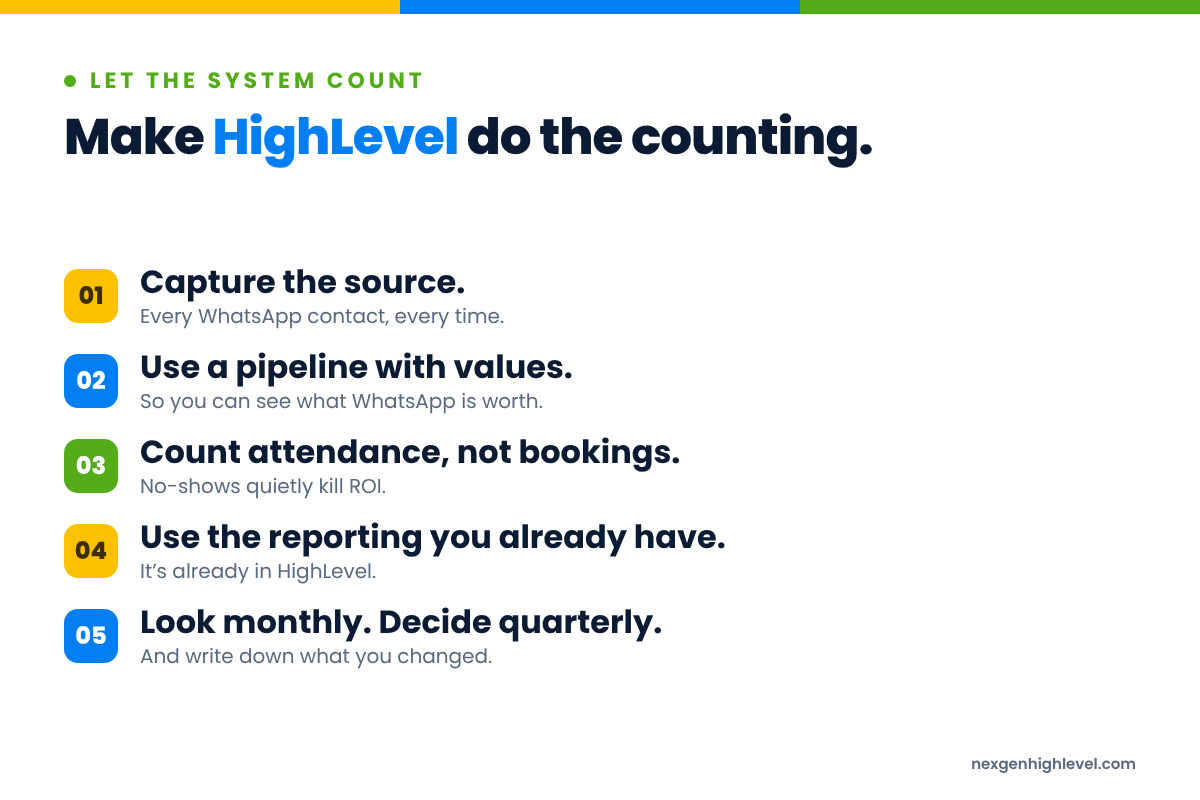
Capture where someone came from before the WhatsApp conversation starts.
Not afterwards. Not by asking them three weeks later "how did you hear about us?" and getting "Erm, Google? Or maybe my sister?" Before.
Because once a contact is sitting in a chat with no source attached, you've lost the thread. And no amount of clever reporting brings it back.
How to capture the source in HighLevel
This is where having WhatsApp inside your CRM, rather than on a phone, changes everything. In HighLevel you've got a few simple tools for this, and none of them are exotic.
- Forms and surveys. If someone opts in to WhatsApp through a form on your site or a landing page, the form can capture the source along with the number and the consent. That's two jobs done in one place.
- Trigger links. Use different links in different places (your Google Business Profile, your email signature, a Facebook post, a QR code on a flyer) so you know which one brought the person in.
- Custom fields. Create a simple "Original source" field and a "WhatsApp opt-in source" field. Fill them in once, never overwrite the first one.
- Tags. Tag the channel and the campaign. "Source: Google Maps." "Campaign: Spring open evening." "Opted in: WhatsApp." Tags are cheap and they make smart lists and reporting much easier later.
- Workflows. When a contact is created or opts in, a workflow can apply the right tags, fill the right fields and notify the right person, so it doesn't depend on someone remembering.
None of this is glamorous. It's plumbing. But it's the plumbing that lets you answer the only question that matters: which of my marketing is actually turning into customers?
One rule that saves a lot of arguments
Decide what "source" means in your business and write it down.
Is it the first thing that brought them in? The last thing before they messaged? The thing they told you on the phone?
There's no single right answer. But if your team is using three different definitions, your report will tell you three different stories and you'll believe whichever one you like best.
Agree the rules first. Then measure.
Put a value on every WhatsApp conversation in HighLevel
Here's where the blue ticks finally get put in their place.
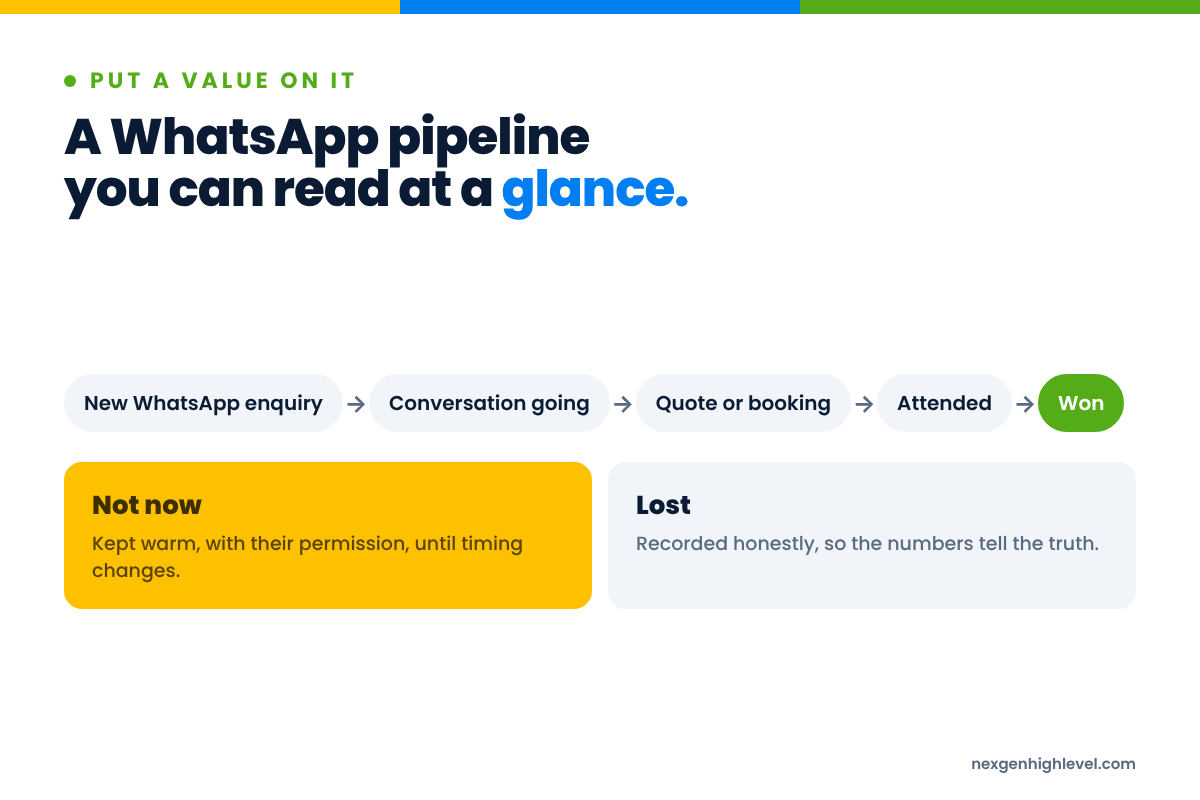
A conversation with no value attached is just a conversation. A conversation attached to an opportunity with a value is a sales pipeline.
Use Opportunities and pipelines, not memory
Opportunities and pipelines let you track a potential sale from "first interested" to "paid". Each opportunity can carry a value. Each stage tells you where it is.
So when a WhatsApp chat turns into a real enquiry, it shouldn't just sit in the inbox. It should become an opportunity, attached to the contact, in a pipeline, with a value on it.
A simple pipeline for a lot of service businesses might look like this:
- New enquiry. They've asked a real question, not just "hi".
- Qualified. It's something you do, for someone you can help, in a place you cover.
- Booked. There's a call, a visit or an appointment in the calendar.
- Showed up. They actually came. (Don't skip this stage. Ask any clinic owner why.)
- Proposal or quote sent.
- Won. Money agreed, or money paid.
- Lost. With a reason. Always with a reason.
That "Lost" reason is gold, by the way. "Too expensive." "Went with someone closer." "Never replied after the quote." Six months of honest lost reasons will teach you more about your business than any dashboard.
What value should you put on it?
People get stuck here. "I don't know what it's worth until they buy."
Fair. So use a sensible estimate and correct it later.
Picture a dental practice. A check-up is worth one thing. A whitening enquiry is worth more. An implant consultation is worth a lot more. The practice doesn't need to be exact. It just needs a reasonable starting value for each type of enquiry, so the pipeline shows the difference between ten chats about check-ups and two chats about implants.
Then, when the deal is won, the value gets updated to what was actually paid.
That's it. Estimate on the way in. Truth on the way out.
Count the people who didn't buy as well
Track the whole funnel, not just the wins. Enquiries, qualified, booked, showed, won. Every stage where people drop out is a question worth asking.
Attribution in HighLevel without kidding yourself
Attribution is the posh word for "which bit of marketing gets the credit?"
And I'll be honest. It's an area where the more clever people get, the less useful the answer often becomes. I've seen attribution models that need a whiteboard, a PhD and a strong coffee to explain. Simple isn't amateur. Simple is often what you arrive at once you understand something.
HighLevel has reporting and attribution built in, so you can see where contacts and opportunities came from. Use it. But use it with your eyes open.
First touch, last touch and the honest middle
There are two common ways to give credit:
- First touch. The thing that first brought someone in gets the credit. Good for understanding what creates new demand.
- Last touch. The last thing before they converted gets the credit. Good for understanding what closes.
WhatsApp almost never wins on first touch. It often wins on last touch. Neither tells the whole truth.
So here's how I'd think about it.
Source channel versus closing channel
Treat WhatsApp as two different jobs.
WhatsApp as a source. Sometimes WhatsApp genuinely is where someone first turns up. They tapped a WhatsApp button on your website or Google profile and that was the first time you'd heard of them. Fine. That's a source. Tag it as one.
WhatsApp as a closing channel. Much more often, WhatsApp is where an existing lead moves forward. They came from Google, opted in, and then the WhatsApp conversation got them booked, answered their worries, and got them through the door.
For the second job, the question isn't "did WhatsApp bring this customer in?" It's "did WhatsApp help this customer buy?"
And you can measure that in a fairly simple way.
A simple comparison anyone can run
Look at two groups of leads over the same period, from the same sources:
- Leads who had a WhatsApp conversation with you.
- Leads who didn't.
Then compare. How many booked? How many showed up? How many bought? What did they spend?
If the WhatsApp group books more, shows up more and buys more, WhatsApp is doing a job. If there's no difference, it might just be a nicer way of having the same conversation.
It's not a scientific trial. People who opt in to WhatsApp might simply be keener to begin with, so be careful about reading too much into it. But it's a lot more honest than "the inbox is busy, so it must be working."
Smart lists filtered by tags (opted in to WhatsApp or not, booked or not, won or not) will get you most of the way there without any heavy lifting.
The WhatsApp numbers that actually matter
So if blue ticks don't count, what does?
I split it into two kinds of numbers. The ones that tell you something is about to go right or wrong. And the ones that tell you whether it did.
Leading signals: early warnings
These don't pay the bills, but they predict whether the bills get paid.
- Time to first reply. Speed matters. Dr James Oldroyd's Lead Response Management study, as reported by InsideSales, found the odds of a lead becoming qualified were 21 times greater when contacted within five minutes than at 30 minutes. That study wasn't about WhatsApp, but the principle carries. I wrote a whole piece on it: WhatsApp Lead Response: The Reply Nobody Sent.
- Enquiry to booked rate. Of the people who asked a real question, how many booked?
- Show-up rate. Of the people who booked, how many turned up?
- Opt-outs and blocks. This is the one most businesses don't track, and it's one of the most important. A rising opt-out rate is your audience telling you, politely, that you're getting it wrong. Listen early. The policy says you "must respect all requests (either on or off WhatsApp) by a person to block, discontinue, or otherwise opt out", so every opt-out should be honoured straight away and recorded with a tag, so nobody messages that person again by accident.
- Unanswered chats. How many conversations are sitting with no reply from you? Each one is a person who asked and got silence.
Lagging results: what actually landed
These are the scoreboard.
- Revenue won from contacts whose journey included WhatsApp.
- Profit on that revenue, if you can get to it. Revenue from a heavily discounted service isn't the same as revenue from your best one.
- Average deal value for WhatsApp-touched customers compared with everyone else.
- Repeat business. WhatsApp is a relationship channel. Do the people you talk to there come back more often, or spend more over a year?
- Cost per customer. Your WhatsApp running costs (time, staff, tools) divided by the customers it helped win.
If I could only see five numbers, I'd want revenue won, show-up rate, time to first reply, opt-out rate and cost per customer. That's enough to know whether WhatsApp is earning its place.
Where no-shows quietly kill your ROI
I'll spend a minute on show-up rate, because it's where a lot of WhatsApp ROI is hiding.
The clinics I worked with had this problem for years. Bookings came in. People didn't turn up. Agency after agency tried to fix the ads, when part of the problem was what happened after the booking.
The evidence on reminders is worth knowing. A Cochrane review from 2013 found text reminders improved attendance compared with no reminders: 67.8% with no reminders against 78.6% with text reminders, based on moderate-quality evidence from seven studies.
And a 2026 study of 475,214 health appointments in Buenos Aires found that no-shows were 34.6% without reminders, and a single WhatsApp reminder about 24 hours before was linked to an 8.21 percentage-point reduction. It's a preprint, so not yet peer reviewed, and it's healthcare, not every industry. But it's food for thought.
Now do the maths for your own business. Imagine you take a hundred bookings a month and a handful more people turn up because the reminder was a conversation rather than a notification. What's each of those appointments worth?
That's WhatsApp ROI you'd never see if you only counted chats. I went much further into this in WhatsApp Reminders: No-Shows Are a Conversation Problem.
Look monthly, decide quarterly
Picture this. It's a very easy trap to fall into.
You change something. A week later the numbers dip. You panic and change it back. A week after that they rise, so you double down. By the end of the month you've changed six things, you've no idea which one mattered, and your team thinks you've lost the plot.
I'm a terrible procrastinator and a perfectionist, so I know both ways of getting this wrong: never looking, and looking far too often.
So the rhythm I'd suggest is simple.
Look monthly
Once a month, sit down with the numbers. Same day, same report, same questions.
- How many WhatsApp enquiries came in, and from which sources?
- How many became opportunities, bookings, shows and wins?
- What was the revenue, and roughly what did it cost us?
- Did response times slip?
- Did opt-outs go up?
- Which conversations are sitting unanswered, and why?
Monthly is for spotting things. A slow responder. A broken form. A campaign that's bringing in tyre-kickers. A message that's suddenly getting people to opt out. Fix the obvious stuff straight away.
Decide quarterly
But save the big decisions for the quarter.
Should we put more into WhatsApp, or less? Should we add a second number for the sales team? Should we change who handles the chats? Should we stop a campaign completely?
Those are strategy decisions, and strategy needs more than four weeks of data. A month can be skewed by a holiday, a bad week, a member of staff off sick or one big customer. A quarter smooths a lot of that out.
Walk before you run. And even when you're ready to run, keep walking for a little bit longer.
Write down what you changed
One more habit that sounds boring and pays for itself.
Keep a simple log. "1st March: changed the first message after opt-in." "15th March: started voice notes for quotes over a certain value." "2nd April: moved WhatsApp replies from Sarah to the front desk team."
When the quarter's numbers come in, you'll know what you were actually testing. Without it, you're just guessing with extra steps.
How to set up WhatsApp ROI tracking in HighLevel
Let me pull it together. Human. Strategy. Leverage. In that order.
Human first
Before any setup, ask the people questions.
- Why do customers want to talk to us on WhatsApp in the first place?
- What are they trying to find out, decide or do?
- What makes someone go quiet halfway through a chat?
- Who on our team is having these conversations, and do they know what a good one looks like?
If you can't answer those, the reports will tell you what happened but never why.
Strategy second
Then decide what you're trying to achieve.
- What's WhatsApp's job in our business? Source, closing channel, customer service, retention, or a bit of everything?
- What does a "good" WhatsApp conversation lead to? A booking? A quote? A repeat order?
- What will we count as a win, and what are we going to stop counting?
Leverage third
Only then build the system. That usually means:
- Contacts with an original source and an opt-in source in custom fields.
- Tags for channel, campaign, opt-in status and opt-out status.
- Forms, surveys and trigger links that capture source and consent at the start.
- Conversations as the shared inbox, so WhatsApp sits next to SMS, email and social rather than on somebody's phone.
- Opportunities and pipelines with values on every real enquiry and a reason on every loss.
- Calendars with confirmations and reminders, so bookings turn into shows.
- Workflows to tag, assign, notify and follow up, so measurement doesn't depend on memory.
- User roles and assignment, so you know who handled what and can see where things slow down.
- Reporting and attribution, checked monthly, acted on quarterly.
If your WhatsApp still lives on a phone, that's the first thing to fix, because none of the above works without it. That's exactly why we built the WhatsApp App for HighLevel: so WhatsApp conversations sit in HighLevel Conversations, attached to the contact, where workflows and reporting can actually see them.
And if you'd rather not build all of this from scratch, our HighLevel Snapshots are complete business systems with the pipelines, fields, tags and workflows already in place for a niche.
But I'll say it again. Technology is leverage, not strategy. Leverage multiplies whatever is underneath it. If the conversations are poor, a beautiful report will just show you poor conversations in more detail.
For agency owners
If you run WhatsApp for clients, this matters even more.
Your client won't remember that you got them 300 chats. They'll remember whether the phone rang, the diary filled and the money came in. I spent years watching the definition of "marketing agency" shrink to "the company running our ads", judged on whatever number the platform happened to show.
Don't let WhatsApp go the same way. Report on revenue, show-up rates and cost per customer, not chat counts. It's a harder conversation the first time. It's a much easier one at renewal.
I wrote about the same principle for LinkedIn in how to measure LinkedIn ROI. Different channel, same honest scoreboard.
Frequently asked questions
How do you measure WhatsApp marketing ROI?
Work out the revenue from customers whose journey included WhatsApp, take off what it costs to run (time, staff, tools), and compare. The key is capturing the source before the chat starts, putting a value on every real enquiry in a pipeline, and tracking it all the way to won or lost. In HighLevel that's custom fields, tags, opportunities and reporting. Without those, you're counting chats, not money.
Is WhatsApp good for small business marketing?
For conversations with people who've chosen to hear from you, yes, I think it can be. More than 3 billion people use WhatsApp, and Meta says 1 billion people message a business each week across its apps. But it's a relationship channel, not a broadcast one. It works best for answering questions, booking, reminding and following up. It's the wrong place for cold outreach or bulk promotions.
What are good WhatsApp metrics to track?
Skip blue ticks and chat counts. Track time to first reply, enquiry-to-booking rate, show-up rate, opt-out rate, revenue won and cost per customer. The first few are early warnings. The last two are the scoreboard. If I could only pick one, it would be revenue from WhatsApp-touched customers, because that's the number that actually pays the bills.
Can you track WhatsApp leads in a CRM?
You can, as long as WhatsApp isn't stuck on somebody's phone. Once WhatsApp conversations sit in HighLevel alongside your other channels, each chat is attached to a contact with a source, tags and an opportunity. Workflows can tag and assign people as chats come in, and reporting can show which leads turned into revenue. That's the difference between a busy inbox and a measurable channel.
Should I use WhatsApp broadcasts to improve ROI?
Not to people who haven't opted in, ever. WhatsApp's terms forbid bulk messaging and auto-messaging, and numbers that spam get restricted or banned. Even with opted-in contacts, a message to everyone at once rarely beats a relevant message to the right few. The return from a blast is short-lived. The cost of losing your number is not.
How long before WhatsApp shows a return?
You'll often see early signals, like faster replies and better show-up rates, within a month or two of setting things up properly. Revenue takes longer to read clearly, especially if your sales cycle is long. That's why I'd look at the numbers monthly but make the big decisions quarterly. A single month is too easy to misread.
The only tick that matters
I keep coming back to the same thought.
WhatsApp is a brilliant place to have a conversation with a customer. It's personal. It's quick. People actually use it. That's exactly why it's worth measuring properly, rather than just enjoying how busy it feels.
So capture the source. Put a value on the conversation. Count the people who show up, not just the people who book. Watch the opt-outs like a hawk. Look every month. Decide every quarter.
And when someone asks how WhatsApp is going, don't tell them how many chats you had.
Tell them what it made.
Blue ticks tell you they read it. Revenue tells you they believed it.