
WhatsApp Lead Response: The Reply Nobody Sent
Somewhere right now, a message is sitting on a business phone.
"Hi, do you have anything available this week? How much would it be?"
Somebody typed that. Somebody chose that business, out of all the others they could have picked, and said hello. And nobody replied. Not because anyone decided to ignore it. The phone was in a van, or a handbag, or on a desk under a pile of invoices. By the time anyone saw it, the person had booked somewhere else.
That's the real story of WhatsApp lead response for most businesses. Not a bad message. No message at all.
You can spend a fortune getting people to reach out. You can have the sharpest ads, the nicest website, the strongest reviews in town. None of it matters if the reply never gets sent.
The most expensive message in your business is the one you never wrote.
Why WhatsApp lead response is where the money leaks
Here's what I find strange about how most business owners think about leads.
They'll argue for an hour about which ad gets the cheapest enquiry. They'll redesign a landing page three times. They'll swap agencies because the cost per lead went up a bit.
And then the lead arrives, and it waits. For hours. Sometimes for days.
Nobody's measuring that. Nobody's in charge of it. It just sort of happens, or doesn't.
WhatsApp makes the leak worse, not better
WhatsApp is where a huge number of your customers already live. More than 3 billion people use WhatsApp, according to Meta. And Meta has said that 1 billion people message a business each week across its platforms.
People are comfortable messaging businesses now. That's the good news.
The bad news is what that comfort does to expectations.
When someone messages you on WhatsApp, they're in the same app they use to talk to their sister, their best friend and the school group chat. They see the two grey ticks. They know you got it. Sometimes they see the blue ticks and know you read it.
And then nothing.
On email, a slow reply feels normal. On WhatsApp, a slow reply feels personal. It feels like being left on read by someone you were trying to give money to.
The enquiry isn't the result. The conversation is.
Most businesses treat an enquiry as the finish line. The ad worked, the form filled, the message arrived. Tick.
It isn't the finish line. It's the starting pistol.
An enquiry is someone putting their hand up and saying, "I might buy from you, if you show me you're worth it." The very first thing you show them is how quickly, and how well, you answer.
It's not a lead. It's a test.
The first five minutes on WhatsApp
Let's talk about speed, because there's real evidence behind it.
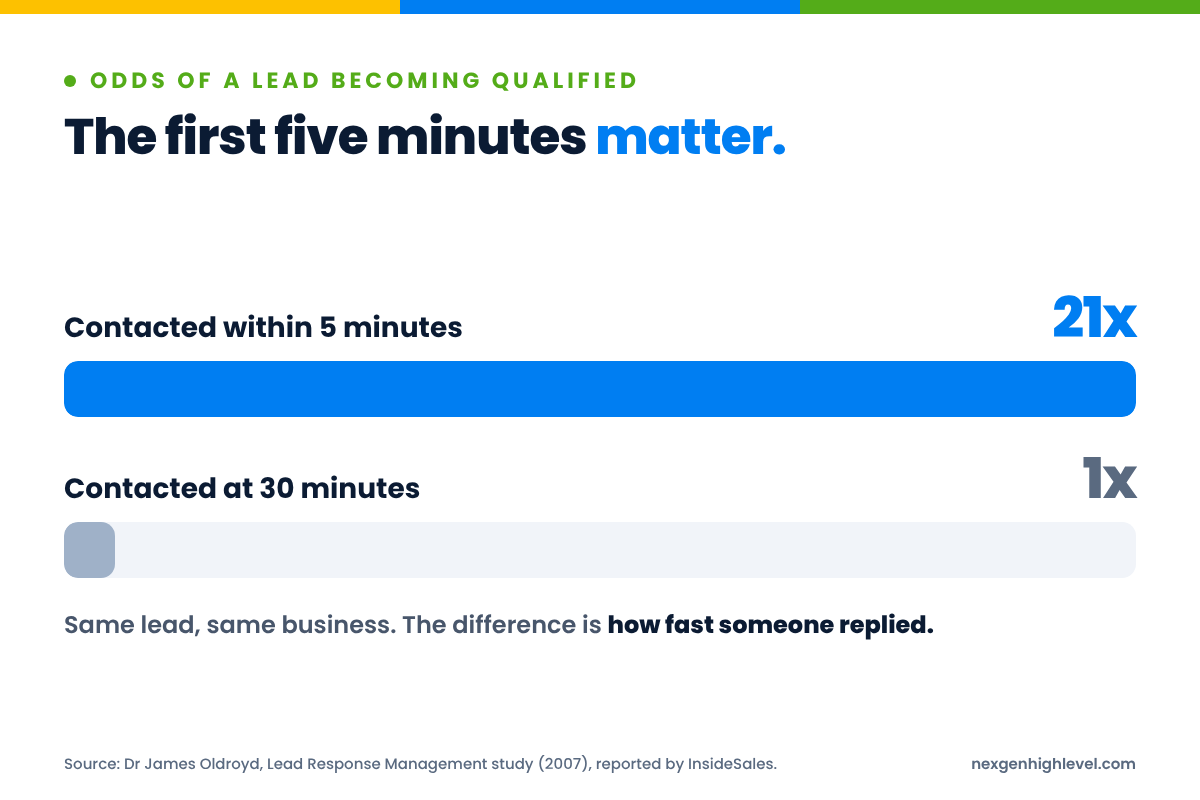
Back in 2007, Dr James Oldroyd ran the Lead Response Management study. As reported by InsideSales, the odds of a lead becoming qualified were 21 times greater when the business made contact within five minutes than when it made contact at 30 minutes.
Not five minutes against five days. Five minutes against half an hour.
Now, I want to be honest about that study. It's from 2007. It was about web leads and phone calls, not WhatsApp. Nobody should read it and claim WhatsApp gives you "21 times more sales". That's not what it says.
But think about why the pattern exists, because the reason hasn't changed.
Why speed works
When someone reaches out, they're in the moment. The problem is fresh. The decision feels urgent. They're holding their phone and they've got a few minutes.
Thirty minutes later, they're making the dinner. They've messaged two of your competitors as well. One of them replied. The moment has passed, and you're now chasing someone who has moved on.
Speed isn't magic. Speed is just catching people while they still care.
Why WhatsApp raises the bar
On WhatsApp, the expectation of speed is built into the channel. It's a messaging app. People use it for quick back-and-forth. If they wanted a reply in three working days, they'd have sent a letter.
And here's the bit that should make every business owner sit up. A WhatsApp message is often the warmest lead you'll ever get. They didn't fill in a form because an ad told them to. They opened a chat and typed to you, in their own words, about their own problem.
That's not a cold lead you're warming up. That's someone already at the counter.
Would you let someone stand at your counter for an hour without saying hello?
Why the reply never gets sent
Nobody sets out to ignore enquiries. I've never met a business owner who said, "I'd rather not answer the people who want to give me money."
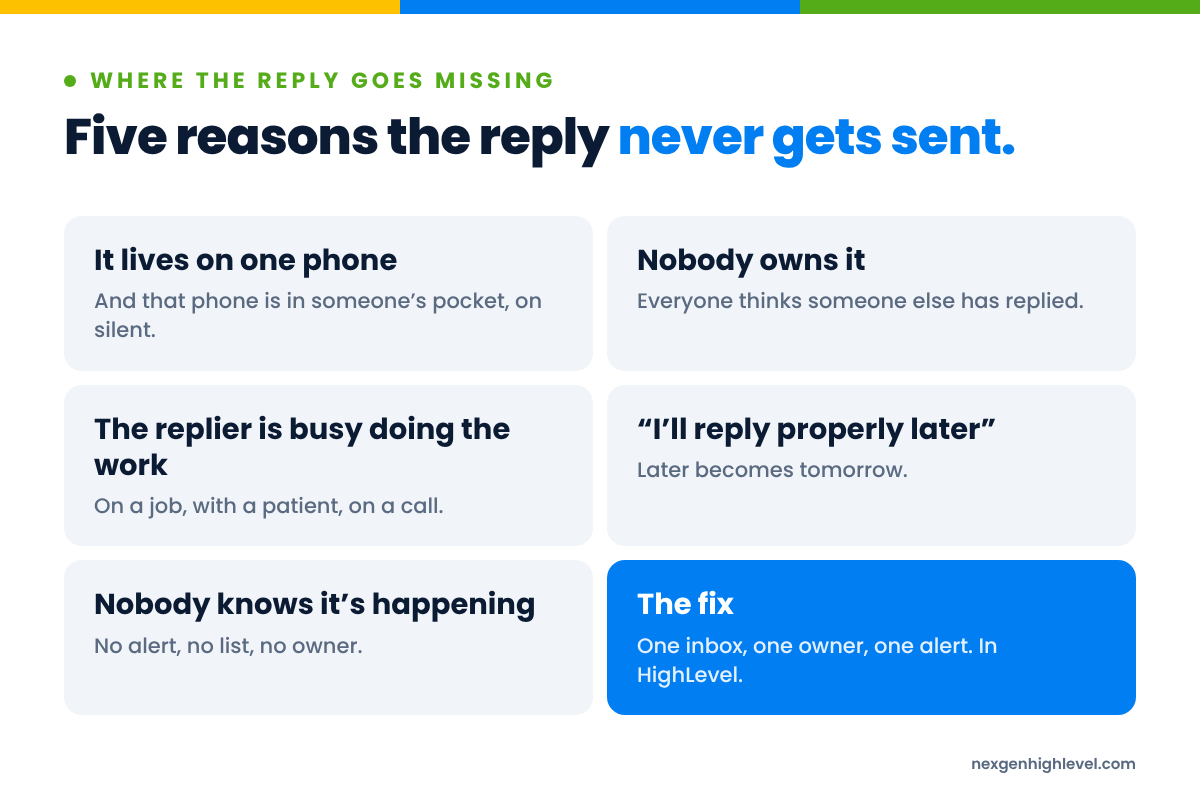
So why does it keep happening? In my experience it's rarely laziness. It's usually one of these.
1. The WhatsApp lives on one phone
The business WhatsApp is on the owner's phone. Or the receptionist's phone. Or an old handset in a drawer that somebody charges on Mondays.
When that person is busy, on holiday, off sick or simply asleep, the business goes deaf.
It's not a system. It's a person. And people have lives.
2. Nobody owns it
When something belongs to everyone, it belongs to no one.
Picture a small team where three people can see the WhatsApp. Each one sees the new message, assumes someone else will pick it up, and gets on with their day. Everyone saw it. Nobody answered it.
If you've ever worked in a shared office kitchen, you already know how this ends. Nobody's washing that mug.
3. The person who replies is the person doing the work
This one is brutal for service businesses.
The plumber who answers enquiries is the same plumber who is under a sink. The clinic owner who checks WhatsApp is the same person treating patients. The roofer is on a roof. You can't pull your hands out of a job every eight minutes to check your phone, and you shouldn't have to.
4. "I'll reply properly later"
This is the sneaky one, and I'm guilty of it myself.
You see the message. You want to give a good answer, with the price and the availability and a helpful bit of advice. You don't have time right now. So you leave it until later, when you can do it properly.
Later becomes tonight. Tonight becomes tomorrow. Tomorrow, they've already booked.
The perfect reply that arrives late loses to the decent reply that arrives now. Every time.
5. Nobody knows it's happening
This is the root of all the others. Most businesses have no idea how long their replies take. They don't measure it, so they can't see it, so they can't fix it.
Ask yourself honestly. What's your average response time on WhatsApp? Not your best day. Your average.
If you don't know, that's your answer.
What this looks like in the real world
I've seen versions of this for a long time, long before WhatsApp.
When I started in recruitment, I had a telephone, a filing cabinet and a phone directory. No email. No CRM. If a client rang and you weren't there, you'd get a note on your desk, and the race was on. Whoever called back first usually got the job to work on. Not the cleverest recruiter. The quickest one who actually picked up the phone.
People buy from people. And people tend to buy from the people who turn up.
Years later, running my agency, most of our clients were private medical practices in the US. A lot of them had been stuck on one channel, usually Facebook Ads, with results getting worse and no-shows and cancellations going up. Agency after agency had tried to fix the same channel.
We usually rebuilt from the ground up, and we took responsibility for the whole journey, from someone discovering the practice to becoming a paying patient. Because I learned something early on. Great ads still fail if the offer is weak, the website is confusing, the phone goes unanswered, or sales take three days to call back.
You can't advertise your way out of a response problem.
And then there was the car leasing business I started in 2019. That one taught me, very quickly, that it was all about online lead generation. When the whole business runs on enquiries, you start to see how much depends on what happens in the minutes after somebody gets in touch.
Different decades. Different channels. Same lesson.
Honest auto-acknowledgements: speed without pretending
So the obvious answer is automation, right? Send an instant reply to every message and the problem goes away.
Partly. But this is where a lot of businesses get it wrong, and where WhatsApp is less forgiving than other channels.
What WhatsApp's rules actually say
First, the boundaries.
WhatsApp is for conversations with people who chose to talk to you. If someone messages you first, they've started that conversation. If they gave you their number on a form and agreed to hear from you on WhatsApp, that's permission too. We go deeper into this in You're a Guest on WhatsApp. Act Like One., because it matters more than most people realise.
What WhatsApp is not is a bulk channel. Its Terms of Service forbid "sending illegal or impermissible communications such as bulk messaging, auto-messaging, auto-dialing, and the like." Numbers that spam get restricted or banned. No tool changes that, including ours, and anyone who tells you their tool makes a number "ban-proof" is selling you something you can't buy.
At the same time, the WhatsApp Business Messaging Policy allows automation when a business is responding to someone during the 24-hour window after they message. But it comes with a condition: businesses "must also have available prompt, clear, and direct escalation paths", such as transfer to a human agent.
Read that again, because it's a pretty good business principle even without the rules.
Automation can respond. A human must be reachable.
The honest acknowledgement
An instant reply isn't there to close the sale. It's there to say, "We've got you. A real person is coming."
Here's an example of the kind of acknowledgement I mean:
Hi Sarah, thanks for getting in touch with Riverside Dental. This is an automatic reply so you know we've got your message. One of the team will reply personally within the hour (we're open 8am to 6pm, Monday to Friday). If it's urgent, call us on [number].
What makes that work?
- It's honest. It says it's automatic. It doesn't pretend to be a receptionist typing at lightning speed.
- It sets an expectation. "Within the hour" is a promise. Make sure it's one you can keep.
- It gives a way out. If it's urgent, there's a human route.
- It's short. Nobody wants a paragraph from a robot.
What a bad acknowledgement looks like
And here's the kind I'd steer clear of:
Thank you for contacting us! Your message is important to us! A member of our team will be in touch shortly! In the meantime, check out our website, follow us on Instagram, and don't forget our summer offer!!!
It's not an acknowledgement. It's a brochure that shouts.
"Shortly" means nothing. The links pull them away. The exclamation marks make it sound like a game show. And it's clearly written for everyone, which means it's written for nobody.
The acknowledgement is not the reply
This is the bit people skip.
An automatic acknowledgement buys you a little time. It doesn't buy you forever. If you send "someone will reply within the hour" and then reply in two days, you've done something worse than saying nothing. You've made a promise and broken it, in writing, inside the first five minutes of the relationship.
Fast and fake loses to slightly slower and real.
The acknowledgement says you're there. The human reply proves it.
Where AI fits, and where it doesn't
AI can genuinely help here. It can sort messages, suggest a draft, pull out what the person is actually asking for, and help your team reply faster. AI doesn't replace humans. It speeds up the process.
But don't let a bot pretend to be a person, and don't leave someone trapped talking to a machine when they want a human. We'll keep writing about this, including what Meta's terms say about AI, because it's a big subject on its own.
Routing and alerts in HighLevel: who replies, and how they know
Right. This is where HighLevel earns its keep.
Most response problems aren't really speed problems. They're visibility and ownership problems. The message arrived, but the right person didn't know, or didn't know it was theirs.
So the job is simple to describe:
- Get every enquiry into one place.
- Make sure one named person owns it.
- Make sure that person knows, straight away.
- Make sure someone notices if it's slipping.
One inbox, not five phones
In HighLevel, Conversations is a unified inbox. SMS, email, social messages and more sit in one place, attached to the contact, with their history.
When WhatsApp sits in there too, it stops being a private thing on somebody's handset and becomes part of the business. That's exactly why we built the WhatsApp App for HighLevel: WhatsApp numbers connect into HighLevel so the conversations live alongside everything else, and messages arriving on a specific connection, from a specific contact or in a specific group can trigger a workflow. I'm not going to turn this into a product tour. The point is bigger than any app.
Your WhatsApp shouldn't depend on whose pocket the phone is in.
We go deeper on that in the article on bringing WhatsApp into HighLevel, and on why WhatsApp is where your customers actually talk in the first place.
Give every enquiry an owner
HighLevel lets you assign contacts and conversations to users. Use it.
Decide your rules in plain English before you build anything:
- Enquiries about new jobs go to Mark.
- Existing customers go to whoever looks after their account.
- Anything after 6pm goes to whoever is on call that night.
- If the owner hasn't replied in 15 minutes, it goes to the manager.
Then build that in Workflows. Not the other way round.
If you can't write your routing rules on the back of a beer mat, they're too complicated. And if you can't write them at all, that's the problem you need to fix first.
Alerts that actually reach a human
A Workflow can notify the assigned person the moment a new enquiry arrives. It can tag the contact as a new enquiry, create an opportunity in your pipeline, and set a task to reply.
But think about where that alert lands. An email notification to an inbox nobody checks during the day is not an alert. It's a diary entry.
Ask yourself:
- Where will this person actually see it?
- What will they be doing when it arrives?
- What happens if they don't act on it?
That last question is the one most businesses never answer.
The escalation step most businesses skip
Here's a simple pattern, with the logic described rather than the button-by-button setup:
- A new WhatsApp enquiry arrives from a contact.
- HighLevel acknowledges it honestly and assigns it to the right person.
- The assigned person gets an alert.
- The workflow waits a set amount of time.
- If there's still no reply from the team, it alerts someone else. A manager. The owner. Whoever is next in line.
That last step is the safety net. It turns "I hope someone gets to it" into "someone will get to it, and if they don't, we'll know."
Hope is not a process.
Opportunities: make every enquiry visible
When an enquiry becomes an opportunity in a pipeline, it stops being a chat and starts being a deal with a stage. New enquiry. Replied. Qualified. Booked. Won or lost.
Suddenly you can see the pile. You can see the enquiries sitting in "new" that haven't moved. You can see that Tuesday afternoons are a black hole because that's when the team does site visits.
You can't fix what you can't see. HighLevel's job here is to make the invisible visible.
A simple WhatsApp lead response plan
Let me pull this together into something you can actually use. I'm a big believer that simple isn't amateur. Simple is often what you arrive at once you understand something.
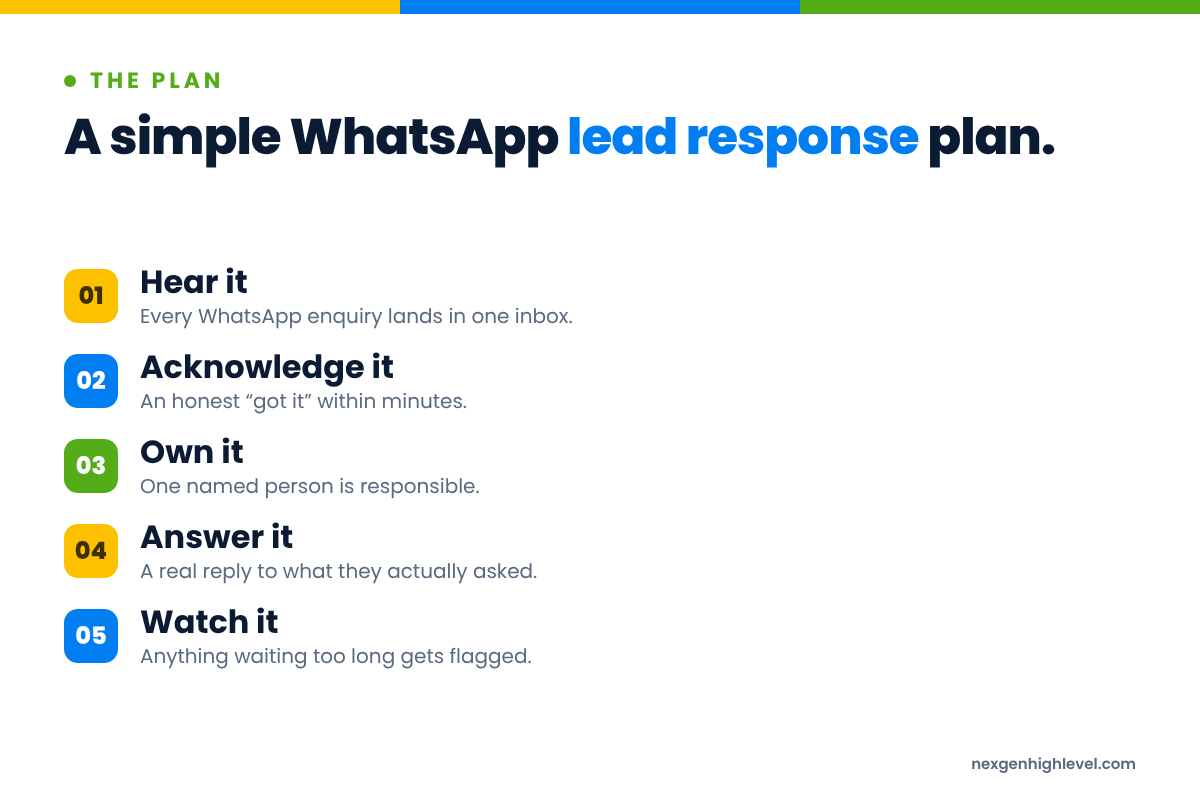
I think of it in five steps.
1. Hear it
Every enquiry, on every channel, lands somewhere a business can see it. Not on one phone. Not in one person's head. In HighLevel, against a contact, with history.
Question to ask yourself: if your phone fell in a lake tonight, would you lose any customer conversations?
2. Acknowledge it
An honest, short, automatic acknowledgement goes out straight away to the person who messaged you. It says it's automatic, it says when a human will reply, and it gives an urgent route.
Question: does your acknowledgement make a promise you can keep?
3. Own it
Every enquiry has one named owner within minutes. Not "the team". A person.
Question: if I asked you now who's responsible for the last enquiry that came in, could you tell me?
4. Answer it
A human reply follows, inside the time you promised. It answers the actual question. It's short and specific. And it ends with one clear next step, usually one question.
Something like this, as an example:
Hi Sarah, it's Emma from Riverside Dental. Thanks for waiting. Yes, we've got a new patient appointment on Thursday at 10am or Friday at 2pm. Would either of those suit you?
That's it. No essay. No brochure. A real person, a real answer and one easy question.
5. Watch it
Every week, look at the enquiries that waited too long. Not to blame anybody. To find the pattern. Is it a time of day? A person? A type of enquiry?
Then fix the pattern, not the person.
Hear it. Acknowledge it. Own it. Answer it. Watch it.
It's not complicated. It's just rarely done.
What to measure, and what to ignore
I'm going to say the thing I always say. Does it make any money?
Response time on its own is not the goal. A business that replies in 40 seconds with a useless answer hasn't won anything. It's just disappointed people faster.
So measure response time, but measure it next to what happens afterwards.
Numbers worth looking at
- Time to first human reply. Not the automatic acknowledgement. The first real reply from a person.
- Enquiries with no human reply after a set time. This is your leak. Make it a smart list or a pipeline stage so you can see it.
- Enquiry to booked. What share of enquiries become an appointment, a call or a quote?
- Booked to paid. Bookings mean nothing if they don't turn up or don't buy. I learned that the hard way with no-shows and cancellations in the clinics.
- Revenue by source. Which channels, and which responses, actually produce customers? HighLevel's reporting and attribution help here, if you set up your sources and pipelines properly.
Numbers that feel good but don't pay
- The number of chats.
- How many messages your team sent.
- Blue ticks.
None of those pay the bills on their own. Don't confuse activity with progress.
Look monthly, decide quarterly
Look at the numbers every month. But don't tear up your process because of one bad week. Give a change long enough to show you something, then decide.
Walk before you run. Fix the leak first, then worry about pouring more water in.
For agencies: lead response is your results problem too
If you run an agency, this one's for you as well.
You can run brilliant campaigns for a client. The cost per lead can look lovely in the report. And the client can still tell you "it's not working", because nobody in their business is answering the leads you're sending them.
You'll take the blame for that. Fair or not.
This is why I've always believed marketing is the whole system, not just the ads. Speed to lead is one of the most practical places an agency can help a client, because it's measurable, it's fixable, and it usually doesn't need a bigger ad budget.
A few questions worth asking every client during onboarding:
- Where do WhatsApp enquiries go today, and who sees them?
- What's your average reply time? Do you actually know?
- What happens to an enquiry at 7pm on a Saturday?
- Who is responsible when nobody replies?
If the answers make everyone go a bit quiet, you've found the work.
And if you've already been through the LinkedIn side of this with us, it's the same principle we wrote about in following up LinkedIn leads in HighLevel. Different channel. Same discipline. Interest is perishable.
What happens after the first reply
Fast first replies matter. But I don't want anyone leaving this thinking speed is the whole game.
The first reply opens the door. What happens after that decides whether someone walks through it.
When they don't reply back
Sometimes you reply in four minutes with a lovely message, and they go quiet.
That's normal. People get busy. The child needed picking up. The boss walked in. Don't take it personally, and don't bombard them.
One thoughtful follow-up, at a sensible time, with something useful in it, is usually worth more than five "just checking in" messages. We cover how to do that without it feeling like chasing in WhatsApp Follow-Up That Doesn't Feel Like Chasing.
When they say no
Respect it. Instantly. WhatsApp's policy says businesses must respect requests to block, discontinue or opt out, on or off WhatsApp. But you shouldn't need the policy to tell you that.
A clean "No problem at all, thanks for letting us know" leaves the door open for the future. Ignoring it closes the door and probably gets you reported.
How you behave when there's nothing in it for you tells people quite a lot about you.
When the lead came from somewhere else
Not every lead starts on WhatsApp. A form, a phone call, an ad. If someone gave you their number and agreed to hear from you on WhatsApp, a quick WhatsApp reply can be a lovely way to start.
If they didn't agree to that, reply on the channel they chose. Call them. Email them. Text them if they agreed to texts. Speed matters, but it never trumps permission.
The rule is simple. Be fast where you've been invited. Be patient everywhere else.
Frequently asked questions
What is a good WhatsApp lead response time?
As fast as you can genuinely manage, with an honest automatic acknowledgement straight away and a human reply soon after. The research I trust most, the Oldroyd study, found big differences between five minutes and thirty, but it's about web leads and phone calls, not WhatsApp. So don't chase a magic number. Measure your own average, then work on bringing it down week by week.
Can I use auto replies on WhatsApp for business?
Yes, used honestly. WhatsApp's Business Messaging Policy allows automation when you're responding to someone during the 24-hour window, as long as there's a clear route to a human. What it doesn't allow is bulk messaging or auto-messaging people who never asked. So acknowledge, set an expectation and make sure a real person follows up. An auto reply should say "we've got you", not pretend to be someone.
How do I make sure WhatsApp enquiries don't get missed?
Get them off a single phone and into one shared inbox, give each enquiry a named owner, and send an alert that reaches that person where they actually are. Then add an escalation step, so if nobody replies within a set time, someone else is told. In HighLevel, that's Conversations, assignment and Workflows working together. The important bit isn't the software, though. It's deciding who owns what.
Should I message new leads on WhatsApp if they filled in a form?
Only if they gave you their number and agreed to hear from you on WhatsApp. That's what WhatsApp's own policy requires, and it's just good manners. If your form has a clear WhatsApp consent option and they ticked it, a quick, personal WhatsApp reply can work really well. If not, reply on the channel they chose. Speed never trumps permission.
Is speed to lead more important than the quality of the reply?
They work together. A fast reply that doesn't answer the question just disappoints people quicker. A brilliant reply that arrives tomorrow often arrives after they've booked someone else. Aim for a decent, specific human reply quickly, rather than a perfect one later. One clear answer and one easy next step beats a long essay every time.
Can AI answer my WhatsApp leads for me?
AI can help a lot: sorting messages, drafting replies and helping your team answer faster. But it shouldn't pretend to be a person, and people must be able to reach a human easily. WhatsApp's policy expects that escalation path. Think of AI as the colleague who hands you a draft, not the one who runs the shop while you're out.
The reply is the marketing
Here's what I'd love you to take from this.
Most businesses don't have a lead problem. They have a reply problem dressed up as a lead problem.
Before you spend another penny getting people to reach out, look at what happens when they do. Pick up the phone, figuratively and literally. See how long your last ten enquiries waited. Ask who owned them. Ask what they were told.
Then fix that. Hear it, acknowledge it, own it, answer it, watch it. In HighLevel, with WhatsApp sitting next to everything else, it's very doable. But the thinking comes first. Human. Strategy. Leverage. In that order.
Your customers chose to say hello. The least you can do is say it back.
Because no ad, however good, can fix a reply nobody sent.