
WhatsApp Follow-Up That Doesn't Feel Like Chasing

You've sent the quote. They said it looked great. Then nothing.
Two days later you type "Hi, just checking in!" and delete it. You type it again. You send it. Then you stare at two grey ticks and feel slightly worse about yourself.
That's the problem with most WhatsApp follow-up. It isn't follow-up at all. It's chasing. And everybody can feel the difference, including the person on the other end of the phone.
Here's the thing, though. The business you lose isn't usually lost to a competitor. It's lost to silence. To the follow-up you didn't send because it felt awkward, or the one you sent that was so needy nobody wanted to answer it.
There's a better way. It's not about sending more messages. It's about sending better ones, at the right time, and knowing when to stop.
Why WhatsApp follow-up feels like chasing
WhatsApp is a personal space. More than 3 billion people use WhatsApp, and for most of them it sits right next to the chat with their mum, the school parents' group and the friend who sends forty memes a day.
When you follow up there, you're not landing in an inbox they check at work. You're landing at the kitchen table.
That changes everything.
An email that gets ignored just sits in a pile with two hundred others. A WhatsApp message that gets ignored sits there, with the person's own blue ticks staring back at them. They saw it. You know they saw it. They know you know.
So when the follow-up arrives, it doesn't just ask a question. It adds a little weight. And if it's the wrong kind of message, that weight starts to feel like pressure.
It's a feeling problem, not a software problem
In my agency days, we worked mostly with private medical practices. The marketing was technically excellent. But the doctors and clinicians wouldn't give us content. Not because they couldn't, but because they'd frozen in front of a camera and didn't want to do it again.
We built an app to help. And what I learned was this: we weren't really solving a content-production problem. We were solving a human-friction problem.
Follow-up is exactly the same.
Most business owners don't avoid following up because they lack a tool. They avoid it because it feels awkward. They don't want to be "that person". They worry they're bothering someone. So they either don't follow up at all, or they send something so apologetic it practically asks to be ignored.
Fix the feeling first. Then the technology has something worth multiplying.
Chasing vs following up: the difference that matters
Let me put it as simply as I can.
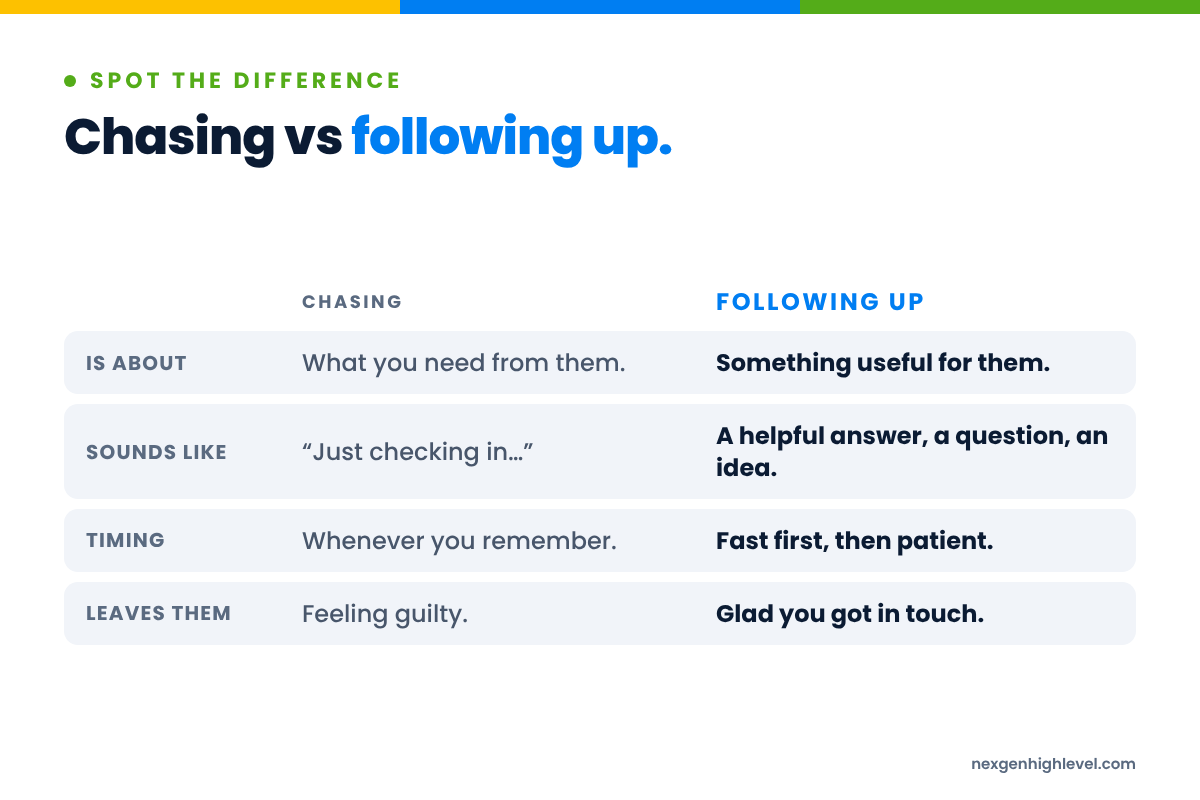
Chasing is about you. Following up is about them.
Chasing says: "I need an answer. I need the deal. I need to know where I stand."
Following up says: "Here's something useful. Here's the next step made easy. I'm still here if you need me."
Same channel. Same person. Completely different feeling.
How to spot a chasing message
Read your last few follow-ups and ask yourself honestly. Do they sound like any of these?
- "Just checking in!"
- "Did you get my last message?"
- "Any update?"
- "Just bumping this to the top of your chat."
- "Sorry to bother you again, but..."
Every one of those asks for something and gives nothing. They make the other person do the work: remember what you were talking about, find your last message, decide what to say, and feel a bit guilty about the delay.
That's not a follow-up. That's a small invoice for their attention.
What following up looks like instead
A real follow-up has three things in it:
- A reason that's about them. Something they said, something they wanted, something that's changed.
- Something of value. An answer, an idea, a photo, a short voice note, a useful bit of information.
- An easy next step. One simple question, or a way to say "not right now" without feeling awkward.
Here's an example, just to show the shape of it. Picture a landscaping business following up a quote:
"Hi Sarah, I was thinking about your back garden after we spoke. You mentioned the kids want somewhere to kick a ball. I've attached a photo of a job where we kept a strip of lawn and moved the patio to the side. Might be worth a look. Happy to tweak the quote either way."
No "just checking in". No guilt. It shows you listened. It gives her something. And replying is easy.
Chasing makes people feel watched. Following up makes people feel remembered.
Earn the right to follow up on WhatsApp
Before we talk about timing and tactics, there's a bigger question.
Should you be on WhatsApp with this person at all?
I'll be blunt here, because your number and your reputation depend on it. WhatsApp is for conversations with people who chose to talk to you. They gave you their number. They agreed to hear from you. That's the deal.
WhatsApp's own Business Messaging Policy is clear. You may only contact people on WhatsApp if "they have given you their mobile phone number or username" and you have "received opt-in permission from the recipient confirming that they wish to receive subsequent messages" from you.
It also says you "must respect all requests (either on or off WhatsApp) by a person to block, discontinue, or otherwise opt out". And if your behaviour breaks the rules, WhatsApp "may limit or remove your access to our services".
The WhatsApp Terms of Service go further, and forbid "sending illegal or impermissible communications such as bulk messaging, auto-messaging, auto-dialing, and the like."
So, plainly:
- No bought lists.
- No scraped numbers.
- No messaging people who never said yes.
- No mass blasts dressed up as "follow-up".
Numbers that spam get restricted or banned. No tool, including anything we build, makes a number immune to that. The only real protection is behaving like a decent guest.
I've written more about this in You're a Guest on WhatsApp. Act Like One, and it's worth reading before you build any follow-up at all.
Cold follow-up belongs somewhere else
If someone hasn't opted in, they're not a WhatsApp follow-up. They're a prospect.
Prospecting and cold outreach belong on LinkedIn and email, where starting a conversation with a stranger is part of the culture. WhatsApp is where the relationship continues once someone has said yes.
That's not a limitation. It's a sequence. Meet people in the business room, earn their interest, and then, when they're happy to hear from you, the conversation moves somewhere more personal. I've written about the earlier part of that journey in how to follow up LinkedIn leads in HighLevel.
Permission isn't a box you tick once. It's something you keep earning with every message.
Timing your WhatsApp follow-up: fast first, then patient
Timing is where most follow-up goes wrong, and it goes wrong in both directions.
Too slow at the start. Too fast later on.
The first reply should be fast
When someone has just enquired, speed matters more than almost anything else.
The Lead Response Management study by Dr James Oldroyd, reported by InsideSales, found that the odds of a lead becoming qualified were 21 times greater when contacted within five minutes than at 30 minutes.
That study is from 2007, and it wasn't about WhatsApp. But the human truth behind it hasn't changed. When someone reaches out, they're thinking about their problem right now. Ten minutes later they're thinking about dinner.
I covered this in detail in WhatsApp Lead Response: The Reply Nobody Sent. The short version: the first reply isn't follow-up. It's the bare minimum.
After that, slow down
Here's the bit people get backwards.
Once you've replied and the conversation has started, the urge is to keep the pressure on. Message tomorrow. Message the day after. Keep the deal warm.
But warmth doesn't come from frequency. It comes from relevance.
Think about how a good friend behaves on WhatsApp. They don't message every day asking if you've decided about the weekend. They send one message, then wait. If you go quiet, they assume you're busy, not rude. And when they do message again, it's usually with something new.
That's the rhythm to aim for.
A follow-up rhythm to start from
This isn't research. It's a sensible starting point. Every business is different, so adjust it to how your customers actually buy.
- Straight away: Answer the enquiry. A real answer, from a real person, as soon as you can.
- The next day or two: One follow-up that adds something. The photo, the example, the answer to the question they didn't quite ask.
- About a week later: A different angle. Something that helps them decide, or a reminder of what they told you they wanted.
- A couple of weeks after that: The graceful exit. Leave the door open and step back. (More on that shortly.)
Four touches over a few weeks. Not four touches in four days.
And notice what's not on the list. A daily "any update?" Ever.
Respect their clock, not yours
A few practical questions to ask yourself about timing:
- When did they message you? If they enquired at 9pm, they're probably an evening person. A follow-up at 7am might land at the worst moment of their day.
- What did they tell you? "I'm away until the 20th" is a gift. Follow up on the 21st, not the 15th.
- Is anything happening on their side? A payday, a school holiday, the end of a season, a decision they mentioned they're waiting on.
- Would you send this to a friend at this hour? If not, don't send it to a customer.
Good timing isn't about the perfect hour. It's about paying attention.
Value-first follow-ups: give before you ask
If chasing is asking without giving, the fix is obvious. Give first.
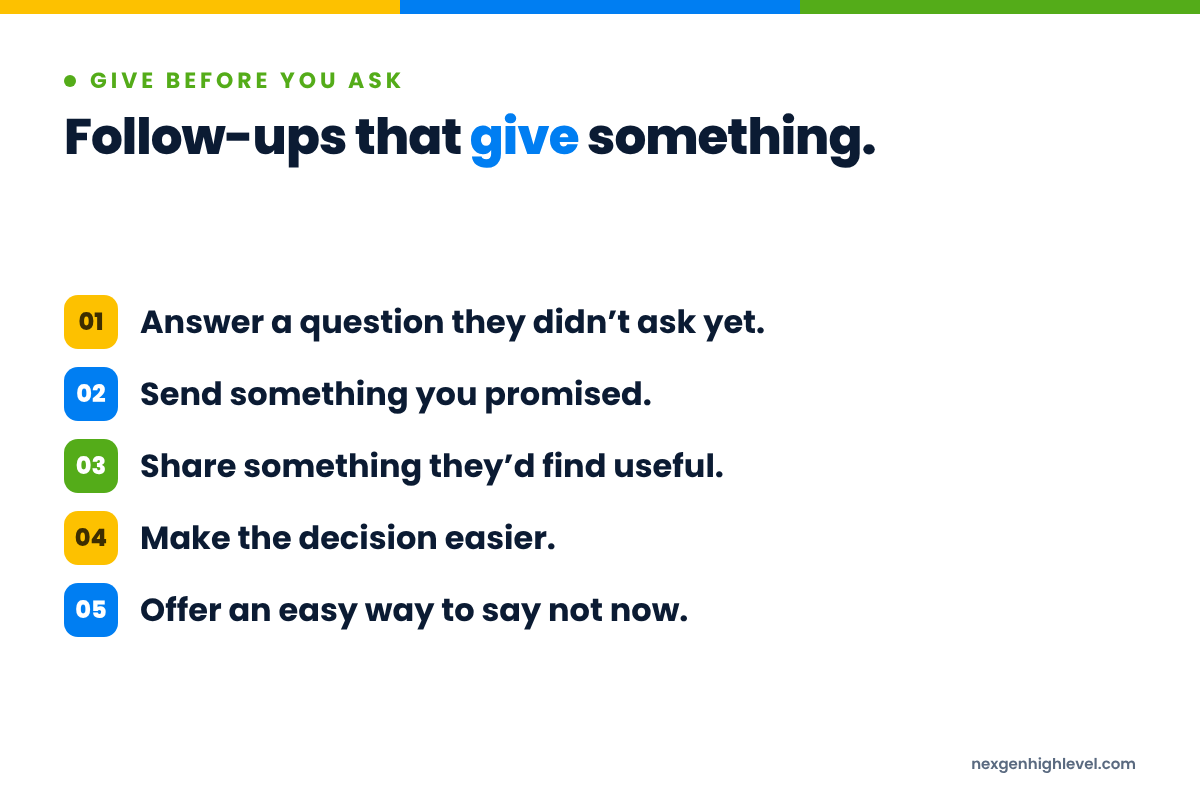
But "add value" is one of those phrases that gets said a lot and explained very little. So let's be specific.
Five kinds of follow-up that give something
1. The answer to a question they didn't ask. Most people have more questions than they send you. They're worried about the price, the timing, the disruption, whether you'll actually turn up. Answer one of those before they ask it.
2. The proof that makes it real. A photo of a similar job. A short clip of the product in use. A before and after. Not a brochure. One relevant thing.
3. The reminder of their goal. People forget why they enquired. Not because they've lost interest, but because life got busy. Remind them gently of what they told you they wanted. "You mentioned you wanted this sorted before your daughter's wedding in June" does more than any sales line you could write.
4. The next step made smaller. Sometimes people go quiet because the next step feels too big. A full consultation feels like a commitment. A ten-minute call to answer two questions doesn't. Make the step smaller.
5. The honest heads-up. If something has genuinely changed, like availability, a schedule, or a new option that fits them better, tell them. Honestly. Not invented scarcity. Real information they'd want to know.
Example: the same follow-up, chasing and not chasing
Here's an example to make it concrete. Imagine a dental practice following up someone who asked about teeth straightening and then went quiet.
The chasing version:
"Hi Tom, just checking whether you'd like to book your consultation? We have availability this week."
The following-up version:
"Hi Tom, a few people ask us whether straightening treatment means months of obvious braces. Often it doesn't, and we can show you the options in a short visit with no obligation. Would a quick chat about what's possible be useful, or is now not the right time?"
The second one answers his likely worry. It makes the next step small. And it gives him a polite way to say "not now" without having to ghost you.
That last bit matters more than people think. I'll come back to it.
One question, not five
Every follow-up should end with, at most, one question.
Not "Would you like to book? And what dates suit? And did you have any questions about the price? And would you like the brochure?"
That's not a message. That's homework.
One clear question. Easy to answer with a word, a thumbs up or a voice note from the car. We'll get deeper into this in WhatsApp Messages People Actually Reply To.
Voice notes: the most human follow-up you can send
Now, a confession. I have an irrational dislike of people taking calls on speakerphone in public. It drives me mad.
Voice notes, though? I'm a fan. In the right place.
Because a voice note does something text can't. It carries a human voice. Tone, warmth, a bit of humour, the fact that you actually took thirty seconds out of your day for this person.
And when follow-up is in danger of feeling like chasing, that human voice changes everything. It's very hard to sound like a pushy salesperson in a relaxed thirty-second voice note that says, "Hi Sarah, it's Mark from the garden job. I was driving past a house today that made me think of what you were describing..."
When a voice note works
- When there's nuance. Explaining options, talking through a quote, answering a worry. Things that would take four paragraphs of text.
- When you want to sound like you. If people buy from you because they like you, let them hear you.
- When the relationship is already warm. Someone who has spoken to you, met you, or sent you a voice note first.
- When they use voice notes too. Mirror how people talk to you.
When it doesn't
- When it's long. If your voice note needs a cup of tea and a biscuit, it's a podcast, not a follow-up. Keep it short.
- When they need to refer back to something. Prices, dates, addresses and times belong in text, where they can find them again.
- When they've never heard from you before. A voice note from a stranger is a lot.
- When it's clearly not a good moment. Some people can't listen at work or on a train. Follow a voice note with one line of text summarising it, so nobody has to listen in public.
A voice note isn't a trick. It's just a person, talking. That's exactly why it works.
Knowing when to stop following up
This is the part nobody likes talking about.
At some point, you have to stop.
Not because the person is a lost cause. But because more messages won't change their mind, and they will change how they feel about you.
There's a difference between persistence and pestering. Persistence is staying useful over time. Pestering is asking the same question louder.
The graceful exit
My favourite follow-up is the last one.
It does three things. It acknowledges that now might not be the right time. It takes the pressure off. And it leaves the door open.
Here's an example of the shape:
"Hi Sarah, I haven't heard back, so I'm guessing the timing isn't right, and that's completely fine. I won't keep messaging. If you do want to pick the garden back up, just send me a message here and I'll be happy to help."
That's it.
What's interesting is how often a message like that gets a reply. "Sorry, it's been mad here, can we look again in the spring?" Because you've taken the pressure away, replying becomes easy again.
And if it doesn't get a reply? You've still left a good impression. Which matters a lot more than you think, because people talk, and people come back.
Give people a way to say no
Here's a slightly uncomfortable thought. A lot of the "ghosting" businesses complain about is caused by the business itself.
If every follow-up assumes a yes, people who want to say "no" or "not now" have no comfortable way of doing it. So they say nothing. Silence feels kinder to them than disappointing you.
Make "no" easy. "Is now not the right time?" "Should I check back after the summer?" "Would you prefer I stopped messaging about this?"
An honest no is worth far more than a polite silence. It tells you where you stand, and it keeps the relationship intact.
When they say stop, stop
And if someone says they don't want to hear from you, on WhatsApp or anywhere else, that's the end of it. Remember the policy: you "must respect all requests (either on or off WhatsApp) by a person to block, discontinue, or otherwise opt out".
That's not just a rule. It's manners.
How you behave when there's nothing in it for you tells people quite a lot about you.
Building WhatsApp follow-up in HighLevel: Wait for Reply and pipelines
Right. Now we can talk about technology.
Notice that it's this far down the article. That's deliberate. My framework is Human, Strategy, Leverage, in that order:
- Human: Understand how it feels to receive a follow-up at the kitchen table, and what the person actually wants.
- Strategy: Decide your rhythm, your value-first messages, your voice notes and your graceful exit.
- Leverage: Then use technology so it actually happens, every time, for every person, without depending on your memory.
Technology is leverage, not strategy. Leverage multiplies whatever is underneath it. Automate "just checking in!" and you've built a very efficient machine for annoying people. Automate thoughtful, well-timed, value-first follow-up and you've built something that quietly looks after every enquiry.
For us, that leverage is HighLevel.
Pipelines: know where every conversation stands
Most follow-up falls apart for one simple reason. Nobody knows where anything is.
The enquiry from Tuesday. The quote from last week. The person who said "after the holidays". They're all in a phone somewhere, scrolled out of sight.
Opportunities and pipelines in HighLevel fix that. Picture a simple pipeline like this:
- New enquiry
- In conversation
- Quote or proposal sent
- Follow-up in progress
- Not now (check back later)
- Won
- Lost
Every person has a place. Every place has a next action. And when you look at the board on a Monday morning, you know exactly who needs a follow-up, who needs leaving alone, and who's ready to go.
Add a value to each opportunity and you'll also see what all that follow-up is actually worth. Not chats. Not blue ticks. Money.
That "Not now" stage is one of the most valuable things you'll ever build, by the way. It's where the graceful exits go. And it's where a lot of next quarter's business is sitting.
Wait for Reply: the logic that stops you chasing
Here's where the "doesn't feel like chasing" part really comes from.
The worst automated follow-up is the kind that doesn't listen. The customer replies "Yes please, Thursday works", and the next day the system sends "Just checking in!" anyway. Now you look like a robot that wasn't paying attention. Which is exactly what you are.
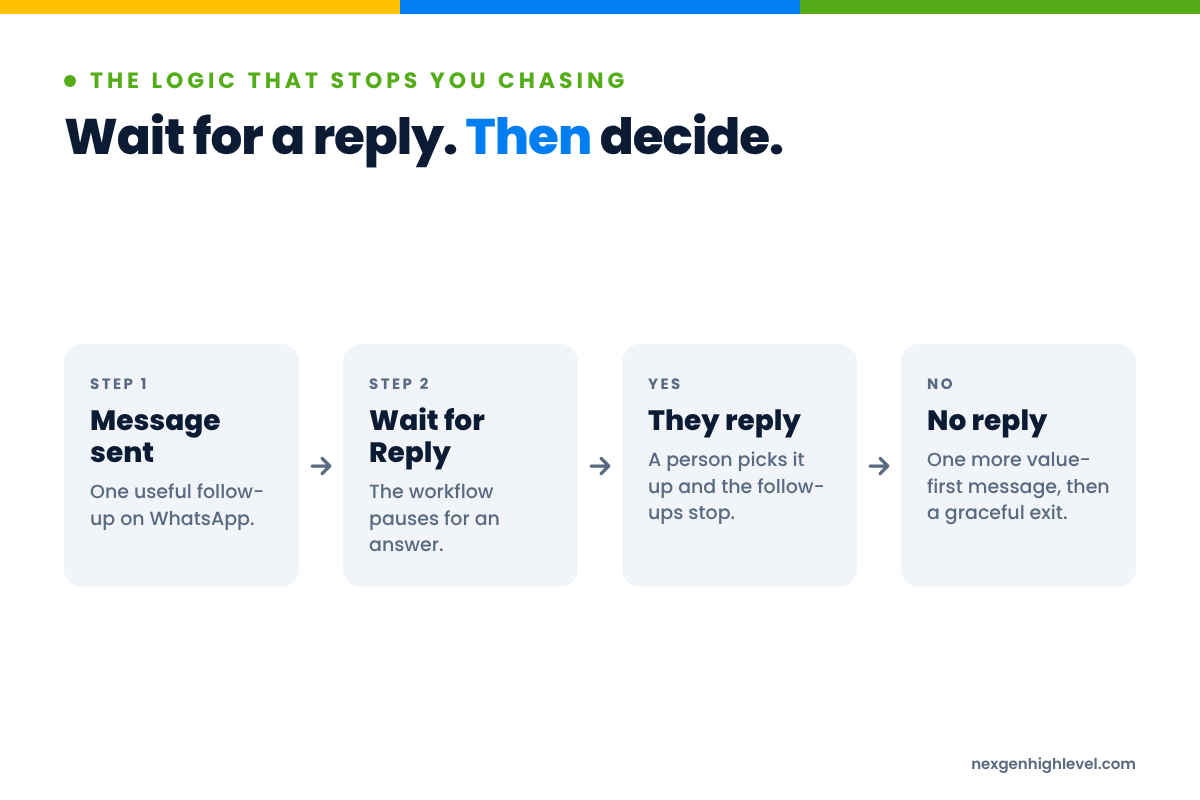
The fix is a simple bit of logic. After every follow-up, wait to see if they reply.
- If they reply: Stop the sequence. Move them in the pipeline. Tell a human, straight away, so a real person picks up the conversation.
- If they don't reply within the time you've chosen: Send the next value-first follow-up, or a task reminding someone to send a voice note.
- If they still don't reply after the last step: Send the graceful exit, move them to "Not now", and set a date to check back much later, if that's appropriate.
- If they ask you to stop: Stop, record it on the contact, and remove them from anything else.
That's it. Listening, built into the system.
In HighLevel, Workflows, tags and custom fields do the heavy lifting here. Tags show where someone is ("quote sent", "not now", "asked to stop"). Custom fields remember what matters ("project", "timing", "main worry"). Workflows handle the waiting, the branching and the reminders, and assign the conversation to the right person on your team.
If you're bringing WhatsApp into HighLevel, our WhatsApp App for HighLevel adds a Wait for Reply action to Workflows, alongside sending and replying to messages, so this logic can run on your WhatsApp conversations too, inside the same Conversations inbox as SMS and email. I go deeper into that side of things in Your WhatsApp Lives on a Phone. Your Business Shouldn't.
Automate the timing, keep the human
One more thing on this, because it's important.
Automation is brilliant at remembering. It's brilliant at timing. It's brilliant at making sure nobody falls through the cracks.
It is not a substitute for you.
Use your workflows to decide when someone needs a follow-up and who should send it. Some steps can be automated messages you've written carefully in advance. Others should be a task: "Send Sarah a voice note about the garden". The system taps you on the shoulder. You do the human bit.
And when someone replies, a real person should be on the other end, quickly. WhatsApp's policy says the same thing about automation: businesses "must also have available prompt, clear, and direct escalation paths" such as transfer to a human agent. Good automation hands over to a person. Bad automation pretends to be one.
AI doesn't replace humans. It speeds up the process.
Follow-up across channels, not just one
Back in my agency days, a lot of the clinics we worked with were stuck on one channel. They relied on Facebook Ads. Results got worse, no-shows and cancellations rose, and agency after agency tried to fix the same channel. We usually ended up rebuilding the whole system from the ground up.
Follow-up has the same trap.
WhatsApp is brilliant for warm, personal, quick conversations. But it isn't the only place your customer lives. Some things work better by email: a detailed proposal, a document they need to keep, a longer explanation. Some people simply prefer a phone call.
The point of running everything through HighLevel is that you can see the whole conversation, across every channel, in one place, and choose the right one for each step. WhatsApp for the friendly nudge. Email for the paperwork. A call when it really matters.
If you'd rather not build all of this from scratch, our HighLevel Snapshots are complete business systems with pipelines, workflows and follow-up already built for particular types of business. And if you're not on HighLevel yet, you can create a HighLevel account through NexGenHighLevel.
But a notebook, a diary and a bit of discipline will get you started either way. The principles don't change.
Frequently asked questions
How often should you follow up on WhatsApp?
Less often than you think. Reply to a new enquiry as fast as you can, then space things out. A sensible starting point is one value-first follow-up in the next day or two, another about a week later, and a graceful exit a couple of weeks after that. Adjust it to how your customers buy. If every follow-up adds something new, the frequency matters less. If it's "any update?", once is too often.
How do I follow up on WhatsApp without being annoying?
Make every message about them, not you. Give something useful, like an answer, a photo, an example or a short voice note, and ask one easy question at most. Make it simple for them to say "not now". Respect their time of day. And stop when the signals say stop. People rarely find a helpful, well-timed message annoying. What annoys them is being asked for an answer over and over with nothing new.
Is it OK to send voice notes to customers on WhatsApp?
Yes, when the relationship is already warm and the voice note is short. A thirty-second voice note can carry warmth and nuance that four paragraphs of text can't, and it's very hard to sound pushy in one. Keep prices, dates and addresses in text so people can find them again, and add a one-line summary so nobody has to listen on a crowded train. Don't send voice notes to people who barely know you.
When should you stop following up with a lead?
When more messages won't change their mind but will change how they feel about you. In practice, that's usually after three or four value-first follow-ups with no reply. Send a graceful exit that leaves the door open, then move them to a "not now" stage and check back much later if that's appropriate. And if anyone asks you to stop, stop immediately. That's both WhatsApp's policy and good manners.
Can I automate WhatsApp follow-up?
You can automate the timing and the reminders, but not the relationship. WhatsApp's terms forbid bulk messaging and auto-messaging, so this is about well-timed, one-to-one follow-up with people who've opted in, not blasting a list. In HighLevel, workflows can wait for a reply, stop when someone answers, alert your team and remind a person to send a voice note. Automation should hand over to a human, never pretend to be one.
What should a WhatsApp follow-up message say?
Three things: a reason that's about them, something of value, and one easy next step. Mention something they told you. Give them an answer, an example or a useful bit of information. Then ask one simple question, ideally one that lets them say "not now" comfortably. Avoid "just checking in", "any update?" and anything that starts with an apology. If the message only helps you, it's chasing.
Follow through, don't chase
In recruitment, long before WhatsApp, email or a CRM, follow-up was most of the job. A telephone, a filing cabinet and a phone directory. The people who won business weren't the ones who rang most often. They were the ones who rang with something worth hearing.
Nothing about that has changed. The channel has just moved closer to the kitchen table.
People buy from people. And people remember how you made them feel when they didn't reply.
So be quick when they reach out. Be patient after that. Give before you ask. Use your voice. Make "no" easy. Build the system in HighLevel so it listens, waits and hands over to a human. And when it's time to step back, step back gracefully.
Chasing asks, "Are you still there?"
Following up says, "I'm still here."