WhatsApp Messages People Actually Reply To
Open your own WhatsApp for a second.
The family group. The friend who sends voice notes from the car. Your neighbour asking if you've still got that ladder. And somewhere in between, a message from a business.
Which one did you answer first?
Most WhatsApp business messages fail for one simple reason. They're written like adverts and sent to a place where people talk. Nobody replies to an advert.
The messages that do get replies aren't clever. They're short, human and specific, and they ask one easy question. That isn't a talent. It's a habit, and you can start building it today.
Why most WhatsApp business messages get ignored
Let's start with where you are when you send a message on WhatsApp.
More than 3 billion people use WhatsApp. For most of them, it isn't a marketing channel. It's where their mum is. It's where the school group lives. It's where the lads arrange five-a-side and argue about who didn't pay last week.
So when your message lands, it isn't competing with other businesses. It's competing with people they love.
That's a tough crowd. And most business messages walk in like a salesman at a christening. Here are the three I see most.
The brochure
"Spring offers now live! 20% off selected services, free consultation, flexible finance, award-winning team. Visit our website to find out more!"
Everything in it is about the business. Nothing in it is about the person. There's no question, so there's nothing to reply to. The best you'll get is a read receipt.
The form letter
"Dear Valued Customer, we are reaching out to inform you that your account is due for review."
Nobody has ever felt valued by being called a Valued Customer. Between a photo of your nephew and a voice note from your sister, it sounds even colder than it would in an email.
The essay
Four paragraphs, three links and a signature with a confidentiality disclaimer. On a phone screen, that's a wall. People don't climb walls. They promise themselves they'll read it later. Later never comes.
It's not a channel problem
When messages like these don't work, business owners usually blame the channel. "Our customers don't reply."
It's not a channel problem. It's a writing problem.
The same person who ignores your brochure will happily reply to a message that sounds like it came from a human who knows who they are. The phone is the same. The person is the same. The words are different.
Before we go any further: this is for people who said yes
One thing needs saying plainly, because everything in this article depends on it.
Everything here is about messaging people who chose to talk to you. They gave you their number and agreed to hear from you. That's not me being precious. It's WhatsApp's own rule. The WhatsApp Business Messaging Policy says you may only contact people if they've given you their number and you've received opt-in permission confirming they want to hear from you. And WhatsApp's Terms of Service forbid "bulk messaging, auto-messaging, auto-dialing, and the like."
Numbers that spam get restricted or banned. No clever wording fixes that, and no tool makes a number immune to it.
If you want to meet new people, that's what LinkedIn and email are for. I've written about outreach messages that start real conversations on LinkedIn. WhatsApp is where the relationship carries on once someone has said yes. If you want the full picture on earning that yes, read You're a Guest on WhatsApp. Act Like One.
So, assuming they've invited you in: how do you write something they'll actually answer?
Write for the kitchen table, not the billboard
Here's the test I use for every message.
Picture the person sitting across a kitchen table from you. Cup of tea. No rush. Now read your message out loud to them.
Does it sound like something you'd say?
Or does it sound like something you'd read off a poster?
If you'd feel a bit daft saying it out loud, it's probably a bit daft to send.
What recruitment taught me about this
When I started in recruitment, there was no email. No LinkedIn. No CRM. There was a telephone, a filing cabinet and a phone directory.
If I rang a hiring manager and opened with a speech about our services, I could hear them switching off. Sometimes I could hear them typing. If I asked how the new project was going, they talked.
The difference wasn't my product. It was whether I sounded like someone who wanted to talk to them, or someone who wanted to talk at them.
WhatsApp is the closest thing we have now to that phone call. The people who do well on it remember that.
People buy from people. They also reply to people.
Your brand voice can relax a bit
On WhatsApp, you're not a brand. You're a person from the business. Sarah from the practice. Mike from the roofing company.
You can still be professional. Professional just doesn't mean stiff. Say "Thanks" rather than "We appreciate your enquiry." Say "Does Tuesday work?" rather than "Please indicate your preferred availability."
What makes WhatsApp business messages get a reply
If I boil down everything I've seen work, it comes to five things.
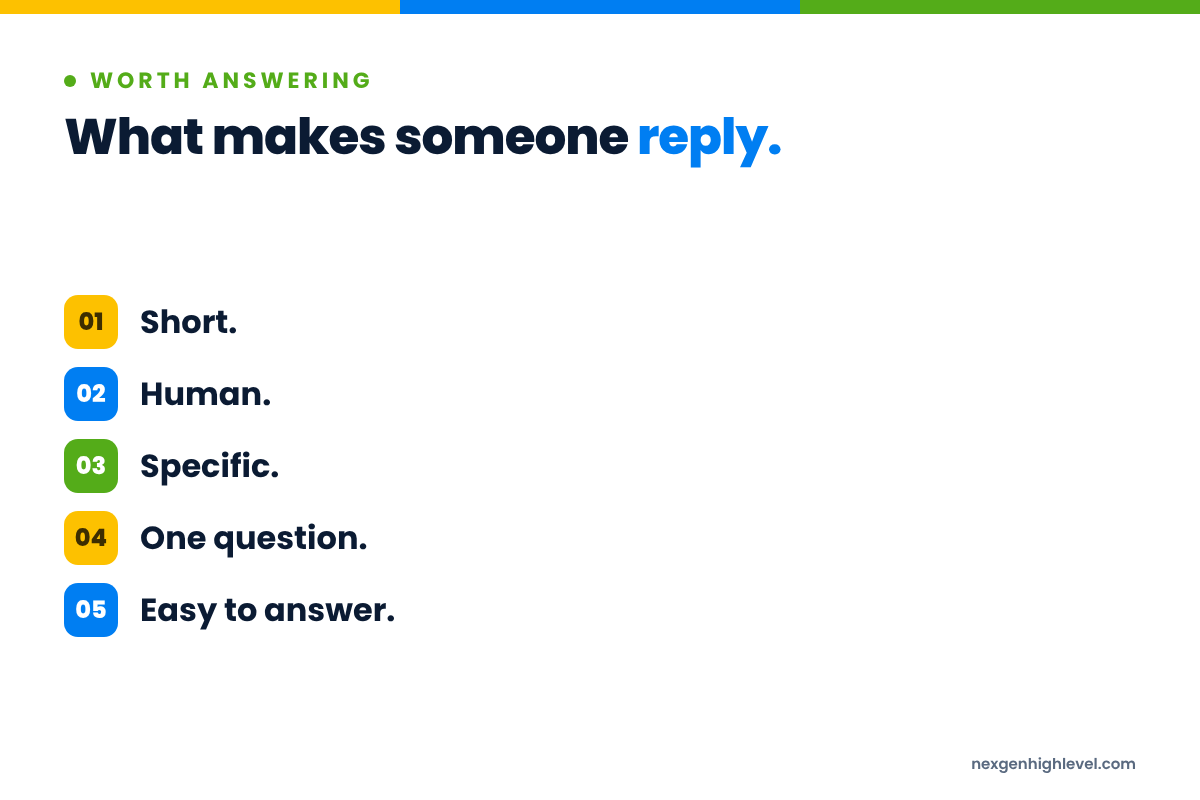
Short. Human. Specific. One question. Easy to answer.
Every good salesperson I worked with in recruitment did all five without thinking about it.
1. Short
On WhatsApp, a long message isn't thorough. It's homework.
Aim for something that fits on the screen without scrolling. Two or three short lines is often plenty. If you need to say more, there are better ways: a follow-up message once they've replied, a quick call, or a voice note (more on those shortly).
Here's a useful discipline. Write your message, then cut it in half. Usually nothing important is missing.
Long messages also feel like they need a long reply. So people wait for ten free minutes they never find.
Short messages get short replies. Short replies start conversations.
2. Human
A human message sounds like it came from one person to one person.
It has a name on it. It has a bit of warmth. It refers to something real that happened between you.
Example of a message that doesn't sound human:
"Thank you for your interest in our services. A member of our team will be in touch shortly to discuss your requirements."
Example of one that does:
"Hi Laura, it's Sarah from Brightside Dental. Thanks for getting in touch about the whitening. Is it something you're hoping to get done before a particular date?"
One sounds like a ticket number. The other sounds like a person who read what Laura sent.
3. Specific
Specificity beats superlatives. Always.
"We'd love to help with your project" could have been sent to anyone, by anyone, about anything.
"You mentioned the leak is over the back bedroom. Has it got worse since the rain on Tuesday?" could only have been sent to one person.
Specific messages prove you listened, and they make the reply easy. Ask yourself: could this message have been sent to anyone else? If the answer is yes, it's probably not specific enough.
4. One question
This is the one most businesses get wrong.
They ask three questions in one message. "What's your budget, when are you looking to start, and would you prefer a call or a site visit?"
It feels efficient. It isn't. Three questions mean three decisions, so they put it off.
Ask one question. Get one answer. Then ask the next. One easy question gets answered in the coffee queue. Three hard ones sit there until Saturday.
And if your message has no question at all? You've written an announcement. Announcements don't get replies. They get read receipts.
5. Easy to answer
There's a difference between a question and an easy question.
"What are your thoughts on our proposal?" is a question. It's also a small essay assignment.
"Shall I hold Thursday at 10 for you, or is the afternoon better?" is easy. They can answer it with one word. Or a thumbs up.
Some of the easiest questions to answer on WhatsApp:
- Either/or. "Morning or afternoon?"
- Yes/no. "Would it help if I sent a couple of photos of similar jobs?"
- A short fact. "Roughly how many people would be coming?"
- Permission. "Mind if I send you a quick voice note explaining the options?"
The goal isn't to trap anyone into a yes. It's to make replying easier than ignoring.
Here's the line I'd stick on the wall: a message that's easy to read and hard to answer is still a message nobody answers.
The first message after someone opts in
If you only fix one message, fix this one.
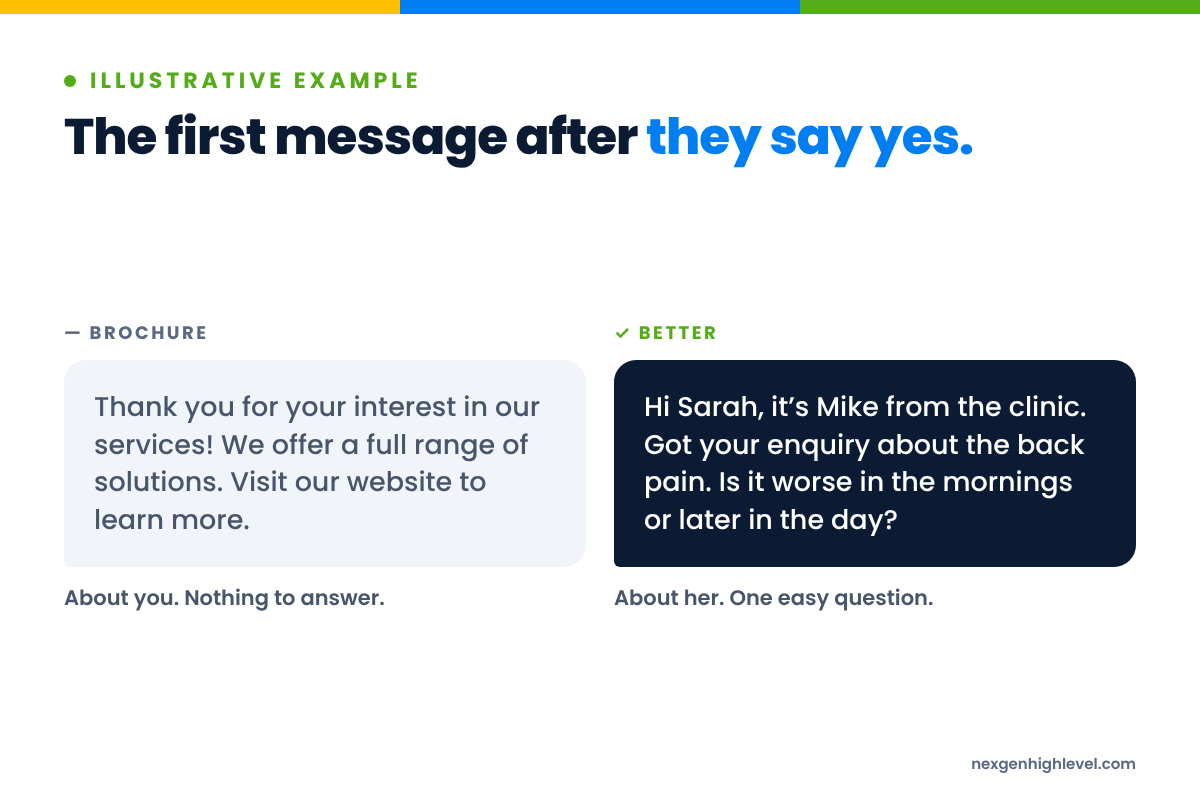
Someone has just filled in your form, ticked the box to hear from you on WhatsApp, or messaged you first. They're interested right now. Their phone is probably still in their hand.
This is the warmest that contact will ever be. And most businesses spend it on "Thank you for your enquiry."
Speed matters more than polish
There's a well-known piece of research on this. Dr James Oldroyd's 2007 Lead Response Management study, as reported by InsideSales, found the odds of a lead becoming qualified were 21 times greater when contacted within five minutes than at 30 minutes.
That study wasn't about WhatsApp, but the principle travels. A reasonable message sent quickly will usually beat a perfect one sent tomorrow. There's more on this in WhatsApp Lead Response: The Reply Nobody Sent.
What the first message needs to do
A good first message after someone opts in does five small jobs:
- Says who you are. Name and business. They may have filled in three forms today.
- Reminds them why they're hearing from you. "You asked about..." Context stops it feeling random.
- Sets expectations. What will you send, and roughly how often? People relax when they know.
- Respects their choice. Make it clear they can tell you to stop at any time. WhatsApp's policy says you must respect any request to opt out, and honestly, you'd want to anyway.
- Asks one easy question. So the conversation actually starts.
That sounds like a lot. It isn't, if you write it like a person.
Some first messages, as examples
These are examples to show the shape, not scripts to copy word for word. Use your own voice.
A dental practice, after a form enquiry about Invisalign:
"Hi James, it's Sarah from Brightside Dental. Thanks for asking about Invisalign. I'll use WhatsApp for anything about your enquiry and appointments, nothing else, and you can tell me to stop any time. Quick question so I point you the right way: is it mainly the gap at the front you're thinking about?"
A roofing company, after someone requested a quote:
"Hi Karen, Mike here from Hartley Roofing. Got your quote request for the flat roof over the garage, thanks. Before I book a visit, is the leak happening now, or is this more of a 'before winter' job?"
A consultant, after someone downloaded a guide and opted in to hear more:
"Hi Dan, it's Priya. Thanks for grabbing the pricing guide. I won't flood your phone: just the odd useful thing, and you can say stop whenever you like. Out of curiosity, what made you look at pricing now?"
Notice what isn't in any of them. No list of services. No links. No "award-winning". No "Valued Customer".
Each one is short, human, specific, and ends on one easy question.
Honest automation beats fake humanity
If the first message goes out automatically, that's fine. Speed often means automation, and I'm all for it.
But don't pretend. If it's an automatic acknowledgement, it can still be warm, and it can still be honest about what happens next:
"Thanks Laura, got your message. Sarah from the team will reply personally this morning. In the meantime, is there a day this week that suits you best?"
What I wouldn't do is dress up an automated message as a person typing live, then leave it for two days. That's a broken promise in their pocket.
Voice notes: the most human thing you can send
If you're not using voice notes in your business conversations, you're missing the most personal tool WhatsApp has.
Think about how you use them yourself. It's the closest thing to a phone call that doesn't demand the other person picks up. For a business, that's gold.
Why voice notes work
- They carry tone. Text can read as cold even when you didn't mean it. Your voice can't. People hear warmth, patience, and the fact that you know what you're talking about.
- They're hard to fake. A voice note proves there's a real person on the other end. In a world where everyone is wondering whether they're talking to a bot, that matters more every month.
- They explain things well. Some answers are three paragraphs of text and twenty seconds of talking. Options, prices that depend on things, "it depends" answers: these are often easier to say than to type.
- They build familiarity. After a couple of voice notes, people feel like they know you.
When to use them, and when not to
Voice notes work best once a conversation is already going.
- When someone asks a question that needs explaining.
- When you want to say thank you properly after a job.
- When the texting back and forth is getting complicated.
They work less well as the very first message, when the person isn't sure who you are yet. And they don't work at all if they're long. A four-minute voice note isn't a message. It's a podcast nobody subscribed to.
Keep them short. Make one point. And if in doubt, ask first: "Mind if I send a quick voice note? Easier than typing it all out."
"But I hate the sound of my own voice"
Most people do. You're not alone.
Back in my agency days, we worked with doctors, clinicians and practice owners who simply wouldn't produce content. Put a camera in front of them and they froze. They hadn't gone into healthcare to become content creators.
What fixed it wasn't telling them to be braver. We built an app with prompts that took away the blank page and the fear of the camera. We weren't really solving a content-production problem. We were solving a human-friction problem.
Voice notes have the same friction, and the same kind of fix. Before you press record, jot down three things you want to say. That's it. Three bullet points. Then talk to the person like you'd talk to them in your waiting room or on site.
Nobody wants a radio presenter. They want you, sounding like you.
What kills replies
Now the other side. Here are the habits that quietly stop people answering. Most of them come from good intentions.
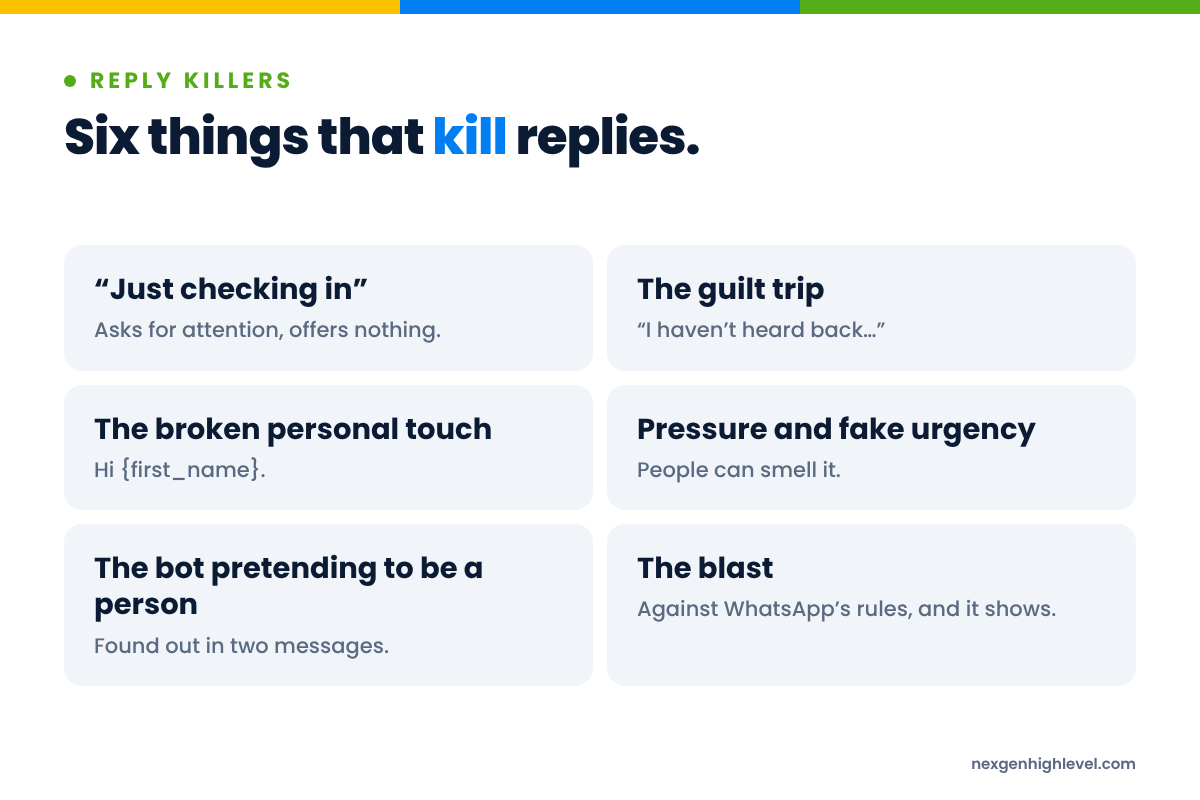
"Just checking in"
The most common follow-up in business, and one of the least useful.
"Just checking in" asks the person to do all the work. Check in on what? What do you need from them? What's in it for them?
Replace it with something specific and useful: "I found a photo of a similar kitchen we did last year with the same worktop you mentioned. Want me to send it over?"
I've written more on following up without nagging in WhatsApp Follow-Up That Doesn't Feel Like Chasing.
The guilt trip
"I've sent you a few messages now and haven't heard back..."
We've all received this one. Nobody has ever read it and felt warmer towards the sender.
If someone hasn't replied, it's usually not about you. They're busy, not ready, or awkward about saying no. Guilt doesn't change any of those.
If you want to give them an easy way out, give it kindly: "No worries if the timing isn't right. Shall I leave it with you for now?" You'll be surprised how often a graceful exit gets a reply.
The broken personal touch
"Hi {first_name}, we noticed you were interested in {service}!"
Or worse: "Hi , thanks for your enquiry."
Nothing says "you're on a list" quite like a merge field that didn't merge. If you're going to personalise, check what the message looks like when the data is missing. And remember that a first name isn't personalisation. It's a starting point.
Pressure and fake urgency
"Only 2 slots left this week!" "Offer ends tonight!"
If it's true, say it plainly. If it isn't, don't say it at all. Fake urgency might get a reply once. It costs you trust for good, and on a channel as personal as WhatsApp, trust is the only thing you're really trading.
The link in the first line, at 11pm
A message that opens with a link looks like spam, because that's what most spam looks like. Send the link once they've asked for it.
And mind the clock. Their phone buzzing on the bedside table at 11pm about gutter cleaning is not a great look. WhatsApp sits next to their family. Behave like a guest in that house.
The bot pretending to be a person
Automation is useful. I use AI every day, and it has a real place in responding quickly.
But if someone is talking to an automated reply, don't dress it up as a person, and make sure there's an easy route to a real one. WhatsApp's Business Messaging Policy is clear that businesses using automation "must also have available prompt, clear, and direct escalation paths" such as transfer to a human agent.
AI doesn't replace humans. It speeds up the process. The moment it starts pretending to be the human, you've lost the thing that made WhatsApp worth using.
The blast
And the biggest one. Anything that feels like it went to 5,000 people at once.
Even if every recipient opted in, a message written for everyone reads like it was written for no one. And sending bulk messages is exactly what WhatsApp's terms forbid. That's how numbers get restricted or banned.
Write to one person at a time, even when a system helps you send it.
A five-second check before you press send
Read your message and ask:
- Would I say this out loud across a kitchen table?
- Could it have been sent to anyone else?
- Is there exactly one question, and can they answer it in a few words?
- Does it fit on the screen without scrolling?
- Is this a reasonable hour to buzz someone's phone?
- If I were them, would I reply?
Six questions. Five seconds. It'll save you a lot of read receipts.
Keeping WhatsApp business messages human at scale in HighLevel
Lovely for one conversation, you might say, but I've got hundreds of contacts and a team. Fair. That's where systems come in, but the order matters.
Human. Strategy. Leverage. In that order.
- Human: What does this person actually want to hear, and what would make replying easy for them?
- Strategy: What's the message at each stage? First message, follow-up, booking, after the job.
- Leverage: How do you send the right message at the right time to the right person, without it turning into a blast?
Technology is leverage, not strategy. Put a brochure message into an automation and you've built a very efficient way of being ignored. Put a short, human, specific message into one and you've got something worth multiplying.
If you multiply zero by a thousand, you've still got zero.
What leverage looks like in HighLevel
For us, the leverage is HighLevel. Here's how the principles in this article map onto it.
- Custom fields make "specific" possible. The thing that makes a message feel personal is detail: what they enquired about, which service, which location, what they told you on the form. Store it in custom fields on the Contact and you can write messages that refer to it, not just to their first name.
- Tags tell you where they are. Enquired, booked, quoted, waiting, not right now. The message for someone who's just enquired should never be the same as the one for someone who's been quoted twice.
- Forms capture the yes properly. Ask for permission to message them on WhatsApp clearly, record it, and tag it. Then your Workflows only ever message people who said yes.
- Workflows handle the timing. The first message goes quickly. Follow-ups wait a sensible amount of time. Nobody gets buzzed at 11pm because somebody forgot to check the clock.
- Conversations keep the human in the loop. When someone replies, it lands in one inbox alongside your SMS, email and social messages, so a real person picks it up and carries on the conversation with the full history in front of them.
- User roles and assignment decide who answers. The person who replies should be the person who can actually help, and the customer shouldn't have to explain themselves twice.
That's the part people miss about automation. The best automated message is the one that gets a reply, and then gets out of the way so a human can take over.
Write your message bank once, properly
Here's a practical exercise. Sit down for an hour with your "how would I actually say this?" hat on, and write the handful of messages your business sends again and again:
- The first message after someone opts in.
- The "here's what happens next" message.
- The gentle follow-up when someone's gone quiet.
- The confirmation before an appointment.
- The thank you after the job.
- The graceful exit.
Run every one through the five-second check. Read them out loud. Cut them in half. Then put them into your Workflows with the custom fields that make them specific.
You've done the strategy work once, so the leverage repeats it well.
If you'd rather start from a business system that's already been built out for your type of business, that's what our HighLevel Snapshots are for. And if you want WhatsApp sitting in that same Conversations inbox rather than on one person's phone, that's what we built the WhatsApp App for HighLevel to do, with workflow actions like Wait for Reply so your follow-ups know when someone has answered. But the words still have to be good. No app writes your messages for you, and no app should.
A word for agency owners
If you run an agency, whether you're on GoHighLevel under your own brand or delivering for clients directly, this is one of the most useful things you can help clients with.
Most business owners have been shown how to write ads, not messages that get replies. Different skills. Rewriting a client's six core messages with them isn't glamorous, but it's the bit that turns interest into a conversation, and a conversation into a customer.
Frequently asked questions
What is a good first message to send a customer on WhatsApp?
Keep it short and make it clearly from a person. Say who you are and which business, remind them why they're hearing from you ("You asked about..."), set expectations about what you'll send, make it clear they can opt out any time, and finish with one easy question. Only send it to someone who has given you their number and agreed to hear from you. That's WhatsApp's rule, and it's good manners too.
How long should a WhatsApp business message be?
Short enough to read without scrolling on a phone. Two or three lines is often plenty. A long message feels like homework and invites a long reply, so people put it off. If you've got more to say, wait for them to reply, offer a quick call, or ask if they'd like a short voice note. Write it, cut it in half, and check nothing important went missing. Usually nothing did.
Are voice notes professional for business?
Yes, used well. Voice notes carry tone, prove there's a real person on the other end, and explain "it depends" answers better than text. Keep them short, make one point, and use them once a conversation has started rather than as the very first message. If you're unsure, ask: "Mind if I send a quick voice note?" Jot down three points before you record. You don't need to sound polished. You need to sound like you.
Can I message customers on WhatsApp who haven't opted in?
No. WhatsApp's Business Messaging Policy says you may only contact people who've given you their number and opted in to hear from you, and its Terms of Service forbid bulk messaging and auto-messaging. Numbers that spam get restricted or banned. If you want to reach new people, use LinkedIn and email, start a real conversation, and invite them onto WhatsApp once they've said yes.
Why do customers read my WhatsApp message but not reply?
Usually because the message made replying hard. There was no question, too many questions, or a question that needed real thought. Sometimes it's timing, or they're simply not ready yet. Look at what you sent: is it short, human, specific, with one easy question at the end? If it is and they still don't reply, give them a graceful way out. Don't guilt them.
Should I automate WhatsApp business messages?
Automate the timing, not the humanity. Automation is brilliant for sending the first message quickly, spacing follow-ups sensibly and making sure nobody falls through the cracks, and HighLevel Workflows do that well. But write every message as if a person were sending it to one person, be honest when a reply is automatic, and always make it easy to reach a real human. WhatsApp's own policy expects that escalation route.
The reply is the point
Here's what I'd like you to take away.
A WhatsApp message isn't a campaign. It's one side of a conversation. Its only job is to make the other side easy.
So write it short. Write it like a person. Make it about them, not you. Ask one question they can answer in the time it takes to queue for a coffee. And send it only to people who asked to hear from you.
None of this is new. It's how good salespeople, receptionists and tradespeople have always talked to customers, long before anybody had heard of WhatsApp.
Pick your six core messages this week. Read them out loud. Rewrite the ones that sound like a poster.
Because if you wouldn't say it across the kitchen table, don't send it to their phone.