LinkedIn Outreach Messages People Actually Answer
You've had this message. Everyone has.
You accept a connection request from someone you don't know. Within about four minutes, a wall of text arrives. They help businesses like yours achieve incredible results. They'd love to jump on a quick 15-minute call. Here's a link to their calendar.
They don't know my name is spelt with a Y. They don't know what I do. They certainly don't know whether I need what they're selling.
And I do what everyone does. I ignore it, and I think slightly less of them.
Most LinkedIn outreach messages fail for exactly that reason. Not because the writer is a bad person. Not because LinkedIn doesn't work. Because they pitched the moment they connected, to someone they'd never spoken to, about something that person hadn't asked about.
Now here's the uncomfortable question. Is any of your outreach like that?
Be honest. Nobody's watching. Go and look at the last five messages you sent to new connections. I'll wait.
This article is about the difference between a campaign and a conversation. It's not a list of magic templates (there aren't any). It's a way of thinking about outreach that I learned long before LinkedIn existed, and that works just as well on it now.
The pitch-the-moment-you-connect problem
Let's start with why that four-minute pitch happens at all.
It happens because somebody, somewhere, told the sender that outreach is a numbers game. Send enough messages and some will stick. So they built a list, wrote one message, and pressed go.
And on paper, it makes sense. Say 2% reply. Then send more, get more replies. Simple maths.
But here's what the maths leaves out. The other 98% didn't just ignore you. They formed an opinion of you. Some of them were exactly the people you wanted as clients one day. And now the first thing they know about you is that you pitched them before you said hello.
That's not a numbers game. That's a reputation game, and you're losing it quietly.
Think about what a connection request actually is. Someone has said, "Yes, I'm open to knowing you." That's it. They haven't said, "Please sell to me." They haven't said, "I have a problem I'd like you to solve." They've opened the door a crack.
The pitch-the-moment-you-connect message kicks the door in.
I get the temptation. It feels efficient. One message, one click, lots of people. But efficient at what? If the thing you're doing efficiently is annoying the people you most want to work with, you've found a very efficient way of making things worse.
Technology is leverage, not strategy. Leverage multiplies whatever is underneath it. Put a bad message underneath it and you just get more bad messages, faster.
A message is not a campaign
The problem starts with the word "campaign".
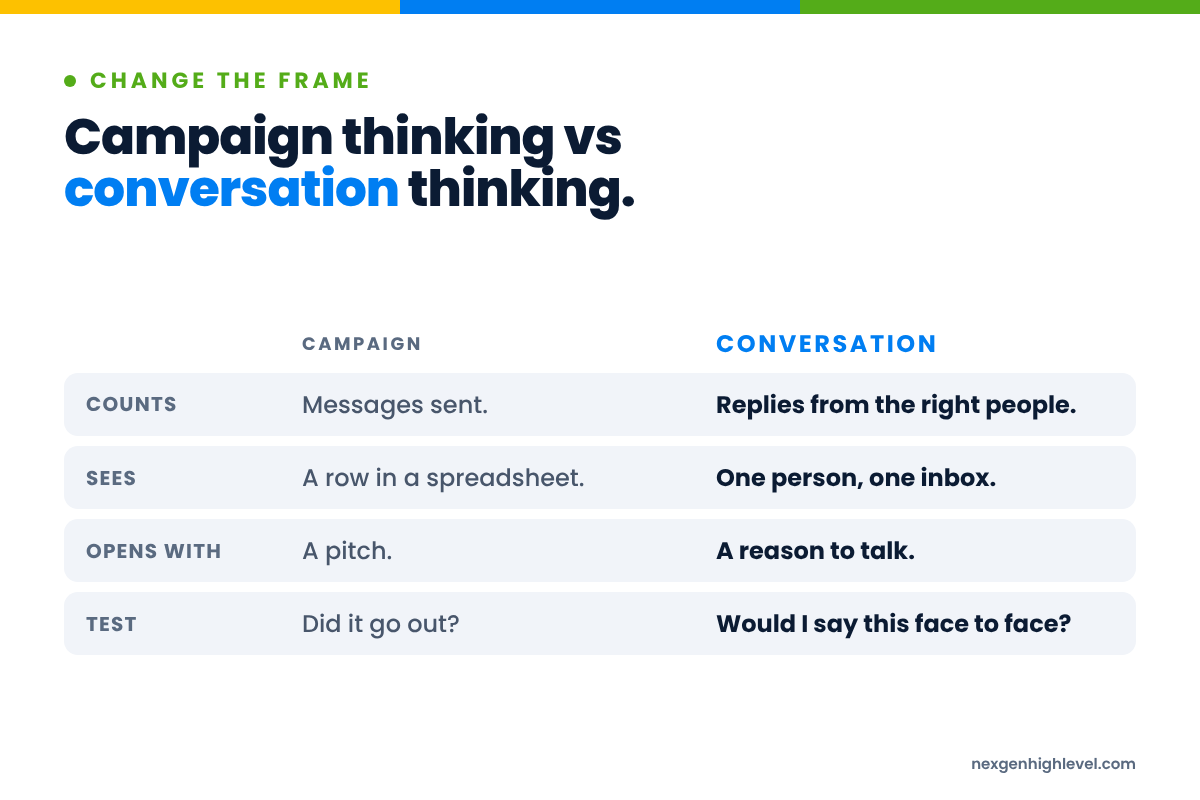
The moment you think in campaigns, you think in volume. Lists, sequences, templates, numbers, open rates, reply rates. And the person on the other end turns into a row in a spreadsheet.
But that person doesn't experience your campaign. They experience one message, arriving in their inbox, from one human being. Them and you. That's it.
They don't know it was message 47 of 300. They don't care that your sequence has five steps. All they see is: who is this, and why are they talking to me?
It's not a campaign. It's a conversation that happens to start in writing.
Once you see it that way, a lot changes. You stop asking "How many can I send?" and start asking "What would I actually say to this person?" You stop measuring sends and start measuring conversations. And you start to notice that the people you'd most like to work with are the ones least likely to answer a broadcast.
The face-to-face test
So every message has to pass a simple test.
Would it make sense if you said it to them face to face?
Picture a networking event. Somebody walks up to you, doesn't introduce themselves properly, doesn't ask a single question, and launches straight into how they help businesses like yours achieve incredible results. Then they hand you a card and ask when you're free for 15 minutes.
You'd find a reason to go and get another drink. Quickly.
Now picture someone else. They say hello, mention they saw you speak earlier or noticed your company's just moved offices, and ask how it's going. They listen. They ask a follow-up question. Maybe ten minutes in, they mention what they do, because it's relevant to something you've just said.
You'd remember that person. You might even look them up afterwards.
Same room. Same goal. Completely different result.
LinkedIn is the same room, just with worse lighting. The face-to-face test works because people don't change their behaviour when they open an app. They still notice when they're being talked at. They still respond when they're being talked to.
Before you send any LinkedIn outreach message, read it out loud as if you were standing in front of that person. If you'd feel a bit embarrassed saying it, don't send it.
What 23 years of recruitment cold calls taught me
I spent nearly 23 years in recruitment, most of it before email was a normal part of business. A telephone, a filing cabinet and a phone directory. Every deal was done face to face or on the phone.
Cold calling was the job. And you learned very quickly what worked, because the feedback was immediate. People hung up.
The cold calls that worked were never about me. They were about them.
"I noticed you've just opened an office in Leeds. How are you finding people up there?" That's a conversation.
"I'm calling from XYZ Recruitment and we're the leading..." That's a hang-up.
The first one shows you've paid attention. It asks about their world. It's easy to answer. And it opens a door to talk about the thing you can help with, without you having to force it.
The second one is all about you. It asks nothing. And the person on the other end has heard it a hundred times that month.
Nothing about LinkedIn has changed that. The tools are better. You can find people faster and know more about them before you speak. But the human on the other end is the same human I was ringing in the nineties. They still want to feel seen. They still don't want to be sold to by a stranger.
People buy from people. They always have. That's not a soft, nice-to-have idea. It's the most commercial thing I know.
Why this matters more now, not less
Back then, finding out that someone had just opened an office in Leeds meant reading trade press or getting lucky. Now it's on their profile, in their posts, in their company updates.
So there's less excuse than ever for a message that could have gone to anyone. If you can see what someone posted yesterday and you still send them a generic pitch, that tells them something about how much effort you'll put into working with them.
LinkedIn outreach limits are a gift, not a problem
LinkedIn doesn't let you shout at everyone anyway.
It applies weekly limits to connection invitations. Around 100 a week is the figure you'll hear most often, but LinkedIn doesn't publish a fixed number, and the limit can vary from one account to another.
And it's worth knowing that LinkedIn's User Agreement (section 8.2) prohibits bots and other unauthorised automated methods used to add contacts, send messages or drive inauthentic engagement. The platform is built to reward real conversations, and it's clear about it.
People moan about the limits. I think they're a gift.
When you can only start a limited number of new conversations each week, every one of them matters. You can't hide behind volume. You have to choose who you talk to and think about what you say.
A hundred thoughtful, relevant messages to the right people will do far more for your business than a thousand generic ones ever could.
And here's a bit of food for thought. If you only had ten messages this week, who would you send them to? What would you say? Now ask yourself why you're not already doing that with the messages you do have.
So stop trying to do more. Try to do it better.
Who you message matters as much as what you say
A brilliant message to the wrong person is still a wasted message.
Before you write a word, you need to know who you're writing to: what they do, what they care about, what keeps them busy, and why your thing might matter to them at some point. That's a bigger topic than one article can cover, and I've gone into the wider strategy in LinkedIn marketing for business owners.
But here's the short version. The more clearly you know who you want to talk to, the easier the message becomes. Most people who struggle to write outreach don't have a writing problem. They have a "who am I actually talking to?" problem.
What makes someone want to reply to a LinkedIn message
There's no magic script. I'll keep saying that, because a lot of people online will tell you otherwise.
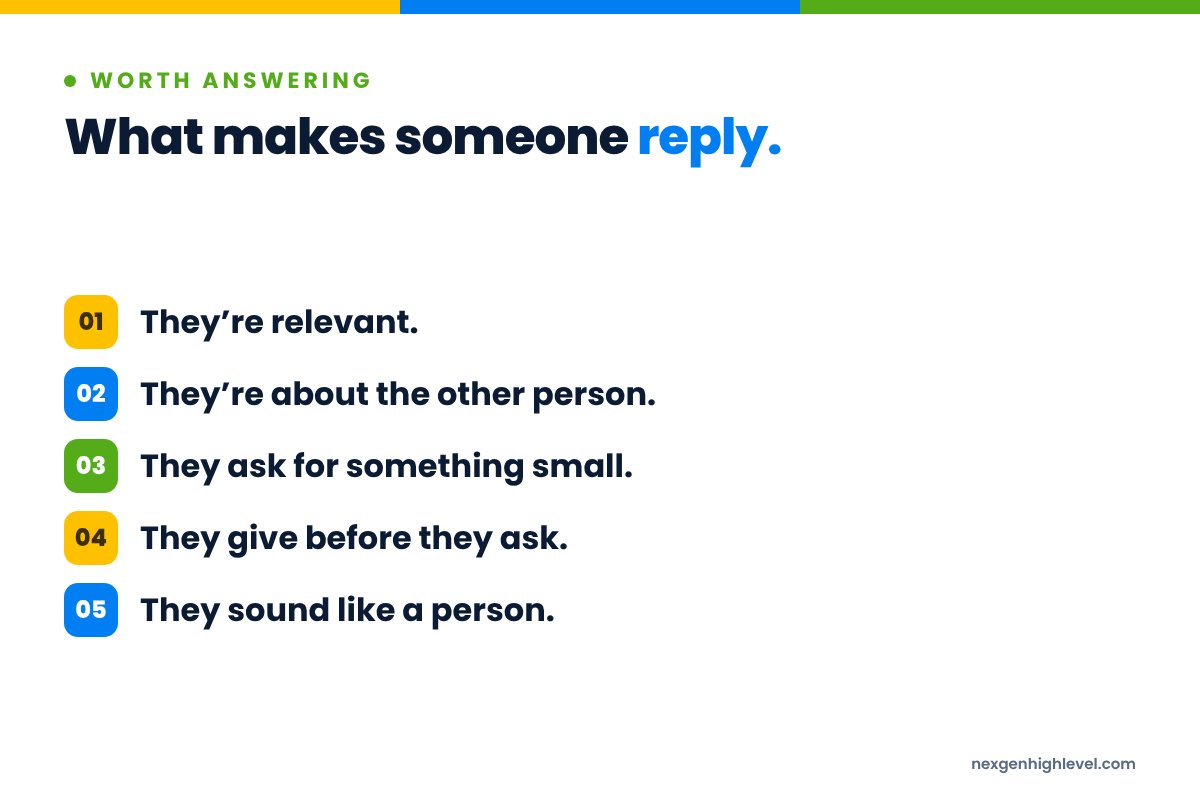
But the messages that get answered nearly always share a few things. Below, I've put some clearly illustrative examples next to each one. These aren't real messages from real people. They're examples I've written to show the difference. Don't copy them word for word. If you do, you've missed the point.
1. They're relevant
There's a reason you're writing to this person, and they can see it. Something they posted, something happening in their business, something you genuinely have in common.
If you could send the same message to 500 people without changing a word, it isn't relevant to any of them.
Illustrative example: bad
Hi Sarah, I help businesses like yours grow with proven marketing strategies. Would love to connect and explore synergies.
Illustrative example: better
Hi Sarah, saw your post about hiring your first two account managers. That's a big step for an agency your size. How are you finding the handover from doing it all yourself?
The first could go to anyone. The second could only go to Sarah. She'll know that straight away.
2. They're about the other person
Count how many times your message says "I" and "we" compared with "you". If you're winning, you're losing.
Illustrative example: bad
I'm the founder of a company that specialises in operations. We've worked with lots of businesses and we've built a great process. I'd love to show you what we do.
Illustrative example: better
You mentioned in your post that the busy season always catches the team out. Is that mostly a staffing thing, or more about how the work gets booked in?
The first is a brochure. The second is a question about their world. Which one would you answer?
3. They ask for something small
Not a 30-minute call with a stranger. A reaction. An opinion. A yes or no.
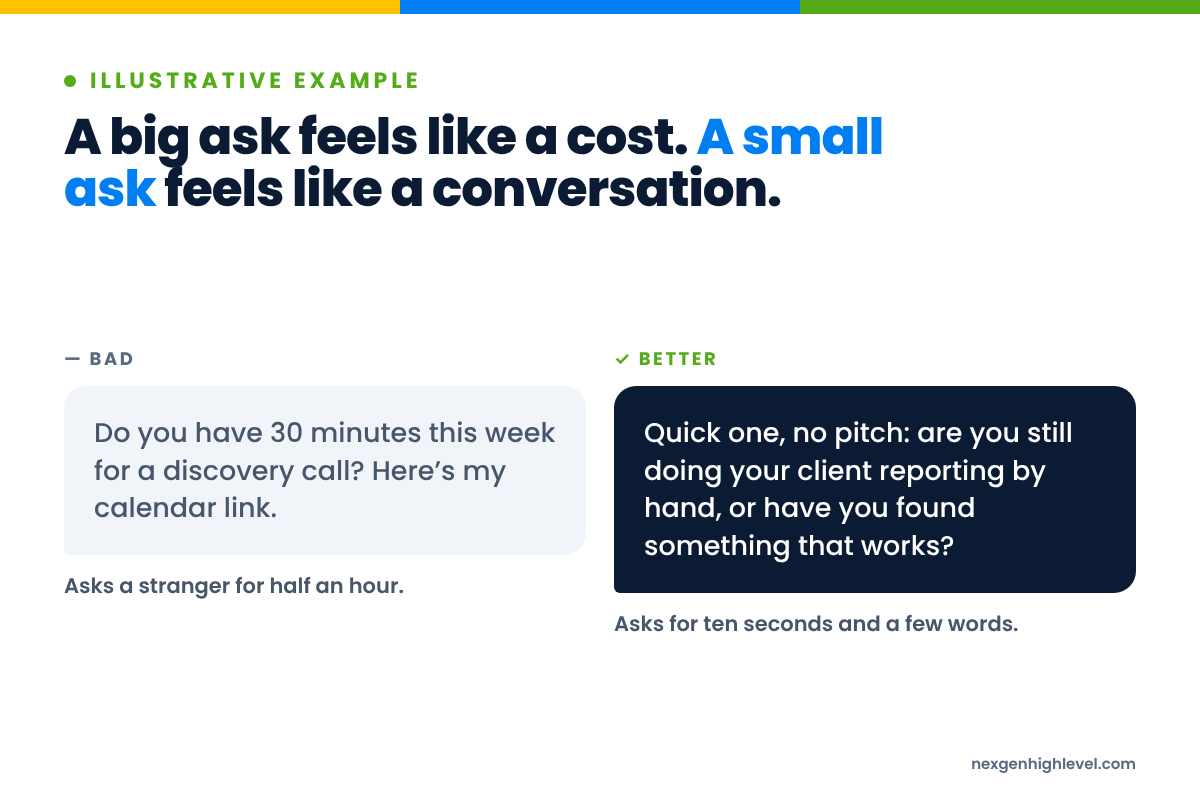
"Is this something you're thinking about this year, or is it not on the radar?" is far easier to answer than "When are you free for a call?"
A big ask from a stranger feels like a cost. A small ask feels like a conversation.
Illustrative example: bad
Do you have 30 minutes this week for a discovery call? Here's my calendar link.
Illustrative example: better
Quick one, no pitch: are you still doing your client reporting by hand, or have you found something that works?
The first asks for half an hour of their life. The second asks for ten seconds and a few words. And, funnily enough, the second is far more likely to lead to the call.
4. They give before they ask
An insight, a useful article, an introduction, a genuine compliment on something they've built.
In the room, the people everyone likes are the ones who help first. Online is no different.
Illustrative example: bad
Loved your profile! We should talk about how I can help you.
Illustrative example: better
Read your piece on pricing for retainers. The point about scoping creep before the contract is signed is one I wish I'd read years ago. Have you found clients push back when you put it in writing?
A genuine compliment is specific. "Loved your profile!" isn't a compliment. It's filler, and everybody can tell.
5. They sound like a person
No buzzwords. No "I hope this finds you well". No "leveraging synergies to drive scalable outcomes". Write how you talk.
Illustrative example: bad
I hope this message finds you well. I'm reaching out to explore potential opportunities for collaboration that could add significant value to your organisation.
Illustrative example: better
Hi Tom, we're both in the Manchester B2B crowd and I keep seeing your comments on the same posts I'm reading. Thought it was time I actually said hello.
Read the first one out loud. Nobody talks like that. Not at a networking event, not in a pub, not anywhere.
A quick note on AI-written messages
AI can help you research, draft and tidy up. I use it every day. But AI is only as good as the person using it.
If you let it write your outreach with no thinking behind it, you'll get the polished, slightly empty tone everybody now recognises. LinkedIn itself said in June 2026 that content that appears AI-generated and lacks a clear perspective is less likely to be distributed widely beyond your immediate network. That's about posts rather than private messages, but the principle is the same. People and platforms can both tell when nobody was really home.
Use AI to speed up the work. Don't use it to skip the part where you actually think about the person.
Your pre-send checklist
Before any LinkedIn outreach message goes out, ask yourself:
- Would I say this to them face to face?
- Could this message only go to this person?
- Does it say "you" more than "I" and "we"?
- Is the ask small enough to answer in ten seconds?
- Am I giving something, or only taking?
- Does it sound like me?
If it fails two or more, rewrite it. If it fails all six, delete it and have a cup of tea.
Silence isn't rejection
Most people won't reply to your first message. That's normal.
It doesn't mean they hate you. It doesn't mean your business is rubbish. It usually means nothing at all.
Remember, most buyers aren't in the market right now. Professor John Dawes's work for LinkedIn's B2B Institute, known as the 95:5 rule, estimates that only around 5% of B2B buyers are in market in a given quarter. The other 95% aren't. Not yet.
So most of the people you message aren't ignoring you. They just don't need you this week.
They're busy. Your message landed at 4pm on a Thursday when the boiler broke. They read it on their phone in a queue, meant to reply, and then life happened.
It's not rejection. It's timing.
Why being remembered matters more than being answered
Here's why this matters so much. When that 5% does come into the market, a lot of the decision is already made.
The 6sense 2024 B2B Buyer Experience Report found that 85% of buyers had mostly or fully defined their requirements before engaging sellers, and 81% already had a preferred vendor at first contact. And that preferred vendor won about 80% of the time.
Read that again. Most buyers have a favourite before they ever speak to a salesperson.
So the job of your LinkedIn outreach messages isn't to close a deal today. It's to be the person they think of when the time comes. Polite, useful, relevant, human. The one who didn't pitch them in four minutes.
That's not a soft strategy. It's how you become the preferred vendor before anyone has a budget.
The polite follow-up
A polite follow-up, a week or two later, with something new to say, is not pestering. It's what grown-ups in business do.
Five follow-ups saying "just bumping this up" is pestering.
The difference is simple. A good follow-up gives the person a new reason to reply. A bad one just reminds them you're waiting.
Illustrative example: bad
Hi Sarah, just bumping this to the top of your inbox. Did you see my last message?
Illustrative example: better
Hi Sarah, came across this short piece on onboarding new account managers and thought of your post. No need to reply, just thought it might be useful.
Notice the second one says "no need to reply". It takes the pressure off. And people are far more likely to reply when they don't feel they have to.
How many follow-ups? There's no perfect number. But if you've followed up twice with something genuinely useful and heard nothing, it's time to stop messaging and start being visible instead. Post good content. Comment on theirs. Let them see you around. Combination marketing: people don't live inside one channel, and they don't make decisions after one message.
I go much deeper on timing and nurturing in the series piece on LinkedIn lead follow-up.
When they do reply, reply properly
One more thing. When someone does reply, don't leave them sitting there.
The Lead Response Management study by Dr James Oldroyd with InsideSales found that the odds of qualifying a lead were 21 times higher when contacted within five minutes rather than after 30 minutes. That study was about inbound leads, not LinkedIn messages, but the human point is the same. When someone's in the mood to talk, talk to them.
You've spent weeks earning a reply. Don't waste it because the notification sat unread until Monday.
It's OK to walk away
And sometimes the honest answer is no.
They're not a fit, or the timing's wrong, or they simply don't want what you do. That's fine.
It's OK to walk away. From a conversation, from a deal, from the money.
I'd much rather have a short, honest conversation that ends politely than a long one built on pressure.
I learned this the hard way with agency clients. Some wouldn't give us what we needed to do the job properly. It was never really "couldn't". It was always "wouldn't", wrapped up as something else. And after trying to work round it, sometimes the honest answer was to walk away. The ones who'd pay but wouldn't take part never paid off in the long run.
The same is true in outreach. If someone tells you clearly they're not interested, thank them and mean it.
Illustrative example: a good way to end it
Totally understand, thanks for being straight with me. If anything changes, you know where I am. Good luck with the new hires.
That's it. No guilt trip. No "can I just ask why?" No sneaking them into a sequence anyway.
And here's the funny thing. A polite exit is often the most memorable message you'll send. People remember the person who took "no" well. Some of them come back. How you behave when there's nothing in it for you tells people quite a lot about you.
When a conversation stalls, ask yourself one question. Am I pushing because it's right for them, or because I've got a target? If the honest answer is "the target", step back. People can feel pressure through a screen.
Keep LinkedIn conversations somewhere you can see them in HighLevel
Here's where a lot of good outreach quietly dies.
Someone replies. They say, "Not right now, but come back to me in the spring."
And by spring, nobody remembers.
The message is buried somewhere in your LinkedIn inbox, under forty other threads. You meant to make a note. You didn't. Spring arrives. They hire someone else. Someone who did remember.
That's not a messaging problem. It's a memory problem. And it's an expensive one, because you'd already done the hard part.
The conversation is the asset. Treat it that way.
What "somewhere you can see it" looks like
When your LinkedIn conversations sit alongside your contacts in HighLevel, things change.
- The person is a Contact, with the context of how you met.
- Notes record what was actually said: "Busy until Q2. Hiring two account managers. Interested in reporting, not ads."
- A custom field or tag records where the conversation is, so it's not just in your head.
- A task or Workflow brings them back up at the right time, so "come back in the spring" actually gets a call in the spring.
- If they go further, an Opportunity in a pipeline shows you where they are, without you having to remember.
That's how "come back in the spring" becomes a real opportunity instead of a lost one.
This is exactly why we built our LinkedIn App to sit inside HighLevel rather than beside it, so LinkedIn conversations land in the same Conversations inbox as everything else. But whatever you use, the principle is the point: if it's not written down somewhere you'll see it again, it didn't happen.
LinkedIn is where conversations start, not where they have to live
LinkedIn is brilliant for starting conversations. It's not built to be the memory of your business.
A good HighLevel setup lets a conversation that started on LinkedIn carry on by email, by phone, at an event, wherever makes sense for that person. One record. One history. No lost threads.
Most buyers aren't ready when you first meet them. If your notes are scattered across your LinkedIn inbox, your email, a notebook and a sticky note on the monitor, you're relying on luck.
Combining LinkedIn and email properly, without becoming the person who's everywhere and annoying, is a skill of its own. I've written about it in LinkedIn and email outreach.
And if you want a longer look at turning connections into proper B2B clients, I've written about what happens after someone says yes, which is worth a read alongside this one.
You wouldn't meet someone brilliant at an event and then throw their business card in the bin. Don't do it online either.
Human, strategy, leverage: in that order
If you remember one framework from this article, make it this one. It's how I think about everything, and outreach is no exception.
Human. Start with the person. What do they actually care about? What's happening in their business right now? What would make their life easier? Not what you'd like them to care about.
Strategy. Then decide how to start the conversation. Who you'll talk to, what you'll say, what small thing you'll ask, what you'll give first, and what happens when they reply or don't.
Leverage. Only then bring in the technology. HighLevel to remember every conversation, Workflows to make sure nothing slips, tags and smart lists to see who's where.
Most people do it the other way round. They buy the tool, build the sequence, then try to work out who they're talking to. That's how you end up with the four-minute pitch.
If you multiply zero by a thousand, you've still got zero. A thousand bad messages is still zero good conversations.
Frequently asked questions
What should my first LinkedIn message say after someone accepts my connection request?
Not a pitch. Say thank you, and mention something specific about them: a post, a company update, something you have in common. If you ask anything, keep it small and about their world. Your first message has one job, which is to make them glad they accepted. Selling comes much later, if at all. Ask yourself: would I say this to them if we'd just been introduced at an event?
How long should LinkedIn outreach messages be?
Short. Usually two to four sentences. If they have to scroll on a phone to reach the end, it's too long. A message is the start of a conversation, not a brochure. Say why you're writing to them in particular, ask one small question, and stop. You can always say more once they reply. Long messages from strangers feel like homework, and nobody wants homework from a stranger.
How many times should I follow up on LinkedIn if I don't get a reply?
There's no perfect number, but one or two thoughtful follow-ups spread over a few weeks is reasonable, as long as each gives them something new: a useful article, an insight, a relevant question. After that, stop messaging and stay visible instead. Comment on their posts, share useful content, and let them see you around. Silence usually means timing, not rejection.
Is there a limit to how many LinkedIn connection requests I can send?
Yes. LinkedIn applies weekly limits to connection invitations. Around 100 a week is commonly reported, but LinkedIn doesn't publish a fixed number and it varies by account. Honestly, I see the limit as a good thing. It forces you to choose the right people and write messages worth reading, rather than hiding behind volume.
Should I use templates for LinkedIn outreach messages?
Use a structure, not a script. It's fine to have a pattern you follow: a specific reason for writing, a question about them, a small ask. But if the message could go to 500 people without changing a word, it won't land with any of them. The personal line is the bit that does the work. If you take it out to save time, you've removed the only part that mattered.
How do I keep track of LinkedIn conversations so leads don't go cold?
Get them out of your head and into one place. In HighLevel, each person can be a Contact with notes on what was said, tags or custom fields for where the conversation stands, and a task or Workflow to bring them back at the right time. Then "come back in the spring" actually gets a message in the spring. The LinkedIn inbox is great for chatting, not for remembering.
The networking event test
Outreach on LinkedIn isn't a new skill. It's an old one, done through a screen.
The rules haven't changed since I was ringing people from a phone directory. Pay attention. Make it about them. Ask for something small. Give before you take. Sound like a person. Take "no" well. And never, ever lose a conversation you worked hard to start.
Stop thinking in campaigns. Start thinking in conversations. One person. One message. One human being on the other end, deciding in a few seconds whether you're worth talking to.
Before you send your next message, picture yourself saying it out loud, in a room full of people, holding a slightly warm glass of wine.
If your message would be ignored at a networking event, it'll be ignored in an inbox.