LinkedIn Lead Follow-Up: What Happens After Someone Says Yes
You've done the hard part.
You knew who you wanted to reach. Your profile told them who you are. Your content earned a bit of trust. Your message was relevant and human.
And they replied. "Yes, actually, that's something we're looking at. Tell me more."
This is the moment where a surprising number of businesses drop the ball. Not at the start. Not in the messaging. Right here, in the LinkedIn lead follow-up, the bit that comes after someone puts their hand up.
They reply two days later because they were busy. They send a calendar link with no context. They forget to send the thing they promised. The prospect goes quiet, and everyone quietly agrees they "weren't that interested anyway".
They were interested. You just let it go cold.
I want to spend this article on that moment. Not on how to get more replies. There's plenty written about that, including in our piece on LinkedIn outreach messages. This is about what you do once you've got one. Because that's where the money actually is.
The finish line everyone celebrates too early
There's a little hit of joy when a prospect replies. I know it. You know it. You've spent weeks on your profile, your content and your messages, and someone has finally said "go on then, tell me more".
It feels like a win.
It isn't. Not yet.
It's not the end of the race. It's the start of a different one. And it's a race that most businesses don't train for, because they've spent all their energy on the first one.
Think about how much effort goes into getting that reply. Finding your ideal customer. Building a profile worth visiting. Writing posts week after week. Crafting a message that doesn't sound like it was written by a vending machine.
Now think about how much effort goes into what happens next.
For most businesses, the honest answer is: not much. A reply when they get round to it. A link. A hope.
That imbalance is the whole problem. All that care at the front, and almost none at the back.
Great marketing can't fix a slow business
When I ran my agency, we had a rule. We took responsibility for the whole journey, from someone first discovering a business to becoming a paying customer.
Not just the ads. Not just the website. The whole thing.
That wasn't us being noble. It was us being practical. We learned the hard way that you can run brilliant marketing and still get poor results if the phone goes unanswered, the form goes nowhere, or the sales team takes three days to ring an enquiry back.
All the hard work at the front gets wasted at the back.
And when that happened, guess who got the blame? Not the phone. Not the three-day callback. The marketing. "The leads are rubbish." Sometimes they were. Often they weren't. They'd just been left sitting long enough to go off, like milk on a windowsill.
So we stopped accepting that line between "marketing" and "what happens next". We built the follow-up, the booking, the reminders, the nurture, the pipeline. Because if we were going to be judged on revenue and profit, and we wanted to be, we had to own the bit where interest turns into money.
LinkedIn is exactly the same.
Getting the reply is the front. What happens next is where the money is.
If you're a business owner doing your own LinkedIn, you're the marketing team and the sales team. Nobody to blame. Nobody to hand the ball to.
Speed is a form of respect
Let's talk about speed, because it's the part people underestimate most.
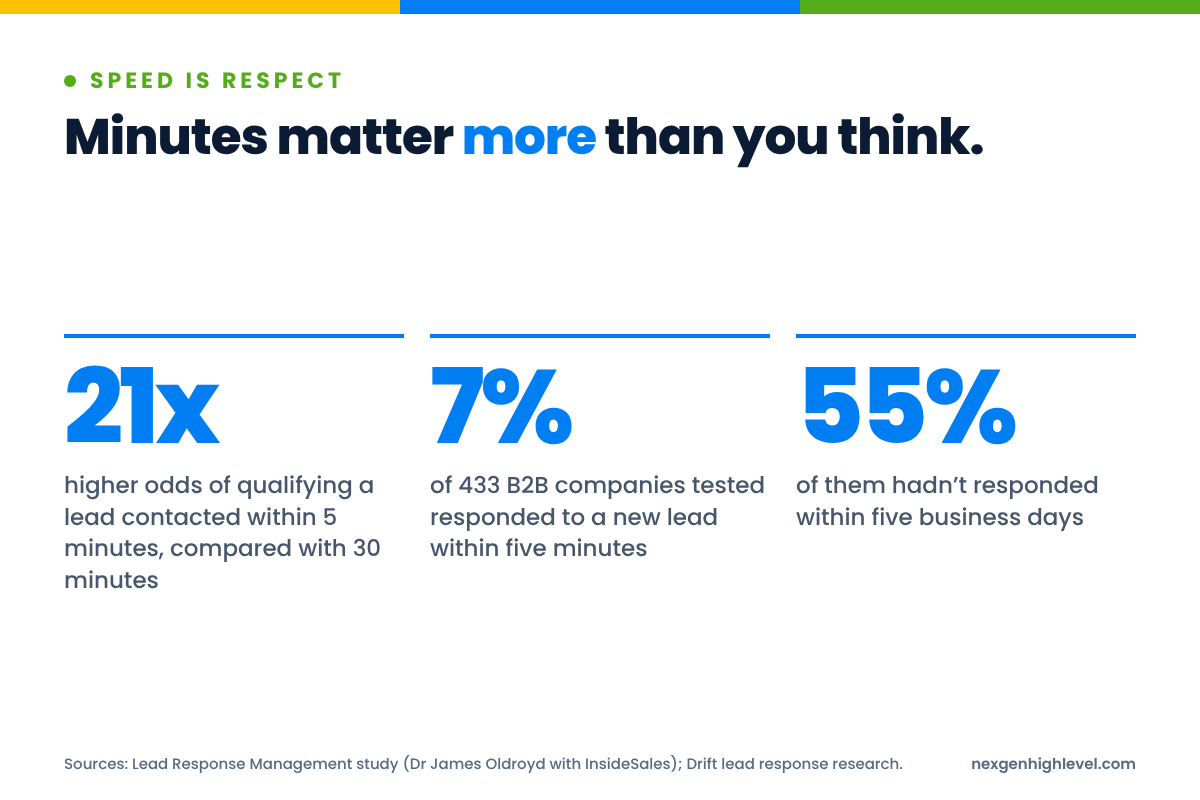
There's a well-known piece of research on this. The Lead Response Management study, by Dr James Oldroyd with InsideSales, found that the odds of qualifying a lead were 21 times higher when the lead was contacted within five minutes compared with after 30 minutes.
Read that again. Thirty minutes. Not three days. Not "when I get a minute on Friday".
And most businesses are nowhere near that. In Drift's lead response research, of 433 B2B companies tested, only 7% responded within five minutes, and 55% hadn't responded within five business days.
Fifty-five percent. Five business days. Nothing.
Now, to be fair, those studies were about inbound enquiries, mostly web forms. A LinkedIn reply isn't identical. But the human truth underneath it applies just as much.
When someone puts their hand up, they're thinking about the problem right now. It's on their mind. Maybe they've just had a bad month. Maybe their boss asked them a question that morning. Maybe they've just read your post and thought, "yes, that's us".
An hour later, they're thinking about something else.
A day later, they've spoken to someone who got back to them first.
A week later, they can't quite remember who you were.
Why speed is about respect, not pressure
Here's the bit I care about most. Speed isn't about pouncing. It's not about being pushy or desperate.
It's about respect.
If someone took the time to reply to you, a stranger, on a platform full of noise, they've given you something. Their attention. A bit of trust. Getting back to them quickly says, "I noticed. You matter. I was listening."
Getting back to them three days later says something else, whether you mean it or not.
I spent nearly 23 years in recruitment, most of it before email was a thing anyone relied on. A telephone, a filing cabinet and a phone directory. If a candidate or a client rang and you didn't ring back that day, someone else did. And they got the deal. It wasn't complicated. It still isn't.
People buy from people. And people notice who turned up.
You don't need to be glued to your phone
None of this means sitting on LinkedIn all day, refreshing your messages like you're waiting on exam results.
You don't need to be faster. You need a system that is.
That's the shift. The goal isn't superhuman discipline. The goal is that a warm reply can't sit unnoticed, can't slip down an inbox, and can't depend on whether you happened to look at the right app at the right time.
Which brings me to the shape of a good follow-up.
What "after yes" should look like in HighLevel
Here's the shape of a LinkedIn lead follow-up process that doesn't depend on you remembering. Five parts. None of them are clever. All of them matter.
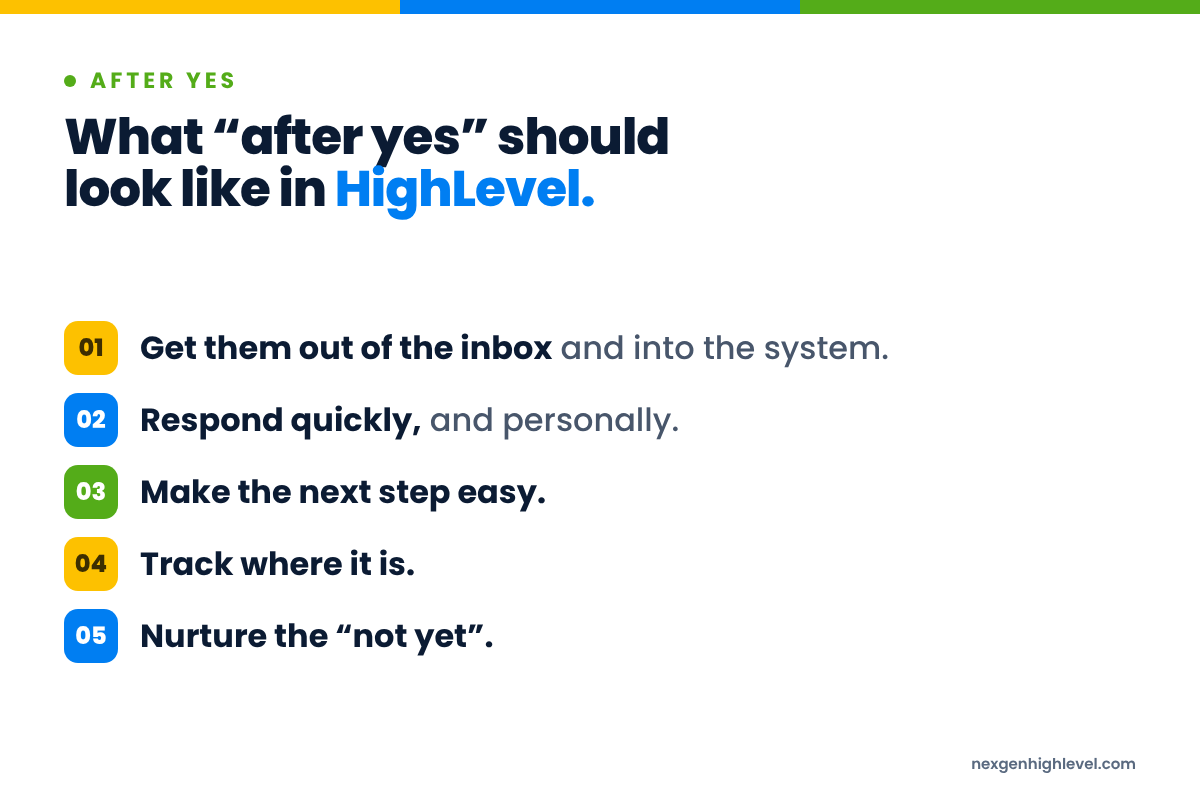
In HighLevel, all of it can run from one contact record, which is rather the point.
- Get them out of the inbox and into the system.
- Respond quickly, and personally.
- Make the next step easy.
- Track where it is.
- Nurture the "not yet".
Let's take them one at a time.
1. Get them out of the inbox and into the system
A conversation that lives only in your LinkedIn messages is easy to lose.
LinkedIn is brilliant for starting conversations. It was never designed to run your sales process. Someone replies on a Tuesday, you see it on your phone in a car park, you think "I'll get back to that properly later", and later becomes never.
The person needs to be a contact. A real record, with the context of what they said, where they came from and what happens next.
This is why we built our LinkedIn App for HighLevel the way we did. It was built for one client who needed it, and we built it as part of HighLevel rather than as a bolt-on sitting outside it. People you find on LinkedIn can be imported straight into HighLevel Contacts. A tag on that contact can trigger a Workflow. And LinkedIn messages sync both ways with HighLevel Conversations, so a warm reply lands in the same inbox as your emails and texts.
I'm not saying that to sell you anything. I'm saying it because it's the problem we were trying to solve. A warm reply shouldn't be buried in a separate inbox you check twice a week. It should be sitting right in front of you, next to everything else, with a Workflow already moving.
That's what "part of HighLevel, not a complement to it" actually means in real life. No API. No stitching tools together. The reply just shows up where the rest of your business already lives.
Whatever you use, the principle is the same. Get the person out of a chat window and into a system that can see them, remember them and act.
2. Respond quickly, and personally
Automation can make sure nothing waits. That's its job.
It can alert you the moment a reply comes in. It can create a task. It can move the contact to the right stage. It can remind you if you haven't responded within the hour.
But the reply itself should sound like you.
It's not about speed instead of care. It's speed and care.
Picture it from the other side. You've just written a thoughtful two-line reply to someone about a real problem in your business. And what comes back is a message that clearly didn't read a word you said.
How does that feel? A bit like ringing a company and getting the hold music.
So answer what they actually said. If they mentioned a specific problem, mention it back. If they asked a question, answer it. If they said "we're looking at this for Q2", acknowledge that.
Here's an illustrative example of the difference:
Generic: "Thanks for your reply! Here's my calendar link, grab a time that suits."
Personal: "Thanks, really appreciate you coming back to me. You mentioned the team's spending too long chasing leads that go nowhere. That's exactly the bit I'd want to dig into. Would a 20-minute call next week be useful? I'll come with a couple of ideas either way."
The second one takes about 90 seconds longer to write. It's also the one that gets a "yes, let's do it".
AI can help you draft it quicker. Fine. But AI is only as good as the person using it. Read it, change it, make sure it sounds like a person who was actually listening.
3. Make the next step easy
Once someone's interested, your job is to remove friction. Every extra step is a chance for momentum to leak out.
If it's a call, send a booking link. But send it with a sentence about what you'll cover, so it doesn't feel like a sales trap.
A naked calendar link can feel like being handed a ticket at the deli counter. A calendar link with context feels like an invitation.
Then let HighLevel's calendar do its job. Confirmations when they book. Reminders before the call. A friendly nudge on the day. A reschedule option if life gets in the way, because it will.
When I ran the agency, booking confirmations and reminders were part of every system we built, alongside the rest of the follow-up. We didn't treat them as optional extras. A booking nobody turns up to is worth nothing, and we were judged on revenue, not on how full the calendar looked.
That's worth pausing on. Bookings aren't the goal. A booking is a promise someone made when they were interested. Confirmations and reminders help them keep it on the day they're busy.
A few questions worth asking yourself about your own next step:
- Is it obvious what the next step is, or do they have to work it out?
- Does your booking page explain what the call is for, and how long it is?
- Do people get a confirmation that sounds like a human sent it?
- Do they get reminded, and is the reminder useful, not just "Don't forget!"?
- If the next step isn't a call, is the thing you promised (a document, a proposal, an example) actually sent, on time?
That last one catches more people than you'd think. "I'll send you something over" is one of the most broken promises in business. Not because people are dishonest. Because nobody set a task.
4. Track where it is
A simple pipeline tells you at a glance who's waiting on you and who you're waiting on.
That sounds dull. It's actually one of the most freeing things you can have.
Without it, your sales process lives in your head. And your head is busy. Mine certainly is. I remember useless facts from years ago and forget what I was told yesterday. I would not trust my head with a sales pipeline.
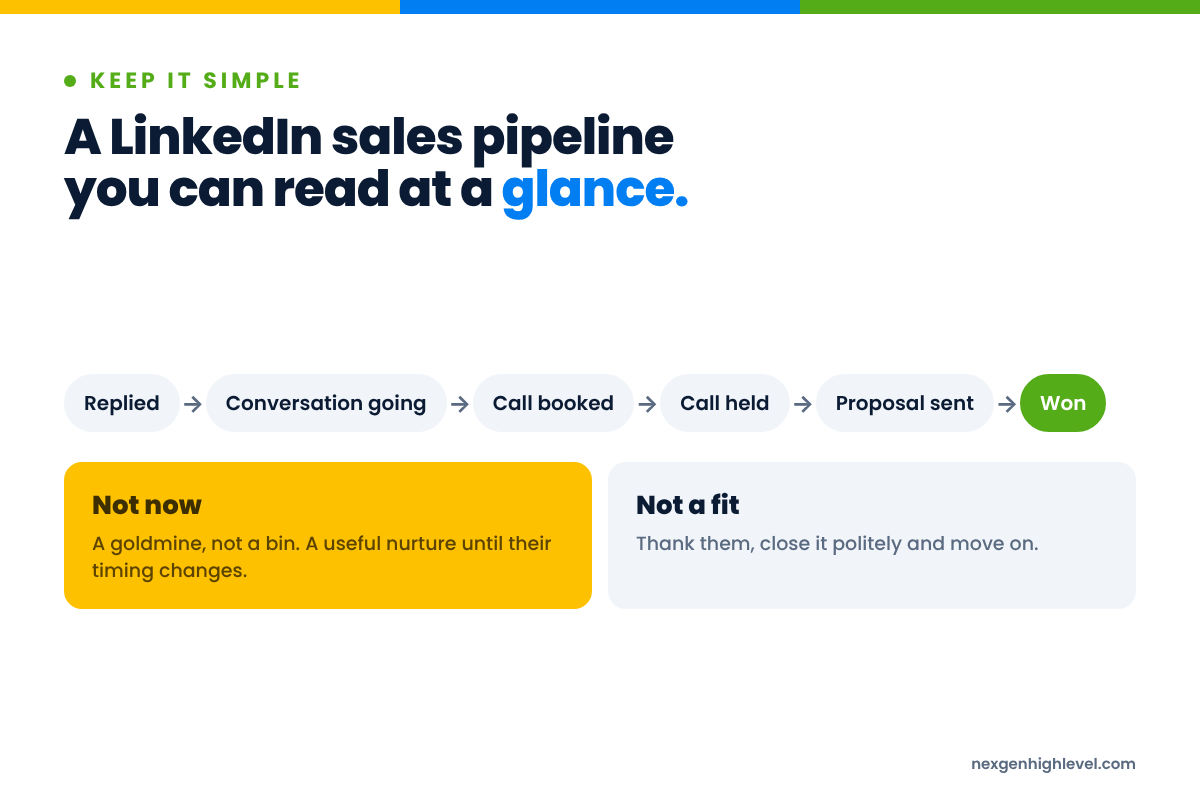
The trick is to make the stages match how your customers actually buy, not how a textbook says they should. For a lot of businesses getting leads from LinkedIn, it might look something like this:
- Replied, interested
- Conversation going
- Call booked
- Call held
- Proposal or next step sent
- Won
- Not now (nurture)
- Not a fit
That's it. You don't need 17 stages and a colour-coding system that requires a key. Simple isn't amateur. Simple is what you arrive at once you understand something.
In HighLevel, that's an Opportunities pipeline, and each card is tied to the same contact record that holds the LinkedIn conversation, the emails, the bookings and the notes. You open one thing and you see the whole story.
And here's the real value. A pipeline doesn't just tell you where people are. It tells you where people get stuck.
If loads of people book calls but few turn up, that's a reminder and expectation problem. If loads of calls happen but few proposals go out, that's a you problem (I say that with love). If proposals go out and go quiet, that's a follow-up problem.
You can't fix what you can't see. A pipeline makes it visible. And it gives you something real to measure, which matters if you want to work out your actual LinkedIn ROI rather than counting likes.
5. Nurture the "not yet"
Most people won't be ready today.
That's not pessimism. It's maths.
Professor John Dawes of the Ehrenberg-Bass Institute, in work published by LinkedIn's B2B Institute, estimated that only around 5% of B2B buyers are in market in a given quarter. The other 95% aren't.
So when someone replies "interesting, but not right now", that's not a failure. That's normal. That's most people.
"Not yet" is not "no".
What you do with "not yet" decides whether you see that person again.
Put them on a sensible, useful email nurture. And set a task to check in personally when they told you the timing might be right. If they said "after our budget is set in March", that's a task for late February. Not a vague "keep in touch".
This is where most businesses lose the most money without ever noticing. Which is why it deserves its own section.
The "not now" pile is a goldmine
Every business has a pile of people who said "interesting, but not right now".
In most businesses, that pile lives in someone's head, or in a spreadsheet nobody opens, or scattered across LinkedIn threads that scroll further down every week.
In six months, some of those people will be ready to buy. Their budget comes through. Their current supplier lets them down. They hire someone new who needs to fix the thing you fix.
The question is whether you'll be the one they think of. Or whether someone else will have kept in touch while you didn't.
Why being remembered matters so much
There's a useful number here. 6sense's 2024 B2B Buyer Experience Report found that 81% of buyers had a preferred vendor at first contact, and that preferred vendor won about 80% of the time.
Sit with that for a moment.
By the time most buyers reach out, they've largely made up their mind who they'd like to work with. So the work of being chosen happens before they're ready. In the quiet months. In the "not now" months.
Your nurture is how you stay in that conversation while they're not actively having it.
What a good nurture actually looks like
A thoughtful nurture is one of the most valuable things you can build.
It's not twelve emails in a week. It's not "just checking in!" every Monday until they block you. And it's definitely not a sales pitch dressed up as a newsletter.
It's something closer to this:
- A useful idea every couple of weeks. Something they can actually use, whether or not they ever buy from you. A lesson you've learned. A mistake you see often. A question worth asking.
- A genuine check-in now and then. A personal note, ideally timed to when they said things might change.
- A Workflow that tells you when someone starts engaging again. They open three emails in a row. They click a link to your pricing page. They reply to a message. That's a signal. HighLevel can tag them, notify you and move them back into the active pipeline.
That third one is where technology properly earns its place. You can't personally watch 300 people for signs of interest. A Workflow can. Then you step in, as a human, at exactly the right moment.
Automation protecting relationships
I want to be really clear about this, because there's a lot of noise right now about automation and AI replacing the human bit of selling.
That's not what a good nurture does.
It's not automation replacing relationships. It's automation protecting them.
Without a system, the relationship dies of neglect. Not because you didn't care, but because you were busy and forgot. A good nurture means the people who trusted you with a reply don't fall off a cliff because you had a hectic month.
It's the same thinking as everything I believe about technology. Human first. Then strategy. Then leverage. The human bit is the relationship. The strategy is when and how you stay in touch. The leverage is HighLevel making sure it actually happens.
Human. Strategy. Leverage. In that order.
LinkedIn and the rest of the journey
One more thing on the "after yes" stage that people often miss.
Once someone has replied on LinkedIn, the conversation doesn't have to stay on LinkedIn. In fact, it usually shouldn't stay only there.
People don't live inside one channel. They might reply to you on LinkedIn, read your email on their phone on the train, see your post in their feed a week later, and book a call from a reminder text. That's how real people behave. Combination marketing isn't a strategy you choose. It's just how people already are.
So once you've got a warm lead, think about where they'd most like to hear from you. Some people love LinkedIn messages. Some never check them. Some prefer email. A good follow-up meets them where they are.
That's one of the reasons email enrichment matters so much. If you've got a verified email for someone alongside their LinkedIn profile, your follow-up doesn't depend on one inbox. We go into that more in our article on LinkedIn and email outreach in HighLevel, but the short version is: familiarity grows when people see you in more than one place, consistently, saying something useful.
The point isn't to chase them across every platform. That's creepy. It's to be easy to reply to, wherever they are when they're ready.
A follow-up checklist for business owners
If you want something to take away and actually use, here's a short set of questions to run your own LinkedIn lead follow-up against. Be honest. Nobody's marking it.
When a reply comes in:
- Do I find out within minutes, or whenever I next open LinkedIn?
- Does the person become a contact in my CRM, or stay in a chat thread?
- Is there a record of what they said and why they replied?
When I respond:
- Do I reply within the hour, ideally sooner?
- Does my reply show I read what they wrote?
- Is the next step obvious and easy?
When they book:
- Do they get a confirmation that sounds human?
- Do they get a reminder that tells them what the call is for?
- Do I prepare, or do I wing it?
When they say "not now":
- Do they go onto a useful nurture?
- Is there a dated task to check in personally?
- Will I know if they start engaging again?
If you answer "no" to more than a few of those, don't panic. You're in the majority. But you've also just found the cheapest growth in your business. Not more leads. Better handling of the leads you've already got.
Look at your last ten LinkedIn replies
Here's a slightly painful exercise. I'd encourage you to do it today, before you read anything else.
Look at the last ten people who replied positively to you on LinkedIn.
Now ask yourself:
- How long did it take you to respond?
- How many are now in a pipeline?
- How many are on a nurture?
- How many did you promise something to, and did you send it?
- How many have you simply forgotten about?
Write the answers down. Actually write them. It's much harder to argue with a number on a page than a feeling in your head.
If the answers make you wince, don't beat yourself up. Most people's do.
Just fix the system before you go and get more replies.
Because here's the thing. If you're losing half your warm replies to slow responses and forgotten follow-ups, getting more replies doesn't fix that. It just means you lose more people, faster. That's not growth. That's a leaky bucket with a bigger tap.
Leverage multiplies whatever is underneath it. Put a great follow-up process underneath your LinkedIn activity, and every reply is worth more. Put nothing underneath it, and you're just generating disappointment at scale.
Where HighLevel fits, and where it doesn't
I want to be fair here. HighLevel won't make you a good follow-up person on its own. No platform will.
If you don't care about your prospects, a Workflow won't make you care. If your offer is weak, a pipeline won't fix it. If your replies sound like a robot wrote them, faster robot replies don't help.
Technology is leverage, not strategy.
But if you do care, and you've got a decent offer, and you just struggle to keep on top of everything (which is basically every business owner I've ever met), then a proper system makes a real difference. Not because it's magic. Because it stops the good stuff falling through the cracks.
That's why HighLevel is at the centre of everything we build. Contacts, tags, Workflows, Conversations, calendars, pipelines, email: it's all there in one place. Our job at NexGenHighLevel has always been to fill the gaps around the edges, especially at the front end, the prospecting and outreach bit that "Capture, Nurture, Close" doesn't quite reach.
And if you'd rather not build all of this from scratch, that's what our HighLevel Snapshots are for. They're complete business systems, from capture right through to retention, already built out for a particular type of business. Clients have used them to skip months, if not years, of trial and error. Not a starter pack. A working system you then make your own.
Either way, build it once, properly. Then let it run.
Frequently asked questions
How quickly should I respond to a LinkedIn lead?
As fast as you reasonably can, ideally within the hour. The Oldroyd research on inbound leads found the odds of qualifying were 21 times higher within five minutes than after 30 minutes. LinkedIn isn't identical to a web form, but the human truth holds: interest fades fast. You don't need to live on your phone. You need a system that tells you the moment someone replies, so it never sits unnoticed.
What should I say when a prospect replies on LinkedIn?
Answer what they actually said. Thank them, reflect back the problem or question they mentioned, and offer one clear, easy next step, usually a short call with a sentence about what you'll cover. Don't fire off a generic calendar link. AI can help you draft faster, but read it and make sure it sounds like a person who was listening. Because that's what you're meant to be.
How do I get LinkedIn leads into HighLevel?
The simplest principle: get the person out of a chat thread and into HighLevel Contacts, with the context of the conversation. Our LinkedIn App imports LinkedIn contacts straight into HighLevel, lets tags trigger Workflows, and syncs LinkedIn messages both ways with HighLevel Conversations. Whatever route you take, the aim is the same: one record per person, with every message and next step in one place.
What's the best way to follow up with LinkedIn prospects who say "not now"?
Treat "not now" as "not yet", because statistically it usually is. Put them on a light, useful email nurture, roughly one genuinely helpful idea every couple of weeks. Set a dated task to check in personally when they said timing might change. And use a Workflow to flag them when they start engaging again, so you can step back in as a human at the right moment.
Should I automate my LinkedIn follow-up?
Automate the remembering, not the relationship. Let automation alert you, create tasks, move pipeline stages, send booking confirmations and reminders, and watch for re-engagement. Keep the replies themselves personal. Also stay within LinkedIn's rules: its User Agreement prohibits bots and unauthorised automated methods for messaging or adding contacts. The goal is a system that protects relationships, not one that fakes them.
How many stages should a LinkedIn sales pipeline have?
Fewer than you think. Most businesses do well with six to eight stages that match how their customers actually buy: replied, conversation going, call booked, call held, proposal sent, won, not now, not a fit. If you need a legend to read your pipeline, it's too complicated. The real value is seeing where people get stuck.
A reply is where the real work starts
Getting someone to reply on LinkedIn takes real effort. A clear idea of who you're for. A profile worth visiting. Content that earns trust. A message that sounds like a human wrote it.
It would be a shame to do all of that and then let the person drift off because you were busy on a Tuesday.
So build the back end with the same care as the front. Get them into a system. Reply quickly and personally. Make the next step easy. Track where everyone is. Look after the "not yet" pile like it's worth something, because it is.
And do the exercise. Look at your last ten replies. Today.
A reply isn't a result. It's a responsibility.