LinkedIn ROI: Likes Don't Pay the Rent
Picture a business owner showing you his LinkedIn results with real pride.
Thousands of impressions. Hundreds of likes. A post that had "gone a bit viral". His follower count climbing every week.
Now ask him the question I always ask. Lovely. Has it made you any money?
I'd put money on a pause. Then something like, "Well, it's brand awareness, isn't it?"
Maybe. But I've been in business long enough to know that "brand awareness" is sometimes what we call it when we don't know whether something works.
That's what this article is about. LinkedIn ROI. Not the version that looks good in a screenshot. The version that shows up in your bank account, eventually, and that you can actually explain to yourself on a wet Tuesday in February when you're wondering whether any of this is worth the effort.
I'm also going to pull a few threads together from earlier articles. Because measurement isn't a separate topic. It's the bit that tells you whether everything else you've done is working.
Why LinkedIn ROI is so hard to pin down
Let's be honest about why this is difficult. It's not because business owners are lazy or bad with numbers. Most of the people I talk to are sharper with numbers than I am.
It's difficult for three reasons.
First, LinkedIn gives you the wrong numbers by default. Open the app and you're shown impressions, reactions, profile views, followers. It doesn't show you revenue. It can't. It doesn't know who paid you.
Second, the journey is long and messy. Somebody reads your post in March. Says nothing. Sees another in May. Looks at your profile. Googles you in July. Fills in a form on your website in September. Which channel gets the credit? Google? Your website? The form? In most businesses, the honest answer is that nobody wrote anything down, so nobody knows.
Third, the good stuff happens in private. The most valuable things LinkedIn does for a business rarely happen in public. A direct message. A referral. A "my colleague mentioned you". A decision-maker quietly reading your posts for six months before they ever say hello. None of that shows up on a post's analytics.
So what happens? People measure what they can see. And what they can see is likes.
It's not that they're measuring the wrong thing on purpose. It's that the right thing is hidden, and the wrong thing is right in front of them, with a little green arrow pointing up.
The numbers that feel good
LinkedIn is very good at giving you numbers. Impressions, reactions, followers, profile views, connection counts. They're easy to see, they go up and to the right, and they give you a nice little hit of dopamine.
They're not useless. They tell you whether anyone is seeing what you do. But they measure attention, not business.
Here's the trap. Attention numbers are designed to be checked often. Business numbers are checked rarely. So the thing you look at most becomes the thing you chase. Before long you're writing posts for the algorithm rather than for the person you actually want to work with.
And the algorithm, I promise you, has never paid an invoice.
The clinics judged on clicks and bookings
I learned this lesson in a different setting, long before I was building apps for HighLevel.
At my agency, most of our clients were private medical practices, mostly in the US. Many of them had been through several agencies before us. And a lot of those agencies had judged their own work on clicks and bookings.
On paper, it looked brilliant. Lots of clicks! Lots of bookings! Brilliant!
Except the no-show rate was high. Cancellations were high. And the people who did turn up were often hunting for the cheapest deal, the low-ticket offer, with no intention of becoming a long-term patient.
The numbers looked great. The bank account didn't.
We did it differently. We judged our work on what really mattered to the client. Revenue and profit. Not because we were cleverer than anyone else, but because that's what the practice owner actually cared about. Nobody opens a clinic to collect bookings. They open a clinic to treat patients and run a healthy business.
That shift sounds small. It isn't. When you're judged on revenue and profit, you stop celebrating the wrong things. You start caring about the phone being answered, the follow-up, the offer, the reminders, the whole journey. You stop asking "Did the ad work?" and start asking "Did the business grow?"
LinkedIn deserves the same honesty.
Vanity metrics versus LinkedIn ROI
Let me put it as simply as I can.
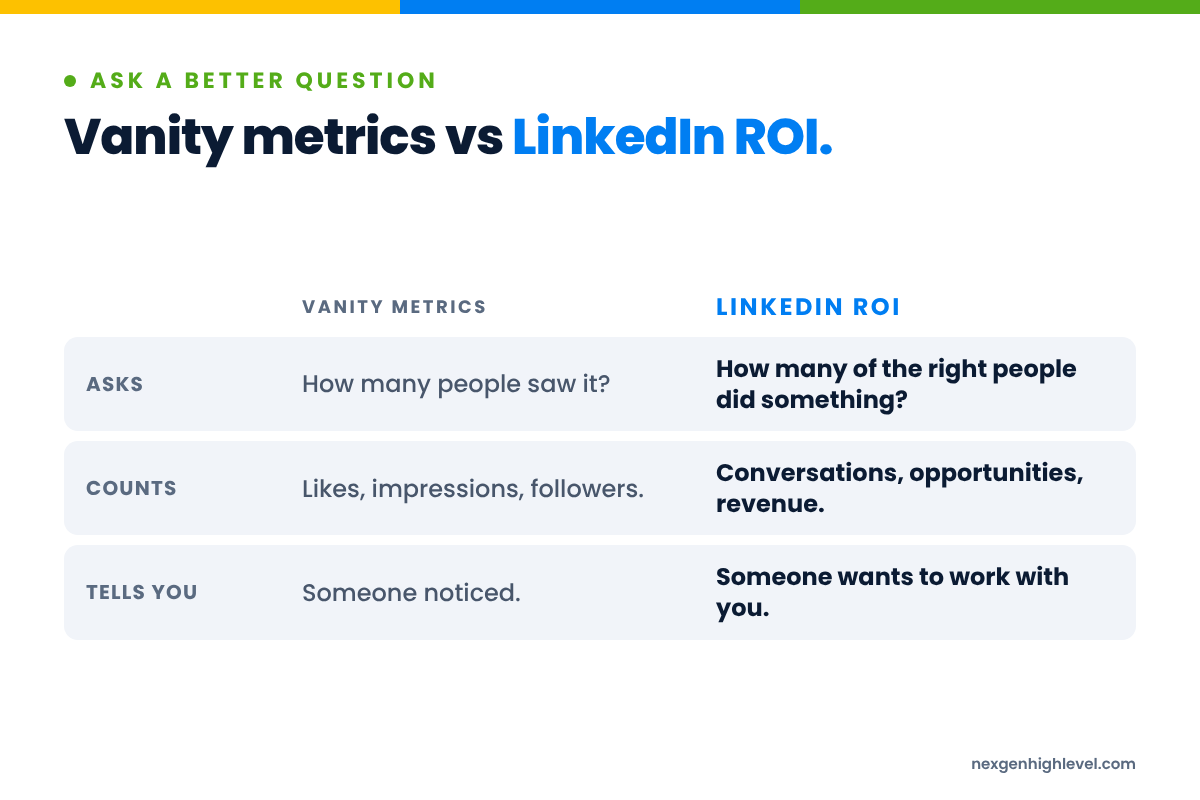
It's not "How many people saw it?" It's "How many of the right people did something because of it?"
Likes aren't bad. They're just incomplete. A like is someone saying "I noticed". It isn't someone saying "I'd like to work with you". Sometimes those are the same person. Often they're not.
Think about who likes your posts. Be honest. A lot of it is probably:
- Friends and former colleagues being supportive (bless them)
- Other people in your own industry, who will never buy from you
- People in the same engagement circles, liking everything that moves
- A handful of genuine prospects, quietly mixed in
That last group is the only one that pays the rent. And the trouble is, you can't tell them apart by looking at a number.
So the question isn't whether to track attention. It's where attention sits in the bigger picture.
The numbers that pay: a five-level ladder for LinkedIn ROI
Here's how I'd think about LinkedIn measurement. Picture a ladder with five rungs. Most people stand on the bottom rung and admire the view. I'd rather you start at the top, because that's what matters most, and work down.
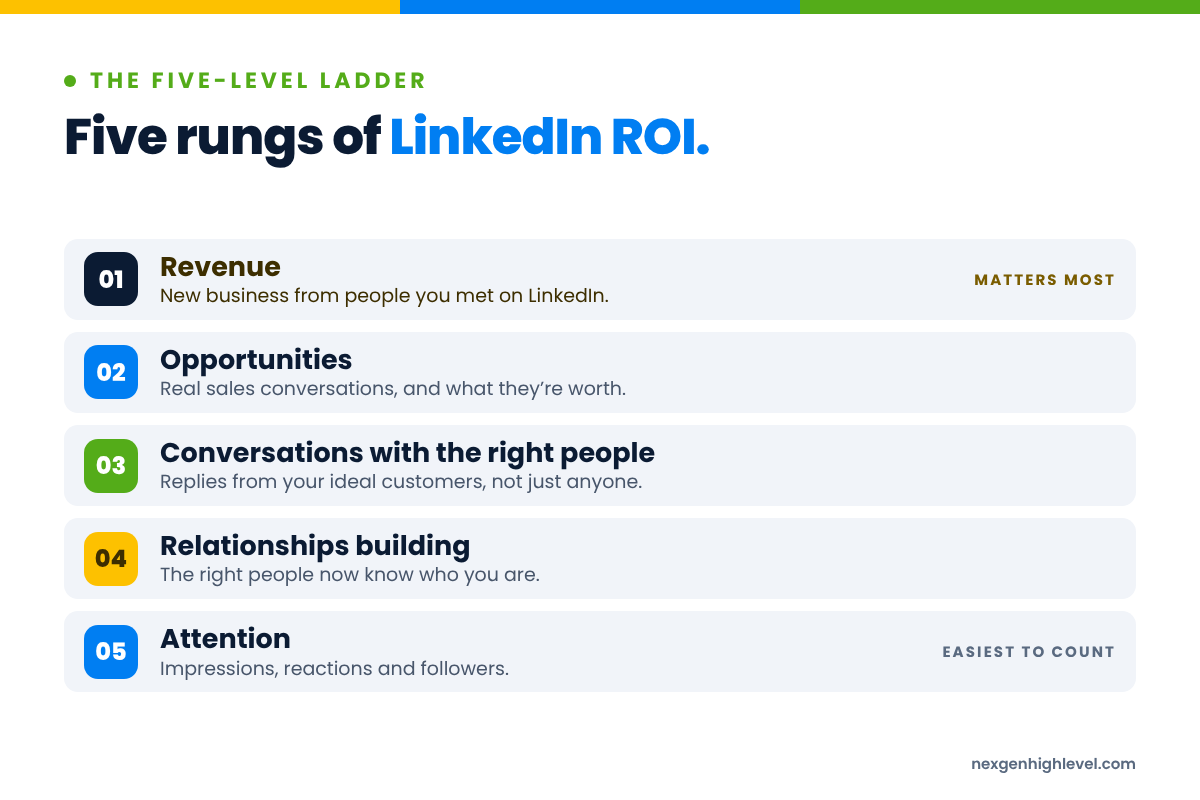
1. Revenue
How much new business came from people you first met, or first properly talked to, on LinkedIn?
This is the only number that really answers the question. Everything else on this ladder is a leading indicator of this one.
A few things to think about:
- First touch or real touch? Somebody might have connected with you three years ago and only properly talked to you last month. I'd count it. LinkedIn is where the relationship actually started.
- Lifetime, not first invoice. If a client came from LinkedIn and stayed for three years, the value of LinkedIn isn't the first invoice. It's the relationship. Track it that way if you can.
- Referrals count too. If a LinkedIn client refers two more people, LinkedIn started that chain. You don't need to be precious about the exact percentage. Just don't pretend it didn't happen.
And here's the bit people skip. Revenue isn't the same as profit. If LinkedIn brings you clients who need endless hand-holding at a low price, the revenue looks fine and the profit doesn't. Same lesson as the clinics. Look at what's left at the end.
2. Opportunities
How many real sales conversations are in your pipeline because of LinkedIn, and what are they worth?
Revenue is a lagging number. By the time it lands, the work that created it was done months ago. Opportunities tell you what's coming.
An opportunity isn't a chat. It's a conversation where both sides know business is being discussed. A proposal requested. A call booked to talk about a specific problem. A "send me some numbers".
If you put a realistic value against each one, you can start to see the shape of your LinkedIn ROI before the money arrives. Ten opportunities worth very little tells you something. Two opportunities worth a lot tells you something different.
And if the number of opportunities is zero for three months running, that tells you something too. Usually that the problem is further down the ladder.
3. Conversations with the right people
Not replies. Replies from people who fit the description of your ideal customer.
This one matters more than most people realise. A hundred replies from the wrong people is a busy inbox, not a business. Ten replies from the right people is the start of a pipeline.
This is why I spent a whole article on knowing your ideal customer profile on LinkedIn. If you don't know who the right people are, you can't measure whether you're talking to them. You'll count every reply as a win.
A useful habit: when a conversation starts, ask yourself one quick question. "Is this person someone I'd genuinely like as a client?" Yes or no. Count the yeses. That's your number.
4. Relationships building
How many of the people on your list of ideal customers now know who you are? Are the right people commenting on your posts, not just your mates?
This is the slow rung. It's the one that feels hardest to measure, and the one that does the most work over time.
Some ways to look at it:
- Of the people you'd most like to work with, how many have engaged with you in the last quarter? A like, a comment, a reply, a profile view.
- Are new comments coming from buyers, or from peers?
- When you start a conversation, do people already know who you are? "Oh, I've seen your posts" is one of the best sentences in business.
None of this is revenue. But it's the soil revenue grows in. I'll come back to why that matters in a minute.
5. Attention
Impressions, reactions and followers. Useful as a health check. Dangerous as a goal.
If your impressions fall off a cliff, something's changed: your posting, your topic, the platform. Worth knowing. If a post does unusually well, worth asking why. That's a health check.
But it's at the bottom of the ladder for a reason. Attention without the other four is noise. Pleasant noise. Still noise.
If you're only measuring number five, you've no idea whether LinkedIn is working.
How the ladder fits together
The useful thing about a ladder is that it tells you where the problem is.
- Lots of attention, no conversations? Your content is reaching people but not the right people, or not giving them a reason to talk to you.
- Plenty of conversations, no opportunities? Your conversations aren't moving towards business. Could be the message, could be the offer.
- Plenty of opportunities, little revenue? Something's going wrong at the close or in the follow-up.
- Good revenue, nothing in the pipeline? Enjoy it, but you're living off last year's work. Keep filling the top.
That's the real value of measuring properly. It's not about producing a report. It's about knowing which bit to fix.
Make the system do the counting in HighLevel
The reason most people measure likes is that likes are the only thing that's easy to count. So make the rest easy too.
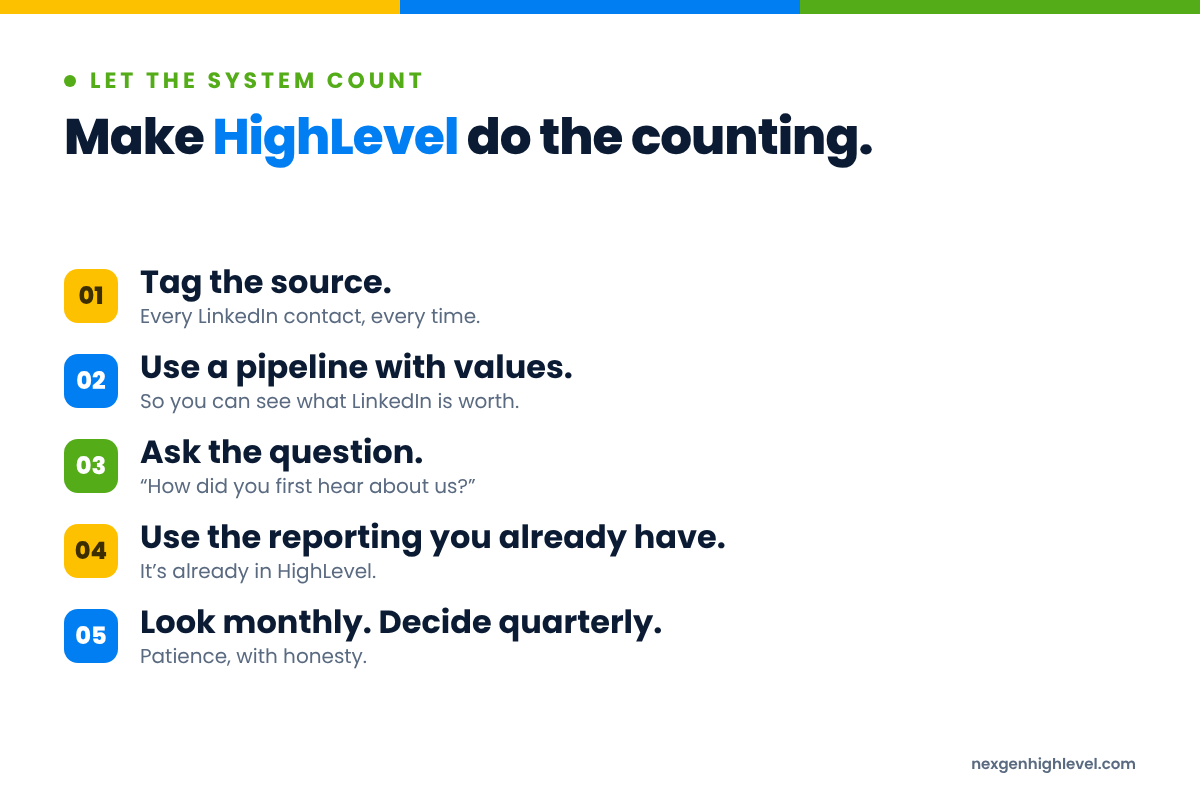
I'm a big believer that you shouldn't rely on memory or good intentions for this. Not yours, not your team's. If it depends on someone remembering to write it down, it won't happen. Not consistently. Not on a busy week. And every week is a busy week.
So let the system do it. In HighLevel, that comes down to a few simple habits.
Tag the source
When someone comes in through LinkedIn, tag them as LinkedIn. Every time.
Not "social". Not "online". LinkedIn. If you want to go further, add a second tag for how: LinkedIn post, LinkedIn outreach, LinkedIn referral. Don't overdo it. Three or four sources you actually use beat thirty you never look at.
If you're importing contacts from LinkedIn into HighLevel, set the tag automatically so nobody has to remember. If someone books through a link you share on LinkedIn, the form or the trigger link can apply the tag for you. A Workflow can do the rest.
The point is simple. When you look back in six months and ask "Where did our best clients come from?", the answer should already be sitting in your Contacts. Not in somebody's head.
Use a pipeline with values
When a LinkedIn conversation becomes a real opportunity, put it in the pipeline with an estimated value. Now you can see what LinkedIn is actually worth.
Opportunities and pipelines in HighLevel are where this ladder comes to life. Each stage tells you something. How many LinkedIn opportunities came in this quarter? How many moved to proposal? How many closed? What were they worth?
A rough value is fine. Nobody's going to audit you. A good guess today beats a perfect number you never write down.
And once the values are there, the conversation changes. It's no longer "LinkedIn feels like it's going OK". It's "LinkedIn has this much in the pipeline right now". That's a very different conversation to have with yourself, your partner, or your accountant.
Ask the question
On your booking form or intake call, ask: "How did you first hear about us?"
It's the oldest question in marketing. It's still one of the most useful. And you can put it straight into a form or survey in HighLevel and save the answer in a custom field against the contact.
You'll be surprised how often the answer is "I've been following your posts for a while", even when they came in through Google.
That's the bit software alone will miss. The technology says Google. The human says LinkedIn. Both are true. Google was the last click. LinkedIn was the reason they searched for you in the first place.
Make it an open question, or give a short list with "other" at the end. And when someone says "LinkedIn", ask one more question if you're on a call: "Oh, what did you see?" You'll learn more about what's working from that one question than from any dashboard.
Use the reporting you already have
HighLevel has reporting and attribution built in, so you can see where contacts and opportunities came from without building spreadsheets by hand. Combine that with your source tags, your pipeline values and your "how did you hear about us?" field, and you've got a picture most businesses never have.
Keep it simple. You don't need forty charts. You need to be able to answer five questions:
- How many new LinkedIn-sourced contacts this month?
- How many of them fit my ideal customer?
- How many became opportunities, and what are they worth?
- How many closed, and for how much?
- What did people say when we asked how they found us?
That's it. If you can answer those, you know more about your LinkedIn ROI than most businesses ten times your size.
Look monthly, decide quarterly
Check the numbers once a month. Make big decisions once a quarter.
Monthly keeps you honest. You'll spot if something has stopped working, or if a type of post is starting conversations.
Quarterly stops you from panicking. One quiet month on LinkedIn means very little. Three quiet months is a pattern. Changing your whole approach because of one slow fortnight is the business equivalent of ripping up a garden because nothing came up the day after you planted it.
Not everything shows up straight away
I want to be fair here, because there's a trap on the other side too.
You can get so obsessed with measuring that you only do the things that show up quickly. And on LinkedIn, a lot of the most valuable work doesn't.
The 95:5 rule
Remember the 95:5 rule. Professor John Dawes of the Ehrenberg-Bass Institute, in research published by LinkedIn's B2B Institute, estimates that only around 5% of B2B buyers are in the market in a given quarter. The other 95% aren't.
Think about what that means for measurement.
A lot of your best LinkedIn work, the posts and conversations that make you known to the other 95%, won't turn into revenue this month. It might turn into revenue next year. When the person who's been reading your posts quietly for a year finally has the problem you solve, you want to be the first name that comes to mind.
If you only measure what closes this quarter, you'll undervalue the work that makes next year possible. And you might stop doing it just before it starts paying.
What the Edelman and LinkedIn research says
Even big companies struggle with this. The 2024 Edelman-LinkedIn B2B Thought Leadership Impact Report found that only 29% of thought-leadership producers could link leads or wins back to it.
Yet the same research found that 86% of buyers said they were likely to invite companies producing thought leadership to bid for work.
Read those two numbers together. The buyers are saying "yes, this influences who we invite to the table". The sellers are mostly saying "we've no idea whether it works".
So the value is real. It's just slow, and it doesn't always leave a neat trail.
That's exactly why the source tags and the "how did you first hear about us?" question matter. They catch the slow value that a simple dashboard would miss.
Balancing patience with honesty
So how do you hold both ideas at once? Measure hard, but don't expect everything to show up straight away?
Here's how I'd think about it:
- Expect the bottom rungs to move first. In the early months, look for movement in relationships and conversations. If those aren't moving at all, something's wrong.
- Expect the top rungs to follow, with a lag. Opportunities come next. Revenue comes last.
- Write down what you expect before you start. "In three months, I'd expect to be having regular conversations with ideal customers." Then check. It stops you moving the goalposts later, in either direction.
Patience isn't the same as ignoring the numbers. It's knowing which numbers to expect, and when.
LinkedIn ROI starts with the earlier steps
Here's the thing about measurement. It doesn't fix anything on its own. It just tells you where to look.
And when you look, the problem is almost always in one of the earlier steps this series has covered.
If attention is low, look at how you show up. Your profile, your posts, whether you're saying anything worth hearing. The first article in the series, on LinkedIn marketing for business owners, is where that thinking starts.
If you're getting conversations with the wrong people, go back to the LinkedIn ideal customer profile. Nine times out of ten, a fuzzy target is the culprit.
If you're not getting enough conversations to begin with, look at how you're finding and approaching people. That's LinkedIn prospecting with HighLevel, and the difference between building a list of people and building a list of the right people.
If conversations are happening but quietly dying, it's usually follow-up. People don't go cold because they lost interest. They go cold because nobody followed up. The article on LinkedIn lead follow-up in HighLevel is all about that.
See the pattern? The ladder tells you which rung is broken. The earlier articles help you fix it.
Give it time, then be honest
I'm a firm believer in walking before you run. And even when you're ready to run, keep walking for a little bit longer.
Don't judge LinkedIn after two weeks. Give a proper, consistent effort a fair run, at least a quarter, with a clear idea of who you're trying to reach and what you're measuring.
Then be honest. Are the right people talking to you? Are opportunities appearing? Is revenue following?
If yes, do more of what's working. Work out which posts, which conversations, which approaches led to the opportunities, and do more of those.
If no, don't just post more. More of something that isn't working is just a more efficient way of not working. Go back to the beginning.
- Is your message right?
- Is your profile right?
- Are you talking to the right people?
- Is your follow-up letting conversations go cold?
And one more, which nobody likes asking. Is the offer right? Sometimes LinkedIn is doing its job perfectly. It's putting you in front of the right people. They're just not interested in what you're selling, or how you're selling it. That's not a LinkedIn problem. That's a business problem. Better to find out now.
Questions to ask yourself every quarter
If you want something to print and stick by your desk, here it is:
- Who did we actually want to reach on LinkedIn this quarter?
- How many of them now know who we are?
- How many real conversations did we have with them?
- What's in the pipeline from LinkedIn, and what's it worth?
- What closed, and was it profitable?
- What did new clients tell us when we asked how they found us?
- What's the one thing we'll change next quarter?
Seven questions. One a week if you're struggling for time. They'll tell you more about your LinkedIn ROI than any amount of scrolling through analytics.
Measurement is a system, not a spreadsheet
There's a reason I keep coming back to systems.
At the agency, we never thought of measurement as a report you produce at the end of the month. It was built into how everything worked. The source was captured on the way in. The value was recorded when the opportunity opened. The outcome was recorded when it closed. Nobody had to sit down on a Friday afternoon and reconstruct anything from memory.
That's what HighLevel lets a small business do now. Source tags, custom fields, pipelines with values, Workflows that apply the right tags automatically, reporting that pulls it all together. None of it is complicated on its own. Put together, it gives you a level of clarity that used to need a marketing department.
If you'd rather not build all of that from scratch, it's worth knowing that our HighLevel Snapshots are complete business systems, with the pipelines, tags and follow-up already thought through. Either way, the principle is the same. Build the counting into the system, so the system tells you the truth.
Technology is leverage, not strategy. But leverage pointed at the right numbers is a lovely thing.
Frequently asked questions
How do you measure LinkedIn ROI for a small business?
Start at the top of the ladder: revenue and profit from people you met or properly talked to on LinkedIn. Then work back through opportunities, conversations with ideal customers, relationships and attention. Tag every LinkedIn contact by source, put real opportunities in a pipeline with a value, and ask every new client how they first heard about you. Check monthly, decide quarterly. Simple beats clever here.
Are LinkedIn likes and impressions worth tracking?
Yes, as a health check. They tell you whether anyone is seeing your work, and a sudden drop is worth investigating. But they measure attention, not business. A like is someone saying "I noticed", not "I'd like to work with you". Track them, glance at them, and then spend most of your time on the numbers further up the ladder.
How long does it take to see a return from LinkedIn?
Longer than most people want. Give a consistent, focused effort at least a quarter before judging it. Conversations and relationships should move first, opportunities next, revenue last. Remember only around 5% of B2B buyers are in market in a given quarter, so some of your best work will pay off next year. Patience isn't ignoring the numbers. It's knowing when to expect them.
How can HighLevel track leads that come from LinkedIn?
Tag every LinkedIn contact with its source, automatically where possible, using forms, trigger links or Workflows. Move real conversations into Opportunities and pipelines with an estimated value. Add a "How did you first hear about us?" question to your forms and save the answer in a custom field. Then use HighLevel's reporting and attribution to see it in one place.
What if a LinkedIn lead comes in through Google or my website?
It happens all the time. Someone reads your posts for months, then searches for you and comes in through your website. The software sees the last click. That's why asking "How did you first hear about us?" matters so much. Record what the person says, not just what the software sees. Both are true. LinkedIn just started the conversation.
Pulling the threads together
Across these LinkedIn articles, I've tried to show that LinkedIn isn't a magic channel. It's a room full of the right people, and like any room, what you get out of it depends on how you show up, what you say, and what you do afterwards.
So far we've talked about knowing who you want to reach. About showing up as a person, not a brochure. About starting conversations like a human being. About using LinkedIn and email together, about follow-up, about AI and automation used properly. And now about measuring what actually matters. There's plenty more to say about LinkedIn, and we'll keep writing about it.
None of it is a secret. There isn't one. It's a set of simple things, done consistently, by someone who cares about the people on the other side.
Understand people first. Build the strategy second. Use technology to multiply it. Never the other way around.
And measure what pays. Because likes don't pay the rent.