Stop Waiting to Be Found: LinkedIn Prospecting and HighLevel
When I first discovered HighLevel in 2020, it opened my eyes. Funnels, follow-up, calendars, pipelines, all in one place, far beyond anything I'd used before.
But it also showed me a gap. And that gap is why I think LinkedIn prospecting deserves a lot more thought from business owners than it usually gets.
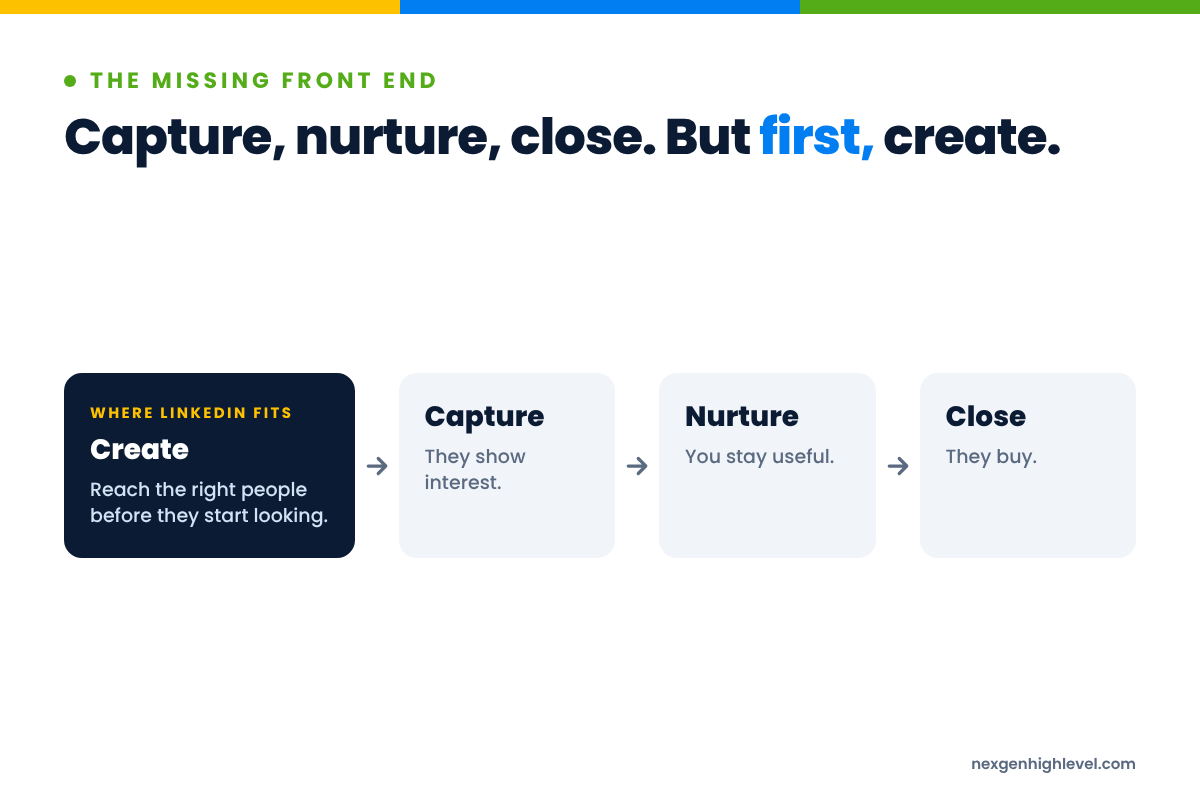
HighLevel's catchphrase back then was "Capture, Nurture, Close". And it did all three really well.
But I kept looking at that phrase and thinking: hang on. Capture what?
Where's the prospecting? Where's the outreach? Where's the market creation?
Capture assumes someone has already turned up. Nurture assumes they've given you their details. Close assumes they're interested. All of it starts after the customer has found you. Nothing in that sentence helps you go and find them.
And that's the gap most businesses live in without realising it.
This article is about that gap. Not how to click buttons on LinkedIn. It's about going first, creating your own market, and making sure every conversation you start lands somewhere it can't get lost.
Most businesses are waiting
Think about where your new customers come from right now.
For most business owners I speak to, it's some mix of referrals, repeat business, people who found them on Google, and maybe some paid ads. All of those are good. I'm not knocking any of them.
But every one of them has something in common. You're waiting for someone else to make the first move.
- The referral depends on a happy client remembering you at the right moment.
- The Google search depends on someone already knowing they have a problem, and already knowing what to type.
- The ad depends on catching someone at the right time and hoping the algorithm is in a good mood that day.
That's not a growth plan. That's a waiting room.
And I get why it happens. Waiting feels safe. Outreach feels like cold calling with a nicer font.
But while you're sitting in the waiting room, somebody else is in the room where the decision is being made.
Buyers make up their minds before they talk to you
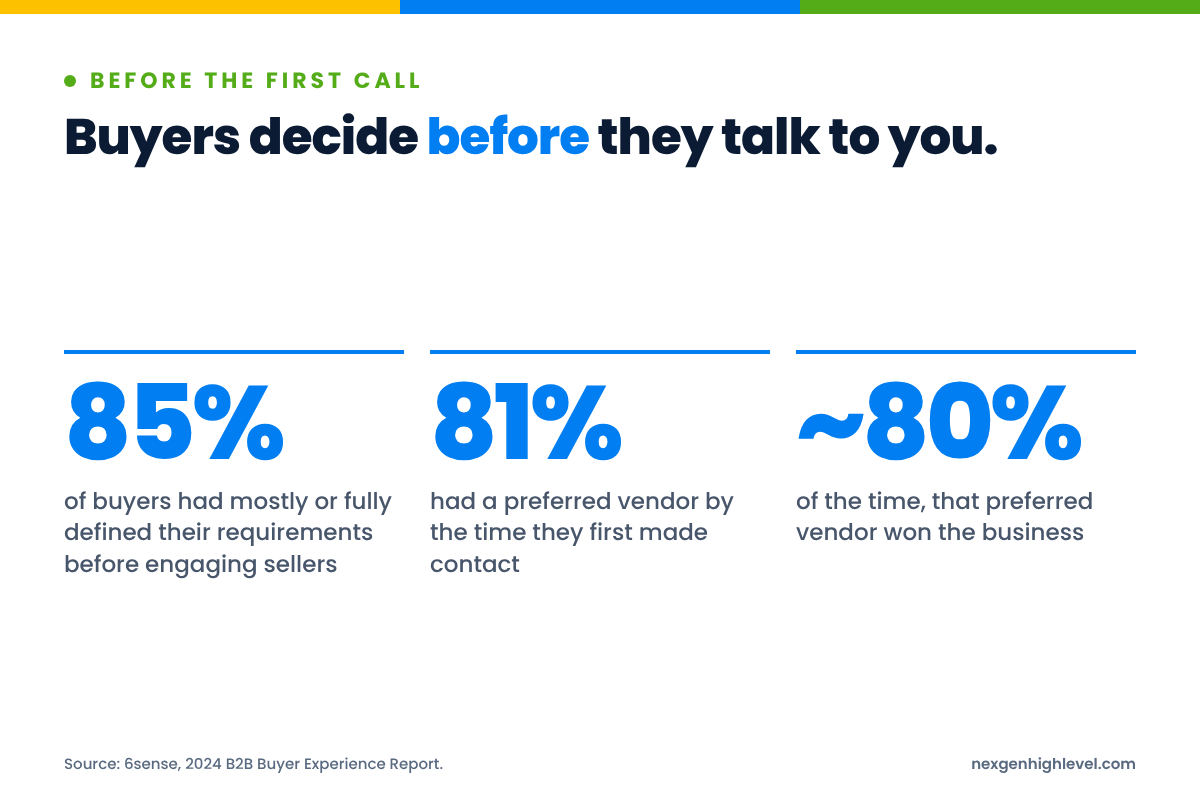
The 6sense 2024 B2B Buyer Experience Report found that 85% of buyers had mostly or fully defined their requirements before they engaged with sellers. 81% already had a preferred vendor by the time they made first contact. And that preferred vendor won about 80% of the time.
Read that again, slowly.
By the time a buyer picks up the phone or fills in your form, the shape of the deal is mostly decided. The shortlist exists. Someone is already at the top of it. And most of the time, that someone wins.
So the question isn't "How do I convert more of the people who contact me?" That matters, and HighLevel is very good at it. The bigger question is: "How do I become the name they already have in mind before they ever contact anyone?"
If they've never heard of you, you're not on the list. Your beautifully built funnel never gets the chance to capture anybody.
It's not a conversion problem. It's an awareness problem that shows up looking like a conversion problem.
The 95% nobody is talking to
There's a piece of research I come back to a lot. Professor John Dawes of the Ehrenberg-Bass Institute, in a paper published by LinkedIn's B2B Institute, estimated that only around 5% of B2B buyers are in market in a given quarter. The other 95% aren't.
Think about what that means for a business that only does inbound.
Your Google ads, your landing pages, your "book a call" button: they're all fishing in the 5%. So is every one of your competitors. That's a crowded little pond, and it's why the cost of getting a lead keeps creeping up.
The 95% aren't buying right now. But they will. Contracts end. People change jobs. A new boss arrives with new ideas. A supplier lets them down. Budgets get signed off.
When that moment comes, who are they going to think of?
Not the business that waited for them to search. The business that was already in their world, quietly useful, before they needed anything.
That's market creation.
Market creation is the bit before "capture"
Market creation means going to the people who should be your customers before they come looking for you. Getting into their world. Getting into their heads. Earning a place on the shortlist before there's even a shortlist.
It's not spamming. It's not "Hi {first_name}, I help businesses like yours grow." It's showing up, consistently, in front of the right people, with something worth their time.
What 23 years of recruitment taught me about going first
I did this for nearly 23 years in recruitment without ever calling it market creation.
When I started, there was no LinkedIn. No email. No CRM. No computers on desks, if you can believe it. A telephone, a filing cabinet and a phone directory. Every deal was done face to face.
And the good recruiters never waited for a company to advertise a job. By the time a job was advertised, every agency in the city was ringing about it. You were one of twenty voices, and the client was already tired of hearing from all of you.
The good recruiters built relationships with the people who'd be hiring next quarter. They knew which companies were growing, who'd just won a contract, which manager was quietly struggling with a team that wasn't working. They had coffee with people when there was nothing to sell.
So when that manager needed someone, they didn't put an ad out first. They picked up the phone and called the person they already knew.
That's the whole game. It hasn't changed. The tools have.
People buy from people. They always have, and I'd bet they always will.
Why LinkedIn changes the economics
Back then, building that kind of network took years. Networking events, phone calls, lunches, a lot of shoe leather and a lot of luck.
LinkedIn compresses that. It has more than 1 billion members in more than 200 countries and territories. The people you want to reach are there, findable by job title, by industry, by company size and location. You can see what they post about. You can see what they care about. You can start a conversation with them directly.
I think it's one of the most useful market creation tools a business owner has ever had. Not because it's magic. Because it puts the filing cabinet, the phone directory and the networking event in one place.
But, and this is the important bit, it only works if you use it like a recruiter, not like a vending machine.
LinkedIn prospecting is a relationship, not a raid
When people hear "LinkedIn prospecting", a lot of them picture the worst of it. The connection request followed thirty seconds later by a pitch. The "quick 15-minute call?" from someone who hasn't read your profile. The message that's so obviously copied and pasted that it still has someone else's company name in it.
We've all had them. Most of us have deleted them without reading past the first line.
That isn't prospecting. That's a raid. Get in, grab something, get out.
Real prospecting looks more like this:
- Know exactly who you're looking for. Not "business owners". Which business owners? What size? What stage? What problem keeps them up at night? If you haven't nailed this, start with defining your LinkedIn ideal customer profile. Everything else depends on it.
- Get into their world before you ask for anything. Look at what they post. Like something because you actually liked it. Leave a comment that adds something. Let them see your name a few times in a useful context.
- Connect with a reason. Not a pitch. A reason. Something you noticed, something you have in common, something genuinely relevant.
- Have a conversation, not a sequence. Ask questions. Be curious. Listen to the answers.
- Stay in their world. Most of the people you speak to won't be ready. That's fine. They're in the 95%. Your job is to still be there, still useful, when they move into the 5%.
None of that is complicated. Simple isn't amateur. Simple is often what you arrive at once you actually understand something.
But simple and easy aren't the same thing. The hard part isn't knowing what to do. The hard part is doing it consistently, for hundreds of people, without dropping anyone.
A word on limits and shortcuts
LinkedIn knows people try to cut corners. It applies weekly limits to connection invitations. Around 100 a week is commonly reported, but LinkedIn doesn't publish a fixed number and the limits vary by account.
And its User Agreement (section 8.2) prohibits bots and unauthorised automated methods used to add contacts, send messages or drive inauthentic engagement.
I actually think those limits do you a favour. If you can only send so many invitations a week, every one of them had better count. It forces you to think about who you're really trying to reach and why.
It's not a numbers game. It's a relevance game that happens to involve numbers.
What a good first message looks like
I'm not going to give you a script. The article on LinkedIn outreach messages goes much deeper on that. But here's the difference in spirit.
Picture two messages landing in the same inbox.
The first one, just as an example:
"Hi Sarah, I help companies like yours generate more leads with our proven system. Would you be open to a quick call this week?"
The second:
"Hi Sarah, saw your post about opening the second clinic in Austin. That's a big step. Out of curiosity, how are you finding it splitting the team across two sites?"
The first one is about the sender. The second one is about Sarah.
The first one asks for something. The second one gives her something: attention, and a question she might actually enjoy answering.
Neither is guaranteed to get a reply. Nothing is. But I know which one I'd answer.
The front end and the back end have to live together
Here's where I see good intentions fall apart.
Somebody does the hard work. They define their customer. They show up on LinkedIn. They start real conversations. People reply.
And then what?
The conversation lives in LinkedIn messages. The contact lives in a spreadsheet. The follow-up lives in their head. And the CRM, the thing that's supposed to hold it all together, has no idea any of it happened.
Three weeks later, a warm conversation goes cold. Not because the prospect lost interest. Because nobody followed up.
I call it falling through the gap between two pieces of software. And I've seen it cost businesses more than any bad ad ever has.
Speed matters more than people think
There's an old study that still gets quoted for good reason. The Lead Response Management study, by Dr James Oldroyd with InsideSales, found the odds of qualifying a lead were 21 times higher when the lead was contacted within five minutes compared with after 30 minutes.
And the reality is worse than you'd hope. When Drift tested 433 B2B companies, only 7% responded within five minutes, and 55% hadn't responded within five business days.
Five business days. To someone who put their hand up.
Now think about LinkedIn. Someone replies to your message at 9.15 on a Tuesday. You're in meetings all day. You see it on Thursday. By then the energy that made them reply has gone.
If the reply had landed inside HighLevel instead, sitting in Conversations alongside every email, text and call, with a Workflow ready to tag it, notify you and create an Opportunity, you'd have seen it in minutes.
It's not about working harder. It's about the reply arriving somewhere you can't miss it.
How we ended up building for this
I'll be honest about how NexGenHighLevel started down this road, because it wasn't a grand plan.
We didn't sit in a boardroom and decide to build a LinkedIn product. A client needed LinkedIn outreach. That was it. One client, one problem.
So we looked at what was out there. There were plenty of LinkedIn tools on the market. But they all did roughly the same basic outreach, and none of them truly sat inside HighLevel. They were bolted on the side.
Your prospects lived in one place, your conversations in another, your follow-up somewhere else again. Getting them to talk to each other meant an API, a third-party automation tool, or a lot of copying and pasting. Which, let's be honest, means it doesn't get done.
Part of HighLevel, not a complement to it
So we built it differently. We made our app a part of HighLevel, rather than a complement to HighLevel.
That sounds like a small distinction. It isn't.
When something is genuinely part of HighLevel, it uses what's already there. Your LinkedIn prospects come straight into Contacts. Tags pick them up. Workflows decide what happens next. LinkedIn actions (viewing a profile, liking a post, sending a connection request or a message) sit inside the Workflow builder like any other step. Replies sync both ways with Conversations, so LinkedIn sits in the same inbox as everything else.
No separate platform to log into. No spreadsheet in the middle. No duct tape.
If you want the details, the LinkedIn App for HighLevel page lays out what it does. I'm not going to turn this article into a features list.
Why email enrichment was a game changer
Then we added email enrichment. And I'll use the phrase "game changer" here because, for once, it actually was one, and I can tell you why.
Before, you were relying on one channel. If someone didn't check LinkedIn much, or didn't accept your connection, that was that.
With enrichment, you could find the right person on LinkedIn or Sales Navigator, find a verified email for them, and bring them into HighLevel with both. Now you could reach them on LinkedIn and by email, and nurture them over time, all from the same account.
That's not two campaigns. It's one relationship across two places where they actually spend time. The article on LinkedIn and email outreach together goes into how those two channels support each other.
What happened next
For those first clients, outreach went up. And so did leads, sales and revenue.
I'm careful with that sentence, because it would be very easy to dress it up. I'm not going to put a percentage on it or tell you it'll happen for you. Every business is different, and a tool behind a weak offer just helps you tell more people about something they don't want.
But it did happen. And it left us asking a question we're still asking: what else can we build?
That's really where NexGenHighLevel came from. Not a love of technology for its own sake. A gap at the front of "Capture, Nurture, Close", and a stubborn belief that the bit that fills it should live in the same place as everything else.
I'm not telling you any of this to sell you an app. I'm telling you because the lesson matters more than the tool. The front end of your marketing should live in the same system as the back end.
Human, Strategy, Leverage: putting LinkedIn prospecting in the right order
Here's where I want to slow you down a bit. Because the risk with any article that mentions a tool is that people skip straight to the tool.
I've got a framework I use for almost everything. Human. Strategy. Leverage. In that order.
Human
Start with the person. Not "decision-makers in mid-sized firms". A person.
- What do they actually want this year?
- What's frustrating them right now?
- What have they tried that didn't work?
- What would make them ignore you instantly?
If you can't answer those, no amount of LinkedIn activity will save you. You'll just be very busy being irrelevant.
Strategy
Then decide how you'll show up for that person.
- What's the reason you're contacting them at all?
- What do you have that's genuinely useful to them before they buy anything?
- What's the path from "never heard of you" to "I'd like to talk"?
- What happens when they say "not now"? (They mostly will. That's the 95%.)
This is where your offer, your message and your content come together. If you're posting on LinkedIn, the 2024 Edelman-LinkedIn B2B Thought Leadership Impact Report, based on around 3,500 management-level professionals, found that 73% of B2B buyers say thought leadership is a more trustworthy basis for judging a company's capabilities than its marketing materials.
In other words, what you think and how you explain it does more for you than your brochure. Prospecting and content aren't separate jobs. Your posts are what people check when your message lands.
Leverage
Only then does technology come in.
Technology is leverage, not strategy. Leverage multiplies whatever is underneath it. Put it behind a clear idea of who you're helping and why, and it lets you do in an afternoon what used to take me a week of phone calls. Put it behind a vague offer and a generic message, and you've just found a very efficient way of annoying people.
If you multiply zero by a thousand, you've still got zero.
So when you think about LinkedIn prospecting inside HighLevel, think about it in that order. The people. Then the plan. Then the Workflows, the tags, the enrichment and the automation that let you do it for hundreds of people without dropping a single one.
What a joined-up LinkedIn and HighLevel system looks like
Let me paint a picture. Not a how-to. Just a picture of what "joined up" means, so you can compare it with what you've got today.
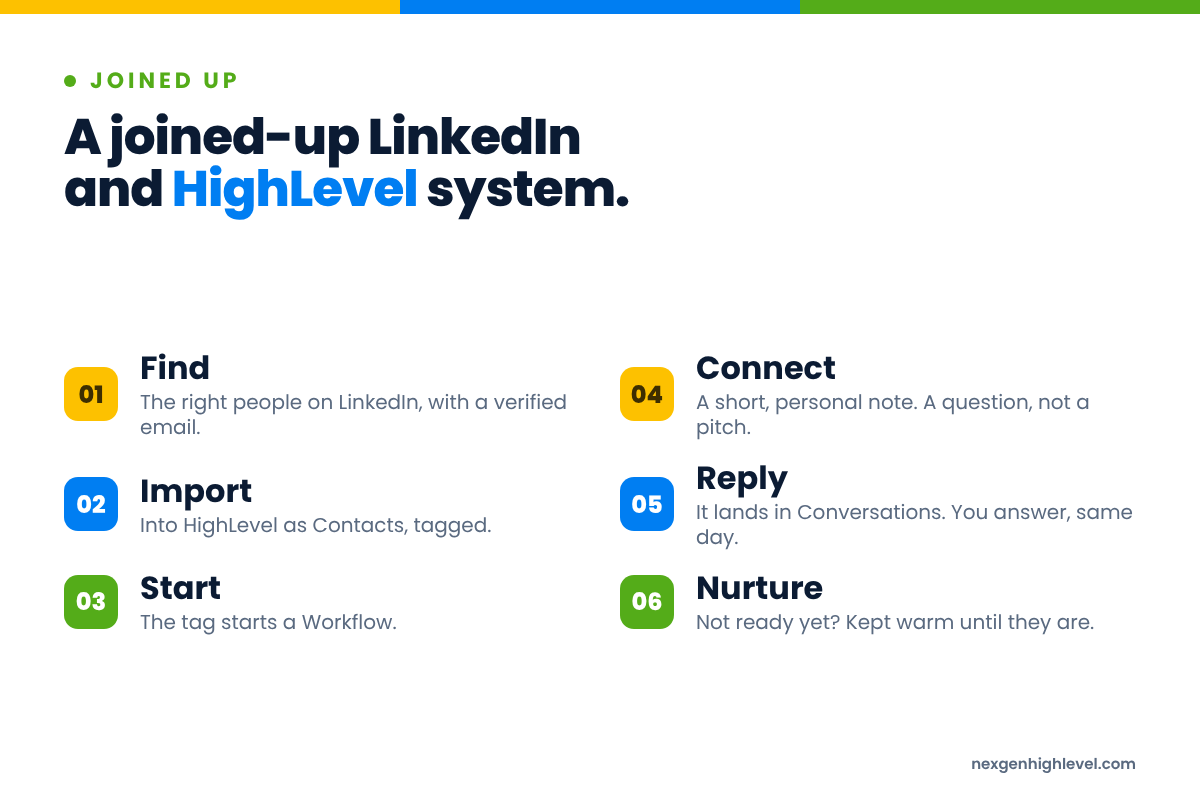
Imagine you run a business that sells to operations managers in logistics firms.
- You've defined who they are. Size of firm, region, the problem you solve for them.
- You search for them on LinkedIn or Sales Navigator, and the ones who fit come into HighLevel as Contacts, with a verified email where one can be found.
- A tag marks them as "logistics ops, new prospect". That tag starts a Workflow.
- Over the next couple of weeks, the Workflow views their profile, likes something they've posted, then sends a connection request with a short, personal note.
- If they accept, a message goes out. Something useful. A question, not a pitch.
- If they reply, it lands in Conversations, a notification goes to you, and an Opportunity appears in your pipeline. You answer it yourself, as a human, the same day.
- If they don't reply, they don't vanish. They move into a gentle nurture: occasional useful emails, your LinkedIn posts in their feed, maybe an invitation to something relevant later.
- When they're ready, maybe in three weeks, maybe in nine months, they book through your calendar, get confirmations and reminders, and you can see exactly where they came from in your reporting.
Nothing in that picture is clever. That's the point. It's just joined up. And you're still the one having the conversations. The system does the remembering. You do the relating.
AI doesn't replace humans, and neither does automation. It speeds up the process. The relationship is still yours to build.
The mistakes I see business owners make with LinkedIn
I've watched a lot of people try this, myself included. Three patterns come up again and again. I recognise myself in all three.
The Tinkerer
Spends six weeks building the perfect Workflow. Fourteen branches, three wait steps, conditional logic for every possible reply. Hasn't sent a single message.
If that's you: build something simple, send it to twenty people, and learn. Six weeks to find out beats six months.
The Rusher
Opens LinkedIn on Monday, connects with 100 people, pitches all of them on Tuesday, decides on Friday that "LinkedIn doesn't work".
If that's you: walk before you run. Relationships move at the speed of trust, not the speed of your calendar.
The Magic-Bullet Believer
Buys the tool. Expects the tool to do it. Doesn't define the customer, doesn't write a decent message, doesn't follow up personally. Then buys another tool.
If that's you: ask "What problem in my business will this solve?" before "What can this tool do?" Then learn to use one thing properly.
And a couple more
- Treating LinkedIn as a broadcast channel. Posting and never talking to anyone. Or talking to everyone and never posting. You need both. People check your profile and posts when you message them.
- Letting AI write everything. Originality.ai looked at 3,368 long-form LinkedIn posts from 99 influential profiles in 2025 and found 53.7% were likely AI-generated. LinkedIn itself said in June 2026 that content which appears AI-generated and lacks a clear perspective is less likely to be distributed widely beyond your immediate network. AI is only as good as the person using it. Use it to help, not to replace your point of view.
Questions to ask yourself this week
You know your business better than I do. So here are some questions worth sitting with, ideally with a coffee and no phone.
- What percentage of your new business comes from you going first? If the honest answer is close to zero, your growth is in someone else's hands.
- Who should know you, but doesn't? Write down 50 people or companies who'd be perfect clients. How many of them would recognise your name today?
- If one of them needed what you sell tomorrow, would you be on their shortlist? Be honest. If not, who would be?
- Where would they go after the first conversation? If someone replies to you on LinkedIn tomorrow, what happens next? If the answer is "I'd try to remember to follow up", that's your next job.
- How long does a reply sit before someone answers it? Minutes, hours or days? Do you actually know?
- What's your plan for the 95%? The people who say "not now". Do they disappear, or do they stay in your world?
If those questions make you uncomfortable, good. That's where the useful work is.
For agency owners
If you run an agency, all of this applies twice. Once for your own pipeline, and once for your clients.
A lot of clients come to agencies having already tried several, and almost all of them were sold on inbound: ads, funnels, landing pages. All good things. But very few were shown how to go and create their own market.
If you can help a B2B client build the front end as well as the back end, inside the same HighLevel account they already use, that's a very different conversation from "we'll run your ads". It's a whole system, and whole systems are what get judged on revenue and profit rather than clicks.
If you'd rather start from something already built, our HighLevel Snapshots are complete business systems, and the Mega Snapshots include LinkedIn outreach built in (that part needs the LinkedIn App). And if you want a broader look at turning connections into clients, what happens after someone says yes is a good companion to this one.
Frequently asked questions
What is LinkedIn prospecting?
LinkedIn prospecting is finding the people who should be your customers on LinkedIn and starting relationships with them before they come looking for you. It's not mass messaging or pitching strangers. It's knowing exactly who you want to reach, getting into their world with something useful, starting genuine conversations and staying present until they're ready. Think of it as the front end of your marketing: the bit that comes before capture, nurture and close.
Does LinkedIn prospecting still work in 2026?
Yes, when it's done properly. LinkedIn has more than a billion members and most of your B2B buyers are on it. What doesn't work is the lazy version: instant pitches, copied templates, AI-written messages with no point of view. LinkedIn limits invitations and discourages automated, inauthentic behaviour. That rewards people who are relevant and patient. If you treat it like recruitment, building relationships early, it works.
Can I manage LinkedIn prospects inside HighLevel?
Yes. HighLevel's Social Planner already posts to LinkedIn, but prospecting and outreach aren't built in. With an app built natively into it, your LinkedIn prospects can become HighLevel Contacts, get tagged, trigger Workflows, and have their LinkedIn messages appear in Conversations alongside email and SMS. That's what we built the LinkedIn App for HighLevel to do. The point is that the conversation lives in the same system as your pipeline and follow-up.
How many LinkedIn connection requests should I send each week?
LinkedIn applies weekly limits to invitations. Around 100 a week is commonly reported, but LinkedIn doesn't publish a fixed number and it varies by account. Honestly, I'd worry less about the maximum and more about relevance. Twenty well-chosen people with a real reason to connect will usually do more for you than a hundred random ones. Quality first, then build volume steadily.
Should I combine LinkedIn with email outreach?
In most cases, yes. People don't live in one channel. Some check LinkedIn daily, others barely at all but read their email. Reaching the same person in both places, with a consistent and useful message, builds familiarity faster than either alone. That's why email enrichment mattered so much to us. Just keep it human, relevant and respectful of how often you're turning up.
Is LinkedIn prospecting only for B2B businesses?
It's strongest for B2B, because that's where decision-makers are easy to find by role, industry and company size. But plenty of service businesses benefit too: anyone selling to professionals, practice owners, consultants or business owners. If the person who buys from you has a job title they'd put on a profile, LinkedIn is probably worth your time.
Stop waiting to be found
Capture, Nurture and Close are brilliant. HighLevel does all three really well, and I'm not knocking any of it.
But they all start with somebody turning up.
The businesses that grow steadily don't just wait for the 5% who are searching today. They go and find the right people, get into their world early, and make sure that every conversation they start lands in a system that won't let it go cold.
That's what I learned with a telephone and a filing cabinet. It's what we built the LinkedIn App around.
If you only market to people who are already looking, you'll always arrive second.