Know Who You're Talking To Before You Post on LinkedIn
"We want more leads."
I must have heard that sentence more times than I can count when I ran my marketing agency. And it's the reason I think a LinkedIn ideal customer profile matters more than any post, any template or any piece of software you'll ever buy.
Because every time I heard it, I'd ask the same follow-up questions.
What kind of leads? For which service? In which area? Worth how much to you?
There'd often be a pause. Then something like, "Well... anyone, really."
And that's the problem. "Anyone" isn't a market. You can't find anyone. You can't speak to anyone. And you certainly can't build a message that makes anyone stop scrolling.
LinkedIn makes this worse, not better. It gives you access to more than 1 billion members in more than 200 countries and territories. That feels like an advantage. And it can be. But access without focus is just noise with a bigger audience.
This article is the second in our series on LinkedIn for business owners. If you haven't read the first one, why LinkedIn marketing for business owners is a thinking job before it's a posting job sets the scene. This one is about the bit almost everybody skips: knowing exactly who you're talking to before you say a word.
"Anyone" isn't a market
Let's be honest about why people say "anyone".
It's not laziness. Usually it's fear.
If you name a specific customer, it feels like you're shutting the door on everybody else. You've got bills to pay. A team, maybe. A month that's quieter than you'd like. So you keep the door wide open and hope the right person wanders in.
I understand that feeling completely. I've run businesses for most of my working life, and I've closed one. Nobody needs to tell me what a quiet month feels like.
But here's what "anyone" actually does to your marketing.
- Your message goes soft. You can't talk about a specific problem, because the problem is different for everybody. So you talk about yourself instead. "We help businesses grow." So does everyone.
- Your content goes vague. You post about "success" and "mindset" and "productivity" because those topics offend nobody. They also help nobody in particular.
- Your outreach goes generic. You send the same message to a dentist, a software founder and a logistics manager. All three can smell it.
Picture two people walking into a busy conference.
The first one says, "I'm here to meet people." They chat to whoever's near the coffee and leave with a pocket full of business cards.
The second one says, "I'm here to meet operations directors at manufacturing firms who are struggling to hire." They know which talks to attend and what to ask. They leave with three proper conversations.
LinkedIn is that conference, running every hour of every day, with a billion people in the hall. The question is whether you're the first person or the second.
Human → Strategy → Leverage: why the order matters on LinkedIn
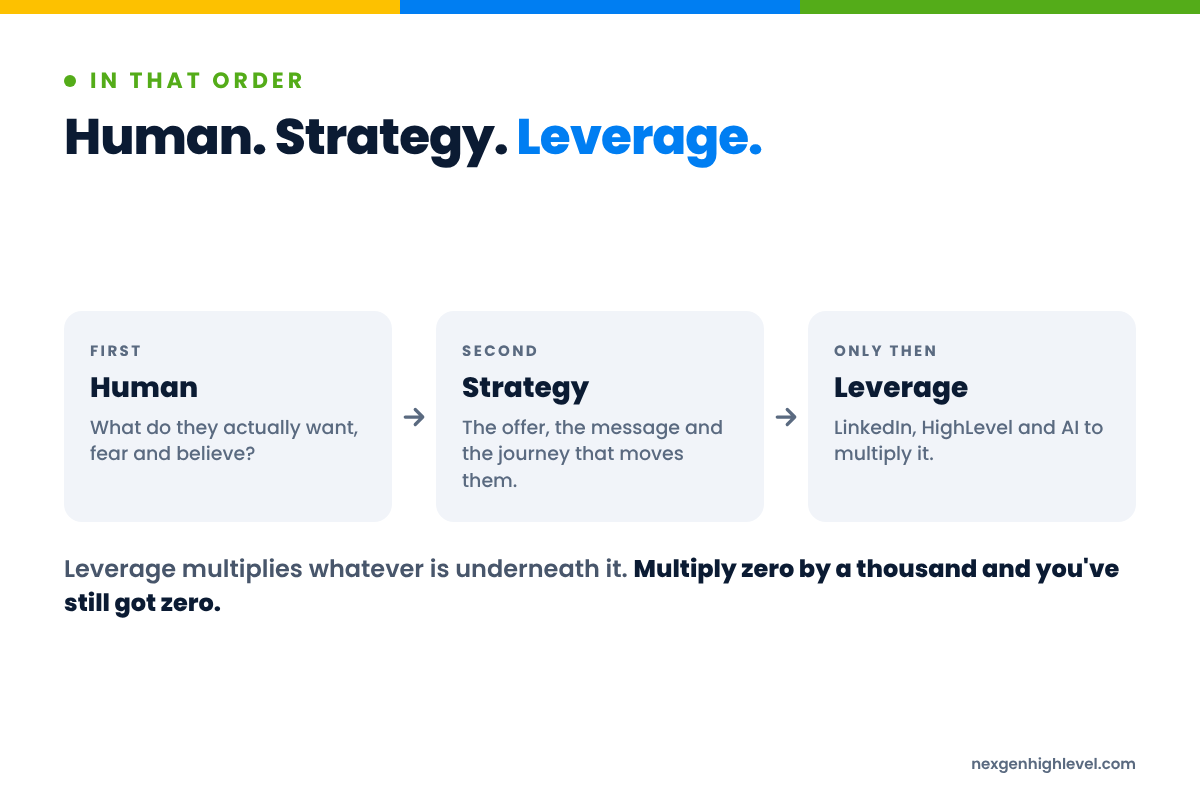
I have a simple way of thinking about marketing. Human, then Strategy, then Leverage. In that order.
It came from a problem we had at the agency. We were technically very good: ads, funnels, follow-up, CRM, the lot. But our medical clients wouldn't give us content. Nothing at all, or two stock photos and a 14-second video filmed from what looked like six miles away.
They hadn't gone into healthcare to be content creators. Put a camera in front of them and they froze.
We could have thrown more technology at it. Instead we built an app with prompts that took away the blank page and the fear of the camera. It worked because we weren't really solving a content-production problem. We were solving a human-friction problem.
That's the order.
- Human. Who is this person? What do they actually want? What frustrates them, scares them, stops them acting? What do they believe? Not what we think they should want.
- Strategy. How do we solve that and talk about it? The offer, the message, the journey from where they are to where they want to be.
- Leverage. Only then does technology come in. LinkedIn, AI, automation, HighLevel Workflows, the whole kit.
Most people do it backwards. They start with the tool (LinkedIn, an automation, a shiny new AI app), then try to work out what to say, and only think about the human being on the other end when nothing works.
Technology is leverage, not strategy. And leverage multiplies whatever is underneath it.
If what's underneath is a vague idea of "anyone", LinkedIn just lets you reach more of the wrong people, faster. If you multiply zero by a thousand, you've still got zero.
So before you post, before you connect, before you send a single message, you need to know who you're talking to. Properly.
Your LinkedIn ideal customer profile is the "Human" part. Everything else in this series sits on top of it.
They've made up their minds before you arrive
There's a reason this matters more now than it used to.
When I started in recruitment, there was no LinkedIn, no email and no CRM. A telephone, a filing cabinet and a phone directory. If a client wanted to know about you, they had to ask you. You were part of the research.
That's gone.
Buyers now do most of their thinking before they ever speak to you. The 6sense 2024 B2B Buyer Experience Report found that:
- 85% of buyers had mostly or fully defined their requirements before engaging sellers.
- 81% already had a preferred vendor by the time they made first contact.
- And that preferred vendor won about 80% of the time.
Read that again.
The decision is mostly made before the first call. Before the discovery meeting. Before your lovely proposal. If you're not already in their head by then, you're often competing for second place.
Now put that next to another piece of research. Professor John Dawes of the Ehrenberg-Bass Institute, in work published by LinkedIn's B2B Institute on the 95:5 rule, estimated that only around 5% of B2B buyers are in market in any given quarter. The other 95% aren't.
So most of the people who'll eventually buy what you sell aren't buying right now. And by the time they are, most of them will have quietly picked a favourite.
Put those two together and the job changes completely.
The question isn't "How do I get in front of buyers when they're ready?"
It's "How do I get into their heads long before they're ready?"
And you can't do that if you don't know whose head you're trying to get into.
This is where LinkedIn is genuinely useful. You can show up, week after week, in front of a specific type of person while they're not buying. So when they move into that 5%, you're the name already on the list. But only if you know who that person is.
Commercial discovery: the afternoon that shapes everything
When we took on a new client at the agency, we had a process. One of the early stages was what I called commercial discovery.
It wasn't about marketing. It was about money. How does this business actually make it?
- Who are the best customers?
- Which services are the most profitable?
- How long does it take someone to go from first contact to paying?
- What are the limits? Capacity, geography, staff, cash?
You'd think every business owner would know the answers. Most didn't. Not because they weren't smart, but because they were busy running the thing.
And very often, the honest answers changed everything. The service they wanted to promote wasn't the one making the money. The customer they thought was ideal was the one who haggled hardest and paid slowest. So we'd usually rebuild from the ground up.
That's why I think commercial discovery is the most valuable afternoon you'll spend on your LinkedIn strategy.
Because if you get the commercial picture right, your LinkedIn ideal customer profile builds itself. And if you get it wrong, no amount of clever content will fix it. You'll just be very efficiently telling more people about something they don't want.
So block out an afternoon. Grab a coffee (or a tea, I'm not judging). Pull up your last year or two of invoices. And work through the six questions below honestly.
Not the answers you'd give at a networking event. The real ones.
Six questions to build your LinkedIn ideal customer profile
1. Who are your best customers?
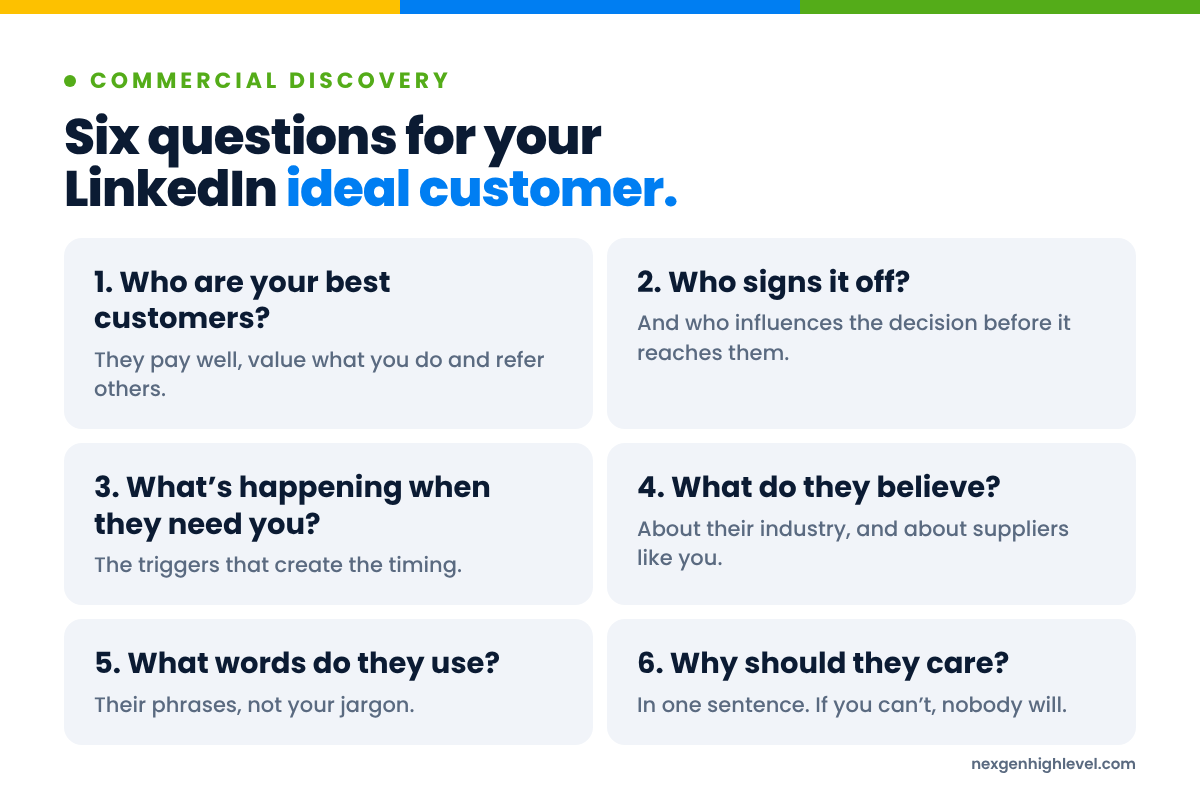
Not all of them. The best.
The ones who pay well, pay on time, value what you do, take part in the process and send you referrals. The ones you'd happily clone.
Make a list of them. Five, ten, twenty, whatever you've got. Then look for what they have in common.
- Industry. Are they clustered in two or three sectors?
- Size. Team size, revenue band, number of locations?
- Role. Who did you actually deal with? The owner, a director, a manager?
- Stage. Were they starting out, growing fast, or established and steady?
Now do the uncomfortable bit. Make a second list: the customers you'd never want again. The ones who wanted everything for nothing, moved the goalposts, or wouldn't give you what you needed to do the job.
At the agency we had clients like that. It was never really a "couldn't". It was always a "wouldn't" wrapped up as something else. Sometimes the honest answer was to walk away. It's OK to walk away from a deal, from the money, from a new client.
Your LinkedIn ideal customer profile is shaped as much by who you leave out as who you put in.
Food for thought: If your best customer and your worst customer have the same job title in the same industry, the difference between them isn't on their LinkedIn profile. It's in their situation, their beliefs or their budget. Keep that in mind for questions 3 and 4.
2. Who signs it off, and who influences it?
The person who buys is often not the person who first notices the problem.
Picture a growing accountancy practice. The office manager feels the pain first: the phones, the chasing, the spreadsheets. They start looking around. They mention it to a partner. The partner asks the finance director whether there's budget. The managing partner signs it off.
That's four people. Four different worries.
- The office manager wants the daily headache gone.
- The partner wants to know it won't upset clients.
- The finance director wants to know what it costs and what it saves.
- The managing partner wants to know it's a good decision they won't regret.
If your LinkedIn content only ever speaks to one of them, you're leaving the others to make up their own minds without you.
The good news is that on LinkedIn you can reach all of them. They're all there, with their job titles on display. Your posts can speak to the person who feels the problem. Your profile can reassure the person who signs it off. Your conversations can help the champion sell it internally.
Food for thought: Who in your best customers' businesses first noticed they needed you? Was it the person who paid? If not, who have you been ignoring?
3. What's happening when they need you?
Nobody wakes up and thinks, "Today I fancy buying some consultancy."
Something happens first. A trigger.
- A new hire, or a key person leaving.
- A bad quarter, or a great one they can't keep up with.
- Growth they can't handle.
- A new regulation landing on their desk.
- A competitor eating their lunch.
- A change of leadership, with a new boss wanting to make their mark.
These triggers are your timing.
Remember the 95:5 rule. Most people aren't buying right now. Triggers are the moments when somebody quietly moves from the 95% into the 5%. If you know what those moments look like for your customers, you can spot them, and you can talk about them before they happen.
Go back to your best customers. What was going on in their world in the month before they contacted you? If you don't know, ask them. It's one of the most useful conversations you'll ever have, and most people are delighted to be asked.
Food for thought: If you could get one notification every time a business like your best customer hit a trigger moment, what would that trigger be? That's probably the most important line in your LinkedIn ideal customer profile.
4. What do they believe?
About their industry. About suppliers like you. About what's possible.
Beliefs are where most marketing quietly falls over, because they're invisible. Two people with the same job title, in the same industry, at the same size company, can believe completely different things.
One believes marketing works if you find the right partner. The other has tried five agencies this year and believes it's all smoke and mirrors.
That second person is very real. I met them over and over after what I call the GoHighLevel Effect: when white-labelling made it possible for thousands of new agencies to appear almost overnight. Many were brilliant at selling themselves. Not all of them could deliver. So prospects arrived with their guard up, wanting a guarantee, while telling you they'd been let down several times already.
If they've been burnt before, your message needs to deal with that. Not ignore it. Not oversell past it. Deal with it.
Some beliefs worth writing down:
- What do they think causes their problem?
- What have they already tried, and what did they conclude from it?
- What do they think a supplier like you is going to do wrong?
- What do they believe about themselves? ("I'm not a marketer." "I'm rubbish on camera." "I don't have time for LinkedIn.")
Food for thought: What's the one belief your ideal customer holds that, if you changed it, would make buying from you feel obvious? Most of your best LinkedIn content should be chipping away at that.
5. What words do they use?
Not your jargon. Theirs.
Every industry has its own language, and so does every supplier. The trouble is, we fall in love with our own. We say "omnichannel lead nurture". Our customer says "I keep forgetting to call people back."
Same problem. Very different words. Only one of them makes the customer feel understood.
LinkedIn is a goldmine for this. Read your ideal customers' posts. Read the comments under posts in their industry. Look at how they describe their own jobs in their headlines and About sections. Notice the phrases that come up again and again.
Then go back through your own emails and sales notes. What did your best customers say when they first got in touch? Write it down, word for word.
The phrases they use to describe their problems are the phrases your content should use.
Here's an illustrative example. Imagine you help small manufacturers with recruitment.
- Your words: "We provide end-to-end talent acquisition solutions."
- Their words: "I've had an advert up for six weeks and nobody decent has applied."
Which of those would make a factory owner stop scrolling?
This also feeds straight into your profile. When somebody lands on your LinkedIn profile and sees their own words reflected back, it feels like you get it. There's more on that in the next article in this series, on building a LinkedIn profile for business owners that actually works.
Food for thought: Could a customer read your last five posts and recognise their own week in them? Or would they need a dictionary?
6. Why should they care?
This is the big one.
There's always a person on the other side of the screen asking, "Why should I care?" They're busy. They've got their own problems. Your post is competing with their inbox, their team and whatever's on fire today.
If you can't answer that question in a sentence, nobody else will either.
Try finishing this:
"[Type of person] should care about what I do because [specific outcome they want], and right now [what's in the way]."
For example (illustrative): "Owners of busy dental practices should care because they want a full diary of the right patients, and right now too many bookings never turn up."
That's not a slogan. It's a test. If you can't fill in the brackets with something specific, you're not ready to post yet. You're ready to go back to questions 1 to 5.
And be careful of the trap. "Why should they care?" is not "What do we do?" Nobody cares what you do. They care what changes for them. Channels and algorithms change. That doesn't.
Food for thought: If your ideal customer had to explain to their boss, partner or spouse why they're talking to you, what would they say? Write that sentence down. It's probably better marketing than anything you've written so far.
From six answers to one page: your LinkedIn ICP
Now squeeze your six answers onto one page. If it doesn't fit on one page, you haven't decided yet.
A simple layout:
- Who they are: industry, size, role, stage, location.
- Who's involved: who feels the problem, who influences, who signs it off.
- Triggers: the two or three moments that move them into buying.
- Beliefs: what they think, what they've tried, what they're wary of.
- Their words: five to ten phrases, exactly as they say them.
- Why they care: your one sentence.
- Who it's not: the customers you'd rather not have again.
Here's a made-up example, purely to show the shape.
- Who: Owners and managing directors of independent accountancy practices, 5 to 30 staff, UK and Ireland, growing but stretched.
- Who's involved: Practice manager feels it first. Owner signs it off.
- Triggers: Losing a key member of staff. Taking on a block of new clients. A partner retiring.
- Beliefs: "We're too small for proper systems." "Every tool we've bought ends up unused." "Clients come by referral, so marketing doesn't matter."
- Their words: "Drowning in admin." "Chasing clients for paperwork." "I can't take on more work without hiring."
- Why they care: They want to grow without hiring three more people, and right now admin is eating the hours they'd spend on clients.
- Not for: Practices that want everything done for them but won't change how they work.
Look at what that gives you on LinkedIn.
Then LinkedIn becomes very precise
Once you've got that page, LinkedIn stops being a crowd and starts being a list.
You know which job titles to look for. You know which industries and company sizes to focus on. You know which triggers to watch for, so you're not just messaging people at random.
You know what to post about, because you know what's on your ideal customer's mind this month. Not "five tips for productivity". Something like "Why the practices I talk to keep losing a week every January to chasing paperwork." Specificity beats superlatives, every time.
You know which comment threads are worth joining, and which are a waste of your morning.
And you know what not to do, which is just as valuable. You stop posting for applause from people who'll never buy, and you stop chasing vanity numbers.
It also changes how you think about thought leadership. The 2024 Edelman-LinkedIn B2B Thought Leadership Impact Report found that 73% of B2B buyers say thought leadership is a more trustworthy basis for judging a company's capabilities than its marketing materials. But thought leadership for whom? Insight only lands when it's insight about the reader's world. You can't be useful to someone you can't describe.
That's also where prospecting comes in, and it's the subject of the fourth article in this series, on LinkedIn prospecting with HighLevel. Prospecting without an ideal customer profile is just knocking on random doors. Prospecting with one is a conversation you've been preparing for.
If you want a longer look at how connections turn into real client relationships, I've written about LinkedIn lead follow-up and what happens after someone says yes too.
Store what you learn in HighLevel, not in your head
One practical tip, and it's a big one.
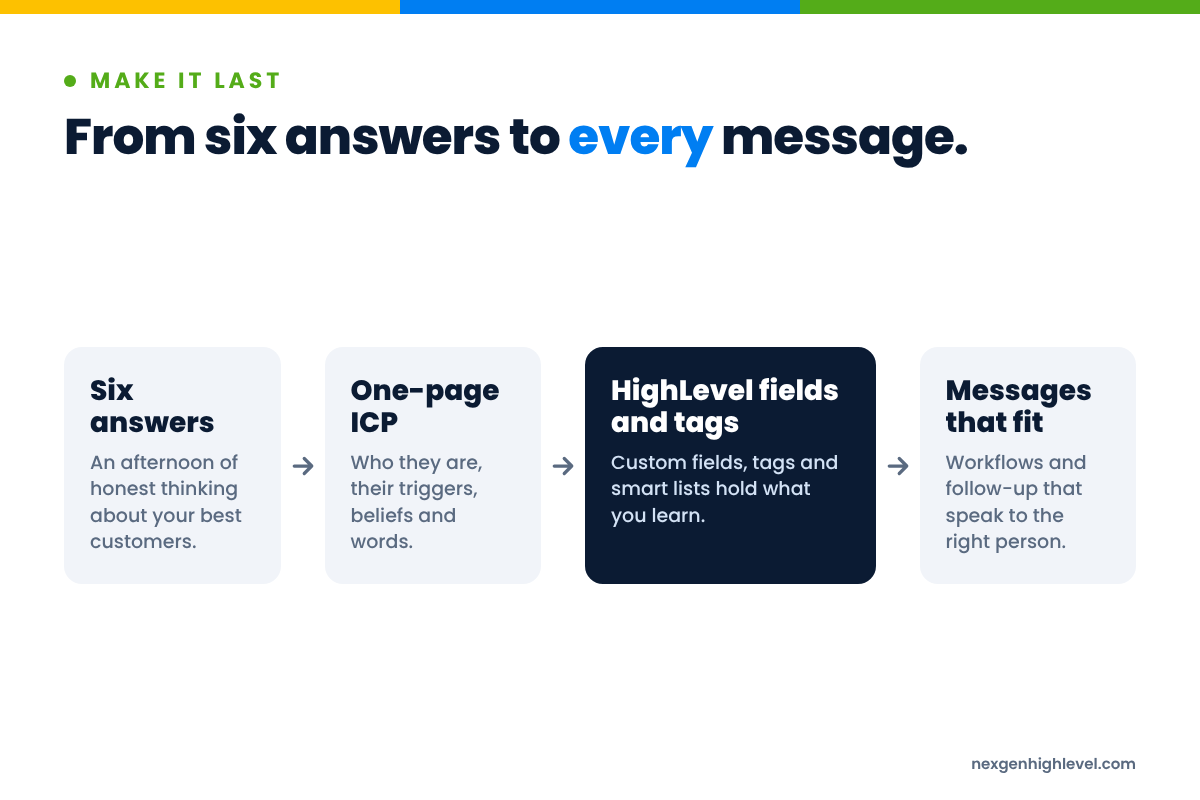
Write all of this down somewhere your whole business can use it. Not just in your head. Not in a notebook in your desk drawer. Not in a document nobody opens again.
In HighLevel, that means custom fields and tags that reflect the things that actually matter.
Picture a contact record that tells you:
- Buyer type: decision-maker, influencer, or champion (a custom field).
- Trigger: "new hire", "new location", "lost key staff" (tags).
- Service interest: which of your services they actually care about (a tag or custom field).
- Belief to address: "burnt by previous supplier", "thinks they're too small" (a custom field).
- Source: where they came from, so you know which LinkedIn activity is actually working.
A Workflow can send a different follow-up to someone tagged "burnt by previous supplier" than to someone who's never tried anything like you before. A smart list can show you every decision-maker in your best-fit industry who hit a trigger this month. Your email marketing can speak to the practice manager about the daily headache and to the owner about the decision. Opportunities in your pipeline can carry the same information, so whoever picks up the call knows who they're talking to.
When the knowledge lives in the system, every follow-up, every email and every Workflow can speak to the right person in the right way.
And this is where the order matters again. Human, Strategy, Leverage. HighLevel is serious leverage. But it's only as good as what you put underneath it. Tags with no thinking behind them are just labels. Tags built on a proper LinkedIn ideal customer profile are a way of remembering every customer like a good salesperson would.
If you're not on HighLevel yet, you can get a HighLevel account through NexGenHighLevel and set it up properly from day one.
One small warning. Don't create fifty custom fields on the first afternoon. That's the Tinkerer in all of us. Start with the five or six things that genuinely change what you'd say to someone. Add more only when you find yourself wishing you'd recorded something.
Simple isn't amateur. Simple is often what you arrive at once you understand something.
Narrow isn't small
The fear I always hear is, "If I focus that tightly, won't I miss out?"
No. You'll miss out on the people who were never going to buy, and you'll stop wasting energy on them.
My agency was niched in healthcare, mostly US private medical practices. Being that specific didn't make the world smaller. It made the conversations better. We knew the language. We knew the worries. We knew why a practice owner might be wary of yet another agency.
The same thing happens on LinkedIn. A clear, specific message to a clear, specific person beats a clever message to everybody.
A few things worth remembering about narrowing down:
- Narrow is a starting point, not a prison. You can widen later, once you're known for something. It's much harder to go the other way.
- Other people will still find you. Being specific doesn't stop anyone else buying. It just means your marketing isn't written for them.
- Referrals get easier. "She helps small accountancy practices" is easy to pass on. "She helps businesses grow" isn't.
Walk before you run. Get really good at reaching one type of customer on LinkedIn. Then, when you can see the green field stretching out in front of you, add the next.
Frequently asked questions
What is a LinkedIn ideal customer profile?
It's a clear description of the specific type of person and business you're best placed to help, written so you can find them, talk to them and follow up with them on LinkedIn. It goes beyond job title and industry. A good one includes their triggers, beliefs, the words they use and why they should care. If you can't describe them, you can't find them.
How is an ideal customer profile different from a buyer persona?
People use the terms loosely. I'd say an ideal customer profile describes the business and situation you want, while a persona describes the person inside it. On LinkedIn you need both, because you're always talking to a human, but that human works somewhere with a budget, a boss and a trigger. Don't get hung up on the labels. Get the answers.
How narrow should my LinkedIn target audience be?
Narrow enough that you could write a post and your ideal customer would think, "That's me." If your description fits half of LinkedIn, it's too wide. Start with your best existing customers and look for the pattern. You can always widen later, once you're known for something. Narrow isn't small. It's focused.
Can I have more than one ideal customer profile?
Yes, but be careful. Each one needs its own message, its own content and, ideally, its own follow-up. If you're starting out on LinkedIn, pick one and get good at it before adding a second. In HighLevel, tags and custom fields make it easy to keep different profiles apart so each one gets the right conversation.
How often should I update my ideal customer profile?
Revisit it every few months, or whenever something changes: a new service, a change in pricing, or a run of customers who don't fit. Look at who actually bought, who paid well and who you enjoyed working with. Your best customers will tell you if the profile is drifting. You just have to look.
Where should I keep my ideal customer profile once I've written it?
Somewhere your whole business uses every day. The one-page summary can live in a shared document, but the useful bits should live in HighLevel as custom fields and tags on every contact. That way your Workflows, emails and team all speak to the right person in the right way, without relying on anyone's memory.
Who exactly is this for?
LinkedIn isn't a megaphone. It's a room full of individual people, each with their own problems, triggers and beliefs. The businesses that do well on it aren't the loudest. They're the ones that know exactly who they're talking to, and talk to them like a human being.
Human first. Then strategy. Then leverage. In that order.
So before you write another post, send another connection request or build another Workflow, ask yourself one question.
Who exactly is this for?
If you can't describe them, you can't find them. And you certainly can't help them.