Your LinkedIn Profile Isn't a CV. It's Your Shopfront.
Imagine walking down a high street and seeing a shop with nothing in the window except the owner's employment history.
"2009 to 2014: Assistant Manager. 2014 to 2019: Manager. Skills: Leadership, Microsoft Excel."
You'd keep walking. You wouldn't even know what they sell.
And yet that's what most LinkedIn profiles for business owners look like. A tidy CV, written for a recruiter who isn't looking, sitting in front of customers who are.
I spent nearly 23 years in recruitment. I know exactly what a CV is for. It's a document designed to get one employer to give you one job. It does that well. It was never designed to make a stranger think, "This person understands my problem. I should talk to them."
That's a different job. It needs a different document.
So this article isn't a list of buttons to press. It's about how to think about your profile: who it's for, what it has to do, and why it quietly sits underneath everything else you'll ever do on LinkedIn.
Everything leads back to your LinkedIn profile
Here's what people miss. On LinkedIn, almost every action ends in the same place.
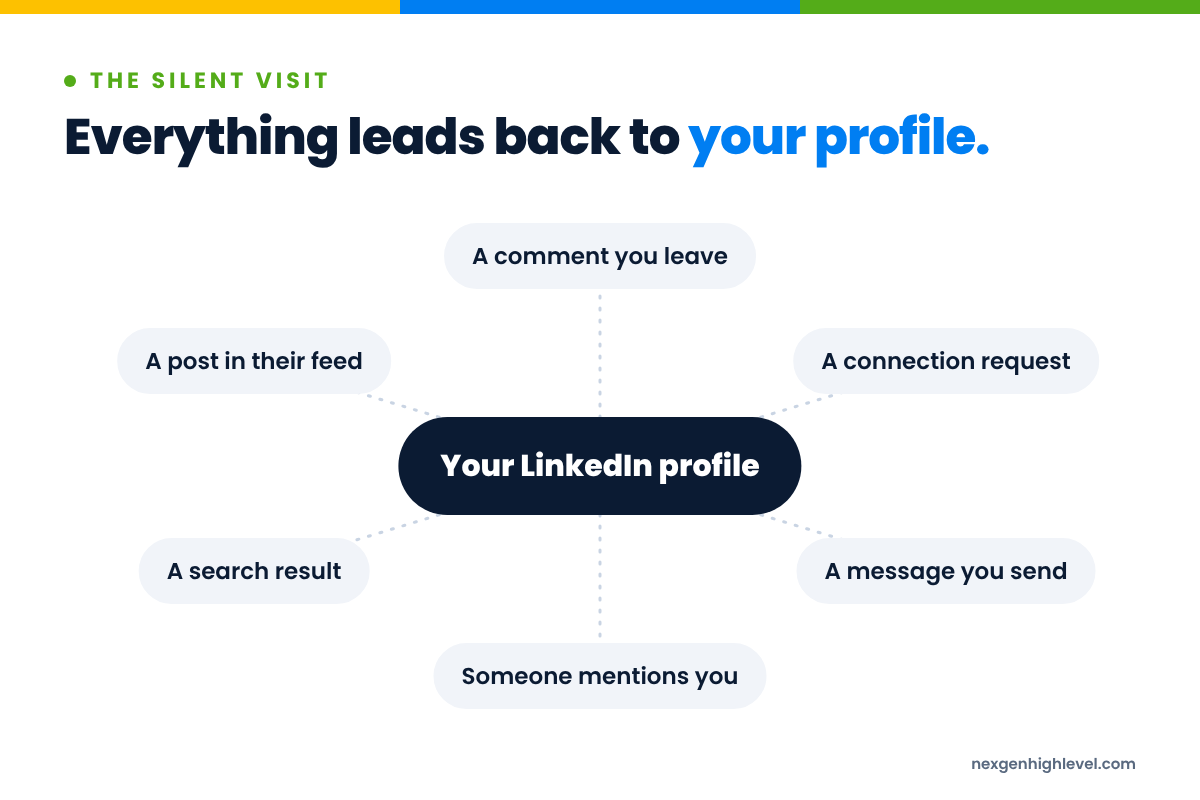
You leave a thoughtful comment on someone's post. If they're curious, they click your name.
You send a connection request. Before accepting, they look at your profile.
You send a message. Before replying, they check who you are.
Someone mentions you in a conversation, or a client recommends you to a friend. The first thing anyone does is look you up.
Your profile is the shopfront every one of those people walks past. In a few seconds, they decide whether to step inside or keep walking.
Think about what that means. You can write the best post of your life. You can send the most considered, personal message anyone has ever received. And all of it funnels through one page. If that page says "Managing Director, 15 years' experience, passionate about excellence", you've done the hard work of getting someone to the door, and then handed them a reason to leave.
It's not the post that wins the conversation. It's what they find when they click.
That's why I'd fix the profile before anything else. Before the content plan. Before the outreach. Before you spend a single hour working out what to post on a Tuesday. Everything you do on LinkedIn sends people back to it, so everything you do on LinkedIn is only as good as what they find there.
The silent visit: why buyers decide before they talk to you
Buyers do a huge amount of their homework before they ever speak to a seller. And on LinkedIn, a big part of that homework is your profile.
The 6sense 2024 B2B Buyer Experience Report found that 85% of buyers had mostly or fully defined their requirements before engaging sellers. 81% already had a preferred vendor by the time they made first contact. And that preferred vendor went on to win about 80% of the time.
Read that again, slowly.
Most of the decision is made before anyone picks up the phone. By the time somebody replies to your message or books a call, they've usually already got a favourite. The question is whether it's you.
So when someone quietly visits your profile, that visit might be the only chance you get to become the favourite. They won't tell you they looked. They won't send you feedback. They'll just quietly decide.
Back in my recruitment days, before email, before LinkedIn, before computers on desks, everything happened face to face. A telephone, a filing cabinet and a phone directory. You got a chance to make an impression in person, read the room, recover from a bad start.
You don't get that on LinkedIn. The impression is made before you know there's a room.
People still buy from people. They just meet you on a screen first now.
The questions a visitor is asking
When someone lands on your profile, they're not reading it like a CV. Nobody sits down with a cup of tea and works through your career history in order. They're scanning it for answers to a few very human questions.
- Who is this person?
- Do they understand people like me?
- Can they help with the thing I'm worried about?
- Can I trust them?
- Is it worth replying?
Notice what's not on that list. "How many years were they an assistant manager?"
Your job history isn't irrelevant. It's evidence. But evidence is supposed to back up a point, and most profiles never make the point.
"Who is this person?"
This one sounds easy. It isn't.
"Founder" isn't an answer. "CEO" isn't an answer. Half of LinkedIn is a founder or a CEO of something. The visitor wants to know who you are to them. What do you do, and who do you do it for?
If they can't answer that in the time it takes to glance at your headline, the rest of the questions don't get asked.
"Do they understand people like me?"
This is the big one, and the one most profiles skip completely.
People don't buy expertise in the abstract. They buy someone who seems to get their situation. The owner of a dental practice wants to feel you understand dental practices. The founder of a small software company wants to feel you've seen their kind of mess before.
You can only answer this question if you know who "people like me" actually are. That's why your profile can't be written before you've done the thinking about your LinkedIn ideal customer profile. If you're writing for everyone, the visitor won't recognise themselves anywhere on the page.
"Can they help with the thing I'm worried about?"
Notice the wording. Not "the thing they offer". The thing I'm worried about.
Visitors arrive with a problem in their head. Cash flow. Staff. Leads drying up. A system that's falling apart. A competitor who seems to be everywhere. They're looking for any sign that you deal with that problem.
If your profile talks only about your services, they have to do the translation themselves. Most won't bother.
"Is it worth replying?"
This is the question that decides whether your outreach works at all.
If you've sent someone a message, they'll almost always visit your profile before deciding whether to reply. That visit either backs up your message or quietly undermines it. A great message pointing to a weak profile feels like a pitch. A decent message pointing to a strong profile feels like a conversation worth having. I go into the message side of this in the article on LinkedIn outreach messages, but the short version is this: the message opens the door, the profile decides whether they walk through it.
CV thinking vs shopfront thinking
It's worth putting the two side by side, because most of us drift into CV thinking without noticing.
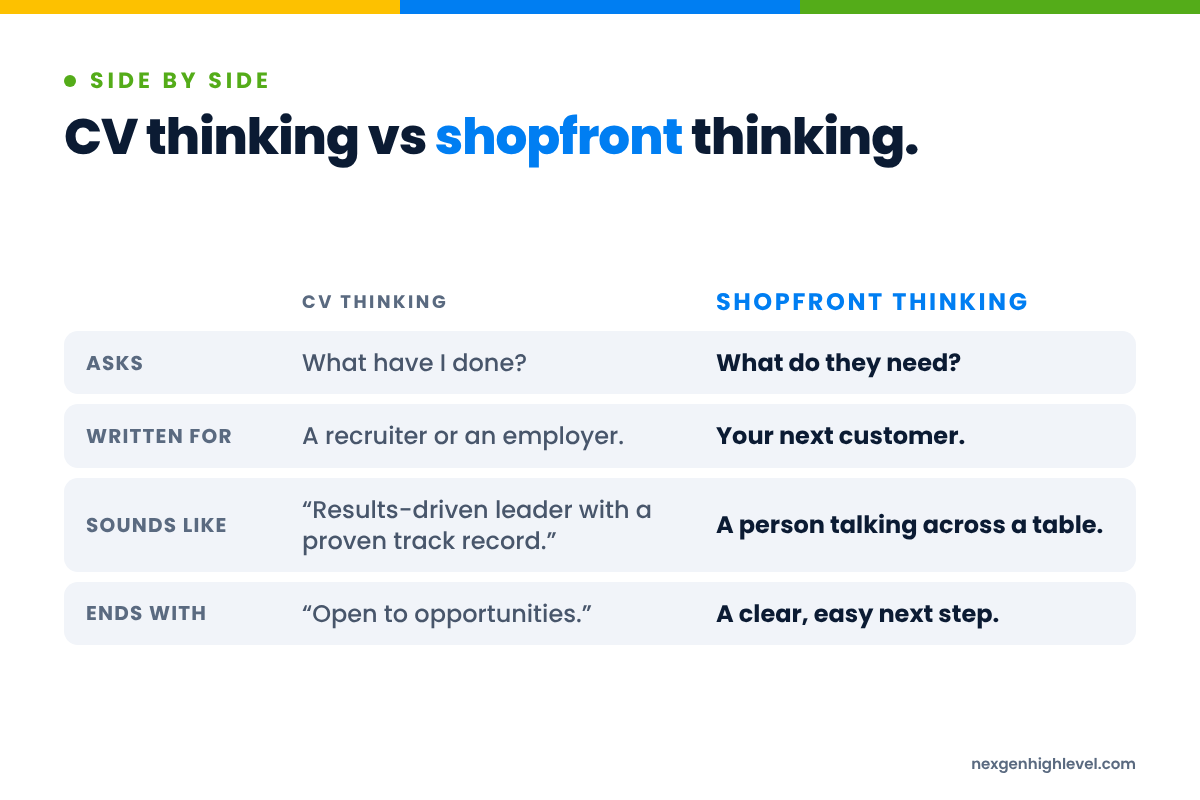
| CV thinking | Shopfront thinking | |
|---|---|---|
| Asks | What have I done? | What do they need? |
| Shows | Job titles, dates, responsibilities, qualifications. | The problem you solve, who you solve it for, how you think about it, and proof that it works. |
| Written for | A recruiter or an employer. | The person who could become your next customer. |
| Sounds like | "Results-driven leader with a proven track record." | A person talking across a table. |
| Ends with | "Open to opportunities." | A clear, easy next step. |
None of this means you have to delete your history. Your experience is part of the evidence. It just isn't the headline act any more.
It's not a record of your past. It's an invitation to their future.
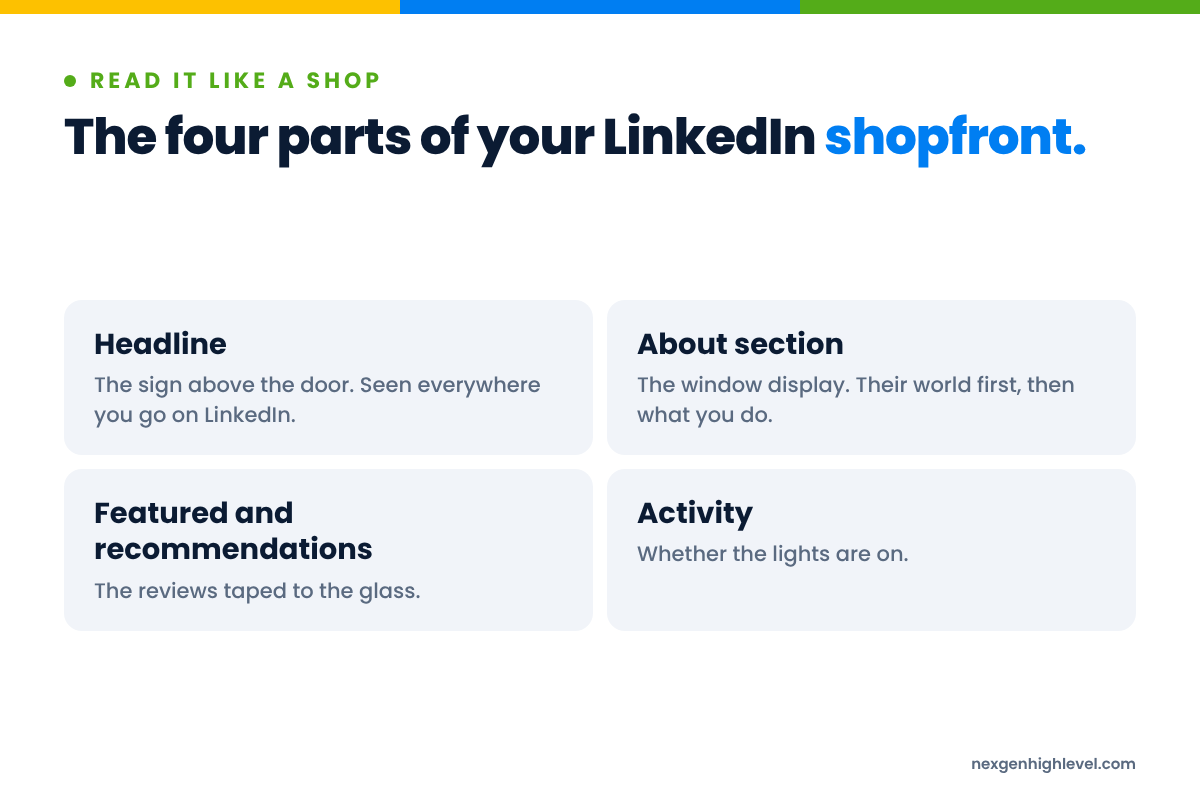
Your headline is the sign above the door
Your headline is the most seen line you'll ever write on LinkedIn. It's next to every comment you leave. It's in search results. It's at the top of every message. It follows you around the platform like a name badge.
"Managing Director at Smith & Co" tells me your title. It doesn't tell me why I should care.
Who do you help, and what changes for them? That's the headline.
Here are a few illustrative before-and-after examples. These are made-up businesses, purely to show the thinking, not real clients.
Example 1 (illustrative): an accountant
- Before: "Director at Clarke Accounting | ACCA | 20+ years' experience"
- After: "I help builders and trades businesses stop guessing about cash flow | Accountant | Director at Clarke Accounting"
Example 2 (illustrative): a marketing agency owner
- Before: "Founder & CEO | Digital Marketing Expert | Passionate about growth"
- After: "Helping private clinics turn enquiries into booked, paying patients | Founder, [Agency Name]"
Example 3 (illustrative): an IT support company
- Before: "Owner at TechServe Ltd"
- After: "IT support for law firms that can't afford a day of downtime | Owner, TechServe"
Notice what changed. The title didn't vanish. It just moved to the back. The front of the headline is now about the visitor: who they are and what they're worried about.
Notice what didn't happen too. Nobody became a "visionary". If you wouldn't say it across a table, don't put it above your door.
Specificity beats superlatives. Every time.
Your About section is the window display
If the headline is the sign, the About section is the window. It's where someone who's slightly interested decides whether to step inside.
Most About sections start like this: "I am a highly motivated professional with over 15 years of experience in…"
Start with their world, not yours.
What problem do your best customers have? What have they usually tried already? What do you believe about solving it? Then tell them, simply, what you do about it. Write it like you'd say it across a table, not like a brochure.
A simple shape for an About section
This isn't a template to copy word for word. It's a shape that keeps you honest.
- Their situation. Describe the problem the way your customer would describe it, in their words.
- What they've usually tried. Show you understand the journey so far. This is where people feel seen.
- What you believe. Your point of view on why it hasn't worked, or what actually matters.
- What you do. Simply. One or two sentences.
- Proof. A little of your background, results you're allowed to talk about, the kind of people you've worked with.
- The next step. What should someone do if this sounds like them?
An illustrative example
Here's an example for a made-up business, to show the shape. It isn't a real company or a real client.
Most dental practice owners I talk to aren't short of marketing. They're short of patients who actually turn up.
They've usually tried an agency or two. They've had months of "great leads" that never answered the phone, or booked and didn't show.
I don't think that's a lead problem. I think it's a follow-up problem. The gap between someone filling in a form and someone sitting in the chair is where most practices quietly lose money.
That's what we fix. We build the follow-up, reminders and booking process so more of the enquiries you already get become patients.
Before this, I spent ten years working inside dental practices, so I've seen the front desk on a Monday morning.
If that sounds familiar, send me a message. I'm happy to have a look at how your enquiries are handled now, no strings.
Notice how little of that is about the writer. It's about the reader's Monday morning. The background is there, but as evidence, not as the opening act.
And notice the tone. It doesn't shout. It doesn't promise to double anything. It sounds like a person.
The first few lines matter most
On LinkedIn, only the start of your About section shows before someone has to click to read more. So the first couple of lines do most of the work.
If those lines are "I am a results-driven professional", most people will never see the good bit underneath. Lead with the line that makes your ideal customer think, "That's me."
Featured, recommendations and activity: the reviews and the lights
Once someone's looked at the sign and the window, they're looking for reasons to trust you. Three parts of your profile do most of that work.
Your featured section and recommendations are the reviews taped to the glass
You know those shops with handwritten notes and newspaper cuttings taped to the window? "Best fish and chips in town." "Thanks for sorting our boiler on Christmas Eve."
That's what your featured section and recommendations are for.
Real words from real clients carry far more weight than anything you say about yourself. You can describe yourself as trustworthy all day long. One line from someone who paid you and was glad they did is worth more.
A few things worth thinking about:
- What would your ideal customer want to see first? A case study? A short video of you explaining how you think? A guide that solves one small part of their problem? Put that at the front.
- Are your recommendations from the right people? Five recommendations from former colleagues saying you're a great team player don't do much for a buyer. One from a customer describing the problem you solved does a lot.
- Does anything in there go stale? A featured post from three years ago about a product you don't sell any more is like a faded poster in the window.
Your featured section is also the one place on your profile where you can give someone a clear next step. A guide they can download. A page that explains how you work. A way to book a call. More on that shortly, because what happens after that click matters just as much.
Your activity is whether the lights are on
A profile that hasn't posted or commented in a year looks like a shop that's closed down. Nobody wants to knock on that door.
You don't have to post every day. You don't have to become a content creator. But a visitor should be able to see signs of life: a few recent posts, thoughtful comments on other people's posts, the odd share of something useful with your take on it.
Activity answers a question nobody asks out loud: "Is this person still in business, and are they paying attention?"
And it matters more on a personal profile than a company page. The Metricool and Favikon "LinkedIn in 2026" study found personal profiles had a 2.60% engagement rate, compared with 1.60% for company pages. People respond to people. I dig into what that means for your strategy in LinkedIn personal profile vs company page, but the short version is that your face and your thinking do more work than your logo.
Your thinking is your proof
There's a reason your posts and comments matter so much to your profile. It's not about being visible for the sake of it. It's about what they prove.
The 2024 Edelman-LinkedIn B2B Thought Leadership Impact Report, which surveyed around 3,500 management-level professionals, found that 73% of B2B buyers say thought leadership is a more trustworthy basis for judging a company's capabilities than its marketing materials.
Think about that. People trust what you think more than what you say about yourself.
The same report found that 52% of decision-makers spend an hour or more a week reading thought leadership. These people are busy. They're choosing to spend that hour reading how other people think.
So when someone visits your profile and sees a stream of useful ideas, honest lessons and clear opinions about their industry, that does more for your credibility than any amount of "passionate, results-driven professional". Nobody has ever been convinced by "results-driven".
"Thought leadership" sounds grander than it is
The phrase puts people off. It sounds like you need a TED talk and a book deal.
You don't. On a profile, thought leadership is just evidence that you've thought about your customer's problem more than they have. That's it.
It might be:
- A short post explaining the mistake you see your customers make most often, and why.
- An opinion on something in your industry that everyone accepts and you don't.
- A lesson from something that went wrong, told honestly.
- A comment on someone else's post that adds something rather than just "Great post!"
Every one of those tells a visitor something a CV never can: how you think.
Your thinking has to be yours
Here's the catch. It has to actually be your thinking.
Originality.ai looked at 3,368 long-form LinkedIn posts from 99 influential profiles in 2025 and estimated that 53.7% were likely AI-generated. And in June 2026, LinkedIn said that content that appears AI-generated and lacks a clear perspective is less likely to be distributed widely beyond the author's immediate network.
I use AI every day. I'm a big fan. But AI is only as good as the person using it. If your activity reads like everyone else's, it proves nothing about you. A visitor scrolling your posts is looking for a person with a point of view. Give them one.
What happens after the visit: where HighLevel fits behind the door
Here's where a lot of business owners stop thinking. They fix the shopfront, people start walking in, and then… nothing is behind the door.
Somebody likes what they see. They click the link in your featured section. They download your guide or book a call. And then the follow-up depends on you remembering, between everything else you're doing, to send an email on Thursday.
That's like a lovely shop window with nobody behind the counter.
This is where I think about the whole system, not just the profile. It goes back to how we ran the agency: we took responsibility for the whole journey from someone discovering a business to becoming a paying customer. Great ads still fail if the phone isn't answered. A great profile still fails if nobody follows up.
If you run your business on HighLevel, the profile is the front of the shop and HighLevel is everything behind the counter. For example:
- A booking link in your featured section can go to a HighLevel calendar, with confirmations and reminders going out automatically, so fewer people forget the call they booked.
- A guide or checklist in your featured section can sit behind a HighLevel form, so the person lands in your Contacts with a tag that tells you exactly where they came from.
- That tag can start a Workflow that sends a useful follow-up, adds them to a pipeline as an Opportunity, or reminds you to message them personally.
- Their replies land in Conversations, so you're not hunting through three inboxes to find who said what.
- Trigger links and reporting help you see which posts and which links actually send people through the door.
None of that replaces the human bit. You still need to be the person they wanted to talk to. But it means the effort you put into your shopfront doesn't leak out the back.
If you're not on HighLevel yet and want to set it up properly, you can get a HighLevel account through NexGenHighLevel and we'll help you get the foundations right.
It's the same principle I come back to again and again. Human, Strategy, Leverage. In that order. The profile is the human part, written for a real person. The strategy is knowing who you're for and what you want them to do next. HighLevel is the leverage that makes sure that next step actually happens.
Technology is leverage, not strategy. A brilliant HighLevel setup behind a profile that says "Managing Director, passionate about excellence" is just a very efficient way of following up with nobody.
Look at it like a stranger would: a LinkedIn profile audit
When we took on clients at the agency, we never started by changing things. We started with an audit: looking at what was there with fresh eyes, and finding what was holding them back. Confusing messages. Weak calls to action. Broken forms. Wrong business details.
Most of it was obvious once someone looked. The business owner just couldn't see it, because they walked past their own shopfront every day.
Your profile is the same. You've stopped seeing it.
The 30-second stranger test
Do this with your profile this week. Better still, ask someone who fits your ideal customer to look at it for 30 seconds and tell you three things:
- What do you do?
- Who do you do it for?
- Would they reply to a message from you?
If they can't answer the first two, your shopfront isn't doing its job. If they hesitate on the third, it's worth finding out why.
Don't argue with what they say. Don't explain what you meant. The visitors who matter won't have you standing next to them to explain either.
Questions to ask yourself
If you can't find a willing stranger, walk past your own shop with these questions:
- The sign: Does my headline say who I help and what changes for them, or just my job title?
- The window: Do the first two lines of my About section describe my customer's world, or mine?
- The reviews: Is there real proof from real customers, near the top, where someone will see it?
- The lights: Have I posted or commented anything useful in the last few weeks?
- The door: Is there one clear, easy next step for someone who's interested?
- Behind the counter: If someone takes that step today, what actually happens next? Who follows up, and when?
- The voice: Does it sound like me, or like a brochure that's swallowed a thesaurus?
Don't make it a six-month project
I'm a perfectionist. It's delightful for everyone who has to work with me. So I know the temptation to treat this as a grand rebrand that never quite gets finished.
Don't. Walk before you run. Fix the headline this week. Rewrite the first lines of your About section next week. Ask one happy customer for a recommendation. Pin one useful thing to your featured section.
Small changes to a page that everybody visits add up quickly. And you'll learn more from six weeks of a better profile than six months of planning a perfect one.
How your profile fits the rest of your LinkedIn strategy
Your profile isn't a standalone task. It's the foundation for everything else.
- Your ideal customer profile tells you who the shopfront is for.
- Your content gives people reasons to walk past it, and proof once they're inside.
- Your outreach messages invite specific people to come and have a look.
- Your choice between personal profile and company page decides who's standing in the window.
- And your follow-up in HighLevel decides whether interest turns into customers.
If you want to see what comes next once the shopfront is right, I've written about going out and creating the market with LinkedIn prospecting.
But it starts here. Every road on LinkedIn leads back to one page.
Frequently asked questions
What should a business owner put in their LinkedIn headline?
Say who you help and what changes for them, then add your title if you like. "Owner at TechServe" tells people your job. "IT support for law firms that can't afford a day of downtime" tells them why they should care. Your headline appears next to every comment, message and search result, so it's the most seen line you'll write on LinkedIn. Make it about the visitor, not your job description.
Should my LinkedIn profile be written in the first person?
Yes, in most cases. Your profile is you talking to a potential customer, so write it the way you'd speak across a table. Third person ("John is a seasoned professional…") feels like a press release and puts distance between you and the reader. First person feels like a conversation. People buy from people, and "I" sounds like a person.
How long should my LinkedIn About section be?
Long enough to answer the visitor's questions, short enough that every line earns its place. The first couple of lines matter most, because that's all people see before clicking to read more. Lead with your customer's problem, show you understand what they've tried, explain what you believe and what you do, add some proof, and end with a clear next step.
Does my job history still matter on LinkedIn?
It does, but as evidence, not as the headline act. Your experience backs up the point your headline and About section make. On its own, a list of job titles doesn't tell a buyer whether you can help with their problem. Keep your history, but make sure the top of your profile does the explaining first.
How often should I post to keep my LinkedIn profile looking active?
There's no magic number. What matters is that a visitor can see signs of life: some recent posts or thoughtful comments that show how you think. A profile with nothing in the last year looks like a shop that's closed down. A couple of useful posts a week, plus genuine comments on other people's posts, is plenty for most business owners. Consistency beats volume.
Can HighLevel help with my LinkedIn profile?
HighLevel won't write your profile for you, and it shouldn't. That part needs your thinking. Where HighLevel helps is behind the door: the calendar people book through, the form behind your guide, the tags and Workflows that follow up, and Conversations, where replies come in. Your profile gets people interested. HighLevel makes sure that interest doesn't get forgotten.
Open the door
Your LinkedIn profile is probably the most visited page you own. More than your website, quite possibly. Every comment, every connection request, every message and every recommendation sends people back to it.
So ask yourself the honest question. If a stranger who fits your ideal customer landed on it right now, what would they think?
Would they know what you do? Would they recognise their own problem? Would they trust you? Would they reply?
If the answer is "maybe", that's not a disaster. It's an opportunity sitting in plain sight. It costs nothing to fix, and it sits underneath every single thing you'll ever do on LinkedIn.
Stop writing for the recruiter who isn't looking. Start writing for the customer who is.
Nobody buys from a CV. They buy from someone who clearly understands their problem.