LinkedIn Personal Profile vs Company Page: Who Gets Heard
I'll start with the slightly uncomfortable news, and then I'll tell you why it's actually good news.
If you've been weighing up your LinkedIn personal profile vs company page, wondering which one deserves your time, here's my honest answer. Your company page is not your marketing channel. Not for organic reach, anyway.
You are.
That's not me being romantic about personal brands. It's what the numbers say, it's what buyers say, and if you think about how you choose suppliers yourself, it's what you already know.
So let's talk about why, what it means for you as a business owner, and how to actually show up as yourself without turning into one of those people who posts sunrise photos with a lesson about resilience underneath.
LinkedIn personal profile vs company page: what the numbers say
Let's get the evidence out of the way first, because I don't want you taking my word for it.
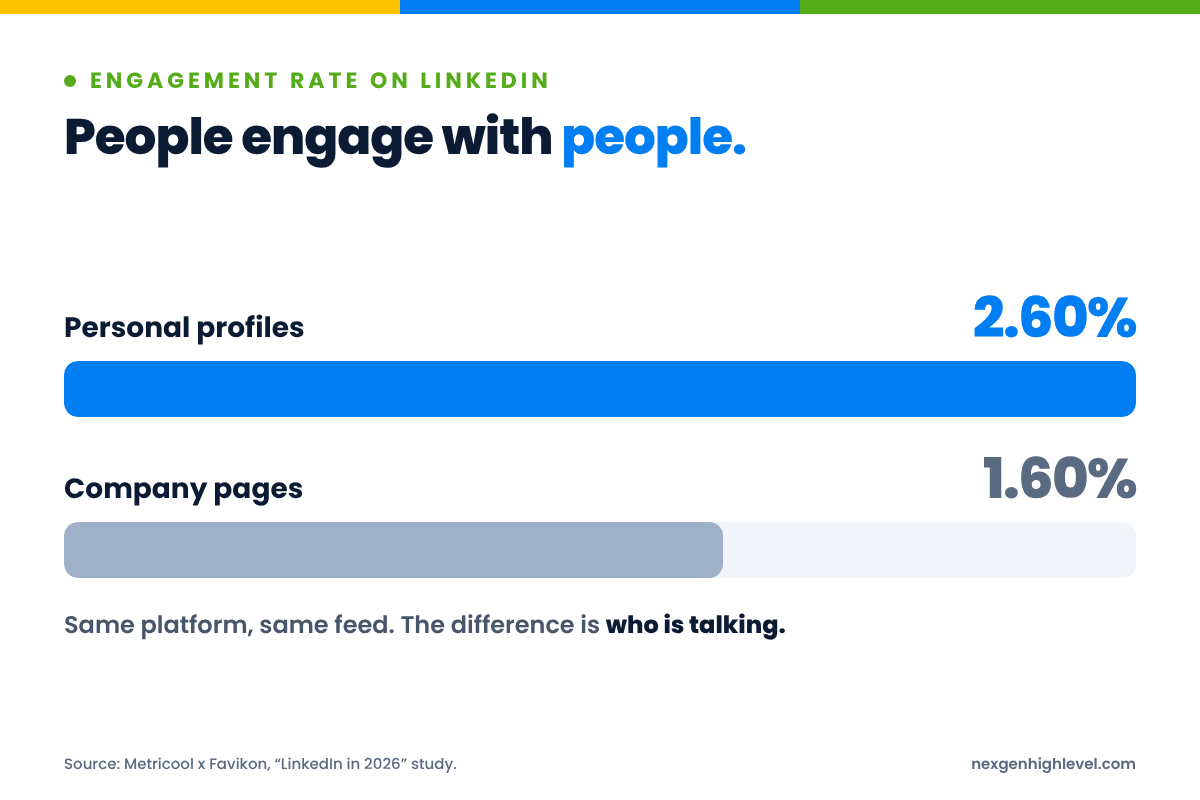
A 2026 study by Metricool and Favikon, looking at LinkedIn activity, found that personal profiles had an engagement rate of 2.60% compared with 1.60% for company pages.
That's a gap of a full percentage point. Put it another way: on those figures, a post from a person gets around 60% more engagement, relative to its audience, than a post from a page.
Same platform. Same feed. Same people scrolling it. The only difference is whether there's a face or a logo at the top.
Now, I'm not going to pretend one study settles everything. Engagement varies by industry, by audience, by how good the post is. A brilliant company page post will beat a lazy personal one every day of the week.
But the direction is clear, and it matches what anyone who's spent time on LinkedIn has seen with their own eyes.
In plain English: LinkedIn shows people what people say. It doesn't care much what logos say.
And honestly? Neither do your customers.
Why the gap exists
Think about why you open LinkedIn in the first place.
You're not there to read brochures. You're there to see what people you know are up to, what they think, what's going on in your world. LinkedIn has more than 1 billion members in more than 200 countries and territories, and the overwhelming majority of them are there as individuals, not as brands.
A company page post feels like an advert, even when it isn't one. Our brains have spent decades learning to skip adverts. We're very good at it.
A post from a person feels like a conversation. And people lean into conversations.
It's not a content problem. It's a trust problem.
People buy from people. LinkedIn just made it official.
Think about the last time you chose a supplier you really trusted. An accountant, a solicitor, a builder, a consultant.
Did you choose them because of their logo? Or because of a conversation with a person who clearly knew what they were talking about?
It's the person. It nearly always is.
I spent nearly 23 years in recruitment. When I started, there was no LinkedIn, no email and no CRM. There weren't even computers on the desks. There was a telephone, a filing cabinet and a phone directory. Every deal was done face to face.
Nobody ever placed a candidate because they liked our letterhead.
They placed candidates with us because they trusted the person on the other end of the phone. Because that person had been useful before. Because they'd given good advice, told the truth when it was awkward, and remembered the detail that mattered.
The tools have changed beyond recognition since then. The psychology hasn't changed at all. People buy from people.
LinkedIn didn't invent that. It just built a platform that rewards it.
What buyers actually say they read
Here's the part that should give every business owner a bit of confidence.
The 2024 Edelman-LinkedIn B2B Thought Leadership Impact Report, which surveyed around 3,500 management-level professionals, found that 52% of decision-makers and 54% of C-suite executives spend an hour or more a week reading thought leadership.
Read that again. More than half of the people who sign off on buying decisions are spending an hour a week reading what experts think.
The same report found that 73% of B2B buyers say thought leadership is a more trustworthy basis for judging a company's capabilities than its marketing materials.
So buyers are reading. They want to hear from people who know their stuff.
They're just not interested in press releases.
And "thought leadership" sounds grander than it is. It doesn't mean a 4,000-word white paper with footnotes. It means a person who knows their trade explaining something useful, with an opinion attached. You can do that. You've probably done it on a sales call this week without thinking twice.
The good news: you have something no marketing department can buy
So here's why the uncomfortable news is actually good news.
Big companies have budgets. They have brand teams, agencies, design guidelines and approval processes that take three weeks to sign off a post about a charity bake sale.
What they mostly can't do is sound like a human being.
As a business owner, you have something no corporate marketing department can buy. You. Your experience, your opinions, your scars, the things you've learned the hard way.
That's exactly what LinkedIn rewards. And it's exactly what buyers are looking for.
You don't need a bigger budget than your competitors. You need a voice they don't have.
The timing matters more than you think
There's another reason this matters, and it's about when people buy.
Professor John Dawes of the Ehrenberg-Bass Institute, in work published by LinkedIn's B2B Institute, estimated that only around 5% of B2B buyers are in market in a given quarter. The other 95% aren't.
That means most of the people reading your posts today aren't ready to buy today. And that's fine.
Because when they are ready, they don't start from scratch. The 6sense 2024 B2B Buyer Experience Report found that 81% of buyers already had a preferred vendor when they first made contact, and that preferred vendor won about 80% of the time.
So the real question isn't "Will this post get me a client this week?"
It's "When someone in my world is finally ready to buy, will my name already be in their head?"
A company page rarely gets you there. A person they've been quietly reading for six months very often does.
"But I'm not a content creator"
I hear this all the time, and I understand it completely.
When I ran my marketing agency, most of our clients were private medical practices in the US, with some in the UK. The agency was strong technically: ads, funnels, follow-up, CRM, the lot. We built whole systems, not just campaigns.
But we kept hitting the same wall. Content.
We'd ask doctors, clinicians and practice owners for videos and photos. We'd get nothing. Or two stock photos and a 14-second video filmed from what looked like six miles away.
It would have been easy to blame them. Plenty of people did.
But these were accomplished, confident people. They made difficult decisions every day. They just hadn't gone into healthcare to become content creators. And when you put a camera in front of them, they froze.
So we built them a little app with prompts, to take away the blank page and the fear of the camera.
And it worked.
But the lesson wasn't about the app. We weren't really solving a content-production problem. We were solving a human-friction problem.
That's stayed with me ever since. Because it's the same thing I see with business owners on LinkedIn.
It's not that you've nothing to say
If posting on LinkedIn feels awkward, that's not because you've nothing to say.
You've got years of experience. You've seen what works and what doesn't. You've had the same conversation with customers a hundred times. You have opinions about your industry that you share freely over a coffee or a pint.
The problem is the gap between knowing something and putting it in public with your name on it.
The blank page. The worry about what people will think. The voice in your head saying "Who am I to post about this?"
That's friction. And friction is a human problem, not a content problem.
So instead of telling you to "be more consistent" or "post more value", let's make the first step easy.
What to actually talk about on LinkedIn
You don't need to be clever. You need to be useful, and you need to be you.
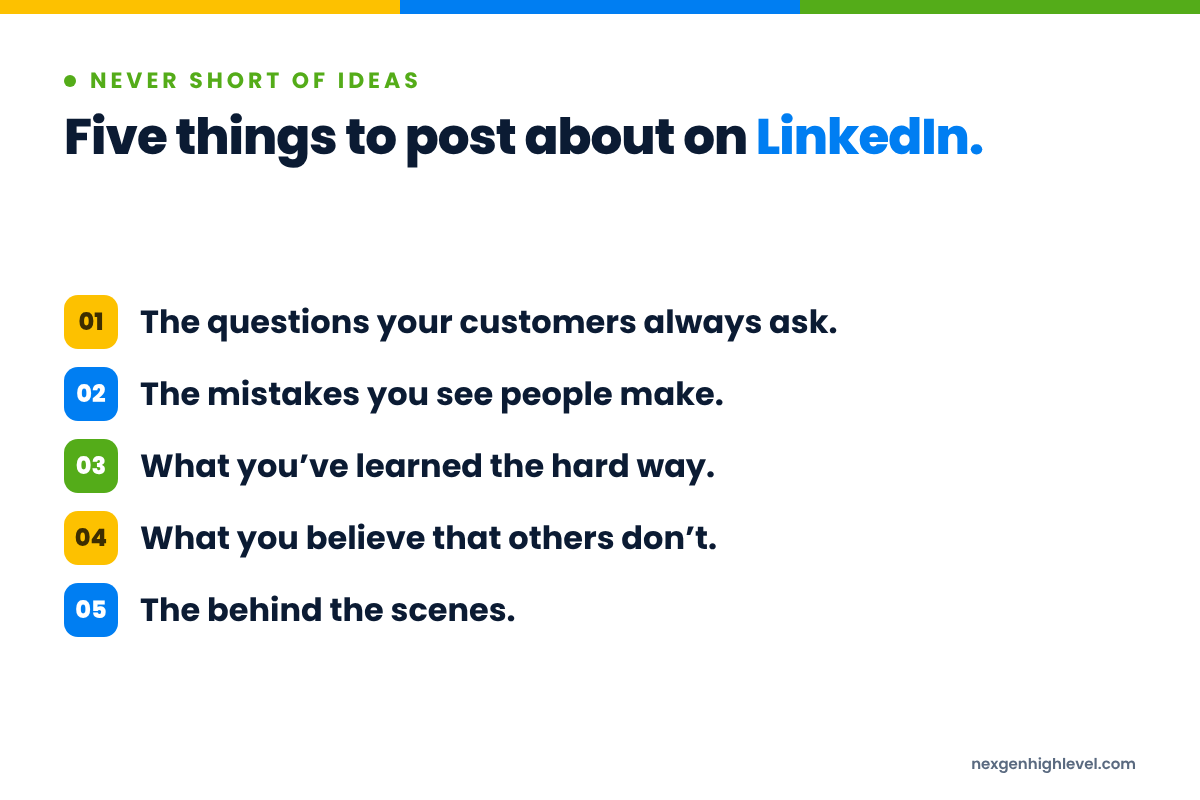
Here are the five things I'd start with. Between them, they'll give you more ideas than you'll ever have time to post.
1. The questions your customers always ask
If you've answered it on a call ten times, write it down once. That's a post.
Every business has these. The question every new enquiry asks. The thing people always misunderstand. The worry that comes up just before someone signs.
Start a list. Literally, a note on your phone. Every time a customer asks you something, jot it down. Within a month you'll have more posts than weeks in the year.
And here's the clever bit (it isn't actually clever, it's just obvious once you see it). If one customer asked, hundreds of people who aren't customers yet are wondering the same thing. Answering it publicly means you've already started the conversation before they've picked up the phone.
Ask yourself: what do I explain so often I could do it in my sleep?
2. The mistakes you see people make
Not to mock anyone. To help them avoid it.
You'll see people in your industry, or your customers' industries, make the same mistakes again and again. Buying the wrong thing. Doing things in the wrong order. Paying for something they don't need.
Write about those. Gently. Without naming anyone, and without making anyone feel stupid.
People remember who saved them from a mistake. They remember it a lot longer than they remember who sold them something.
There's a line here, mind you. "Here's a common mistake and how to avoid it" builds trust. "Look how stupid everyone else is" builds nothing except a reputation for being difficult. Nobody wants to hire the person who sneers.
Ask yourself: what do I wish every customer knew before they came to me?
3. What you've learned the hard way
Your failures are more useful to your audience than your wins. And they're far more believable.
Anyone can post a win. Wins are easy to fake, easy to exaggerate and, frankly, a bit boring after the third one.
A failure, honestly told, does something different. It tells the reader you've been where they are. It tells them you're not pretending. And it gives them something they can actually use.
I'll give you one of mine. I grew my recruitment business aggressively, with heavy overheads, and never imagined the world could just stop. Then Covid arrived. Furlough covered salaries, but not the rent, property taxes, leases or software licences, and no supplier cut us a break. I had to close the business and make good people redundant. It's the hardest business decision I've ever made.
What did I learn? Walk before you run. And even when you're ready to run, keep walking for a little bit longer.
That's not a lesson I'd ever have believed from someone else's success story. I believed it because I lived it. And it's exactly the kind of thing that makes someone stop scrolling and think, "Fair enough. He's not just selling."
You don't need a story that big. A pricing mistake, a hire that didn't work, a client you shouldn't have taken on. Small, honest and useful beats big and polished.
Ask yourself: what would I tell my younger self, five years into this business?
4. What you believe that others don't
An opinion, honestly argued, gives people something to agree or disagree with. Both are good.
Most business content on LinkedIn is beige. It's so careful not to offend anyone that it doesn't say anything at all.
You have opinions about your industry. About how things should be done. About what people get wrong. Some of them probably go against what most of your competitors say.
Those are your best posts.
Not because controversy is good for its own sake. It isn't, and I'd steer well clear of politics, religion and whatever the internet is angry about this week. But because a clear point of view tells people who you are and how you think. It lets the right customers find you and the wrong ones quietly move along.
Here's a simple test. If nobody could possibly disagree with your post, it probably isn't saying much.
Ask yourself: what do I believe about my industry that I'd happily argue about over dinner?
5. The behind the scenes
How you actually do the work. People trust what they can see.
This is the one most business owners overlook, because their own process feels ordinary to them. You do it every day. Why would anyone care?
They care because it's not ordinary to them. How you onboard a new customer. What you check before you quote. How you handle it when something goes wrong. The tools you use and why. What a normal Tuesday looks like.
Showing your process does two things. It proves you know what you're doing. And it makes the decision to work with you feel less risky, because the buyer can already picture what happens next.
The unknown is scary. The known is reassuring. Every behind-the-scenes post shrinks the unknown a little.
Ask yourself: what part of my work would surprise a customer if they saw it?
How to write it
Write it like you'd say it to a client over a coffee.
Short sentences. Your words, not marketing words. If you'd never say "leveraging synergies" out loud, don't post it.
Start with the point, not the warm-up. Nobody needs three sentences about how you've been thinking a lot lately.
And don't worry about it being perfect. Perfect is often what makes it sound fake. I say that as a recovering perfectionist, which my colleagues will tell you is delightful for everyone who has to work with me.
The reaction test: is this worth posting?
Before you hit publish, ask yourself whether the post would get one of three reactions.
- "I didn't know that."
- "I hadn't thought about it like that."
- "Right, I'm going to do something about this."
If it gets none of them, it's probably not worth posting.
That's the whole test. It's simple on purpose.
The first reaction is about information. You've told someone something useful they didn't know.
The second is about perspective. They knew the facts, but you've shown them a different way to look at them.
The third is about action. You've given them the push, or the confidence, to actually do something.
Notice what's not on that list. "Wow, he's doing well." "Lovely photo." "Congratulations on the award." Those reactions are fine, but they don't build trust and they don't make anyone think of you when they need help.
Run every post through the test. It'll save you from a lot of filler, and it'll make the posts you do publish better.
A word on AI and your voice
You might be thinking, "Can't I just get AI to write all this for me?"
You can use it. I use AI every day. It speeds things up, helps me get past the blank page and catches things I miss.
But AI is only as good as the person using it. If you hand it your whole voice, you end up sounding like everyone else who did the same. And the entire point of posting as yourself is that you don't sound like everyone else.
Use it to help you think, structure and tidy up. Don't use it to replace the bit that makes people listen: your experience and your opinion. I've written more about this in how to use AI on LinkedIn without losing the human bit.
Make LinkedIn a habit, not a heroic effort
The people who do well on LinkedIn aren't the most talented writers. They're the most consistent ones.
Consistency beats brilliance, because trust is built through repetition. Someone sees your name once and forgets it. They see it every week for three months, saying useful things, and you've become "the person who knows about that".
The problem is that most business owners treat content as a heroic effort. They have a burst of enthusiasm, post every day for a fortnight, run out of steam and disappear for four months.
That's the Rusher in action. Get to market fast, then run out of road.
A better approach is to make it boring. Boring is sustainable.
One idea, several ways
Create one idea and use it several ways.
A post this week can become a short video next week, an email to your list, and part of a talk later in the year. The same thought, in different shapes, for different moments.
You don't need fifty ideas a month. You need four good ones, used well.
And here's the thing people forget. Your audience doesn't see everything you post. Most people will miss most of it. Saying the same important thing three different ways isn't repeating yourself. It's making sure it actually lands.
Use HighLevel to take the friction out
If you use HighLevel, the Social Planner lets you schedule your posts in a calm hour on a Monday, rather than scrambling for something to say every morning.
That one change makes a real difference to how it feels.
Sit down once a week. Look at your list of customer questions, mistakes, lessons, opinions and behind-the-scenes moments. Write two or three posts. Schedule them in the HighLevel Social Planner. Then get on with running your business.
No daily panic. No staring at a blank box at 7am wondering what to say.
And because it's in HighLevel, it sits alongside everything else in your business: your Contacts, your Conversations, your pipelines. When a post starts a conversation and someone gets in touch, you're not juggling five different tools to keep track of it. If you're not on HighLevel yet, you can get a HighLevel account through NexGenHighLevel.
This is exactly what I mean by human friction. The hard part of posting was never the posting. It was the deciding, the blank page and the daily pressure. Take those away and the habit takes care of itself.
Don't forget the conversation after the post
A post isn't the finish line. It's the start of a conversation.
When someone comments, reply properly. Not "Thanks!" but an actual response, the way you would if they'd said it to you in person.
When the same people keep turning up, notice that. They're telling you something. And when a conversation moves into a message or an enquiry, make sure it lands somewhere it won't be forgotten. Your HighLevel Contacts and Conversations are the place for that, so nothing falls through the gaps between LinkedIn and the rest of your business.
If you want to know whether all of this is actually working, rather than just feeling busy, I've written about how to measure LinkedIn ROI without getting lost in vanity numbers.
So what is the LinkedIn company page actually for?
Don't abandon your company page. It still matters, just for different reasons.
It's not where the conversation happens. But it does three jobs well.
Credibility
When someone reads your post and wants to know more, they'll often click through to your business. If they find an empty page with a logo from 2017 and no posts since the Christmas party, that's a bit of a let-down.
A tidy, up-to-date company page tells them you're a real business that takes itself seriously. It's the shop front, not the sales conversation. But a scruffy shop front still puts people off.
Ads
If you ever run LinkedIn ads, they run from a company page. So it needs to exist, it needs to look professional, and it helps if it has some activity on it.
Think of it as the foundation the paid side is built on.
Hiring
When people consider working for you, they look at your company page. They want to see what you do, what you care about and who else works there.
If you're growing a team, that page is part of how you attract good people. It's worth looking after.
The simple split
So here's how I'd think about it.
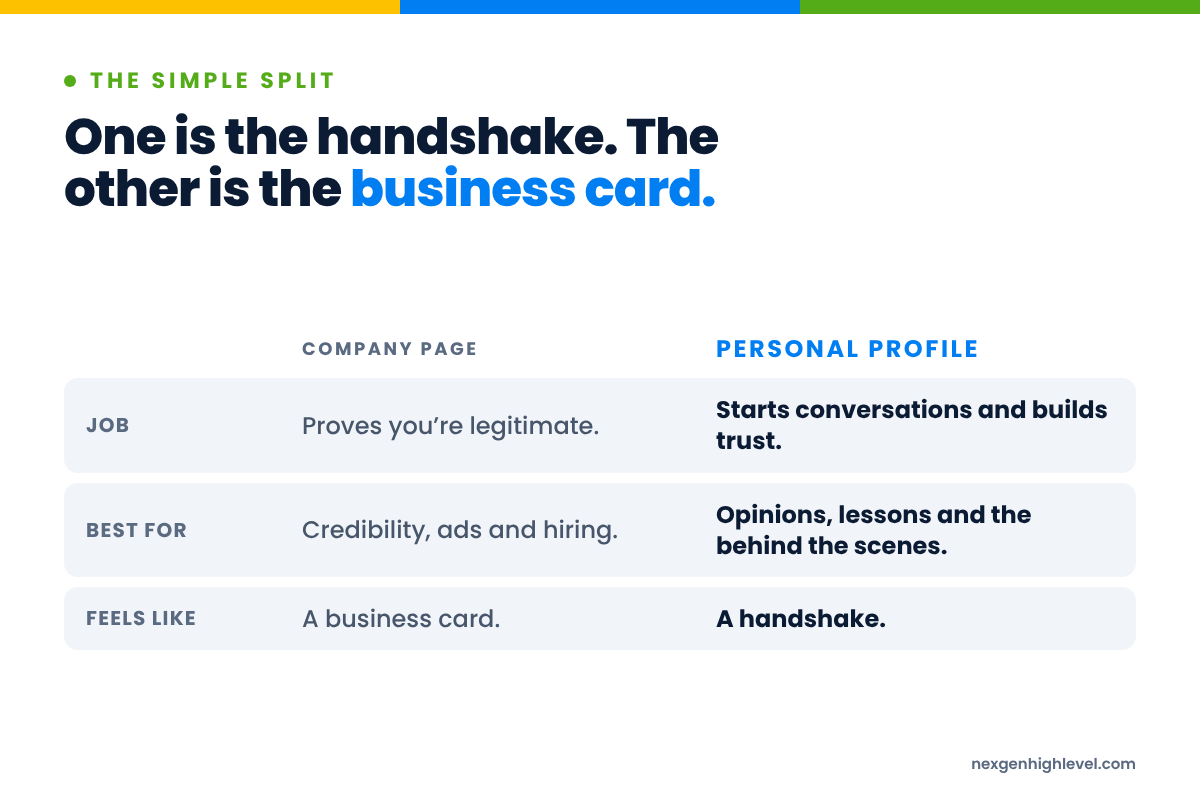
Your personal profile is where you start conversations and build trust. Your company page is where people go to check you're legitimate.
One is the handshake. The other is the business card.
You want both. But only one of them has ever made a friend.
And if your personal profile is going to be doing the heavy lifting, it's worth making sure it's set up properly. I've covered that in detail in the LinkedIn profile for business owners, including what your headline and About section should actually say.
A few questions to sit with
Before you go and write anything, it's worth spending ten minutes on these. Be honest with yourself.
- If a potential customer looked at my LinkedIn profile today, what would they learn about how I think?
- What have I been posting on the company page that would land better coming from me?
- What's the one thing I know about my industry that most of my customers don't?
- What's actually stopping me posting: time, confidence, or not knowing what to say?
- If I posted once a week for the next six months, what would I want people to know me for?
That last one is the important one. You don't need to be known for everything. You need to be known for something.
Human, strategy, leverage. In that order. Understand who you're talking to, decide what you want to be known for, and only then use tools like HighLevel to make it easy and consistent.
Frequently asked questions
Should I post on my LinkedIn personal profile or my company page?
Both, but not equally. Your personal profile is where reach, trust and conversations happen. The Metricool and Favikon 2026 study found personal profiles had a 2.60% engagement rate against 1.60% for company pages. Post your opinions, lessons and expertise as yourself. Use the company page for credibility, ads and hiring, and share the best of your personal content there too.
Is a LinkedIn company page still worth having?
Yes. It just has a different job. People check it to see you're a real business, LinkedIn ads run from it, and potential employees look at it before applying. Keep it tidy, up to date and active. Just don't expect it to start conversations on its own. That's your job, as a person.
How often should a business owner post on LinkedIn?
Often enough to be consistent, rarely enough that you can keep it up. For most business owners, two or three good posts a week is plenty. Once a week is far better than daily for a fortnight followed by silence. Batch them in one sitting and schedule them, for example with the HighLevel Social Planner, so it doesn't eat into every day.
What should I post on LinkedIn if I'm not a natural writer?
Start with what you already say out loud. The questions customers ask you, the mistakes you see, the lessons you've learned the hard way, your honest opinions, and how you actually do the work. Write it the way you'd explain it over a coffee. Short sentences, plain words. You don't need to be a writer. You need to be useful.
Can I use AI to write my LinkedIn posts?
You can use AI to help, but don't let it replace your voice. It's great for getting past the blank page, structuring ideas and tidying up. But people follow you for your experience and your opinions, and AI doesn't have either. Use it to speed you up. Keep the thinking, the stories and the point of view your own.
Can I schedule LinkedIn posts from HighLevel?
Yes. HighLevel's Social Planner lets you plan and schedule posts in advance, so you can sit down once a week, write a few posts and get back to running your business. It's one of the simplest ways to turn posting from a daily scramble into a calm weekly habit, alongside the rest of your marketing in HighLevel.
The conversation happens where people are
Here's where I'll leave you.
Your company page is a shop front. It's useful. Keep it tidy.
But nobody ever walked past a shop front and felt they knew the owner. Trust comes from hearing someone think out loud, week after week, until one day you need what they do and their name is the first one that comes to mind.
That's not a marketing trick. It's how people have always chosen who to work with. LinkedIn just gives you a way to do it at a scale my old phone directory could only dream about.
So be there, as yourself. Say useful things. Have an opinion. Make it a habit.
Your logo has never been in a sales meeting. You have.