LinkedIn Isn't a Social Network. It's the Room.
When I started in recruitment in the 1990s, I had a telephone, a filing cabinet and a phone directory.
That was it. No LinkedIn. No email. No CRM. Not even a computer on the desk.
This article is the start of a series on LinkedIn marketing for business owners, and I want to begin there, with the phone and the filing cabinet, because it explains everything I believe about LinkedIn.
If I wanted to speak to a managing director, I had to get past a receptionist who was very good at her job. If I wanted to meet people in a particular industry, I went to the events, stood in the room with a warm glass of wine, and introduced myself. Then I followed up. Then I followed up again.
It was slow. It was hard. And I loved it.
The skill wasn't the phone. The skill was understanding people: who they were, what was keeping them up at night, and whether I could actually help.
So when I look at LinkedIn today, I don't see a social network. I see the room. The biggest business networking room that has ever existed.
And most business owners are standing in the corner, looking at their phones.
The LinkedIn room is enormous
LinkedIn has more than 1 billion members in more than 200 countries and territories.
Think about what that means for a second.
Now picture the managing director you'd love to work with. The one you'd have spent weeks trying to reach back then.
She's probably on there. So is her operations director. So is the person who'll replace her in two years. And they're not hiding behind a switchboard. They're posting about their week, commenting on industry news, sharing what went wrong on a project, and telling you, in public, what they care about.
The receptionist has left the building.
That's the bit I don't think people fully appreciate. It isn't just that the people are there. It's that they're telling you things. What they're hiring for. What they're frustrated by. Which conference they've just come back from. What they think about the latest change in their industry.
In recruitment, I'd have spent days on the phone trying to piece that together. It's now sitting there for anyone willing to pay attention.
A room, not a stage
Here's the distinction that matters.
A stage is somewhere you stand and broadcast.
A room is somewhere you mingle. You move around. You listen more than you talk. You find the two or three conversations that are worth having, and you have them properly.
Most LinkedIn advice treats it as a stage. Post more. Go viral. Grow your followers.
There's nothing wrong with posting. I'll get to that. But if you think of LinkedIn as a stage first, you'll measure the wrong things. Likes. Impressions. Follower counts.
If you think of it as a room, you measure what actually matters. Who did I meet? Who do I now know a bit better? Which conversations are moving forward?
It's not a stage. It's a room.
Why LinkedIn marketing isn't working for most business owners
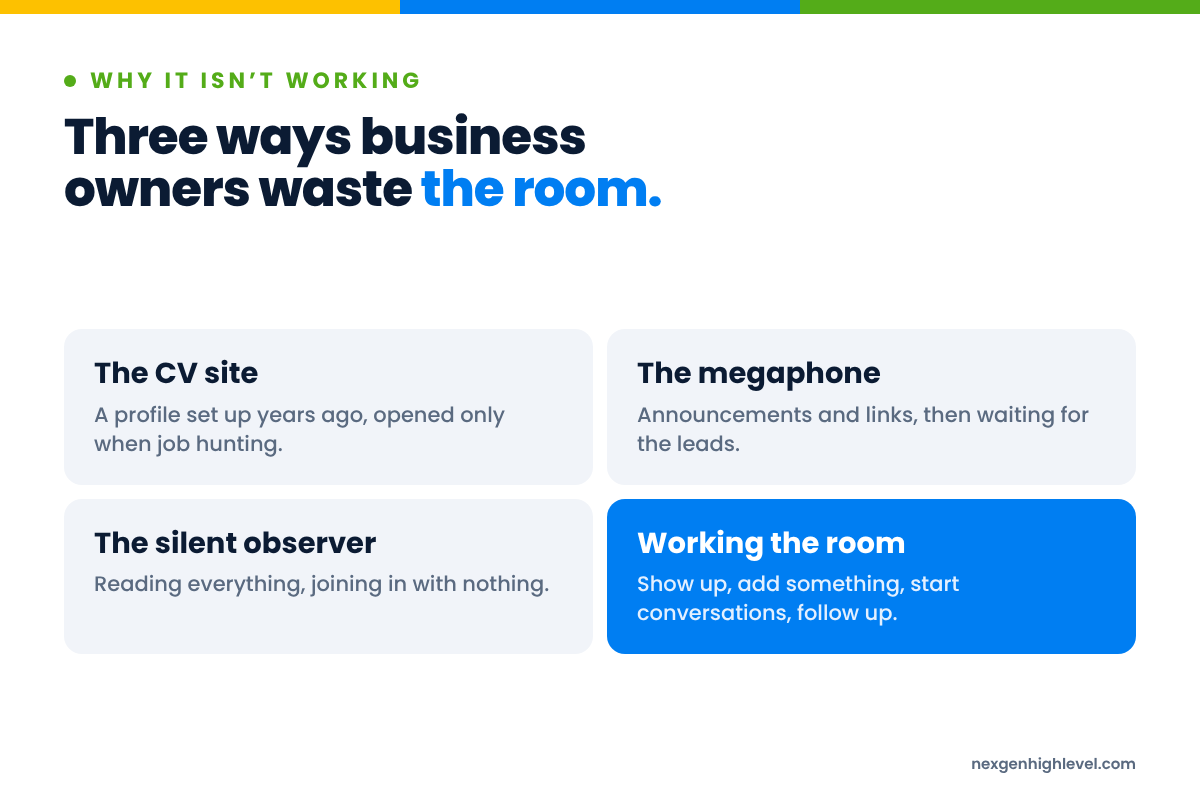
Because most people treat LinkedIn like one of three things.
The CV site
The first is a CV site. They set up a profile years ago, list their job history, and log in when they're looking for work, or when someone they used to work with has a new job and they get a notification.
That's not a marketing channel. That's a filing cabinet. And I should know. I had one.
A profile like that tells the room one thing: this person is either looking for a job or not really here. Neither of those makes anybody want to start a conversation with you about your business.
The megaphone
The second is a megaphone. They post the company announcement, share the blog link, and wait for the leads.
Or worse, they connect with as many strangers as LinkedIn will allow and send each of them a pitch before the ink is dry on the connection.
You know the message. You've probably had three this week.
"Hi, thanks for connecting. We help businesses like yours grow revenue with our proven system. Do you have 15 minutes on Thursday?"
They've never read a word you've written. And they want 15 minutes of your Thursday.
The silent observer
The third, and this is the biggest group, is the observer. They scroll. They read. They might even like a few posts. But they never say anything, never start anything, never follow anything up.
They're in the room. They're just leaning against the wall.
And honestly? I understand it. Putting yourself out there is uncomfortable. Plenty of very capable business owners would rather do almost anything than write a post about themselves. Back in my agency days we saw exactly the same thing with doctors and clinicians who froze the moment a camera was pointed at them.
Would you do any of this at a real event?
Would you walk in, hand everyone a brochure, and leave?
Would you grab someone's hand and, before they'd told you their name, start explaining your pricing?
Would you stand in the corner all night, then go home and wonder why you didn't get any business out of it?
Of course not. You'd be the person everyone quietly avoids at the buffet. Or the person nobody remembers was there.
And yet that's exactly how a lot of LinkedIn "marketing" behaves.
Most of the room isn't buying today
Here's something that changed how I think about all of this.
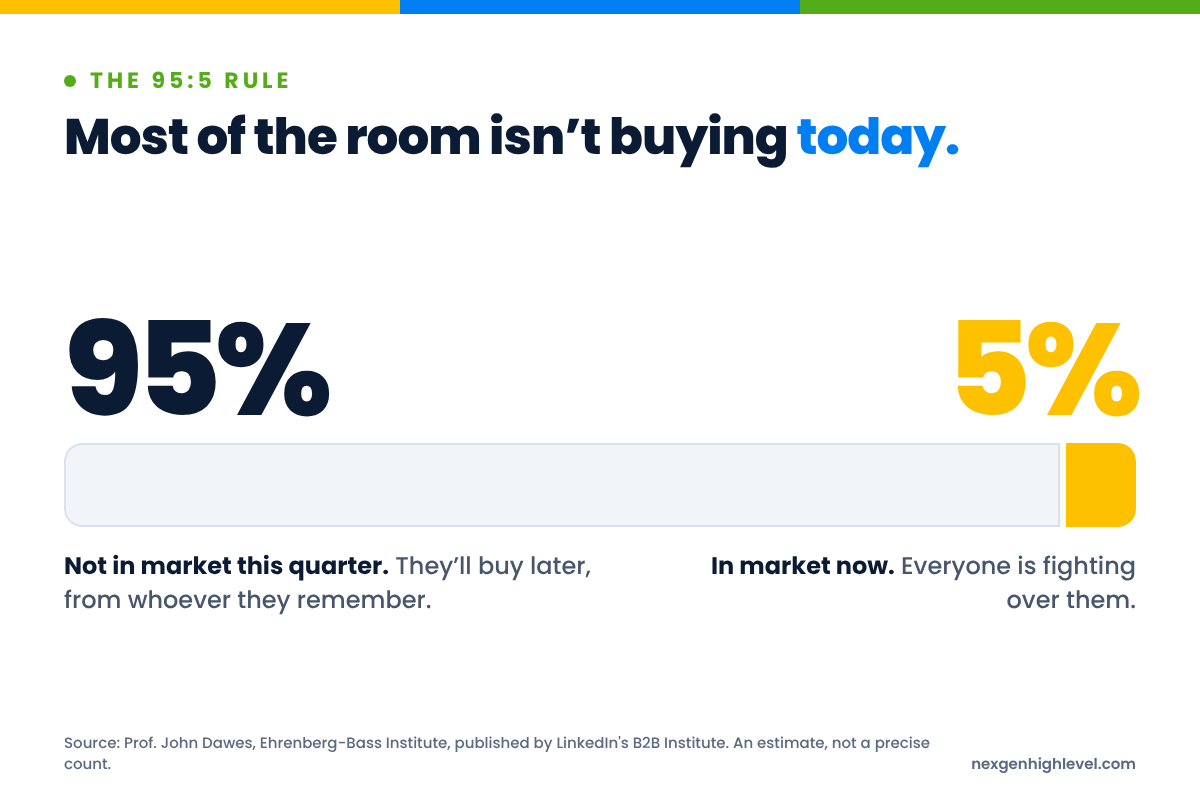
Research by Professor John Dawes of the Ehrenberg-Bass Institute, published by LinkedIn's own B2B Institute, estimates that only around 5% of B2B buyers are in market in a given quarter. The other 95% aren't.
It's known as the 95:5 rule, and once you see it, you can't unsee it.
So if your whole LinkedIn approach is built around the 5% who are ready right now, you're fighting everyone else for a very small slice. And you're ignoring the 95% who'll be ready later.
Even a brilliant pitch lands on people who mostly don't need anything right now. It's not that they've said no. It's that you've asked the wrong question at the wrong time.
By the time they talk to you, they've mostly decided
There's a second piece of research that makes this even more important.
The 6sense 2024 B2B Buyer Experience Report found that 85% of buyers had mostly or fully defined their requirements before they engaged with sellers. 81% already had a preferred vendor at first contact. And that preferred vendor won about 80% of the time.
Read that again.
By the time a buyer picks up the phone, or replies to a message, or fills in your form, most of the decision has already been made. Quietly. Without you in the room.
So the question isn't "How do I pitch better?"
It's "How do I become the preferred vendor before they're ready to buy?"
And the answer to that is the same as it's always been. You get known. You get remembered. You get trusted. Over time, by the right people.
The room works the same way
When I was going to events, most of the people I met didn't need me that night. Some of them didn't need me for a year or two.
The ones who won business were the ones who were remembered when the need arrived. The person who'd been helpful. Who'd followed up. Who'd sent the article, made the introduction, asked how the new office move went.
That's not a sales job. That's a relationship job.
And LinkedIn, done properly, is a relationship machine. Done badly, it's a very efficient way of annoying people you'll want to do business with in 18 months.
The five rules of the room
None of this is complicated. It's what good business people have always done.
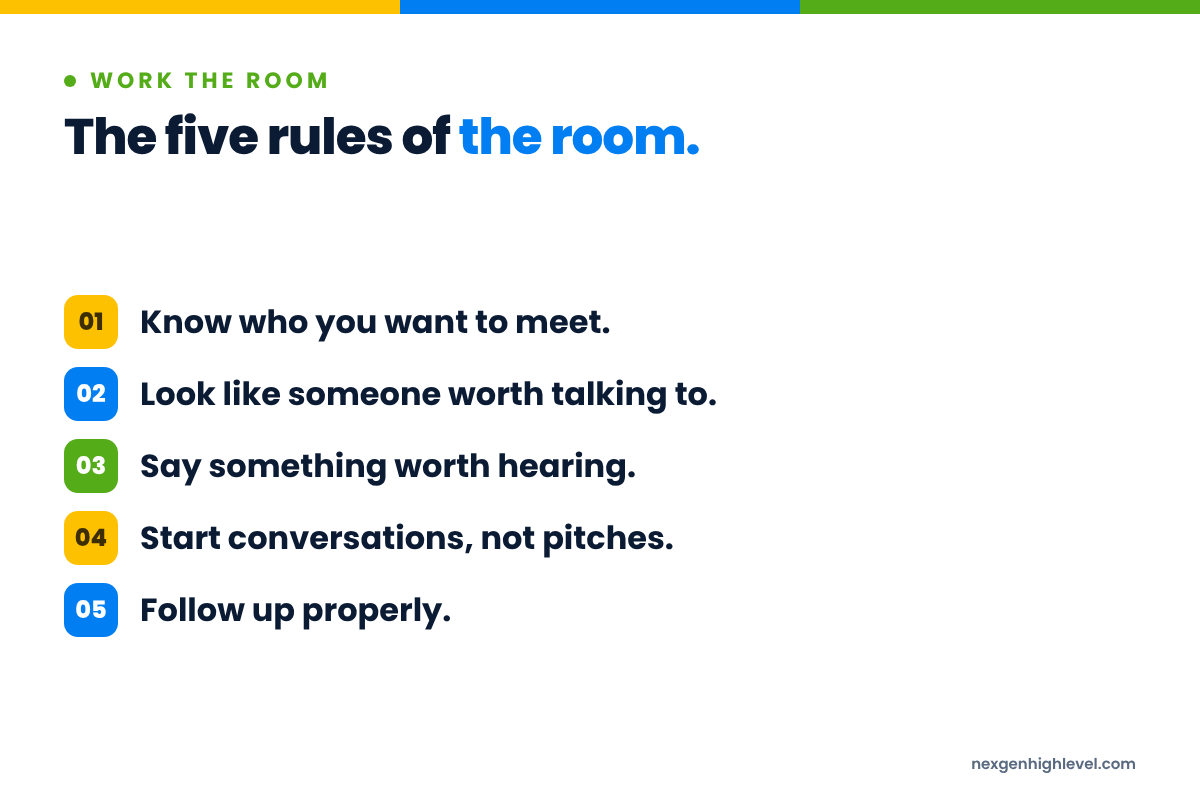
LinkedIn just lets you do it at a scale I could only have dreamt of with my filing cabinet.
Rule 1: Know who you want to meet
Walking into a room hoping someone useful bumps into you isn't a strategy. It's a raffle.
In my recruitment days I never went to an event to "meet people". I went to meet particular people, and I knew why.
On LinkedIn, the room is so big that this matters a hundred times more. With over a billion people in it, "everyone" isn't a target market. It's a way of guaranteeing you'll talk to nobody in particular.
So ask yourself:
- Who are the five types of people who'd make the biggest difference to my business? Customers, yes. But also referrers, partners, and the people who influence the buyer without signing the cheque.
- What do my best customers have in common? Not the ones who paid the most. The ones who were profitable, easy to work with, and stayed.
- What job titles, industries, company sizes and locations keep turning up?
- Who do I not want to meet? Be honest. Some customers cost you more than they pay you.
Here's a slightly uncomfortable thought. Most business owners can describe their product in great detail and their ideal customer in about four words. "Small businesses, mostly." "Anyone who needs marketing."
If you can't describe the person, you can't find them, and you definitely can't say anything that makes them stop and listen.
This is Human first. Before strategy, before technology, understand the person. What do they want? What frustrates them? What stops them acting? Not what you think they should want.
I've written a whole article on this: how to build a LinkedIn ideal customer profile that actually helps you find and talk to the right people. If you only read one other piece in this series, make it that one.
Rule 2: Look like someone worth talking to
At an event, people judge you in seconds. How you're dressed. Your handshake. Whether you look them in the eye or over their shoulder at someone more important.
On LinkedIn, it's your profile.
And here's the thing. Every single action you take on LinkedIn, every comment, every connection request, every message, sends people back to your profile. It's the first thing they check. "Who is this person, and why are they talking to me?"
If your profile reads like a CV, people assume you're looking for a job.
If it reads like a brochure, people assume you're about to sell them something.
If it hasn't been touched since 2017, people assume you're not really here.
What you want is for someone to land on it and think, "Oh, this person helps people like me with a problem like mine. That's interesting."
A few questions to ask yourself:
- Does my headline say who I help and how, or does it just say my job title?
- If my ideal customer read my "About" section, would they recognise themselves in it?
- Does my photo look like a person you'd want to have a coffee with, or a passport photo taken under duress?
And one more, because it matters. Your personal profile is the one that does the heavy lifting here, not your company page. The Metricool and Favikon "LinkedIn in 2026" study found personal profiles had a 2.60% engagement rate, compared with 1.60% for company pages. People connect with people. They always have.
There's more on this in how to write a LinkedIn profile for business owners, the third article in this series.
Rule 3: Say something worth hearing
Share what you actually know. The mistakes, the lessons, the opinions. The thing you've learned the hard way that your customers are about to learn the hard way.
Not "We're delighted to announce."
Nobody has ever stopped scrolling because a company was delighted. They stop because something made them think, "I didn't know that," or "I hadn't thought about it like that."
This matters more than people realise, because of what we saw with the 95:5 rule. If most of your future customers aren't buying today, what you post is how they get to know you in the meantime. It's how you become the preferred vendor before they've even started looking.
And the research backs that up. The 2024 Edelman-LinkedIn B2B Thought Leadership Impact Report, which surveyed around 3,500 management-level professionals, found that 73% of B2B buyers say thought leadership is a more trustworthy basis for judging a company's capabilities than its marketing materials. 86% said they're likely to invite thought-leadership producers to bid for work. And 52% of decision-makers, and 54% of C-suite executives, spend an hour or more a week reading it.
An hour a week. That's the managing director you couldn't get past the receptionist to reach, reading what people in her industry have to say.
"Thought leadership" is a grand phrase. It sounds like you need a stage and a headset microphone. You don't. It just means saying something useful you actually believe, based on things you've actually done.
A few ways to think about what to post:
- What question do customers ask you every week? Answer it properly.
- What does everyone in your industry get wrong? Say so, kindly.
- What did you learn from a mistake? People trust the person who admits them.
A note on AI
You'll be tempted to get AI to write all of this for you. I use AI every day, so I'm not going to pretend otherwise. AI doesn't replace humans. It speeds up the process.
But be careful. Originality.ai looked at 3,368 long-form LinkedIn posts from 99 influential profiles in 2025 and found 53.7% were likely AI-generated. Half the room is starting to sound the same.
And LinkedIn has noticed. In June 2026 it said that content which appears AI-generated and lacks a clear perspective is less likely to be distributed widely beyond the author's immediate network.
The key words there are "lacks a clear perspective". AI can help you get your thoughts down. It can't have your thoughts for you. AI is only as good as the person using it.
Your perspective is the bit nobody else can copy. Don't outsource it.
Rule 4: Start conversations, not pitches
Ask questions. Be curious. Help people.
The pitch, if it ever comes, should feel like the natural next step, not an ambush.
This was the whole job in recruitment. If I rang a hiring manager and opened with "I've got a great candidate for you," the phone went down. If I rang and asked how the new project was going, and whether they were finding it hard to get the right people, we'd have a conversation. Sometimes there was business in it. Sometimes there wasn't, yet. But either way, I was now someone they'd spoken to rather than someone who'd tried to sell to them.
On LinkedIn, conversations start in all sorts of ways:
- A thoughtful comment on someone's post. Not "Great post!" Something that adds to it, disagrees politely, or asks a good question.
- A connection request with a real reason attached. "I saw your comment on X's post about Y, and I've been thinking about the same thing."
- A message that's about them, not you. "Congratulations on the new role. How are you finding the first few weeks?"
A simple test: if the whole message is about you, your company and your offer, it's not a conversation starter. It's an advert in a direct message.
Respect the limits of the room
There's a practical side to this too.
LinkedIn applies weekly limits to connection invitations. Around 100 a week is commonly reported, but LinkedIn doesn't publish a fixed number, and limits vary by account. Spend them on people you actually want to know.
And LinkedIn's User Agreement prohibits bots and other unauthorised automated methods used to add contacts, send messages or drive inauthentic engagement. If someone sells you a tool that promises to send thousands of messages on autopilot from outside LinkedIn, ask yourself what happens to your account, and your reputation, when it goes wrong.
Speed and scale are great. But not at the cost of being the person everyone avoids at the buffet.
If you want to get into the detail of what to actually say, I've written about LinkedIn outreach messages that start real conversations, and about what happens after someone says yes.
Rule 5: Follow up properly
This is where most people fall down, in the room and online.
You meet someone interesting. You have a great chat. You mean to get back to them. And then life gets in the way. A client emergency, a staffing problem, a week that simply disappears.
Two weeks later it feels awkward, so you don't bother. Multiply that by every good conversation this year and you'll see where a lot of your future business went.
The research on this is quite sobering. The Lead Response Management study by Dr James Oldroyd with InsideSales found the odds of qualifying a lead were 21 times higher when contacted within 5 minutes than after 30 minutes. And when Drift tested 433 B2B companies, only 7% responded within five minutes, and 55% hadn't responded within five business days.
Five business days. In recruitment, that candidate would have been placed by someone else by Tuesday.
LinkedIn conversations are often slow-burn relationships rather than "leads", and that's fine. The principle is the same. The person who follows up, thoughtfully and on time, gets remembered.
So how do you follow up properly?
- Write things down. What did they say? What are they working on? What did you promise?
- Know what "next" looks like. Is it a coffee, a call, an article you said you'd send, an introduction?
- Put a date on it. "I'll follow up" isn't a plan. "I'll follow up on the 14th" is.
- Keep showing up between follow-ups. Comment on their posts. Congratulate them on their news. Stay in their world without asking for anything.
This is exactly where a system matters. My memory is terrible. I remember useless facts from years ago and forget what I was told yesterday. So I need all the help I can get.
Where HighLevel fits: the room needs a memory
It would be easy to start selling you something here. Let me use my own framework instead. Human. Strategy. Leverage. In that order.
- Human: Who's in the room that you want to meet, and what do they care about? (Rules 1 and 2.)
- Strategy: What will you say, and how will you move a conversation from "Hello" to "Let's talk"? (Rules 3 and 4.)
- Leverage: How do you make sure nobody falls through the cracks, at a scale your memory can't manage on its own? (Rule 5.)
Technology is leverage, not strategy. Leverage multiplies whatever is underneath it. If you're pitching strangers on connection, technology will help you annoy more people, faster. If you're having real conversations, technology will help you have more of them, and stop the good ones going cold.
If you multiply zero by a thousand, you've still got zero.
So what does "leverage" look like in practice? For us, it's HighLevel.
When the people you're talking to on LinkedIn live in your HighLevel account, the follow-up stops depending on your memory. Picture it like this:
- Every person you're building a relationship with is a Contact in HighLevel, with notes on what you talked about and custom fields for the things that matter in your business.
- Tags show where they are. Met at an event. Commented on a post. Asked a question. Interested, but not yet.
- Workflows remind you, or your team, when it's time to check in, and can kick off nurture emails for people who've asked for more information.
- Opportunities and pipelines show you which conversations have turned into real potential business, and what they're worth.
- Conversations pull messages into one inbox, so you're not hunting through five apps to remember what you last said.
- Reporting shows you which relationships actually turned into revenue. Not clicks. Not bookings. Revenue.
That's the filing cabinet I always wanted. One that taps you on the shoulder and says, "You promised to call her back this week."
The missing front end
There's a reason I care so much about this.
HighLevel's line has always been "Capture, Nurture, Close". It's brilliant at what happens once someone shows interest. But when I first started using it, I kept asking: where's the prospecting? Where's the outreach? Where's the market creation?
LinkedIn is the room where a lot of that market creation happens. And that's why we've spent so much time building tools that sit natively inside HighLevel rather than bolted on beside it. You can see what we've built, and what's coming, on our HighLevel apps page.
But I want to be really clear about the order. Get the human part right first. Get the strategy right second. The tools come third.
If you're not already using HighLevel, you can create a HighLevel account through NexGenHighLevel. If you'd rather start with a whole system already built for your type of business, have a look at our HighLevel Snapshots.
And if you're not ready for any of that? Fine. A notebook and a diary will do to start with. The rules of the room work either way.
The skill hasn't changed
People buy from people.
That was true when I was cold-calling from a phone directory, and it's true now.
What's changed is access. The decision-maker you want to reach is a few clicks away, telling you publicly what she cares about. That's an extraordinary opportunity, and most of your competitors aren't taking it seriously. They're either broadcasting into the void, firing off pitches, or leaning against the wall.
Which means the bar is lower than you think. You don't need to be the loudest person in the room. You don't need a million followers or a viral post. You need to know who you want to meet, look like someone worth talking to, say something worth hearing, start real conversations, and follow up properly.
That's it. Five rules. None of them new.
We're selling things on the internet. We're not negotiating world peace. But we are dealing with people, and people still want what they've always wanted: to be understood, to be helped, and to feel they've made a good decision.
Your challenge for this week
So here's my challenge.
Log in, and instead of posting or pitching, behave like you're at the best networking event of the year.
- Find ten people you'd genuinely love to know. Not ten people you want to sell to. Ten people who'd make a difference to your business, as customers, referrers or partners.
- Read what they've posted. Properly. Get a sense of what they care about.
- Leave a comment that adds something. A question, an experience, a polite disagreement. Not "Great post!"
- Write down what you learned about each of them. In HighLevel, in a spreadsheet, in a notebook. Somewhere you'll see it again.
- Put a date in the diary to check back in.
Just that. No pitch. No connection-request blitz.
Do it every week for a month and see how differently the room starts treating you.
Frequently asked questions
Is LinkedIn worth it for small business owners?
It depends who your customers are, but if you sell to other businesses, or to professionals, then yes, I think it is. LinkedIn has more than a billion members, and the people who make buying decisions are there, telling you what they care about. The trick is treating it as a room full of relationships, not a billboard. Small businesses often do better than big ones, because people would rather talk to a person than a logo.
How much time should a business owner spend on LinkedIn?
Less than you'd think, if it's focused. Twenty to thirty minutes most working days is plenty for most business owners: reading what your ideal customers post, leaving useful comments, replying to messages and following up. Add an hour a week to write something worth reading. Consistency matters far more than volume. A little, done properly, every week, beats a mad burst every three months followed by silence.
Should I post from my personal profile or my company page?
Mostly your personal profile. People connect with people, and the data agrees: Metricool and Favikon's 2026 study found personal profiles had a 2.60% engagement rate against 1.60% for company pages. Keep your company page tidy and up to date, because people will check it. But the conversations, the opinions and the relationships happen person to person. That's how the room has always worked.
How do I get clients from LinkedIn without being salesy?
Stop thinking about getting clients and start thinking about having conversations. Know exactly who you want to meet, make your profile speak to them, share useful things you actually know, and comment and message with curiosity, not a pitch. Then follow up properly. When someone has a need, the pitch becomes the natural next step. Most people skip straight to the pitch, which is why it feels salesy.
Can I automate my LinkedIn marketing?
You can automate the admin, but not the relationship. Be careful with tools that send messages or connection requests on autopilot from outside LinkedIn: its User Agreement prohibits bots and unauthorised automated methods. What you can do is use a system like HighLevel to remember who you've spoken to, remind you when to follow up and nurture people by email. Technology should multiply good conversations, not replace them.
How long does it take to see results from LinkedIn?
Longer than most people want, and shorter than most people fear. Remember the 95:5 rule: most of your future customers aren't buying this quarter. You're building familiarity now so you're remembered when they are. You'll usually notice better conversations within a few weeks of showing up properly. Real business tends to follow over months. Walk before you run, and keep walking a bit longer.
Back to the room
I still think about that filing cabinet sometimes.
Every card in it was a person: a name, a number, a few scribbled notes about what they wanted. It was only valuable because I used it.
LinkedIn is that filing cabinet, the phone directory and every networking event I ever went to, rolled into one and open all hours. The people are there. The conversations are there. The opportunity is there.
The only thing missing is you, walking across the room and saying hello.
LinkedIn didn't replace networking. It removed the excuses.