
You're a Guest on WhatsApp. Act Like One.
Picture a stranger walking into your kitchen while you're making dinner.
They don't knock. They pull up a chair, slide a leaflet across the table and ask if you've got five minutes to talk about your energy bill.
You wouldn't buy anything. You'd want them out. And you'd remember their face.
That's what an uninvited WhatsApp message feels like. Which is why WhatsApp marketing opt-in isn't a box you tick for the lawyers. It's the difference between being a guest and being an intruder.
The businesses that do well on WhatsApp aren't the ones with the cleverest messages. They're the ones who were invited in, and behave like it.
Why WhatsApp marketing opt-in is different from every other channel
More than 3 billion people use WhatsApp. That number gets thrown around a lot in marketing circles, usually followed by a sentence that starts "imagine if you could reach them all".
You can't. And you shouldn't want to.
Here's why. Think about where WhatsApp sits on your own phone.
It's where your family group lives. The padel group arguing about who booked the court. The friend you only hear from at Christmas. The school, the neighbours.
It's not a newsfeed. It's not an inbox full of newsletters you'll never read. It's the kitchen table.
So when a business turns up in that list, it lands right beside the people you love most. That's an enormous privilege. It's also an enormous risk, because the bar for "this is welcome" is far higher than anywhere else.
Email is the post. WhatsApp is the kitchen.
I spent nearly 23 years in recruitment, and when I started there was no email, no LinkedIn and no CRM. A telephone, a filing cabinet and a phone directory. Every deal was done face to face.
What that taught me has never changed: people buy from people. And people remember how you made them feel.
Different channels carry different expectations. Here's how I think about it:
- Email is the post. People expect a bit of marketing in there. They skim, they delete, they unsubscribe. Annoying, but normal.
- LinkedIn is the business room. Introducing yourself to someone you don't know is part of why people are there, as long as you do it well.
- WhatsApp is the kitchen. You're only there because someone opened the door.
It's not a broadcast channel. It's a conversation channel.
And conversations need two people who want to have them.
Being invited in changes everything
Here's the bit I find exciting.
When someone gives you their number and says "yes, message me on WhatsApp", they're telling you something. They trust you a little. They'd rather hear from you there than anywhere else.
Meta says that 1 billion people message a business each week on its platforms. That's across Meta's apps, not WhatsApp alone. But it tells you people are perfectly happy to talk to businesses in these spaces.
When they chose to.
That's the whole game. Earn the invitation, then be the kind of guest people want back.
What WhatsApp's own rules actually say
You don't have to take my word on any of this. WhatsApp has written it down.
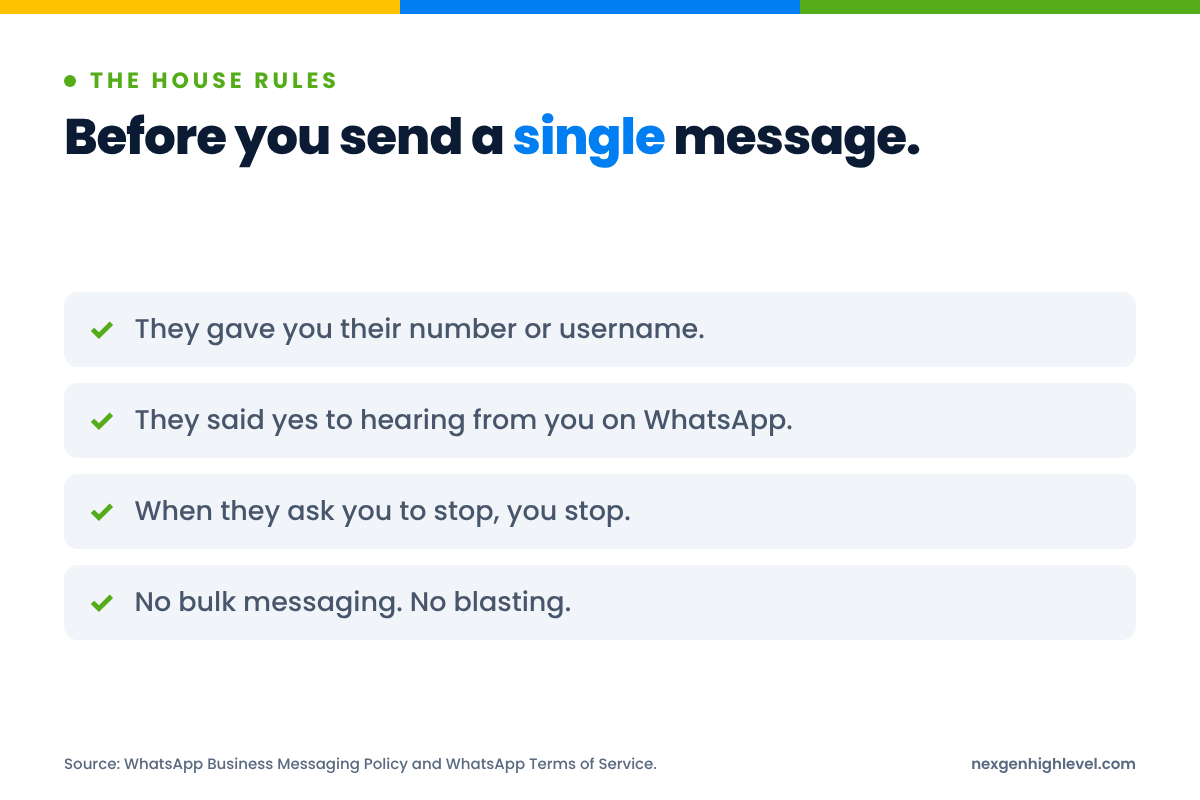
The WhatsApp Business Messaging Policy is very clear. You may only contact people on WhatsApp if:
"(a) they have given you their mobile phone number or username and (b) you have received opt-in permission from the recipient confirming that they wish to receive subsequent messages"
Read that twice. There are two conditions, not one.
Having someone's number isn't enough. They have to have given it to you. And they have to have agreed to hear from you after that.
Two conditions, not one
This is where a lot of business owners go wrong, so let's slow down.
They gave you the number. Not a list you bought. Not numbers scraped from a directory or a website. Not your cousin's mate who "might be interested". The person themselves handed it over.
They agreed to further messages. Someone filling in a quote request has given you their number so you can deal with that quote. Have they agreed to your monthly offers on WhatsApp? Not unless you asked, and they said yes.
It's the difference between "you can ring me about this" and "you can message me whenever you like". We all understand that in real life. We just forget it when there's a CRM full of numbers in front of us.
Stopping means stopping
The policy also says businesses "must respect all requests (either on or off WhatsApp) by a person to block, discontinue, or otherwise opt out".
Notice the words "on or off WhatsApp".
If someone tells your receptionist on the phone "please stop messaging me", that counts. If they email you, that counts. If they reply "not interested" on WhatsApp, that counts too, even if they didn't type the magic word STOP.
That has real consequences for how you organise your business, and we'll get to it shortly.
Bulk messaging is off the table
Then there are the WhatsApp Terms of Service, which forbid "sending illegal or impermissible communications such as bulk messaging, auto-messaging, auto-dialing, and the like."
So let me say it plainly, because plenty of people won't.
WhatsApp is not a mass blast channel. It wasn't built to be one and its rules forbid it. If someone sells you a way to fire the same message at thousands of numbers who never asked to hear from you, they're selling you a way to break WhatsApp's rules.
And, quite possibly, a way to lose your number.
Why spam gets WhatsApp numbers restricted or banned
The policy doesn't mince its words: "If content or actions violate our terms or policies, we may limit or remove your access to our services."
Limit. Or remove.
For a lot of businesses that's not an abstract risk. Their WhatsApp number is printed on the van, the website, the business cards, the Google listing. Every customer conversation for the last three years is in there.
Lose it and you don't just lose a marketing channel. You lose the front door.
What actually happens when people get annoyed
I don't know the inner workings of how WhatsApp decides who to restrict. Anyone who claims to know exactly where the line is deserves some suspicion.
But you don't need to know the mechanics to understand the logic.
People on WhatsApp can block you. They can report you. WhatsApp has every reason to protect the experience of the people who use it, because that experience is the product. A business that makes the app feel like a spam folder is a problem WhatsApp wants to solve.
So ask yourself a simple question before any message goes out:
If this person saw my message right now, would they be glad, indifferent or annoyed?
Glad is great. Indifferent is a warning. Annoyed is a block waiting to happen.
There's no such thing as "ban-proof"
You'll see tools and courses promising ways to message at scale "without getting banned". Rotating numbers. Warming up accounts. Clever timing.
I'd stay well away.
Nothing makes a number ban-proof. Not a tool, not a trick, and not our app either. The only reliable protection is behaving in a way WhatsApp and the people on it are happy with: message people who asked to hear from you, about things they care about, and stop when they tell you to.
It's not a technical problem. It's a behaviour problem.
The real cost isn't the ban
Here's the bit people miss.
Even if WhatsApp never touched your number, spam would still cost you. Every unwanted message teaches someone that your name on their screen means "ignore". You've spent trust you'll need later, when you've got something genuinely useful to say, or a reminder for an appointment they actually booked.
Picture a dental practice that decides to "reactivate" its old patient list with a WhatsApp offer. Thousands of numbers, collected years ago for appointment reminders, none of whom agreed to marketing on WhatsApp.
Some will book. Most will ignore it. A few will block. And a few more will quietly decide that this is the practice that messages you about teeth whitening while you're on holiday.
Was it worth it? Maybe in week one. Probably not in year two.
Business is a people game disguised as a numbers game. WhatsApp is where that becomes very obvious, very quickly.
Earning the right to message: think like a guest
So if permission is the rule, how do you get it without being awkward?
I think of it as earning the right to message. And it starts long before anyone ticks a box.
Permission is a relationship, not a checkbox
A checkbox records permission. It doesn't create it.
What creates it is the person believing that hearing from you on WhatsApp will be useful. Faster answers. Easier booking. A real human on the other end. Something they'd genuinely miss if it stopped.
This is my Human, Strategy, Leverage thinking again, and it fits WhatsApp perfectly:
- Human. Why would this person want you in their WhatsApp? What would make their life easier? What would make them nervous?
- Strategy. What exactly are you offering to send them, how often, and why is WhatsApp better for it than email or a phone call?
- Leverage. Only then: the forms, the tags, the workflows and the automation that make it run.
Get the first two right and the opt-in almost asks for itself. Skip them and no amount of automation will save you.
The guest test
Before you ask anyone for WhatsApp permission, run through these questions. They're simple. They're also where most businesses fall over.
- What will I actually send? "Updates" isn't an answer. Appointment reminders? Quote follow-ups? A monthly offer? Be specific.
- How often? Once a month feels very different from three times a week.
- Would I be happy getting this myself? Honestly. On a Sunday evening. Between messages from your family.
- Is there a person behind it? If someone replies, will a human see it and answer?
- How do they leave? And will you make it easy, and respect it everywhere?
If you can't answer those clearly, you're not ready to ask for permission. You're ready to think a bit more.
Service messages and marketing messages are different invitations
This distinction will save you a lot of trouble.
Someone who books an appointment has invited you to talk about that appointment. Confirmations, reminders, "running ten minutes late", "here's how to find us". That's service. It's what they expect.
The same person hasn't automatically invited you to send them promotions, newsletters or "we miss you" offers. That's marketing. It's a separate invitation and it deserves a separate ask.
It's not one permission. It's two.
Treat them as two and people trust you with both. Blur them and you'll lose both.
How to collect WhatsApp opt-in properly
Right. Let's get practical. Not a manual, but the places where permission naturally happens in a business, and how to ask well in each of them.
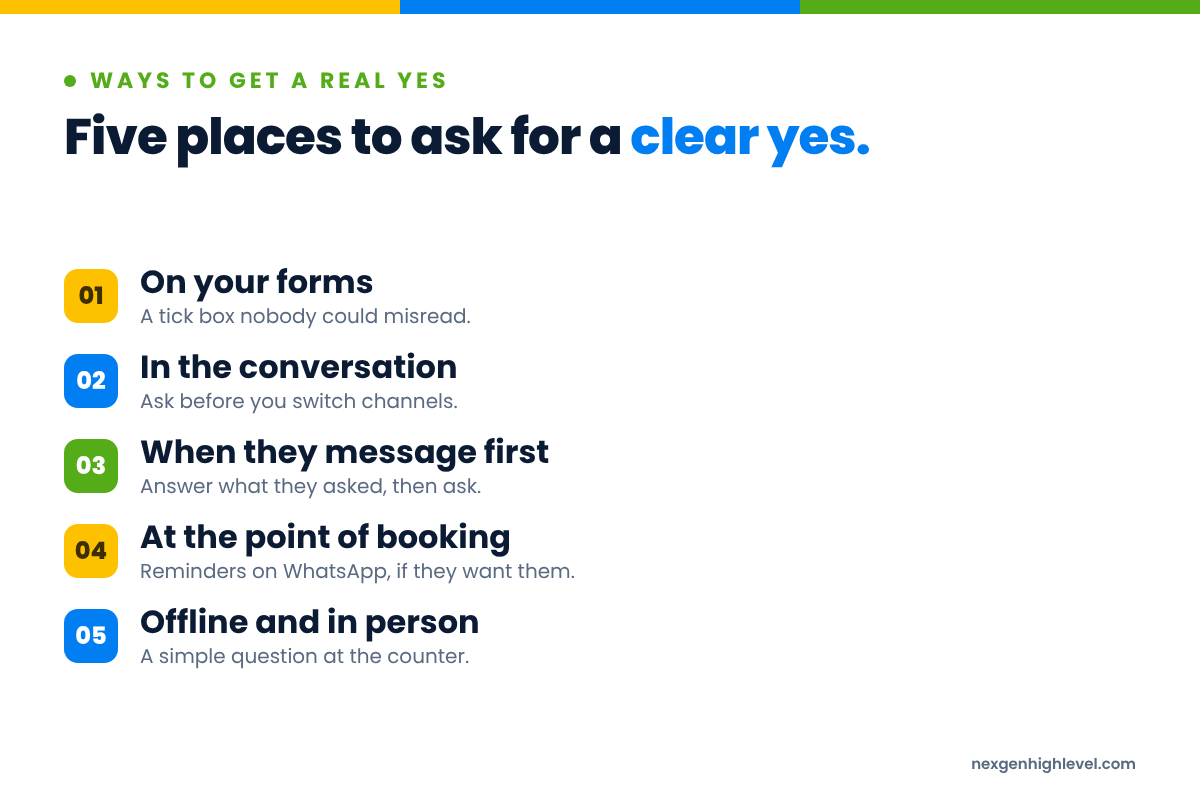
On your forms
Your website forms are where most WhatsApp numbers arrive. So make the ask clear and honest there.
A few principles:
- Ask separately. Don't hide WhatsApp consent inside your terms and conditions or bundle it with "I agree to the privacy policy".
- Leave it unticked. A pre-ticked box isn't someone agreeing. It's you agreeing on their behalf.
- Say what they'll get. Name the channel and the type of message.
- Say how to stop. Right there, in the same sentence.
Here's an example of the kind of wording I mean. It's an example, so adapt it to your business and your situation:
☐ Yes, I'm happy for [Business Name] to message me on WhatsApp about my enquiry, and to send me occasional offers. I can reply STOP at any time.
Better still, split it into two:
☐ Message me on WhatsApp about my enquiry or booking. ☐ Send me occasional offers and news on WhatsApp too.
Fewer people will tick the second box. That's fine. The ones who do actually want to hear from you, and that's the list worth having.
A smaller list of people who said yes beats a bigger list of people who never knew they were on it.
In the conversation
Some of the best opt-ins happen naturally, mid-conversation.
Picture someone who's just had a quote from a kitchen fitter over the phone. At the end, the fitter says: "Would it be easier if I sent the drawings and any updates over WhatsApp? Some people prefer it, some don't."
That's a real choice, asked like a human. Most people will say yes, because it genuinely is easier.
And when the first message arrives, it can confirm it:
"Hi Sarah, it's Mark from [Business Name]. As promised, here are the drawings. I'll use WhatsApp for anything about your kitchen. If you'd rather I didn't, just say and I'll stick to email."
That message does three things. It reminds her she asked for this. It sets expectations. And it gives her an easy way out. If you want to dig into first messages like this, I've written more about it in WhatsApp messages people actually reply to.
When they message you first
When someone messages your business on WhatsApp, they've opened the door themselves. They've given you their number, and they want an answer.
So answer. Quickly, and like a person. How fast you reply matters more than most businesses realise, and it's a big enough subject that it has its own article: WhatsApp lead response: the reply nobody sent.
But don't confuse "they asked about one thing" with "they've signed up for everything". Deal with what they asked about. Then, if it makes sense, ask whether they'd like to hear from you on WhatsApp about anything else.
At the point of booking
Bookings are a natural moment to ask, because the value is obvious. Nobody wants to miss an appointment they've chosen to make.
If you use HighLevel calendars, your booking form is a good place for the WhatsApp question. Keep it tied to the appointment: "Can we send your confirmation and reminder on WhatsApp?" It's specific, it's useful and people understand it immediately.
Offline and in person
People still give their numbers face to face, at counters, events and showrooms. The rule doesn't change just because there's no form. A QR code at reception that opens a simple HighLevel form with the WhatsApp question on it does the job, and it means you've got a record rather than a receptionist's memory.
Recording WhatsApp consent in HighLevel
Asking properly is half of it. The other half is remembering, properly, who said yes, to what, and when.
This is where a lot of businesses come unstuck. The permission exists, but it lives in someone's head, a spreadsheet, or the notes on one person's phone. Then someone new joins the team, or a campaign goes out in a hurry, and the person who said "please stop" gets a message anyway.
HighLevel gives you everything you need to keep this straight, using things that are already in your account.
Tags and custom fields
Keep it simple and consistent.
- Tags for the current status. For example:
whatsapp-service-ok,whatsapp-marketing-ok,whatsapp-opted-out. - Custom fields for the detail. When they agreed, where (which form, which conversation, which event), and which wording they saw.
Sounds fussy. It isn't. If anyone asks "how did this person agree to hear from you?", you want to answer in ten seconds, not ten days.
Smart lists
Build a smart list of contacts who have the marketing permission tag and don't have the opted-out tag.
Then make a rule for your team: marketing messages on WhatsApp only ever go to that list. Not "everyone in the pipeline". Not "everyone who's been to an event". That list.
It sounds obvious. It's also the single thing that stops most accidents.
Workflows that check before they send
HighLevel Workflows are where permission stops being a policy document and starts being how your business actually behaves.
A few patterns worth building:
- When a form is submitted with the WhatsApp box ticked, add the right tag and record the date and source in custom fields.
- Before any WhatsApp marketing step, check the contact has the marketing tag and doesn't have the opted-out tag. If not, skip it, or use email instead if they agreed to that.
- When someone opts out, remove the permission tags, add the opted-out tag, and remove them from any WhatsApp sequences they're in.
Notice what's going on there. The workflow isn't deciding who to message. You decided that, when you defined what permission means. The workflow just makes sure nobody forgets.
Trigger links for a clear "yes"
Here's one I like. Instead of assuming someone wants your offers, send an email to people who've bought from you, with a simple link: "Want our seasonal offers on WhatsApp instead? Tap here."
A HighLevel trigger link can tag the contact when they click it. Then the first WhatsApp message confirms it, as in the kitchen fitter example above. That's a clear, recorded, active yes, and it came from them.
Make opting out easy, everywhere
Remember "on or off WhatsApp"?
That means opt-outs can arrive in your HighLevel Conversations inbox on WhatsApp, by email, by SMS, through a phone call, or at the front desk. Your team needs one simple way to record them, wherever they arrive. A tag, applied by anyone, that every workflow respects.
And train people to recognise opt-outs that don't use the word STOP. "Please don't message me." "Who is this?" "Take me off your list." A human reads those for what they are. Make sure your process does too.
When WhatsApp sits inside HighLevel Conversations, next to SMS, email and social, this gets much easier, because your team sees the full history in one place rather than on one person's phone. That's exactly why we built the WhatsApp App for HighLevel, and it's a story for another article.
A word on the law
WhatsApp's rules aren't the only rules. Depending on where you are and where your customers are, there may be laws about consent for marketing messages too.
I'm not a lawyer, and this isn't legal advice. If you're unsure, speak to someone who is.
Cold outreach belongs on LinkedIn and email, not WhatsApp
Right. The question I get asked most.
"Jay, this is all very well for people who've already found us. But I need new customers. Where's the prospecting?"
Fair question. I've been asking HighLevel's "Capture, Nurture, Close" the same thing for years. Where's the prospecting? Where's the outreach? Where's the market creation?
But the answer isn't WhatsApp.
The right room for the first hello
Every channel has a job. Cold outreach, introducing yourself to someone who doesn't know you yet, belongs in places where that's expected.
LinkedIn is a business room. People are there to meet other people in business. A thoughtful, relevant introduction from a stranger is normal. A clumsy pitch isn't, but that's a different problem.
Email is the post. Business email has carried introductions for decades, and done carefully, with good data and a genuinely relevant message, it still works.
WhatsApp is the kitchen. Nobody wants a stranger in the kitchen.
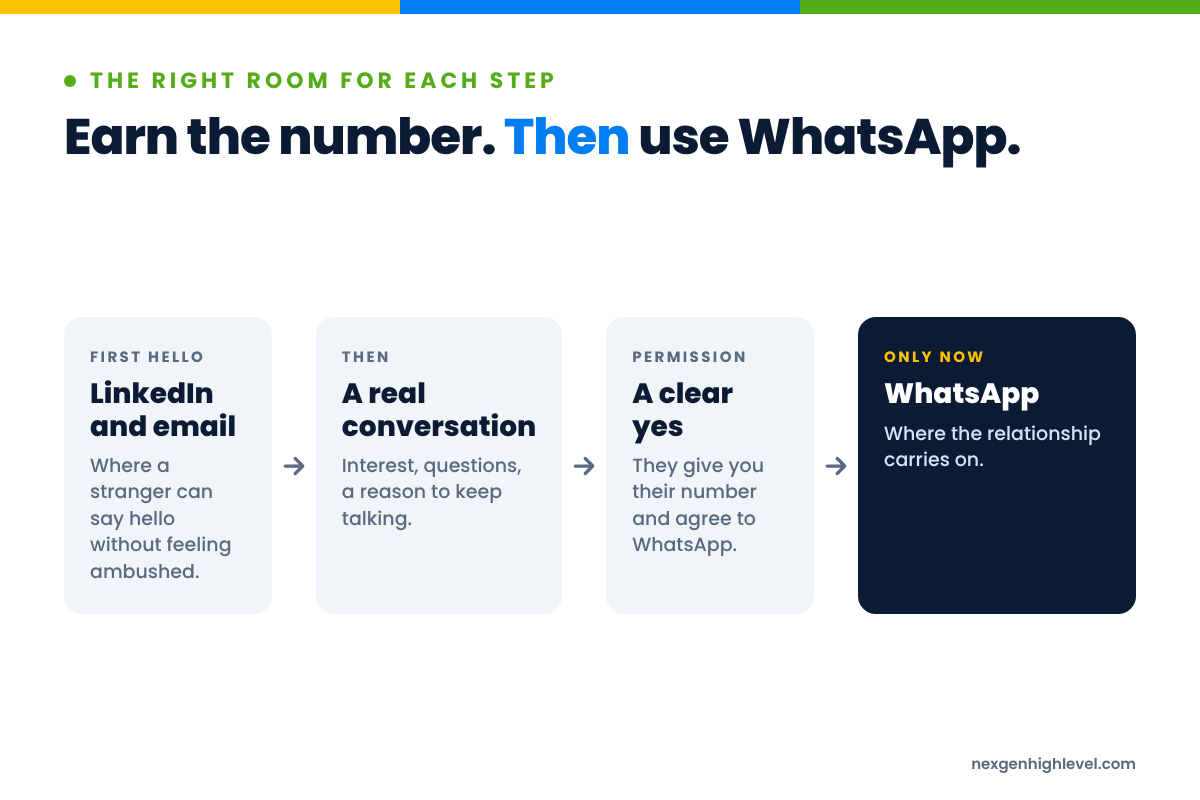
So the job of LinkedIn and email is to start the relationship. The job of WhatsApp is to continue it, once someone has said yes.
How the hand-off works
Think of it as a journey rather than a channel choice.
- Find and introduce. LinkedIn and email, to people who've never heard of you.
- Earn interest. Useful posts, good conversations, a relevant offer.
- Get the yes. They reply, book a call, fill in a form, ask a question.
- Ask about WhatsApp. "Would it be easier to carry on over WhatsApp?"
- Continue the relationship. Now WhatsApp does what it's brilliant at: quick, human, personal conversation.
Skip straight to step five and you're the stranger at the kitchen table. Walk through the steps and you're the guest who brought a decent bottle of wine.
If you want the detail on the first steps, I've written about how LinkedIn and email outreach work together in HighLevel.
Why we built for this
This is close to my heart, because it's how NexGenHighLevel started.
The first app we built was the LinkedIn App for HighLevel, for a client who needed it. Other LinkedIn tools offered the same basic outreach and didn't sit inside HighLevel. Adding email enrichment meant people could find their ideal customer, reach them on LinkedIn and email, and nurture them, all inside the account they already run their business from.
That's the front end. The prospecting, the outreach, the market creation. We're also building a Cold Email app, which is in development and launching soon, for exactly the same reason.
WhatsApp sits further along. It's where the relationship lives once it's real.
Each channel doing its own job. That's combination marketing, and it's how customers actually behave.
What good WhatsApp behaviour looks like after the yes
Getting permission is the start. Keeping it is the work.
An opt-in isn't a lifetime pass. People can, and do, change their minds. Every message you send either earns you the next one or moves you closer to the block button.
Stay inside what they agreed to
If someone said yes to appointment reminders, send them appointment reminders. Not offers. Not a "quick survey". Not your new podcast.
If you want more, ask for more. Most people will tell you honestly.
Fewer messages, better messages
You don't need to message people often. You need to message them well.
One genuinely useful message a month will do more for you than four "just checking in" nudges. If you're wondering how to follow up without becoming that business, there's a whole article on it: WhatsApp follow-up that doesn't feel like chasing. We'll keep writing about the detail across these articles, because it matters.
Be a person
WhatsApp works because it's personal. So be personal.
Use their name. Sign off with yours. Reply when they reply. Don't pretend an automated message was typed by hand, and make sure there's always a human who'll pick up the conversation when it needs one.
Automation is brilliant for remembering, reminding and routing. It's not a replacement for being a decent guest.
AI doesn't replace humans. It speeds up the process. On WhatsApp, the human bit is the whole point.
Check in on permission now and then
Here's a habit worth building. Every so often, look at the people on your WhatsApp marketing list who haven't replied, clicked or booked in a long time.
Do they still want to hear from you? You could ask them. Or you could quietly move them back to email. Either way, you're protecting the relationship rather than squeezing it.
Shrinking a list on purpose feels odd. It's also what a good guest does: notices when it's time to go.
Frequently asked questions
What counts as opt-in for WhatsApp marketing?
Two things, according to WhatsApp's Business Messaging Policy. The person has given you their number themselves, and they've agreed to receive further messages from you. So a bought list fails the first test, and a number given for one quote doesn't automatically pass the second. My advice: ask clearly, say what you'll send, leave the box unticked, and record when and where they said yes.
Can I message customers on WhatsApp if I already have their phone number?
Having a number isn't the same as having permission. If they gave it to you for appointment reminders, you can talk about appointments. If you want to send offers or news on WhatsApp, ask them first, and keep a record of the answer. An email or text asking "would you like our offers on WhatsApp?" is a perfectly good way to do it, and the people who say yes are worth more.
Can I use WhatsApp for cold outreach?
No. WhatsApp's rules require the person to have given you their number and agreed to hear from you, and its terms forbid bulk and auto-messaging. Cold outreach belongs on LinkedIn and email, where introductions from people you don't know are normal. Use those to start the relationship. Then, once someone has said yes, ask whether they'd like to carry on over WhatsApp.
Why do WhatsApp business numbers get banned?
WhatsApp's policy says it may limit or remove access to its services when businesses break its terms or policies. Messaging people who never asked to hear from you, and bulk or automated blasting, are the obvious ways to get there, and people blocking or reporting you won't help. No tool can make a number ban-proof, including ours. Behaving like a welcome guest is the only protection worth relying on.
How do I record WhatsApp consent in HighLevel?
Keep it simple. Use tags for the current status, such as marketing permission or opted out, and custom fields for the date, the source and the wording they agreed to. Build a smart list of people with permission and no opt-out, and make your workflows check those tags before any WhatsApp step runs. Then make sure anyone on your team can record an opt-out, wherever it arrives.
What should I do when someone asks me to stop?
Stop. Straight away, and everywhere. WhatsApp's policy says you must respect opt-out requests made on or off WhatsApp, so a phone call or an email counts just as much as a reply saying STOP. Tag them as opted out, take them out of any WhatsApp sequences, and thank them. How you behave when there's nothing in it for you tells people quite a lot about you.
Be the guest people want back
Here's what I'd leave you with.
WhatsApp isn't a new place to shout. It's a place you've been allowed into, beside people's families and friends, because someone trusted you a little.
That trust is worth more than any list you could buy. It's what makes your reminders get read, your follow-ups get answered, and your name on someone's screen feel welcome rather than annoying.
So ask properly. Record it properly. Stick to what you were invited to talk about. And when someone shows you the door, thank them and leave with good grace.
If you're just joining us, the first article in this series sets out why WhatsApp is where your customers actually talk, and we'll keep building on it.
The rest is simple.
Knock before you come in. Wipe your feet. Don't overstay your welcome.
You're a guest on WhatsApp. Act like one.