
WhatsApp Is Where Your Customers Actually Talk
Think about the last real conversation you had on your phone. Not an email. Not a notification from your bank. A proper back-and-forth with someone you actually know.
For a huge number of people, that conversation happened on WhatsApp. The family group. The school parents. The friend who sends voice notes longer than most podcasts.
That's where people actually talk. And it's exactly why WhatsApp for business is such a big opportunity, and why so many businesses get it wrong the moment they arrive.
WhatsApp isn't a billboard. It's the kitchen table.
You don't put a billboard on somebody's kitchen table. You get invited to sit down. And how you behave once you're sitting there decides whether you're ever asked back.
Why WhatsApp for business matters right now
Let's start with the size of the thing, because it's hard to get your head around.
According to Meta, more than 3 billion people use WhatsApp, in over 180 countries.
Three billion. That's not a channel. That's a large part of humanity's daily conversation, happening in one green app.
And people aren't only talking to friends and family there. Back in 2023, Meta said that 1 billion people message a business each week on our platforms. That figure covers all of Meta's apps, not WhatsApp on its own. But the direction is obvious. People have got used to the idea that you can message a business the same way you message your sister.
That's a big shift. For most of my working life, contacting a business meant one of three things: ring them, email them, or fill in a form and wait.
Now? A lot of people would rather send a quick message and get on with their day.
"But my customers are in the US"
I know what some of you are thinking. "Jay, that's fine for Dublin and Manchester. My customers text."
Fair. Back home in Ireland, and here in the UK, WhatsApp is how people organise their lives. Football training, birthday plans, the plumber, the dentist. In the US, plenty of people still default to plain text messages.
I'm not going to throw a US statistic at you that I can't stand behind. So ask your customers. Look at who's already messaging you, the customers who travel, the families spread across countries.
Either way, you'll know rather than guess. And the thinking here applies to every conversation channel you use, not just the green one.
The shift from broadcast to conversation
Here's the bigger point, and it's not really about WhatsApp at all.
For decades, marketing was mostly broadcast. You bought attention, you shouted your message at it, and you hoped the right people were listening. TV, radio, billboards, banner ads, the email newsletter that goes to everyone.
Broadcast still has its place. But people now expect to ask a question and get an answer. From a person. Who remembers what they said last time.
That's not a broadcast. That's a conversation.
And WhatsApp is where a lot of those conversations want to live.
WhatsApp isn't a billboard. It's the kitchen table.
This is the idea I want you to take away from this article, so I'm going to spend some time on it.
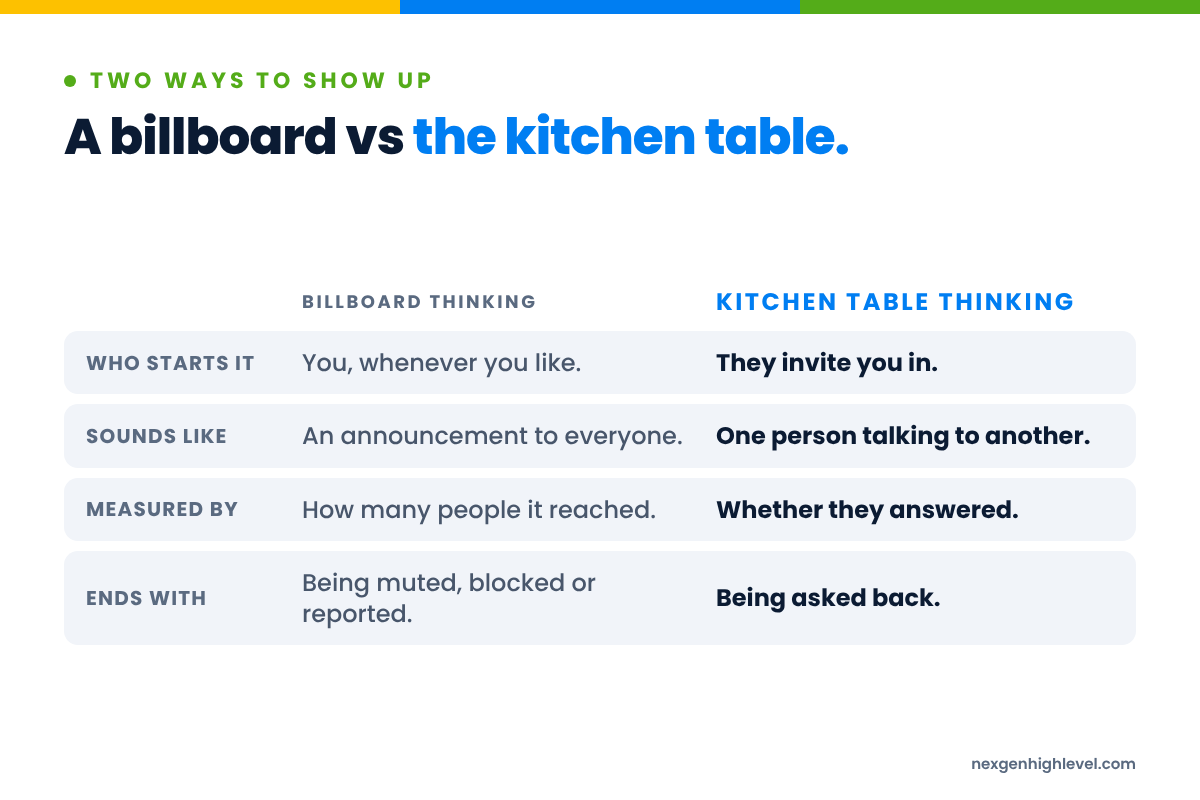
Picture the apps on your own phone. Some of them are public squares. Social feeds, video apps, news. You go there knowing you'll see adverts. Brands are expected. You scroll past them, or occasionally you don't.
WhatsApp is different. Look at who's in there. Your partner. Your kids. Your mum. Your oldest friends. The group chat that's been going since 2014 and is mostly memes now.
It's personal. It's private. It's the kitchen table.
So when a business turns up in that list, it's sitting between your daughter and your best mate. That's a privileged spot. And it's a fragile one.
You were invited in
Nobody walks into somebody's kitchen uninvited and starts handing out leaflets.
Well. Somebody might. Once.
On WhatsApp, the invitation is simple. Somebody gave you their number and said, in one way or another, "Yes, you can message me here." Maybe they messaged you first. Maybe they ticked a box on a form. Maybe they asked you to send their appointment details there.
That's the invitation. It's not a technicality. It's the whole basis of the relationship.
And it changes how you should think about every message you send. Not "How do I get my message in front of this person?" but "I've been invited in. What would a good guest do?"
What a good guest does
Think about the last time you were a guest in someone's house. What did you do?
- You were useful. You brought something, or offered to help.
- You listened. You didn't spend the whole evening talking about yourself.
- You were yourself. You didn't put on a corporate voice.
- You knew when to leave. You didn't hang around until two in the morning.
- You remembered things. You asked how the new job was going.
Now flip it. What does a bad guest do? Talks too much. Only talks about themselves. Turns up too often. Brings their own agenda. Ignores the hints that it's time to go.
Every one of those maps straight onto business messaging.
The business that sends five promotions a week is the guest who won't stop talking. The business that never replies is the guest who stares at their phone all night. The business that sends a message that reads like a legal disclaimer is the guest who addresses everyone as "Sir or Madam".
It's not a billboard. It's the kitchen table. Behave accordingly.
On WhatsApp, the line between you and the people they love is a few pixels wide. One annoying message, and you're not just ignored. You're resented. Then you're blocked.
But the same closeness is the opportunity. Be genuinely helpful in that space and you stop being a company. You become the business they actually want to hear from.
What WhatsApp's own rules say about business messages
I'll keep this short, because we'll go deeper in the article on WhatsApp marketing opt-in. But you need to know where the lines are before you go anywhere near this channel.
WhatsApp's Business Messaging Policy says you may only contact people on WhatsApp if (a) "they have given you their mobile phone number or username" and (b) "you have received opt-in permission from the recipient confirming that they wish to receive subsequent messages" from you.
It also says you "must respect all requests (either on or off WhatsApp) by a person to block, discontinue, or otherwise opt out".
And it's clear about what happens if you don't: "If content or actions violate our terms or policies, we may limit or remove your access to our services."
On top of that, WhatsApp's Terms of Service forbid "sending illegal or impermissible communications such as bulk messaging, auto-messaging, auto-dialing, and the like."
So let me say it plainly.
WhatsApp is not a cold outreach channel. It's not a bulk broadcast channel. Numbers that spam people get restricted or banned. And no tool, including anything we've built, makes a number "ban-proof". Anyone who tells you otherwise is selling you something you'll regret.
Where cold outreach actually belongs
I'm not against outreach. Far from it. I spent nearly 23 years in recruitment, and a big part of that job was getting in touch with people who didn't know me yet. Prospecting is the reason we started building apps in the first place.
But there's a place for it. Cold outreach belongs on LinkedIn and email, where people expect to hear from businesses and professionals they haven't met. I've written about working LinkedIn like a room full of business people, and about combining LinkedIn and email outreach inside HighLevel.
WhatsApp is where the relationship continues once someone has said yes.
Think of it like this:
- LinkedIn and email: the introduction. "Hello, here's who I am, would it be useful to talk?"
- WhatsApp: the conversation that follows, once they've said "Yes, message me there."
Get those the wrong way round and you damage your reputation and your number. Get them the right way round and each channel does the job it's good at.
Where WhatsApp fits in your customer journey
One of the things I learned running a marketing agency is that no single channel saves a business.
We worked mostly with private medical practices in the US. A lot of them had been relying on one channel, usually Facebook Ads. The results were getting worse. No-shows and cancellations were going up. And agency after agency had tried to fix the same channel, over and over.
We usually ended up rebuilding from the ground up. Not because the ads were the problem, but because ads were only one piece of a much bigger picture. The phone that didn't get answered. The follow-up that never happened. The reminder nobody sent.
Systems, not just ads.
So I don't want you to think of WhatsApp as "the new channel that will fix everything". It won't. Think of it as one part of a system, doing a particular job at particular moments.
The moments that suit WhatsApp
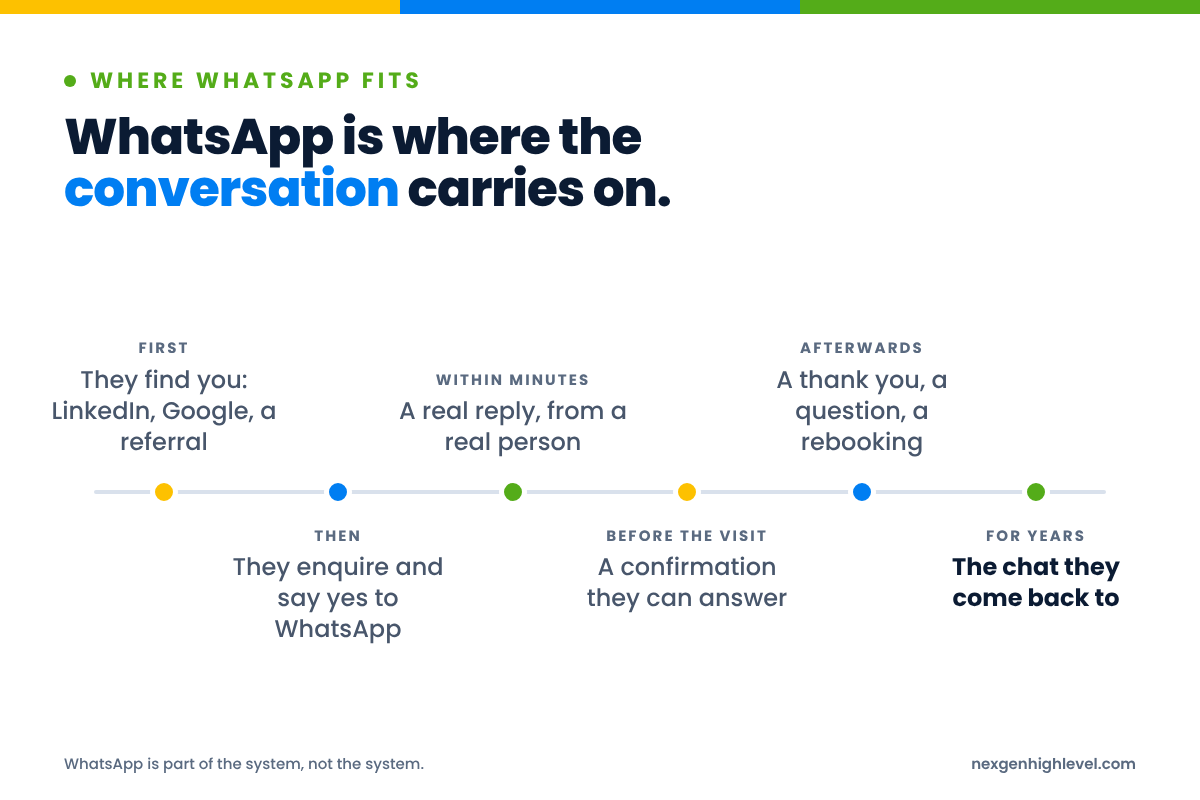
Where does WhatsApp genuinely earn its place? Mostly after someone has put their hand up. A few examples:
- The enquiry. Someone has a question and would rather message than ring. "Do you do evening appointments?" "Can you quote for a kitchen this size?"
- The booking. Confirming a time, sharing directions, answering the "Where do I park?" question before it's asked.
- The reminder. A friendly nudge before an appointment, with an easy way to confirm or rearrange.
- The follow-up. Checking in after a quote, a consultation or a first visit.
- The aftercare. "How's the new boiler behaving?" "Any questions about the treatment plan?"
- The return visit. A message, to people who've asked to hear from you, when it's genuinely time to come back.
- The referral. A happy customer is often one tap away from forwarding your number to a friend.
Notice what's not on that list. "Blasting a promotion to everyone who's ever walked through the door." Not on the list.
WhatsApp is part of the system, not the system
Customers don't live inside one channel. They see your Google listing, read your reviews, glance at a Facebook post, get an email, and then message you on a Tuesday night when they finally have a minute.
I call that combination marketing. The point isn't to pick the one perfect channel. It's to make the channels work together, so the customer gets a joined-up experience wherever they turn up.
WhatsApp is often where those threads come together into an actual conversation. Which is exactly why it can't sit on its own island, on one person's phone, disconnected from everything else you know about that customer. More on that shortly.
Why conversations beat broadcasts
So far, this has been mostly about manners. Let's talk about results, because good manners and good business usually point in the same direction.
Speed matters more than polish
There's a well-known piece of research on lead response by Dr James Oldroyd. His 2007 Lead Response Management study, as reported by InsideSales, found that the odds of a lead becoming qualified were 21 times greater when contacted within five minutes than at 30 minutes.
Five minutes versus thirty.
That study wasn't about WhatsApp. But think about what it tells you. When someone reaches out, there's a short window where they're interested, paying attention and ready to talk. Then life gets in the way. The kettle boils. The kids need picking up. Someone else replies first.
A messaging channel, where people already expect a quick back-and-forth, plays to that. It also means a slow reply is far more noticeable. People can see their message sitting there. Delivered. Read. Nothing.
That's the reply nobody sent, and it's the subject of our article on WhatsApp lead response.
Reminders work better as conversations
Here's another one close to my heart, given how many no-shows I watched clinics suffer.
A 2013 Cochrane review of mobile phone message reminders found that text reminders improved attendance compared with no reminders (a risk ratio of 1.14). Attendance was 67.8% with no reminders and 78.6% with text reminders. That's moderate-quality evidence from seven studies.
And there's newer work looking at WhatsApp specifically. A 2026 study of 475,214 health appointments in Buenos Aires found no-shows were 34.6% without reminders, and a single WhatsApp reminder about 24 hours before was linked to an 8.21 percentage-point reduction (a relative risk of 0.76). It's a preprint, so not yet peer reviewed, and it's healthcare in one city. But it's interesting, and it points the same way.
A reminder isn't just a notification. On WhatsApp, it's the start of a conversation. "Can't make it, can we do Thursday instead?" is a far better outcome than a silent empty chair.
We'll come back to that in the article on WhatsApp appointment reminders.
Lower friction, more honesty
There's a softer benefit, and it's one I've seen play out in other ways.
At the agency, we had a problem with our medical clients. We were technically very good: ads, funnels, follow-up, CRM. But the clients wouldn't give us content. Nothing at all, or two stock photos and a 14-second video filmed from what looked like six miles away. Put a camera in front of them and they froze.
So we built an app with prompts to take away the blank page and the fear of the camera. And it worked. Not because it was clever technology, but because we weren't really solving a content-production problem. We were solving a human-friction problem.
Customers have human friction too. Ringing a business feels like a commitment. Forms feel like you're about to be sold to. Email feels formal.
A quick message, on an app they already use all day, removes a lot of that friction. People ask the question they wouldn't have rung about. They tell you what they actually want. They mention the thing that's worrying them.
That's gold, if you're paying attention.
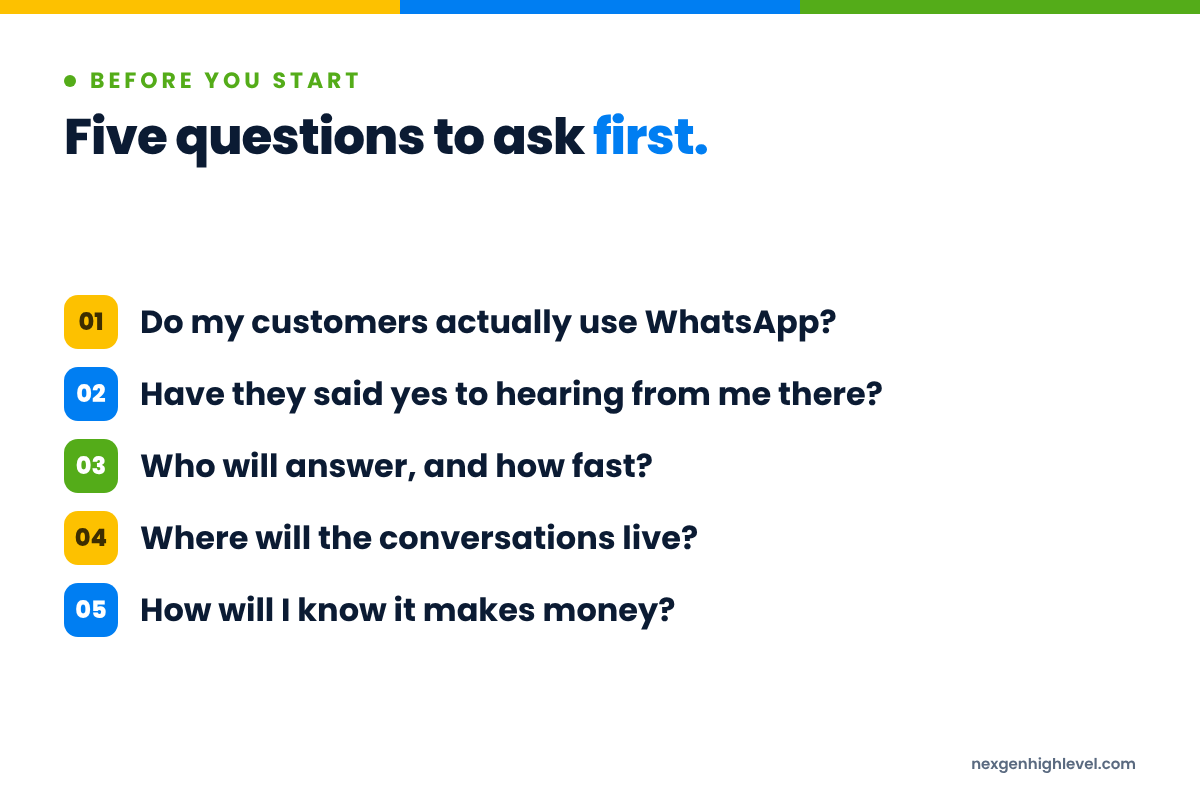
Five questions to ask before you use WhatsApp in your business
Before you set anything up, before any software, I'd sit down with a cup of tea and answer these honestly. This is my own framework at work: Human, Strategy, Leverage. In that order.
1. Who actually wants to hear from us here?
Not "Who could we message?" Who has asked to hear from you, or would genuinely welcome it?
Be specific. Existing customers with an upcoming appointment? People who've made an enquiry in the last month? Customers who've asked to be told when something is back in stock?
If the honest answer is "people who haven't agreed to it", stop there. That's not a WhatsApp conversation. That's a LinkedIn or email introduction, at best.
2. What do they want from us in this space?
People don't open WhatsApp hoping a business will message them. So when you do, it needs to be something they'd be glad to get.
The answer to their question. The confirmation they were waiting for. The reminder that saves them a wasted trip. The heads-up they asked for.
Here's a test I like. Would this message make sense if it came from a friend who happened to run your business? If not, rewrite it or don't send it.
3. Who replies, and how quickly?
This is where good intentions fall over.
It's easy to put "Message us on WhatsApp" on your website. It's harder to make sure someone actually answers in the evening, at the weekend, or when the person who usually handles it is on holiday.
Decide who owns the replies. Decide what a reasonable response time looks like. And if you're going to use an automatic acknowledgement, make it honest. "Thanks, we've got your message. Sarah's with a customer and will reply by 3pm" beats pretending a human is typing when they're not.
4. What do we do with what people tell us?
Every conversation tells you something. Their name. What they're interested in. What worried them. When they want to come in.
If that information stays in a chat on one person's phone, it's lost the moment that person changes jobs, loses their phone or simply forgets. It never reaches your follow-up, your reporting or the rest of your team.
Where does it go? Who can see it? How does it shape what happens next?
5. How will we know it's working?
Blue ticks are nice. Replies are nice. Lots of chats feel busy.
None of that pays the bills.
Decide up front what success means. More bookings that turn up? More quotes accepted? Customers coming back sooner? Then make sure you can trace a conversation through to revenue. Does it make any money? We'll keep writing about that one, because it's the question most people skip.
Your WhatsApp lives on a phone. Your business shouldn't.
Here's the problem I see over and over again with WhatsApp in small businesses.
It starts innocently. The owner uses their personal WhatsApp to answer a customer. Then another. Then a member of staff does the same on their phone. Before long, a big chunk of the business's customer conversations are spread across several personal phones, mixed in with family groups and holiday photos.
Nobody else can see them. Nothing gets recorded. Follow-ups depend on someone's memory. And if a phone gets lost, or a person leaves, those conversations leave too.
My memory is terrible, by the way. I remember useless facts from years ago and forget what I was told yesterday. If my customer relationships depended on it, I'd be in trouble.
Give the kitchen table a memory
This is where technology comes in. Third, not first.
Technology is leverage, not strategy. Leverage multiplies whatever is underneath it. If you're messaging people who never asked to hear from you, technology will help you annoy more people, faster, and probably lose your number along the way. If you're having real conversations with people who invited you in, technology helps you have more of them, and stops the good ones going cold.
If you multiply zero by a thousand, you've still got zero.
For us, the leverage is HighLevel. When your WhatsApp conversations live inside HighLevel alongside everything else, the kitchen table gets a memory. Picture it:
- Conversations puts WhatsApp messages in the same inbox as SMS, email and social messages, so your team works from one place.
- Every person is a Contact, with their history, notes and custom fields for the details that matter in your business.
- Tags and smart lists show who has opted in, who's an active enquiry and who's an existing customer, so the right people get the right messages and nobody gets messages they didn't ask for.
- Workflows handle the predictable parts: an honest acknowledgement, an alert to the right person, a reminder before an appointment.
- Calendars with confirmations and reminders keep bookings and conversations joined up.
- Opportunities and pipelines show which conversations are turning into real business, and what they're worth.
- User roles and assignment mean the right person picks up the conversation, and the owner can see what's going on.
- Reporting and attribution show what actually turned into revenue.
That's not a gadget. That's a business remembering its customers.
Built as part of HighLevel
When I first found HighLevel in 2020, it opened my eyes. But I kept noticing gaps. Some of the tools that claimed to work with it needed APIs or extra connectors, or just sat on a menu link looking a bit lost.
When we built our LinkedIn App, we made it part of HighLevel rather than a complement to it. It used what was already there: Workflows, Contacts, Tags, Conversations. That's the approach we've taken ever since.
It's why we built a WhatsApp App for HighLevel that connects your WhatsApp numbers into your HighLevel account, so those conversations sit with everything else you know about a customer. I'll go into it properly in the article on WhatsApp and HighLevel integration. For now, the point is simpler.
Whatever you use, get your business conversations off individual phones and into a system the business owns.
And if you'd rather start with a complete system already built for your type of business, take a look at our HighLevel Snapshots.
A word on the official route
You'll also come across the WhatsApp Business Platform, which is WhatsApp's API route. It's a real, official option, used mostly by larger businesses, with approved message templates and per-message pricing. For some organisations it's the right choice.
And the WhatsApp Business app has useful features for a small business on its own: greeting and away messages, quick replies, labels, a catalogue. If you're a one-person business just starting out, that may be plenty for now.
The question isn't which tool is best in the abstract. It's the one I always come back to: what problem in my business will this solve?
Mistakes that get businesses uninvited
Let's be practical. Here are the things I'd avoid, all of which come back to the kitchen table.
Treating WhatsApp like an email list
Sending your whole database the same promotion. It's bulk messaging, it's against WhatsApp's terms, and it's the guest who stands on the table and makes a speech.
Messaging people who never said yes
Bought lists. Scraped numbers. "They filled in a form two years ago for something else." No. If they didn't agree to hear from you on WhatsApp, don't message them on WhatsApp.
Writing like a company
"Dear Valued Customer, we are pleased to inform you..." Nobody talks like that at a kitchen table. Write like a person. Short. Warm. Specific. One clear question if you need a reply.
Pretending to be human when you're not
Automation can be genuinely helpful, and AI can help a business reply faster. But WhatsApp's policy expects businesses using automation to have "prompt, clear, and direct escalation paths", such as a way to reach a human. Don't hide behind a bot. Be honest about what's automatic, and make it easy to reach a real person.
Ignoring "stop"
If someone asks you to stop, stop. Straight away. Record it, so nobody on your team messages them again by accident. That's not just good manners. It's in the rules.
Going quiet
The opposite mistake. A customer messages, sees two blue ticks, and hears nothing for two days. On a channel where people expect a conversation, silence says a lot. None of it good.
Where we go from here
Every one of those mistakes has a better habit behind it. That's what we'll explore across these articles, and keep writing about as WhatsApp and customers change:
- Permission. Earning the right to message someone, and keeping it.
- Speed. Why the reply nobody sent costs more than you think.
- Ownership. Getting conversations off one phone and into HighLevel.
- Follow-up, messages and reminders. Staying in touch without chasing, writing messages people reply to, and why no-shows are a conversation problem.
- Teams, AI and return on investment. Who owns the chats, faster replies with the same human, and why blue ticks don't pay the bills.
Pick the one that matches the problem in front of you.
Frequently asked questions
Is WhatsApp worth it for small businesses?
It depends on whether your customers use it, so ask them. More than 3 billion people use WhatsApp, and plenty of them would rather message a business than ring it. For a small business, that can mean faster answers, fewer missed enquiries and better-attended appointments. The catch is that it only works if you treat it as a conversation with people who asked to hear from you, not as another advertising channel.
Can I use WhatsApp to send marketing messages to my customers?
Only to people who've given you their number and agreed to hear from you on WhatsApp. That's in WhatsApp's own Business Messaging Policy. Even then, think like a guest: send things they'd be glad to get, not a weekly promotion. And when someone asks you to stop, stop straight away. WhatsApp can limit or remove access for businesses that break its rules.
Can I send bulk WhatsApp messages or use it for cold outreach?
No. WhatsApp's Terms of Service forbid bulk messaging and auto-messaging, and numbers that spam people get restricted or banned. No tool makes a number ban-proof. Cold outreach belongs on LinkedIn and email, where people expect to hear from businesses they haven't met yet. WhatsApp is where the relationship carries on once someone has said yes.
What's the difference between the WhatsApp Business app and the WhatsApp Business Platform?
Broadly, the WhatsApp Business app is an app for small businesses, with things like greeting and away messages, quick replies, labels and a catalogue. The WhatsApp Business Platform is the API route, used mostly by larger businesses, with approved templates and per-message pricing. Neither is right for everyone. Start with the problem you're solving, then pick the route that fits it.
How does WhatsApp work with HighLevel?
The idea is to bring WhatsApp conversations into HighLevel, next to your SMS, email and social messages in Conversations, so they're linked to the right Contact, tagged, followed up by Workflows and tracked in your pipelines. That way the business owns the conversation, not one person's phone, and the next message is shaped by everything you already know about that customer.
Should WhatsApp replace SMS and email for my business?
I wouldn't replace anything. Customers move between channels, so the aim is to make them work together. Email is good for longer information and introductions. SMS still matters, especially for customers who don't use WhatsApp. WhatsApp suits quick, personal back-and-forth with people who've invited you in. Use each one for the job it does well, and keep them all in one place.
Pull up a chair
When I started in recruitment, I had a telephone, a filing cabinet and a phone directory. Every deal was done face to face.
The tools have changed beyond recognition since then. People haven't.
They still want to be listened to. They still want a straight answer, quickly. They still remember the business that treated them well, and they still quietly drop the one that didn't. People buy from people.
WhatsApp just puts all of that in the most personal place on their phone. Right between their family and their friends.
That's a privilege, not a target. If you're invited in, be useful, be human, be quick and know when to leave. Do that, and you won't need to shout.
Nobody ever got invited back to the kitchen table by shouting.