
WhatsApp Reminders: No-Shows Are a Conversation Problem
Picture the 10am slot. The room is ready. The clinician is ready. The coffee has been poured.
Nobody comes.
No call. No message. Just an empty chair and an hour of the day you can't sell to anyone else.
Most businesses treat that as a memory problem. Send a reminder, job done. And WhatsApp appointment reminders do help. The evidence says so, and I'll show you it. But after years of working with clinics, I've come to believe something slightly different.
A lot of no-shows aren't people who forgot. They're people who didn't feel able to tell you they weren't coming.
That's not a memory problem. It's a conversation problem. And conversations are exactly what WhatsApp is for.
The real cost of an empty chair
In my agency days, most of our clients were private medical practices in the US, with some in the UK.
A pattern kept turning up. A practice would rely on one channel, usually Facebook Ads. Results would get worse. No-shows and cancellations would rise. And agency after agency would try to fix the same channel. More ads. Different ads. Cheaper leads.
But the problem wasn't always at the top. Sometimes the leads were fine. The bookings were fine. The people just weren't walking through the door.
That's why we usually rebuilt things from the ground up, and why I've always said you should measure revenue and profit, not clicks or bookings. Bookings mean nothing if people don't turn up.
What a no-show actually costs
It's easy to think of a no-show as "one lost appointment". It's more than that.
- The slot itself. Time is the one thing a service business can't put back on the shelf. Once 10am has gone, it's gone.
- The money that bought the booking. The ad, the content, the follow-up, the staff time on the phone. All of it spent to produce an empty chair.
- The person who could have had that slot. Somebody else wanted an appointment this week and was told "next Thursday".
- The customer themselves. In healthcare, that's someone who needed care and didn't get it. In any business, it's a relationship that just got a bit more awkward.
- Your team's mood. Nobody enjoys sitting in a prepared room waiting for someone who isn't coming.
This isn't only a clinic problem. Dentists, physios, vets, salons, personal trainers, accountants, solicitors, tradespeople booking home estimates, consultants booking sales calls. If your business runs on a diary, you know this feeling.
And if you're an agency owner, you know a different version of it. The client who says "the leads are rubbish" when actually the leads booked and then didn't show. You can run brilliant ads and still lose the client in the gap between the booking and the door.
A booking isn't revenue. A booking is a promise. Attendance is the revenue.
A reminder is a notification. A confirmation is a conversation.
Here's where most reminder systems go wrong.
They send a notification. One way. Information out, nothing back.
"Reminder: your appointment is tomorrow at 10:00am."
The person reads it. Maybe. And then what? There's nothing to do. Nothing to answer. If they've had second thoughts, the message hasn't helped them tell you. It's just reminded them of the thing they've been quietly dreading or avoiding.
Now compare that with this:
"Hi Sarah, it's Emma at the practice. Just checking you're still good for tomorrow at 10 with Dr Patel? Reply YES to confirm, or let me know if you need to move it and I'll find you another time."
Same information. Completely different job.
That second message asks a question. And a question changes everything:
- It gives permission to say no. "If you need to move it" tells the person that moving is normal and nobody will be cross.
- It tells you early. A "no" at 3pm the day before is a slot you can still fill. A no-show at 10am is not.
- It creates a small commitment. Someone who has typed "yes" has said out loud that they're coming. That matters to people.
- It sounds like a person. Because it is one, or at least it's written by one and answered by one.
It's not a reminder. It's a conversation.
Why people really don't turn up
Ask yourself honestly why people miss appointments with your business. Not the reason they give afterwards. The real one.
Some of them did forget. Life is busy. Fine.
But think about the others:
- Something came up, and cancelling felt like a hassle. The only way to cancel is to ring during office hours, wait on hold, and explain yourself to a receptionist. So they don't.
- They're anxious. The dentist. The difficult conversation with the solicitor. The physio who's going to tell them to do the exercises they haven't done.
- They booked on impulse. They saw an ad at 11pm, felt motivated, booked. By Tuesday the motivation had gone.
- They're not sure what to expect. Where to park, how long it takes, what it costs, what to bring. Uncertainty makes staying at home feel easier.
- They've changed their mind, and they feel awkward telling you.
A notification only fixes the first one. A conversation can help with all of them.
If the only way to cancel is a phone call during office hours, you haven't got a reminder system. You've designed a no-show.
What the research says about appointment reminders
I don't want to sell you a feeling here, so let's look at what's actually been studied.
Text reminders: the Cochrane review
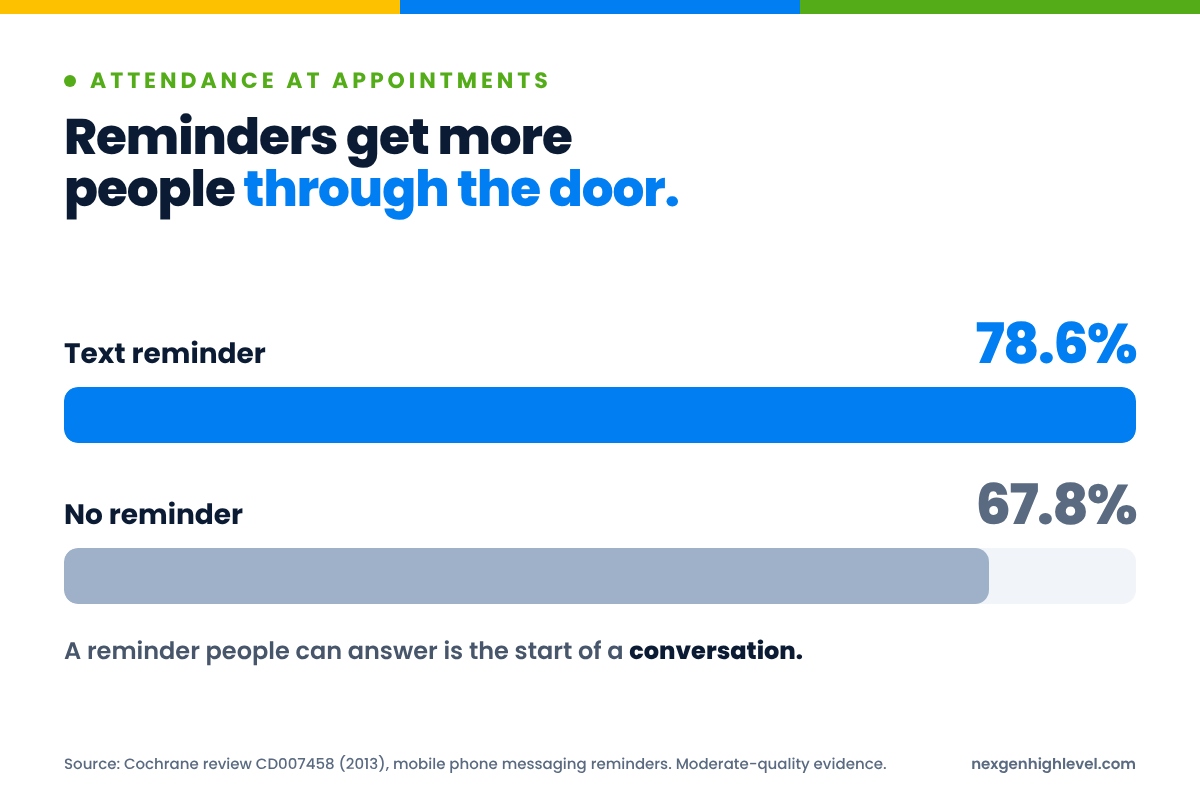
A Cochrane review of mobile phone message reminders, published in 2013, looked at reminders for healthcare appointments. It found text reminders improved attendance compared with no reminders, with a risk ratio of 1.14.
In plain English: attendance was 67.8% with no reminders and 78.6% with text reminders. That's based on moderate-quality evidence from seven studies.
So reminders help. That's the good news.
Now look at it the other way round. Even with text reminders, more than one in five people still didn't attend. The reminder closed part of the gap. Not all of it.
WhatsApp reminders: a large new study
More recently, a 2026 study looked at 475,214 health appointments in Buenos Aires. It's a preprint, so not yet peer reviewed, and it's worth holding it a little more loosely for that reason.
Without reminders, the no-show rate was 34.6%. A single WhatsApp reminder, sent about 24 hours before the appointment, was linked to an 8.21 percentage-point reduction in no-shows (a risk ratio of 0.76).
One message. One day before. Not a twelve-step sequence. Not an AI agent. One message, on the app people already had open.
What I take from it
Three things.
First, reminders are worth doing. If you're not sending any, that's the easiest win in this whole article.
Second, the channel matters less than people think, and the habit matters more. A reminder that arrives where people actually read their messages has a better chance of landing.
Third, and this is the bit I find interesting, both studies are mostly about one-way reminders. The research doesn't tell us how much more a two-way conversation adds. I'm not going to pretend it does.
But it's a question worth asking in your own business. If one simple message moves the number, what happens when that message makes it easy to reply, reschedule or ask a question? Don't take my word for it. Test it, and measure it.
Why WhatsApp suits reminders, when you've earned the right
More than 3 billion people use WhatsApp. For a lot of them, it's where family chats, friends and the important stuff live.
I've called it the kitchen table rather than the billboard. You're invited into a personal space, not handed a megaphone.
And here's the thing. Of all the messages a business could send on WhatsApp, an appointment reminder is about the most welcome one there is. It's about them. It's about their time. It's about something they asked for. It's useful.
That's why reminders are such a good place to start using WhatsApp in a business. The value is obvious to both sides.
Not everyone lives on WhatsApp
Be honest about your own customers. Some live on WhatsApp. Some would much rather have a text or an email. That varies a lot by market, by age and by community.
So don't guess. Ask.
"How would you like us to remind you: WhatsApp, text or email?" is a perfectly normal question at the point of booking. Write the answer down, and respect it.
Permission isn't a box to tick
WhatsApp's Business Messaging Policy is clear. You may only contact people on WhatsApp if they've given you their phone number and you've "received opt-in permission from the recipient confirming that they wish to receive subsequent messages" from you. You must also respect any request to block, stop or opt out, whether that request comes on WhatsApp or off it.
The WhatsApp Terms of Service go further. They forbid "bulk messaging, auto-messaging, auto-dialing, and the like". Numbers that spam get restricted or banned.
A reminder to someone who booked, gave you their number and asked to hear from you about their appointment is a very different thing from a blast to a list. But be honest with yourself about volume, about permission and about what you're actually sending. And no tool, ours included, makes a number "ban-proof". Anyone who tells you otherwise is selling you something.
One more rule, and I feel strongly about it. Your reminder list is not a marketing list.
Someone who agreed to be reminded about a dental check-up didn't agree to receive your summer whitening promotion on WhatsApp. If you want to market to them, ask separately. I've written more about earning that right in WhatsApp marketing opt-in.
You're a guest on WhatsApp. A reminder is a guest bringing something useful. A promotion nobody asked for is a guest who's opened your fridge.
The four conversations around every appointment
Think of an appointment not as one reminder, but as four small conversations. Each one has a different job.
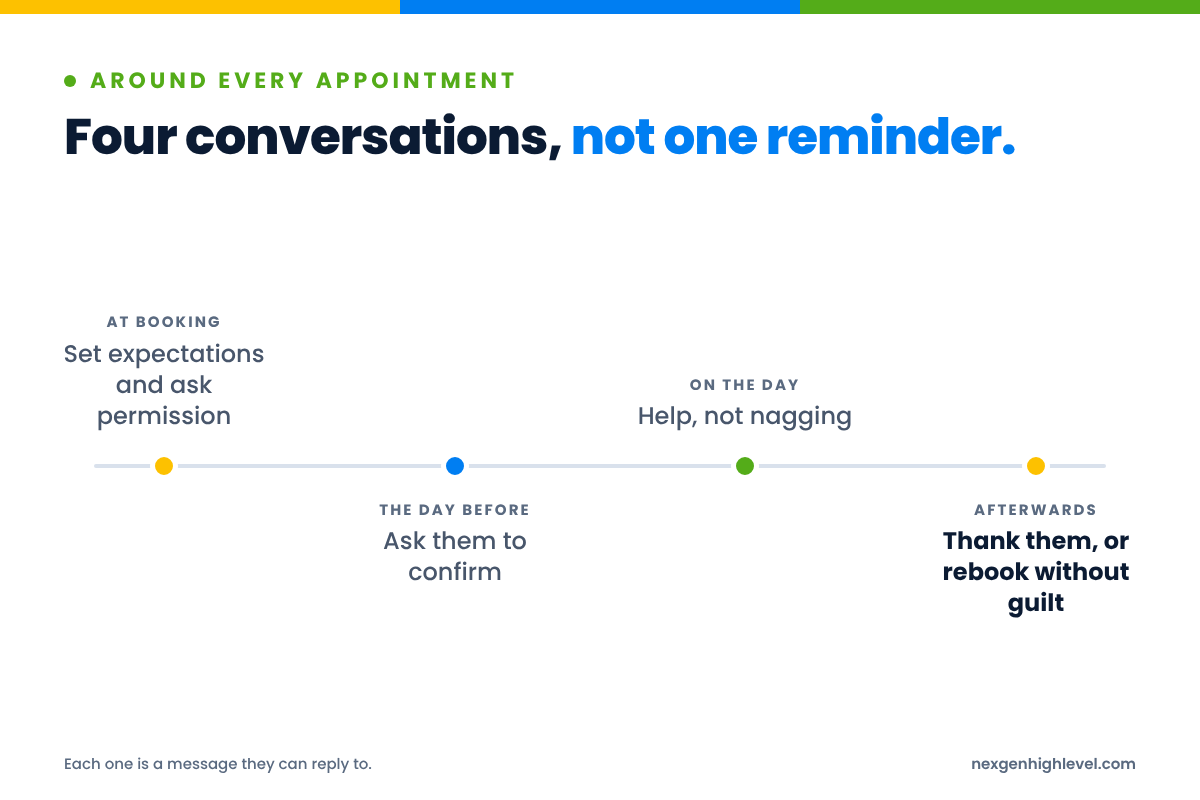
1. At booking: set expectations and ask permission
The first conversation happens the moment someone books. This is where most no-shows are prevented, long before any reminder goes out.
Its jobs:
- Confirm the basics: day, time, who they're seeing, where.
- Ask how they'd like to be reminded, and get a clear yes for WhatsApp if that's what they want.
- Answer the questions that make people nervous: how long it takes, what to bring, where to park, what it costs.
- Tell them, in a friendly way, how to move it if they need to.
Here's an example of what that might look like:
"Thanks Sarah, you're booked in with Dr Patel on Thursday at 10am. It takes about 40 minutes, and there's free parking at the back. If anything changes, just reply here and we'll sort out another time. No need to ring."
That last line is doing more work than it looks. It removes the hold music before it's ever needed.
If you have a cancellation fee, this is where you mention it. Calmly, clearly, at the start. Not as an ambush after someone's missed.
2. The day before: the confirmation question
This is the conversation the research looked at, give or take: a message about 24 hours before.
The difference is that you ask a question, and you plan for every answer.
- "Yes." Lovely. Mark them as confirmed, and thank them. That's it. Don't send three more messages.
- "I need to move it." This is a gift, not a problem. A real person picks it up quickly, offers a couple of times, and rebooks. Then the freed slot goes to someone who wanted an earlier appointment.
- A question. "Do I need to fast?" "Can my husband come in with me?" Someone answers it. Often, this is the real reason they were wobbling.
- No reply. Decide in advance what happens. For a routine appointment, maybe a short, friendly nudge the next morning. For a high-value consultation, maybe a phone call from a human.
What you're building isn't a message. It's a set of decisions about what happens next.
3. On the day: help, not nagging
The morning of the appointment, the job changes. They know they're coming. Now you're helping them arrive.
"See you at 10, Sarah. If you're running a few minutes late, just reply here and we'll let Dr Patel know."
Simple. Useful. And it turns "I'm late, I'll just not bother" into "I'm late, I'll send a quick message".
Be careful here, though. Not every appointment needs a day-of message. If you've already had a booking confirmation and a day-before confirmation, a third message for a 20-minute haircut isn't service. It's nagging.
4. Afterwards: thank, or rebook without guilt
If they came, the conversation after is about the relationship. A thank you. The next step. The follow-up appointment they should book now while they're thinking about it.
If they didn't come, this is the conversation most businesses get wrong.
The temptation is to lead with the policy. "You missed your appointment. A fee will be applied."
Picture how that lands with somebody who missed it because their child was sick, or because they were frightened.
Compare it with this example:
"Hi Sarah, we missed you today. Hope everything's OK. Would you like me to find you another time this week?"
You can still apply your policy if you have one. But lead with the person. You'll rebook more of them, and the ones you rebook won't feel like they're walking back in with their head down.
The no-show isn't the end of the conversation. It's often the start of an honest one.
Writing WhatsApp reminders people actually reply to
The words matter more than the software. Here are the rules I'd work to.
Sound like a person. Use their name. Use your name. Name the person they're seeing. "Your appointment has been scheduled" sounds like a machine. "You're booked in with Dr Patel" sounds like a practice that knows you.
Ask one question. Not "Reply YES to confirm, NO to cancel, R to reschedule, or call us on…". One question. Make the answer easy.
Make "no" as easy as "yes". This is the one that feels wrong. Surely you want to discourage cancellations? No. You want to discourage no-shows. A cancellation with notice is a slot you can still fill.
Include the one useful detail. The address, the parking, "bring your glasses", "wear something loose". The thing that saves them a worry.
Keep it short. If it needs scrolling, it's an email pretending to be a message.
Don't add links unless they help. A map link to a new location is helpful. A link to your blog in a reminder is not.
Think about voice notes for the nervous ones. For an anxious first-time patient, a short, warm voice note from the actual person they're seeing can do more than any written message. Not for every reminder. For the moments that matter.
Here's a quick contrast, as an example.
The notification:
"APPOINTMENT REMINDER: You have an appointment scheduled for 14/11 at 10:00. Please arrive 10 minutes early. To cancel call 555-0100 during business hours. Cancellations within 24 hours will be charged."
The conversation:
"Hi Sarah, it's Emma at the practice. Still good for tomorrow at 10 with Dr Patel? Just reply yes, or tell me if you need to move it and I'll sort it."
Which one would you answer?
I've gone into more detail on what makes people reply in WhatsApp messages people actually reply to.
Getting the timing right
There's no perfect timing for every business, so think about your own diary.
- About 24 hours before is what the Buenos Aires study looked at, and it's a sensible default for most appointments.
- For appointments booked weeks out, a confirmation at booking plus one a few days before gives you time to refill a slot if someone can't make it.
- For same-day or next-day bookings, one message is often plenty.
- For high-value or long appointments, consider whether a human phone call is worth more than any message.
Ask yourself: if this person says "I can't make it", how much notice do I need to fill the slot? Work backwards from that.
Building WhatsApp appointment reminders in HighLevel
Now, and only now, the technology.
Human. Strategy. Leverage. In that order.
The human bit is understanding why your customers don't turn up. The strategy is the four conversations and the words you use. The leverage is making sure every one of those conversations happens, every time, without depending on whether Emma on reception had a busy morning.
Technology is leverage, not strategy. Leverage multiplies whatever is underneath it. Automate a cold, one-way notification and you'll send more cold, one-way notifications. Automate a warm conversation with a human ready to pick up the replies, and you'll have more of those conversations.
Here's how the pieces fit together in HighLevel.
Capture permission at the point of booking
- Calendars take the booking and handle confirmations and reminders.
- Forms and surveys can ask the preferred reminder channel and record a clear opt-in for WhatsApp.
- Custom fields hold that preference, along with anything useful for the conversation: who they're seeing, first visit or returning, any notes.
- Tags mark who has opted in to WhatsApp reminders, and keep that separate from anyone who has opted in to marketing.
That separation is important. Your reminder workflow should only ever touch people who said yes to reminders.
Let Workflows run the rhythm
Workflows can start when an appointment is booked, or when its status changes. From there, the rhythm of the four conversations is just a series of steps: send the booking confirmation, wait until the day before, ask the confirmation question, then branch on what happens next.
- A "yes" adds a confirmed tag and moves on.
- A request to move it alerts the right person and assigns the conversation to them.
- No reply after a set time triggers the gentle nudge or a call task for a human.
- A no-show starts the rebooking conversation.
Keep every reply in one place
This is where most reminder systems fall over. The message goes out automatically. The reply goes… somewhere. A shared phone in a drawer. Somebody's personal WhatsApp. Nowhere at all.
In HighLevel, Conversations is the unified inbox, so replies sit next to the contact's texts, emails and history. User roles and assignment mean the right person sees the "can I move it?" message quickly and deals with it.
That matters for more than convenience. WhatsApp's Business Messaging Policy says businesses using automation "must also have available prompt, clear, and direct escalation paths", such as transfer to a human agent. A reminder system where nobody reads the replies isn't just bad service. It's missing the point of the channel.
If you want WhatsApp itself inside HighLevel, so those replies land in Conversations and can be part of your Workflows, that's exactly why we built the WhatsApp App for HighLevel. It's built as part of HighLevel, not bolted on beside it.
See the whole journey, not just the booking
- Opportunities and pipelines can show each appointment moving from booked, to confirmed, to attended, or to missed and rebooked, with a value against it.
- Smart lists can show everyone who missed an appointment and hasn't rebooked, so nobody quietly drops off the edge.
- Reporting and attribution can connect attended appointments back to where the customer came from.
That last one is where agency owners should pay attention. If you're running ads for a clinic, being able to show that a lead booked, confirmed and attended is a very different conversation from "we got you 60 leads this month".
If you'd rather not build all of this from scratch, our HighLevel Snapshots are complete business systems, built out for particular types of business. And if you're not on HighLevel yet, you can create a HighLevel account through NexGenHighLevel.
But a notebook, a diary and a kind message the day before will beat a clever system that sends cold notifications. Get the conversation right first.
Measure attendance, not bookings
Most businesses measure the wrong end of this.
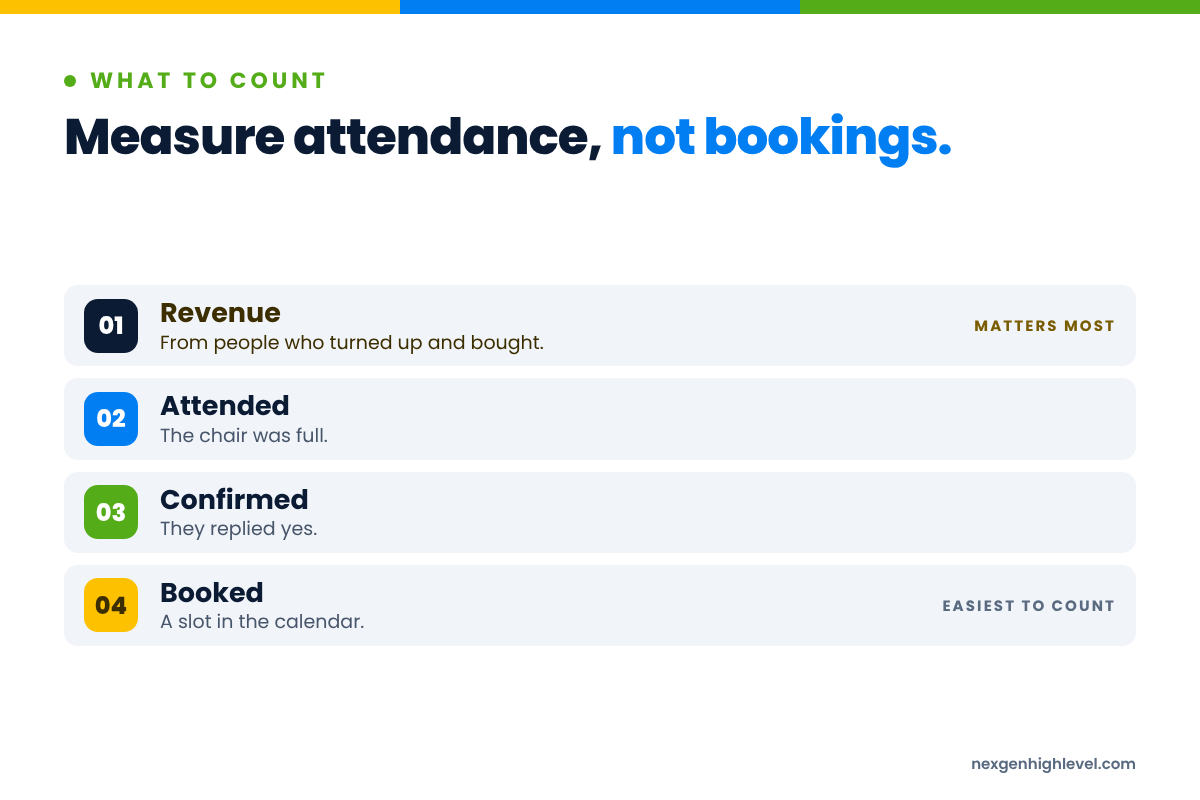
They count bookings. Bookings feel good. They go up when the ads are working. They make a nice chart.
But the number that pays the bills is attendance. So start tracking the things that sit between a booking and a paying customer.
- Show rate. Of the appointments booked, how many actually attended?
- Confirmation rate. Of the day-before messages sent, how many got a reply?
- Saved slots. How many people moved their appointment with notice instead of not turning up, and how many of those slots did you refill?
- Rebook rate after a no-show. Of the people who missed, how many came back?
- Revenue from attended appointments. Not booked. Attended.
Then be honest with yourself.
Look at your numbers before you change anything. Make one change at a time. Give it a month. Look monthly, and decide quarterly.
Don't expect your results to match a study from Buenos Aires or a Cochrane review. Your customers, your services and your diary are your own. What you're looking for is whether your show rate is moving in the right direction, and whether the conversations are getting easier.
Questions to ask yourself this week
- If someone needs to cancel tomorrow, how easy is it, honestly?
- Do our reminders ask a question, or just state a fact?
- When someone replies to a reminder, who sees it, and how quickly?
- Do we know our show rate, or only our booking numbers?
- When someone misses, what's the first thing we say to them?
If any of those made you wince a little, good. That's where the work is.
Frequently asked questions
Do WhatsApp appointment reminders reduce no-shows?
The evidence suggests reminders help. A 2013 Cochrane review found text reminders raised healthcare attendance from 67.8% to 78.6%. A large 2026 study in Buenos Aires, a preprint so not yet peer reviewed, linked a single WhatsApp reminder about 24 hours before with an 8.21 percentage-point drop in no-shows. Your results will depend on your customers and your messages. Make it a conversation, then measure it.
Is it allowed to send appointment reminders on WhatsApp?
Yes, with permission. WhatsApp's Business Messaging Policy says people must have given you their number and opted in to hear from you. You must respect any request to stop. WhatsApp's terms also forbid bulk messaging and auto-messaging, and numbers that spam get restricted or banned. So ask at booking, record the answer, and only send people the reminders they agreed to.
How far in advance should I send an appointment reminder?
About 24 hours before is a sensible default, and it's what the Buenos Aires study looked at. But work backwards from your diary. If you need two days to fill a cancelled slot, ask two days before. For appointments booked weeks ahead, confirm at booking and again a few days out. Don't overdo it. Three reminders for a short appointment starts to feel like nagging.
What should a WhatsApp appointment reminder say?
Keep it short and human. Use their name and yours, mention who they're seeing, ask one question, and make it as easy to say "I need to move it" as "yes". Add the one detail that saves them a worry, like parking or what to bring. Something like: "Still good for tomorrow at 10 with Dr Patel? Just reply yes, or tell me if you need to move it."
Can HighLevel send WhatsApp appointment reminders automatically?
HighLevel calendars handle confirmations and reminders, and Workflows can start when an appointment is booked or its status changes, wait until the right moment, then send and branch on the reply. With WhatsApp connected to HighLevel, replies land in Conversations next to texts and emails. The important part isn't the automation. It's making sure a real person picks up the replies quickly.
Should I charge a fee for no-shows?
That's your call, and plenty of businesses do. If you have a policy, explain it calmly at the point of booking, not as an ambush afterwards. And when someone misses, lead with the person rather than the fee. "We missed you today, hope everything's OK" rebooks far more people than an invoice. You can still apply the policy. Just don't make it the first thing they hear.
The empty chair
I think about those clinics a lot.
Good practices. Good clinicians. Decent marketing, a lot of the time. And still that empty chair at 10am, with everyone looking at the door.
The fix was rarely more ads. It was usually somewhere in the gap between "you're booked" and "come on in". The phone nobody answered. The cancellation nobody felt able to make. The question nobody asked.
People buy from people. They turn up for people too.
Send a reminder and some will remember. Start a conversation and they'll tell you what's really going on.
Most empty chairs are just conversations nobody started.