HighLevel vs Pipedrive comes up a lot when I talk to business owners. And I get why. Both have a pipeline. Both move deals from left to right. Both look tidy on a screen.
But a pipeline is only one part of how a business makes money.
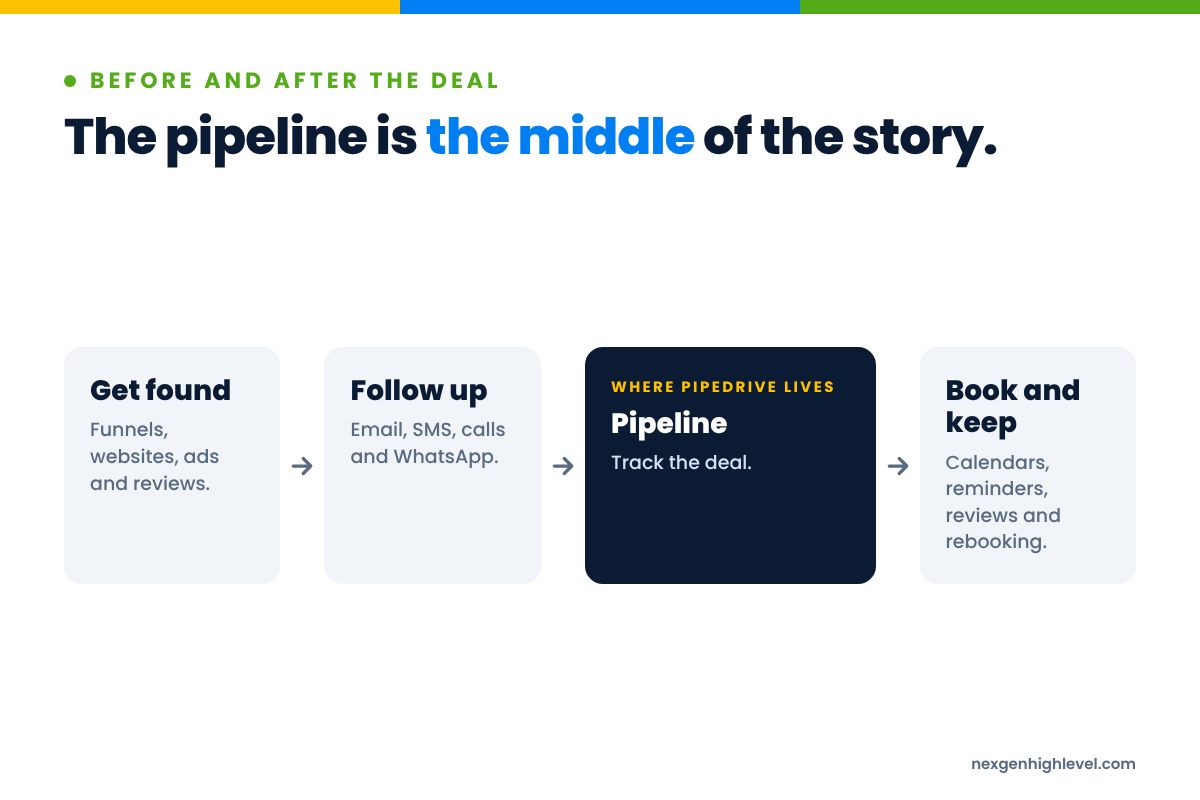
Before a deal lands in the first column, somebody had to find you. Click something. Fill in a form. Book a call. Get a reminder so they actually turn up. And after the deal is won, somebody has to ask for a review, send the invoice, and keep that customer coming back.
Pipedrive is a very good sales pipeline. I'll say that plainly, and I'll say why.
HighLevel is something different. It's the whole system around the pipeline: the marketing, the booking, the follow-up, the reviews, the AI, and a way for agencies to run all of it for their clients under their own brand.
It's not "which pipeline is nicer". It's "which platform runs the business".
That's the comparison worth making. So let's make it properly.
HighLevel vs Pipedrive at a glance
Everything on the Pipedrive side comes from its own pages, checked on 25 October 2026. Where it doesn't list a native feature, I've said "not listed", not "can't".
| HighLevel | Pipedrive | |
|---|---|---|
| Who it's for | Agencies and small and medium businesses; calls itself "the AI-powered business operating system" | A sales CRM; used by more than 105,000 companies |
| CRM and pipelines | CRM, sales pipelines, lead scoring, smart lists | Lead, pipeline and calendar management (its core strength) |
| Email, SMS and phone | Email, SMS, WhatsApp and Messenger broadcasts; one conversation stream; missed call text-back; call tracking; ringless voicemail | Email sync and tracking; email marketing (Campaigns) is an add-on; SMS not listed on the features page; calling via the mobile app or Marketplace phone apps |
| Funnels and websites | Websites, funnels, landing pages, forms, surveys, quizzes | Not listed on the features page |
| Calendars and booking | Calendars, appointment reminders, paid calendars | Calendar management; meeting scheduler on Growth and above |
| Reviews and reputation | Reputation management, automated review requests, AI review reply | Not listed on the features page |
| Courses and memberships | Membership offers, courses and communities | Not listed on the features page |
| AI | Voice AI, Conversation AI, Content AI, AI review reply | AI report creation and Pipedrive Nova meeting intelligence |
| App marketplace | 1,500+ apps; developers publish apps that install natively; HighLevel handles billing | 500+ integrations; developers can build apps for all Pipedrive users |
| Whole-account templates | Snapshots: a whole account setup packaged and loaded in one go | 36 automation templates, each creating one automation; no packaged account template found |
| White-label for agencies | Full white-label, unlimited sub-accounts on higher agency plans, SaaS mode | Solution Provider Partner programme to resell Pipedrive licences; no white-label mentioned |
| Pricing model | Flat agency subscription with unlimited users; usage-based phone, email and AI | Per seat, four tiers, with paid add-ons |
Sources for the Pipedrive column: features, pricing, marketplace, automation templates and the partner programme. HighLevel's column comes from its homepage and pricing page.
Look down the right-hand column. A lot of it says "not listed". That's the real story of Pipedrive vs HighLevel.
That isn't a criticism. Pipedrive has chosen to be a sales CRM. The question is whether a sales CRM is what your business needs.
What Pipedrive does well, and who it suits
Pipedrive started in an Estonian garage in 2010 and built a sales CRM that salespeople genuinely like using. That's rarer than it sounds. I spent nearly 23 years in recruitment, and I can tell you most salespeople would rather do anything than update a CRM.
Pipedrive made the pipeline visual and simple. You see your deals. You drag them along. You know what to do next. It's grown to more than 105,000 companies across 180+ countries, and that doesn't happen by accident.
Its pricing page also lists email sync and tracking, automations, nurturing sequences, a meeting scheduler, e-signatures and Pipedrive Nova for meeting intelligence.
If you run a sales team that gets its leads from somewhere else, and your only job is to work those leads and close them, Pipedrive does that job well.
But most small businesses I talk to aren't a sales team with a pipeline to manage. They're the marketing department, the sales team, the receptionist and the accounts office, all at once. Often the same person.
A pipeline isn't a business system
This took me years to learn in my agency.
When we worked with US medical practices, the clients who struggled rarely had a pipeline problem. They had a "nothing joined up" problem. Great ads still failed if the offer was weak, the website confusing, the phone unanswered, or sales took three days to call back.
You could have given them the best pipeline in the world. It would have sat there looking lovely and empty. That's why we built whole systems, not just campaigns.
A deal pipeline tells you where your deals are. A business system makes sure there are deals in it, and that they move.
What sits around the pipeline in HighLevel
HighLevel groups its features around the customer journey: Capture, Nurture, Close, Evangelise, Reactivate. Roughly, it looks like this, all from HighLevel's own feature list:
- Capture. Websites, funnels, landing pages, forms, surveys, quizzes, QR codes, webinar funnels, an ad manager for Google and Meta ads, and a social planner.
- Nurture. Workflows and automations, email, SMS, WhatsApp and Messenger broadcasts, missed call text-back, ringless voicemail and one consolidated conversation stream.
- Close. The CRM and sales pipelines, calendars, appointment reminders, estimates and proposals, invoicing, Text-2-Pay and order forms.
- Evangelise. Reputation management, automated review requests, AI review replies and video reviews.
- Reactivate. Smart lists, segmentation and broadcast campaigns to bring past customers back.
Then there's the AI layer: Voice AI that answers calls, Conversation AI that chats with website visitors, Content AI, and more.
Now compare that with the gaps on Pipedrive's side. Its features page doesn't list SMS, websites or funnels, reviews and reputation, courses or memberships, a social planner, or payments and invoicing as native features. Payments, for example, appear as an integration category in the Marketplace. Email marketing itself is a paid add-on called Campaigns, according to the pricing page.
So with Pipedrive, the pipeline is the centre and you connect everything else to it.
With HighLevel, the pipeline is one part of a system that's already connected.
Why "connected" matters more than "more features"
I'm not a fan of feature-counting. The point isn't that HighLevel has a longer list. It's what happens between the features.
Someone fills in a form on your website. In HighLevel, that same contact is now in your CRM, tagged, dropped into a pipeline stage, sent a text within a minute, offered a booking link, reminded the day before the appointment, and asked for a review after the job. One contact record. One workflow. One place to see the conversation.
When those pieces live in different tools, every handover is a gap. And leads always find the gaps.
The question I'd ask any business owner is simple. What problem in my business will this solve?
If it's "my salespeople need a clearer view of their deals", Pipedrive will help. If it's "I need more leads, followed up properly, turning up and paying", you need the system, not just the pipeline.
And if you run an agency
This is where the two platforms really part ways, and it's why so many agency owners go looking for a Pipedrive alternative.
Pipedrive has a Solution Provider Partner programme. Partners "market and resell Pipedrive along with their professional services" and "earn competitive margins on Pipedrive licenses". The programme was revamped in June 2025 with Authorized, Gold and Platinum tiers, and more than 700 partners. That's a real programme. But you're reselling Pipedrive, as Pipedrive. No white-label is mentioned.
HighLevel was built for agencies from day one. Its 2018 mission was to give "agencies the tools to automate, scale and deliver stronger results", per its about page.
In HighLevel, an agency subscribes at the agency level and runs a sub-account for each client. The higher agency plans give unlimited sub-accounts. You can white-label the platform so all traces of HighLevel branding are removed, on your own login domain. With SaaS mode, you can build your own plans, set your own pricing and sell the software as your own. You can rebill phone and email usage, and on the Agency Pro plan, add a markup.
That's the difference. With Pipedrive, an agency earns a margin on someone else's product. With GoHighLevel, an agency can own the product its clients log into.
HighLevel vs Pipedrive: platforms you can build on
A platform isn't just what it does on day one. It's what other people can build on top of it. On that score, the gap between HighLevel and Pipedrive is wider than the feature table suggests.
The HighLevel App Marketplace
The HighLevel App Marketplace lists more than 1,500 apps. Developers register, build an app and publish it after review.
Three things make it different from a list of integrations.
First, apps install natively into HighLevel accounts and sub-accounts. They show up where you work, not in a separate tab you have to remember.
Second, HighLevel runs the money. Developers can charge free, subscription, one-time, freemium or usage-based pricing, and HighLevel handles billing and payouts. As of today, HighLevel says it currently takes no commission.
Third, and this is the big one for agencies: agencies can resell marketplace apps to their own clients with their own markup, and the base price is hidden from the sub-account. So an app isn't just a tool for the agency. It's something the agency can package and sell.
Snapshots: a whole account in one go
The second thing you can build on HighLevel is a Snapshot.
HighLevel's own definition: Snapshots are "reusable templates that capture selected configuration assets from a HighLevel sub-account" so they can be copied into other sub-accounts.
That covers a lot: funnels and websites, forms, workflows and triggers, pipelines, custom fields and tags, calendars, email and text templates, Conversation AI and Voice AI agents, membership products, dashboards and review settings.
You load a Snapshot into an account, choose what to import, and the whole setup arrives. You can even create a brand-new sub-account straight from one.
Third parties can sell Snapshots on the App Marketplace too, and buyers push them straight into their own accounts. That's a real market for complete, ready-built business setups.
What Pipedrive offers on both points
Let's be precise and fair here.
Pipedrive does have a marketplace. Its pricing page includes 500+ integrations on every plan, and developers can build apps "for either your company or for all Pipedrive users", reaching over 100,000 companies. That's a healthy ecosystem for a sales CRM.
What I couldn't find on Pipedrive's official pages is any description of selling apps through the Marketplace, or of white-labelled apps for agencies to resell. Pipedrive doesn't publish a built-in model for it the way HighLevel does.
On templates, Pipedrive offers 36 pre-made automation templates, and each template creates one automation. Useful, but small in scope.
Pipedrive doesn't offer a packaged account template like a Snapshot, as far as its published docs show. There's no feature described for packaging a whole setup (pipelines, fields, automations and so on) and loading it into another Pipedrive account, and no template marketplace.
So here's the honest summary.
| HighLevel | Pipedrive | |
|---|---|---|
| Apps install natively | Yes, from the App Marketplace | Yes, Marketplace apps and integrations |
| Platform handles app billing | Yes, with payouts to developers | Not described on official pages |
| Agencies resell apps with markup | Yes | Not described |
| Packaged whole-account setup | Snapshots | Not offered, per published docs |
| Marketplace for ready-built setups | Yes, Snapshots sold on the App Marketplace | No template marketplace found |
One automation template saves you an afternoon. One Snapshot can save you months.
How our apps help you get more out of HighLevel
When I found HighLevel in 2020, its line was "Capture, Nurture, Close". Brilliant once somebody shows interest. But I kept asking the same question. Where's the prospecting? Where's the outreach? Where's the market creation?
Nobody was filling that gap, so we started building. You can see everything we've built on our HighLevel apps page.
And here's the rule we built by. Every app is part of HighLevel, not a complement to it. They use what's already there: Workflows, Contacts, Tags and Conversations. No API projects. No Zapier, no Make, no n8n.
For anyone coming from Pipedrive, two of our apps matter most, because they cover the bits a sales team leans on hardest.
LinkedIn for HighLevel: prospecting that feeds the pipeline
A pipeline is only as good as what goes into it.
Our LinkedIn for HighLevel app brings LinkedIn prospecting inside HighLevel sub-accounts. You find the right people, enrich their email addresses, import them as contacts, and run outreach from the same place you run everything else.
We first built it for one client who needed it. The other LinkedIn tools all offered the same basic outreach, and none of them sat inside HighLevel. Adding email enrichment changed things. Our users could find their ideal customer, reach them on LinkedIn and by email, and nurture them in HighLevel Workflows. For those first clients, outreach went up. So did leads, sales, revenue and profit.
Agencies can white-label it and resell it to their own clients, too.
If prospecting is a big part of how you sell, I've written more on LinkedIn prospecting inside HighLevel.
WhatsApp for HighLevel: talking to people where they already are
Salespeople spend all day talking to people. And more of those people would rather message than take a call.
Our WhatsApp for HighLevel app connects your existing WhatsApp or WhatsApp Business number with a QR code. No Meta API approval needed. Chats come into HighLevel Conversations, and your Workflows can send messages and follow up automatically.
There's a standard version for businesses and an agency white-label version, and both install from the HighLevel App Marketplace.
Speed matters. I've gone into why in faster WhatsApp lead response.
Together, they cover the front end a pipeline-only CRM leaves to somebody else: finding people, starting conversations and following up.
Every one of our apps is included when you get HighLevel through NexGenHighLevel. More on that further down.
Why Snapshots make starting with HighLevel easier
Here's the fair objection to everything I've said so far.
"Jay, HighLevel does a lot. That sounds like a lot to set up."
It's a good objection. A blank HighLevel account can feel like walking into an empty warehouse. All that space, and nothing on the shelves.
That's exactly what a Snapshot fixes.
What a NexGenHighLevel Snapshot actually is
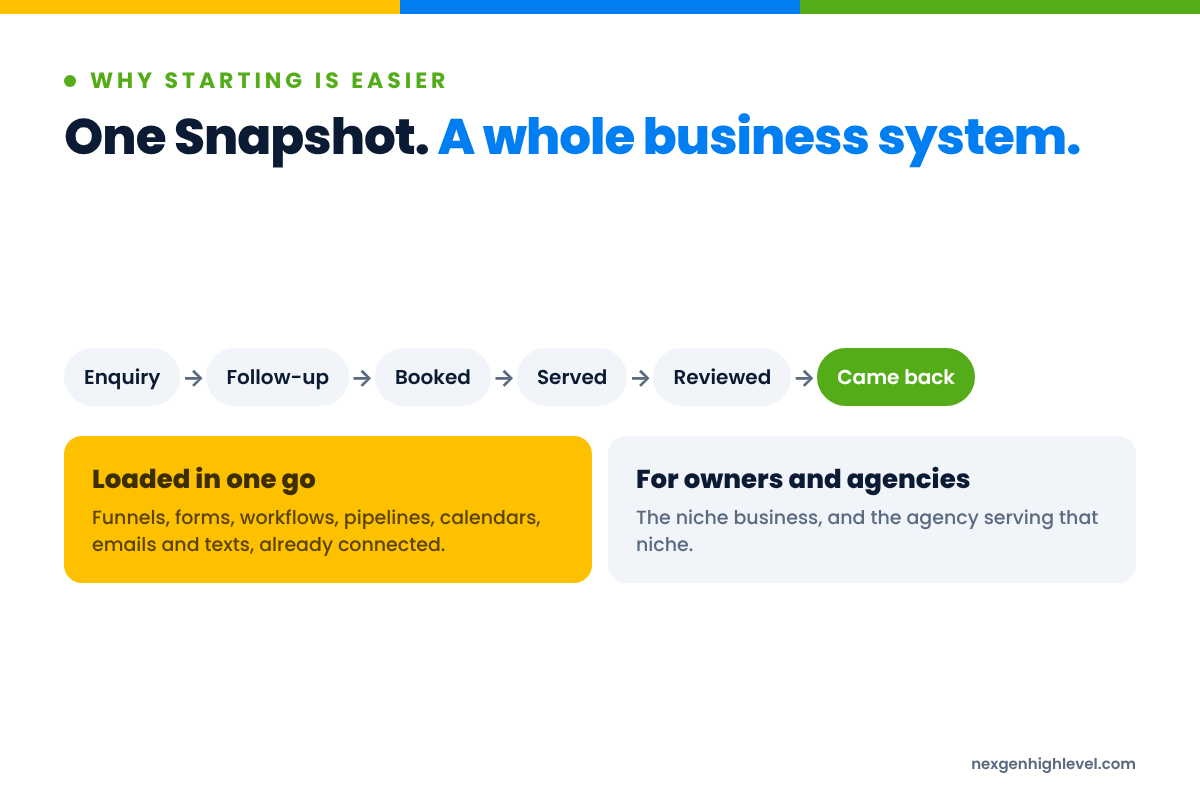
A NexGenHighLevel Snapshot is a complete, fully built-out business system for a niche, loaded into your HighLevel account. A business system in a box.
Funnels, forms, workflows, pipelines, calendars, emails and texts, and AI features, all connected around the whole client journey. From the moment someone first finds the business, through booking and follow-up, to paying, reviewing and coming back.
It is not a starter pack.
And not all Snapshots are equal. A typical Snapshot on the market might be a couple of funnels, a few workflows and one pipeline. That's a useful start, but you're still left building the system yourself. Ours are built out across the whole journey, so the pieces already talk to each other.
I've written about the thinking behind it in the HighLevel Snapshot as a business in a box.
For the business owner and the agency
A Snapshot works for two people.
If you run the business yourself, it means you start with a working system on day one, instead of learning HighLevel by trial and error while your leads wait.
If you're an agency serving a niche, it means every new client in that niche starts from the same proven setup. You spend your time on their offer and their market, not on rebuilding the same workflows again.
Our live Snapshots include:
- The Social Media Marketing Agency (SMMA) Snapshot, for agencies running their own business on HighLevel.
- The HVAC Snapshot, for heating and cooling businesses and the agencies who serve them.
- The Landscaping and Lawn Care Snapshot, built around seasonal, local, repeat work.
There's also Credit Repair, and more niches are on the way. You can see them all on our HighLevel Snapshots page.
Compare that with what a pipeline-only setup gives you on day one: a board with some columns. Everything else, you build yourself, often in other tools.
I'll only make one claim about results, because it's the one I can stand behind. Clients have used Snapshots to skip months, if not years, of trial and error building a system.
Walk before you run, yes. But you don't have to build the road first.
HighLevel's growth vs Pipedrive over the last five years
Only published numbers here, with dates and sources. No estimates.
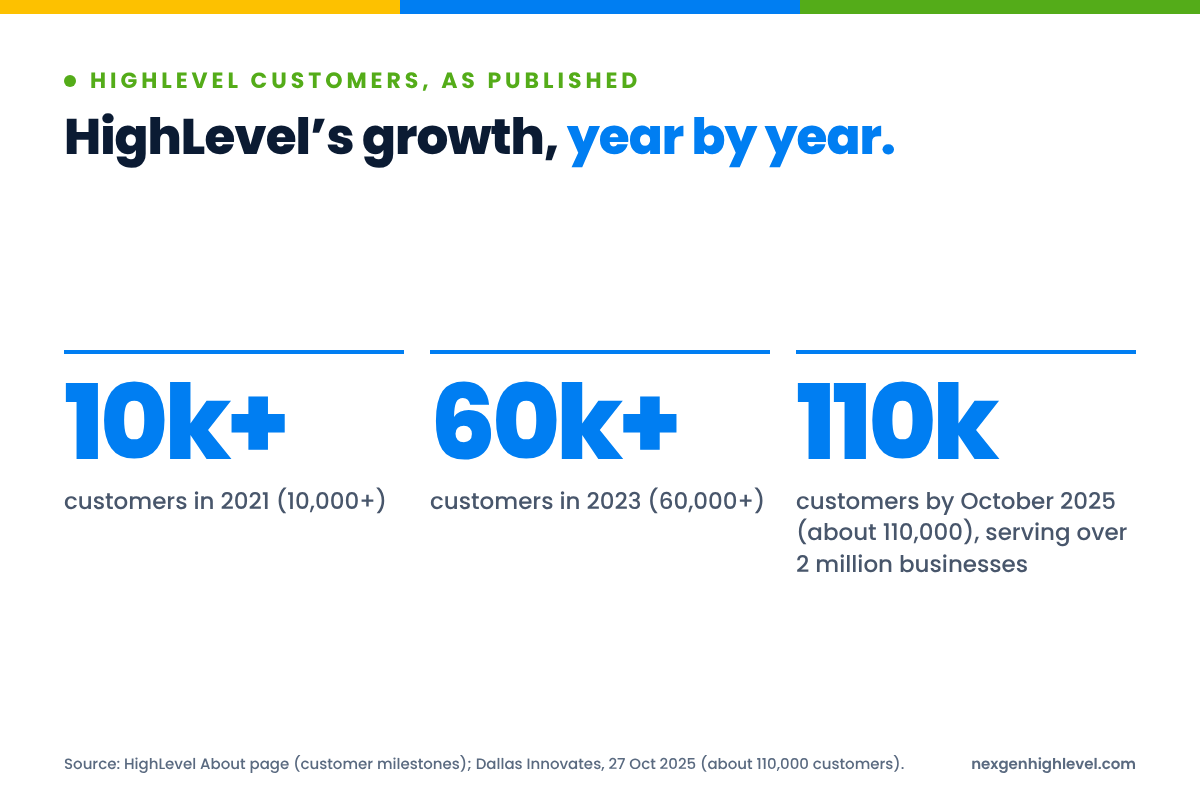
First, what's comparable? Neither company publishes its own revenue for recent years. HighLevel is private and doesn't publish revenue. Pipedrive is majority-owned by Vista Equity Partners and hasn't published revenue or valuation figures since 2020, as far as I could find.
What both do publish is a customer count. So that's the fairest like-for-like.
| Year | HighLevel customers | Pipedrive companies |
|---|---|---|
| 2020 | 5,000+ (about page) | 95,000+ (Vista release, Nov 2020) |
| 2021 | 10,000+ (about page) | 95,000+ (Nov 2021) |
| 2022 | 20,000+ (about page) | 100,000+ (Jun 2022) |
| 2023 | 60,000+ (about page) | 100,000+ (Mar 2023) |
| 2025 | About 110,000 (Dallas Innovates, Oct 2025) | 100,000+ (Jun 2025) |
| 2026 | Not yet published | 105,000+ (Sep 2026) |
The arithmetic is simple.
HighLevel went from 10,000+ customers in 2021 to about 110,000 in 2025. That's roughly eleven times bigger in four years.
Pipedrive went from 95,000+ companies in 2021 to 105,000+ in 2026. That's growth of roughly 10% over five years.
To be fair: in 2021, Pipedrive had far more customers than HighLevel, and holding a customer base that size for years is no small thing. Most of these figures are also "more than" numbers, so they're floors, not exact counts.
But the direction is clear. HighLevel started well behind and is now at a similar customer count, and still climbing.
It's not just customers
A HighLevel customer isn't one business. Many are agencies running dozens or hundreds of client sub-accounts.
That's why HighLevel reports two kinds of number. As of October 2025, about 110,000 customers, and over 2 million businesses using the platform through them.
Other published signals point the same way:
- In April 2024, HighLevel said it had grown "more than 5x" over the prior three years while staying profitable, when General Atlantic made a minority investment.
- HighLevel was ranked on the Deloitte Technology Fast 500 three years running: No. 47 in 2023, No. 103 in 2024, and No. 116 in 2025 with 781% revenue growth from 2021 to 2024.
- It made the Inc. 5000 in 2025 at No. 516, its third year in a row on the list.
Pipedrive hasn't published a revenue growth figure for the same years, so there's nothing to set beside those percentages. I'm not going to guess one.
Growth doesn't make a platform right for you. But it tells you where developers, agencies and new features are heading. Right now, that's HighLevel.
Who should choose Pipedrive, and who should choose HighLevel
Short and fair.
Pipedrive could be the better fit if:
- You run a sales team whose leads come from somewhere else, and you only need to manage and close deals.
- Your marketing, website, booking and reviews are already handled well elsewhere.
- You want a focused, visual sales CRM and nothing else.
HighLevel is the better fit if:
- You're a small or medium business that needs to attract leads, follow them up, book them in, get paid and get reviewed, all in one place.
- You want texting, calls, WhatsApp, email and chat in one conversation stream.
- You want AI that answers calls and chats, not just AI that writes reports.
- You'd rather pay a flat platform price than add another seat every time you hire someone.
- You run an agency and want to white-label the platform, give every client their own sub-account, and resell apps and Snapshots under your own brand.
For most small businesses I talk to, that second list is them. And for agencies, it's not even close. If you're looking for a Pipedrive alternative that covers the whole business rather than one stage of it, HighLevel is where I'd point you.
If you're weighing up other platforms too, I've also compared HighLevel vs HubSpot.
Switching from Pipedrive to HighLevel
Moving platforms sounds worse than it is. If you've decided GoHighLevel is the Pipedrive alternative for you, here's what it involves in practice.
1. Export your data from Pipedrive
Export your contacts, organisations and deals, then import them into HighLevel and recreate your deals in a HighLevel pipeline. Tidy them up first. There's no point moving a mess.
2. Stand up the new account
You can rebuild your setup by hand. Pipelines, stages, custom fields, tags, forms, automations, calendars, templates.
Or you can load a Snapshot and have a complete system in place before you import a single contact. For a niche business, or an agency serving one, this is the fastest way to stand up the new account.
One thing to know: a Snapshot carries configuration, not live data. HighLevel says Snapshots don't transfer contacts, appointments, conversations or third-party connections. So you load the system first, then bring your contacts in.
3. Connect phone, email and messaging
Set up your phone number, your email sending domain and channels like WhatsApp. Do this carefully: missed call text-back, reminders, review requests and follow-up all depend on it.
4. Run both for a short overlap
Don't flip the switch on a Friday afternoon. Run both side by side briefly. Work new leads in HighLevel, finish open deals where they are, and check your automations fire. Then move across fully.
Walk before you run. Then run.
What you get when you start HighLevel with us
If you start your HighLevel account with us, you sign up to HighLevel under the NexGenHighLevel agency. Here's what that includes:
- Over 200 HighLevel training courses.
- Access to all our Apps for HighLevel, both the live ones and future releases.
- 24/7 support and personalised, one-to-one onboarding.
- A full HighLevel sub-account under our agency, and a free Snapshot from NexGenHighLevel.
No hard sell. It's the support I'd have wanted when I first opened a blank account in 2020.
Frequently asked questions
Is HighLevel better than Pipedrive?
For most small businesses and agencies, yes. Pipedrive is a strong sales pipeline CRM. HighLevel includes a CRM and pipelines too, but adds websites, funnels, calendars, SMS, WhatsApp, calls, reviews, memberships, AI and full agency white-label in one platform. If you only need to manage deals, Pipedrive works well. If you need the whole system that fills and moves the pipeline, HighLevel is the stronger choice.
Can I migrate from Pipedrive to HighLevel?
Yes. Export your contacts, organisations and deals from Pipedrive, then import them into HighLevel and recreate your deal stages in a HighLevel pipeline. The quickest way to build the new account is to load a Snapshot first, then bring your contacts in. Connect your phone and email, and run both platforms side by side briefly before moving across fully.
Is GoHighLevel cheaper than Pipedrive?
It depends on your team and what else you pay for. Pipedrive charges per seat across four tiers, with paid add-ons such as email marketing. GoHighLevel charges a flat platform subscription with unlimited users, plus usage-based phone, email and AI costs. As your team grows, or as you replace separate tools for websites, booking and reviews, the flat model often works out simpler to manage.
Does Pipedrive have white-label?
No white-label option is mentioned on Pipedrive's official partner pages. Its Solution Provider Partner programme lets partners resell Pipedrive licences, with margins, alongside their own services. HighLevel lets agencies remove HighLevel branding entirely, use their own domain, run a sub-account for each client and, with SaaS mode, sell the platform as their own software.
What is a HighLevel Snapshot?
A Snapshot is a packaged setup that copies configuration from one HighLevel sub-account into another: funnels, forms, workflows, pipelines, calendars, templates, AI agents and more. A NexGenHighLevel Snapshot goes further. It's a complete, fully built-out business system for a niche, connected around the whole client journey, so you start with a working system instead of a blank account.
What do I get if I sign up to HighLevel through NexGenHighLevel?
You get a full HighLevel sub-account under our agency, a free Snapshot from NexGenHighLevel, access to all our Apps for HighLevel (live and future), over 200 HighLevel training courses, and 24/7 support with personalised one-to-one onboarding. It's designed to get you set up properly from day one, rather than leaving you to work it all out alone.
The bottom line on HighLevel vs Pipedrive
I've real respect for what Pipedrive built. A sales CRM that salespeople enjoy is a genuine achievement.
But I've spent too long inside businesses to believe a pipeline is the whole answer. Leads have to be found. Conversations have to start. People have to be reminded, followed up, asked for a review and brought back. That's the business. The pipeline is just where you keep score.
HighLevel gives you the whole system. Our apps fill the gaps at the front of it. And a Snapshot means you don't start from an empty warehouse.
If that sounds like what your business needs, get HighLevel through NexGenHighLevel and we'll help you set it up properly.
Build something better. Let the customer decide.
A pipeline shows you where your deals are. A business system makes sure there are deals to show.