HighLevel vs ActiveCampaign. On paper it looks like a fair fight. Both do CRM. Both do automation. Both send emails and texts.
But here's the question I always come back to. What happens after the email gets opened?
Somebody clicks. They want to book a call. They want to ask a question on WhatsApp. They ring you and you miss it. They come in, they buy, and you want a review. Is all of that happening in one place, or is your email tool handing the customer over to five other tools and hoping for the best?
When I found HighLevel in 2020, it opened my eyes to marketing automation far beyond what I'd seen in ActiveCampaign. Not because ActiveCampaign is bad. It isn't. It's very good at what it was built for.
It's just that email automation is one part of a business. HighLevel is built to run the whole thing.
That's the difference. And if you run a small business or an agency, it matters more than any single feature.
HighLevel vs ActiveCampaign at a glance
Before we get into the detail, here's the side-by-side. Everything about ActiveCampaign below comes from its own website and help centre, linked through the article.
| HighLevel | ActiveCampaign | |
|---|---|---|
| Who it's for | Agencies, entrepreneurs and small and medium businesses; "the AI-powered business operating system" | Growing businesses; positions itself as "the autonomous marketing platform" |
| CRM and pipelines | CRM, sales pipelines, lead scoring, smart lists, custom objects | CRM, with an Enhanced CRM on higher plans |
| Email, SMS and phone | Email, SMS, WhatsApp, Messenger, Instagram DM and live chat in one inbox; call tracking, missed call text-back, ringless voicemail | Email marketing, SMS marketing and WhatsApp messaging; phone calling not listed on its features page |
| Funnels and websites | Websites, funnels, landing pages, webinar funnels, forms, surveys and quizzes | Landing pages and site messages; websites not listed on its features page |
| Calendars and booking | Native calendars, appointment reminders, paid calendars | Calendly listed as an integration |
| Reviews and reputation | Reputation management, automated review requests, AI review reply | Not listed on its features page |
| Courses and memberships | Membership offers, courses and communities | Not listed on its features page |
| AI | Voice AI, Conversation AI, Content AI, Reviews AI, AI Employee | Active Intelligence, with AI agents for segments, personalisation and forms |
| App marketplace | 1,500+ apps; developers publish and sell apps that install natively | Over 1,000 integrations; developer tools to build your own connector |
| Whole-account templates | Snapshots: a whole sub-account setup loaded in one go | Automation recipes: one automation (with its emails) per recipe |
| White-label for agencies | Unlimited sub-accounts, full white-label, SaaS mode, rebilling | Agency Partner programme with white-label reselling of ActiveCampaign accounts |
| Pricing model | Flat agency subscription, unlimited users | Plan tiers with set seats; price scales with contact count |
That table tells most of the story. But the detail is where the decision gets made, so let's go through it.
Email automation vs the whole customer journey
Let me be fair first, because ActiveCampaign deserves it.
Where ActiveCampaign is genuinely good
ActiveCampaign has been around since 2003, when it was founded by Jason VandeBoom in Chicago. It describes itself as an email marketing, marketing automation, sales automation and CRM platform, and email automation is where it made its name.
It's genuinely strong there. The automation builder is well thought out. It has a big library of pre-built automation recipes. Its features page covers CRM, email, SMS, WhatsApp messaging, landing pages and its Active Intelligence AI. In October 2025 it opened its AI agents to all customers, which can build segments from plain language, personalise emails and generate forms from a single sentence.
If you're an ecommerce brand or a content business whose whole world is the email list, ActiveCampaign is a serious, well-built tool. I'm not going to pretend otherwise.
But email is one part of the business
Here's where I see it differently.
Most small businesses I talk to aren't running an email programme. They're running a business. A plumber. A credit repair company. A landscaper. An agency with twenty clients.
Their customer journey looks something like this:
- Someone sees an ad or a Google listing.
- They land on a page and fill in a form.
- They want to book an appointment.
- They get a reminder, by text or WhatsApp.
- They turn up (or they don't, and you follow up).
- They pay, ideally without you chasing an invoice.
- You ask for a review.
- Six months later, you bring them back.
ActiveCampaign is brilliant at step two and the follow-up emails around it. But its features page doesn't list phone calling, websites, a native calendar (Calendly is listed as an integration), reviews and reputation, courses and memberships, a social planner, or payments and invoicing (Square is listed as an integration).
That doesn't mean you can't do those things with ActiveCampaign in your stack. It means you're doing them with other tools, connected to it.
HighLevel does every step in that list natively. The official feature list runs from capture to reactivation: CRM and pipelines, websites and funnels, calendars with reminders and paid bookings, a consolidated inbox for SMS, Messenger, Instagram DM, WhatsApp and live chat, missed call text-back, call tracking, reputation management with automated review requests, invoicing, Text-2-Pay, courses, communities, a social planner, an ad manager, and Voice AI and Conversation AI on top.
It's not an email tool with extras. It's a business system with email in it.
Why that matters more than it sounds
I learned this the hard way running my healthcare marketing agency. We were technically excellent. Ads, funnels, follow-up, CRM. But the results came from every channel working together around one commercial goal, not from one brilliant channel.
Great ads still fail if the phone isn't answered. A great email sequence still fails if booking takes three steps and two tools.
Every tool you add is another login, another bill, another place for data to go missing, and another thing to break at 11pm. One platform where the contact, the conversation, the appointment, the payment and the review all live on the same record is simply easier to run.
Simple isn't amateur. Simple is often what you arrive at once you understand the problem.
HighLevel vs ActiveCampaign for agencies and white-label
This is where the gap gets wide. And I want to be accurate about it, because ActiveCampaign does have a white-label option.
What ActiveCampaign offers agencies
ActiveCampaign runs an Agency Partner programme. Agencies can resell ActiveCampaign at a discounted rate or refer clients for commission. There are white-label options: you can customise the look and feel, sell it to your niche and invoice clients directly with your own pricing and packages.
Its Agency Partner Agreement sets out how the White Label Program works. Partners white-label or provide their own branding, can use their own domain, and handle client billing. The discount is per account, and it rises as you add more active client accounts. White-label partners can't also collect referral commissions.
So yes. You can white-label ActiveCampaign. That's a real programme and I'd never tell you otherwise.
What HighLevel offers agencies
The difference is the model.
With ActiveCampaign, you're reselling ActiveCampaign accounts, one client at a time, under partner terms.
With HighLevel, the platform was built for agencies from day one. HighLevel's own developer docs put it plainly: agencies subscribe at the agency level, each agency account hosts multiple sub-accounts, often one per client, and agencies white-label the platform under their own branding and custom domains.
Here's what that gives you:
- Unlimited sub-accounts on the Unlimited and Agency Pro plans, per HighLevel's pricing page. One flat agency subscription, not a cost per client account.
- Full white-label. The white-labelling feature removes HighLevel branding, with your own login domain, desktop app and API domain. There's a White Label Mobile App too, published under your own Apple and Google developer accounts.
- SaaS mode. On Agency Pro, you can rebrand the software as your own, build your own plans, set your own pricing and trials, and attach Snapshots to each plan, so every new client starts with a full setup.
- Rebilling. You can rebill phone and email usage to clients, and on Agency Pro add a markup. You can rebill and resell AI Employee too.
- Unlimited users. No counting seats every time a client adds a member of staff.
It's not "resell our product". It's "build your own software business on our platform".
That's what created what I call the GoHighLevel Effect. When HighLevel let anyone white-label the platform, the number of agencies in my US sector went from 10 or 20 to thousands, almost overnight. That brought its own challenges. But it tells you how powerful the model is.
A platform you can build on: apps, recipes and Snapshots
This is the bit most comparisons skip. And for me, it's the most important.
A platform isn't only what it does on the day you sign up. It's what other people can build on top of it. That's where HighLevel pulls well ahead.
The HighLevel App Marketplace
The HighLevel App Marketplace lists 1,500+ apps for CRM, marketing automation and business workflows.
But the number isn't the point. The point is how it works:
- Developers register, build an app and publish it after review against HighLevel's App Review Guidelines.
- Apps are reviewed for white-label compatibility, so an agency can put them in front of clients under its own brand.
- HighLevel handles billing, collects payment from agencies and pays developers monthly. It says it currently deducts no commission.
- Agencies can resell marketplace apps to their sub-accounts with their own markup, and the base price is hidden from the client.
That last one is huge for agencies. An app isn't just a tool you use. It's something you can add to your own offer.
What ActiveCampaign offers developers
ActiveCampaign's apps page says you can integrate and connect over 1,000 apps. It offers developer tools, API documentation, a low-code App Studio and webhooks so you can build your own custom connector.
That's a solid integrations ecosystem. But the page doesn't describe developers selling apps through ActiveCampaign, and white-label apps aren't mentioned.
So the difference is this. ActiveCampaign's ecosystem connects ActiveCampaign to other software. HighLevel's marketplace lets people build software that becomes part of HighLevel, gets billed through HighLevel, and gets resold by agencies under their own brand.
Recipes vs Snapshots
ActiveCampaign has automation recipes, and they're good. The recipes page says "Automate right away with 1,000+ pre-built recipes". Its help centre defines one simply: "An automation recipe is a template of an automation." Importing one copies the automation's steps and logic, plus any designed campaign emails, and maps lists, tags and forms to your account. You can share any automation by link, and some marketplace recipes are free while others can be bought from the creator. The recipe marketplace launched in May 2020.
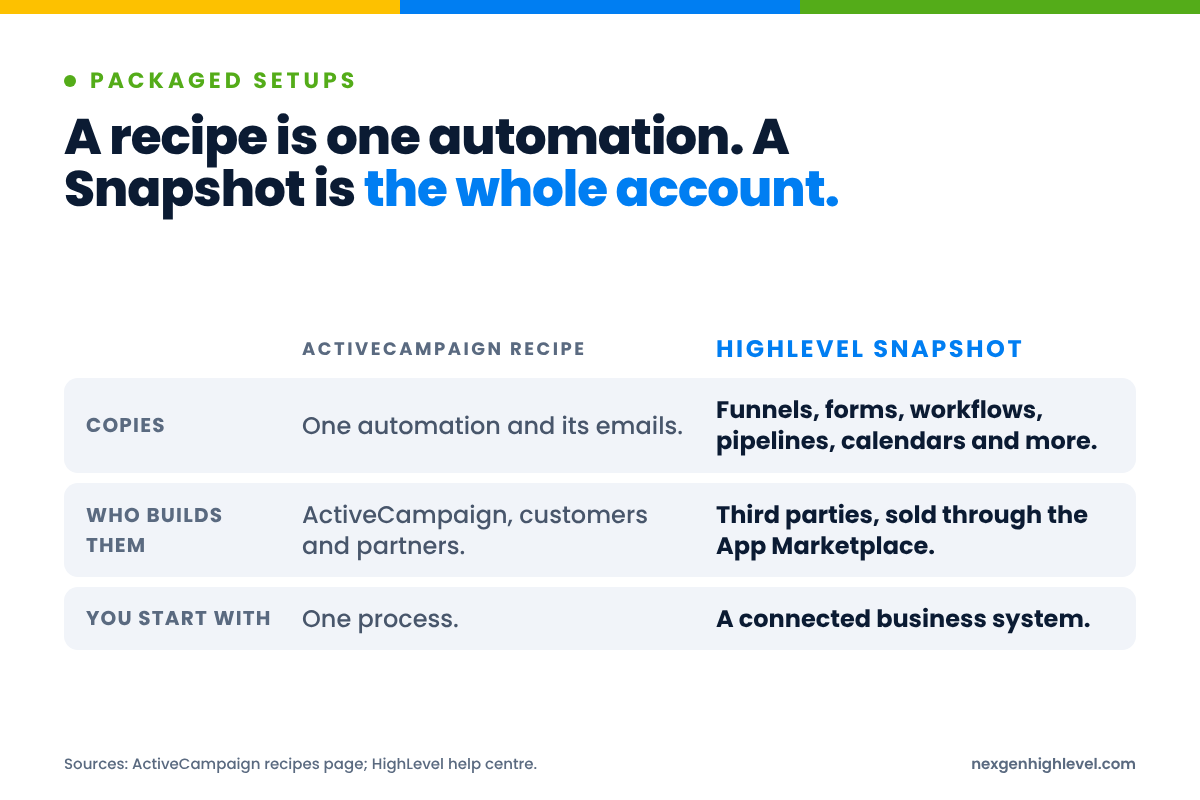
That's genuinely useful. But a recipe is one automation.
A HighLevel Snapshot is a whole account.
HighLevel's official definition says Snapshots capture configuration assets from a sub-account so they can be copied into other sub-accounts. And the list of what a Snapshot can carry is long: workflows and triggers, Conversation AI and Voice AI agents, calendars, pipelines, custom fields and values, tags, funnels and websites, forms, surveys, quizzes, email and text templates, membership offers, dashboards and reports, documents and contracts, knowledge bases, review settings, WhatsApp templates and more.
You load it into a new or existing sub-account, choose what to import, and review any conflicts. Agencies can load a Snapshot into multiple sub-accounts. And Snapshots can be sold on the App Marketplace to other agencies, who push them straight to their locations.
Think of it like this. A recipe gives you one room, furnished. A Snapshot gives you the house, with the plumbing connected and the lights on.
Recipes copy an automation. Snapshots copy a business.
How our apps help you get more out of HighLevel
HighLevel's line has always been "Capture, Nurture, Close". It does that brilliantly. But when I started using it, I kept asking the same question.
Where's the prospecting? Where's the outreach? Where's the market creation?
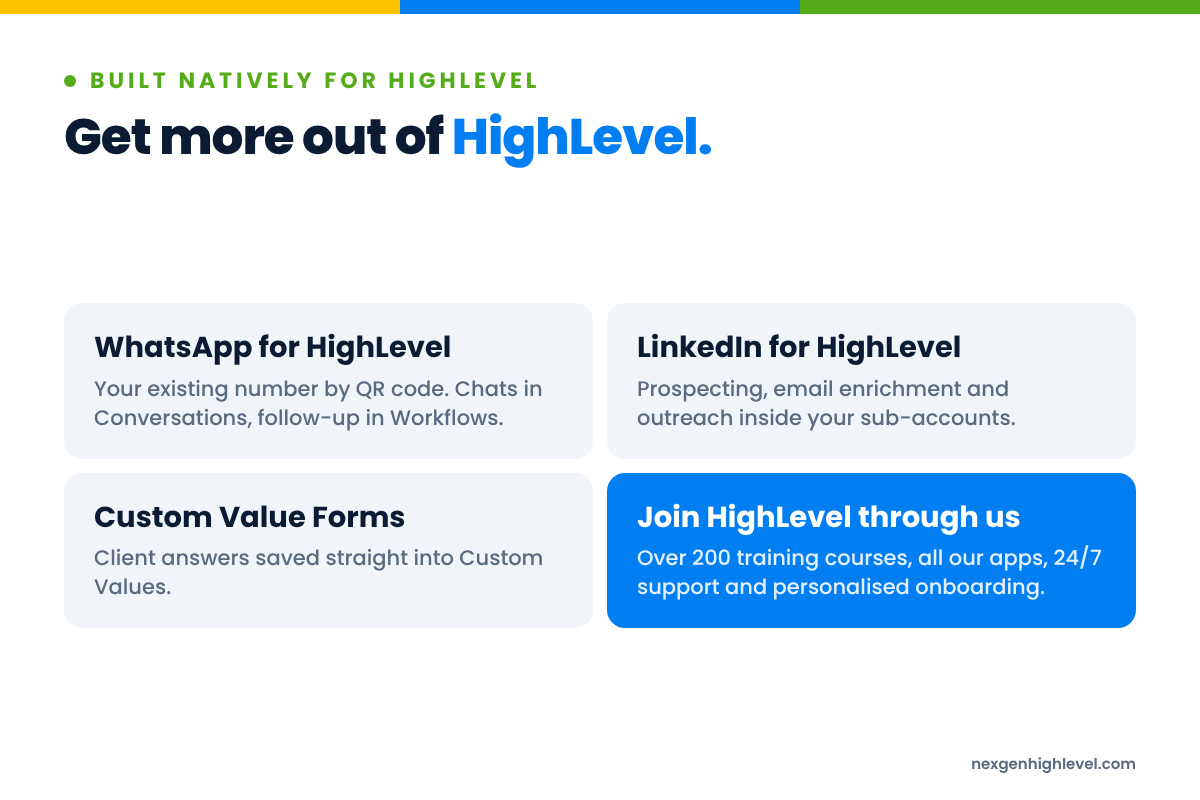
That's the gap we built NexGenHighLevel apps to fill. And there's one rule behind every one of them. We make our apps part of HighLevel, not a complement to it. They use what's already there: Workflows, Contacts, Tags and Conversations. No API to wire up. No Zapier, Make or n8n.
For anyone comparing HighLevel with an email-first platform, three of them are especially relevant.
WhatsApp for HighLevel
ActiveCampaign takes WhatsApp seriously. It acquired Hilos, a WhatsApp automation platform, in April 2025, and WhatsApp messaging is on its features page. That tells you where customer conversations are heading.
WhatsApp for HighLevel connects your existing WhatsApp or WhatsApp Business number by scanning a QR code. No Meta API approval process. Your chats land in HighLevel Conversations alongside SMS, email and everything else, and your Workflows can send messages and follow up automatically.
There's a standard version for businesses and a white-label version for agencies, and both install from the HighLevel App Marketplace. If you want to see how it fits together, I've written about connecting WhatsApp to HighLevel.
LinkedIn for HighLevel
Here's the thing about email-first platforms. They're brilliant once you have a list. But where does the list come from?
LinkedIn for HighLevel brings LinkedIn prospecting inside your HighLevel sub-account. You find your ideal customers, import them, enrich their email addresses and reach them on LinkedIn and by email, then nurture them with the same Workflows you already use.
We built it originally for one client who needed it. Adding email enrichment was a game changer, because it meant people could build reliable data for email outreach, not just LinkedIn. Outreach went up for those first clients, and so did leads, sales, revenue and profit. Agencies can white-label it and resell it too.
Custom Value Forms
This one is for agency owners. Every new client means collecting the same information: business name, address, phone, offers, links. Then someone has to paste it into the right places in the sub-account.
Custom Value Forms gives you branded forms whose answers save straight into Custom Values in your clients' sub-accounts. No Zapier, no Make, no webhooks. Pair it with a Snapshot and a new client's account fills itself in.
That's the kind of thing that only works because HighLevel is a platform you can build on.
Snapshots make getting started with HighLevel easier
Let's be honest about HighLevel for a second. It does a lot. And when a platform does a lot, the blank account on day one can feel like a lot.
That's exactly the problem Snapshots solve.
Not all Snapshots are equal
A typical Snapshot you'll find might be a couple of funnels, a few workflows and one pipeline. That's a starter pack. It's useful, but you're still building most of the system yourself.
A NexGenHighLevel Snapshot is different. It's a complete, fully built-out business system in a box for a niche. Funnels, forms, workflows, pipelines, calendars, emails and texts, and AI features, all connected around the whole client journey, from the first enquiry to the review and the repeat booking.
Load it into a HighLevel account and the system is there. You make it yours: your branding, your offers, your numbers. You're not starting from scratch.
I've written more about this idea in the HighLevel Snapshot as a business in a box.
For the business owner and the agency
Every one of our Snapshots works for two people.
The business owner in that niche, who wants a proven system running in their own account. And the agency serving that niche, who wants to deliver the same quality system to every client without rebuilding it each time.
Here's what's live today:
- Social Media Marketing Agency (SMMA) Snapshot, built for agencies to run their own business on HighLevel.
- Credit Repair Snapshot, for credit repair businesses and the agencies that serve them.
- HVAC Snapshot, for heating and cooling companies and their agencies.
- Landscaping and Lawn Care Snapshot, for landscapers, lawn care businesses and their agencies.
More niches are on the way. You can see them all on our HighLevel Snapshots page.
Why this is the real difference vs recipes
Clients have used Snapshots to skip months, if not years, of trial and error building a system.
Compare that with importing recipes one by one. Each recipe gives you an automation. You still need the pipeline, the forms, the landing pages, the calendar, the reminders, the review requests, and the logic that ties them all together.
With a Snapshot, that logic is the product.
HighLevel's growth vs ActiveCampaign over the last five years
Growth isn't everything. But momentum tells you where a platform is putting its energy, and whether the ecosystem around it is getting bigger.
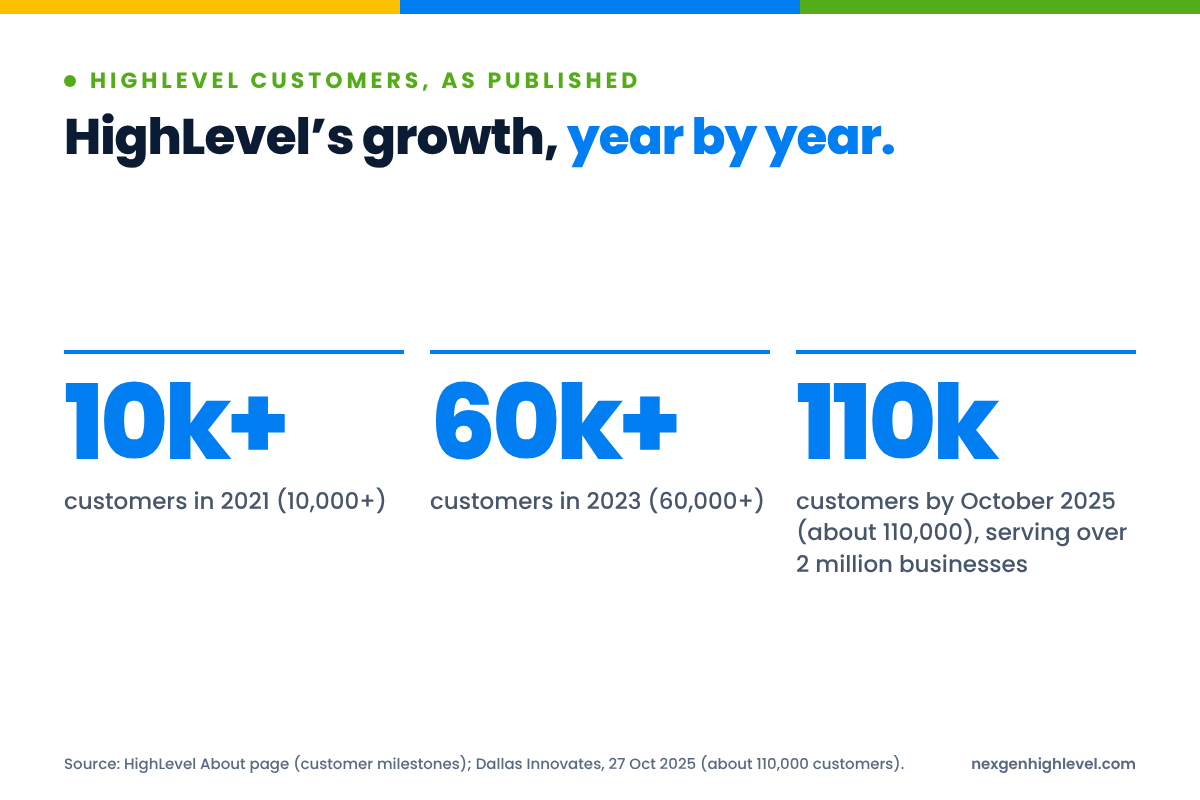
Both companies are private, so neither publishes full yearly accounts. Here's what each has published.
| Published figure | HighLevel | ActiveCampaign |
|---|---|---|
| Founded | 2018 | 2003 |
| Customers, 2021 | 10,000+ (about page) | 145,000 companies (April 2021) |
| Customers, latest | About 110,000 (Oct 2025) | More than 150,000 (About page) |
| Businesses on the platform | Over 2 million (Oct 2025) | Not published |
| Team | 1,800+ (Oct 2025) | 850+ in 2021; its About page now shows both 800+ and 1,000+ |
| Revenue | Not published | Over $165 million ARR in 2021; nothing published since |
| Latest funding | General Atlantic minority investment, April 2024 | 240 million dollar funding round led by Tiger Global, April 2021 |
Let me be straight about what this shows.
In 2021, ActiveCampaign was the much bigger business by customer count. It had 145,000 companies and had passed $165 million in annual recurring revenue. HighLevel had just grown to 10,000+ customers. That's fifteen years of head start, and it showed.
Since then, the picture has changed. HighLevel went from 10,000+ customers in 2021 to about 110,000 in October 2025. That's roughly eleven times as many, from two published figures of the same kind. ActiveCampaign went from 145,000 companies in 2021 to "more than 150,000" on its current About page (another section of the same page says over 180,000, so I'm using the lower figure).
And HighLevel's customers are mostly agencies. Behind those 110,000 customers sit over 2 million businesses using the platform.
Independent rankings
You don't have to take HighLevel's word for it:
- Deloitte Technology Fast 500: No. 47 in 2023 (revenue growth of 3,362% from 2019 to 2022), No. 103 in 2024 and No. 116 in 2025.
- Inc. 5000: No. 516 in 2025, with 781% three-year revenue growth, its third year in a row on the list.
- General Atlantic, April 2024: HighLevel had grown more than 5x over the previous three years while staying profitable.
ActiveCampaign is a well-established company with a big customer base. I'm not taking anything away from that. But if you're asking which platform has the momentum, and which one is building its future around agencies and small businesses, the published numbers point one way.
Who should choose ActiveCampaign, and who should choose HighLevel
Here's my honest view.
ActiveCampaign suits you if your business really is the email list. You sell online, your customers rarely need a call or an appointment, and you already have a website, booking tool and payments set up that you're happy with. You want a deep, mature email automation tool, and you're happy to connect other tools around it.
HighLevel suits you if you're a small or medium business that books appointments, takes calls, sends quotes, collects payments and lives on reviews. You want one platform for all of it, with the contact, conversation and calendar on one record. You'd rather load a complete system than build one from scratch.
HighLevel is the clear choice if you're an agency. Unlimited sub-accounts on a flat subscription, full white-label, SaaS mode, rebilling, Snapshots for every client and an App Marketplace you can resell from. ActiveCampaign's white-label programme is real, but it's a reseller arrangement for one product. HighLevel lets you build a software business.
For most small businesses and agencies I talk to, HighLevel is the better ActiveCampaign alternative because it replaces the stack rather than sitting in the middle of one.
If you're also weighing up the bigger names, I've compared HighLevel vs HubSpot too.
Switching from ActiveCampaign to HighLevel
Moving platforms sounds scary. In practice, it's a handful of clear steps. Walk before you run.
What the move involves
- Export your contacts. Take your contacts, tags and custom field data out of ActiveCampaign as a file and import them into HighLevel. Keep a record of which tags mean what.
- Load a Snapshot, or rebuild. This is where most of the time goes, or doesn't. Rebuilding every automation, form and pipeline by hand takes a while. Loading a Snapshot gives you the whole system in one go, and you adapt it from there. It's the fastest way to stand up the new account.
- Connect phone and email. Set up your sending domain and phone number in HighLevel so texts, calls and emails come from you. Snapshots don't carry live connections, so this step is always done fresh.
- Recreate what's unique to you. Any automation that's specific to your business and not in the Snapshot, rebuild it in HighLevel Workflows. Often you'll find it's simpler, because the calendar and inbox are now in the same place.
- Run both for a short overlap. Keep ActiveCampaign live for a few weeks while HighLevel takes over. Let any running sequences finish, check everything fires, then switch off.
If you're coming over as an ActiveCampaign alternative for a client base, do one client first. Get it right. Then roll it out.
Getting HighLevel through NexGenHighLevel
You can sign up to HighLevel directly. Or you can get HighLevel through NexGenHighLevel and have help from day one.
When you join under our agency, you get:
- Over 200 HighLevel training courses.
- Access to all our Apps for HighLevel, the live ones and future releases.
- 24/7 support and personalised one-to-one onboarding.
- A full HighLevel sub-account under our agency, plus a free Snapshot from NexGenHighLevel.
No hard sell. It's just a better way to start than an empty account and a help centre.
Frequently asked questions
Is HighLevel better than ActiveCampaign?
For email marketing alone, ActiveCampaign is a strong, mature tool. For running a whole small business or agency, I think HighLevel is better. It covers funnels, websites, calendars, SMS, calls, WhatsApp, reviews, payments, courses and AI natively, with white-label, unlimited sub-accounts and Snapshots for agencies. ActiveCampaign's features page doesn't list calling, native booking, reviews or courses.
Can I migrate from ActiveCampaign to HighLevel?
Yes. Export your contacts and tags from ActiveCampaign, import them into HighLevel, then load a Snapshot or rebuild your automations in HighLevel Workflows. Connect your phone number and sending domain, and run both platforms for a short overlap while sequences finish. A complete Snapshot makes this much faster than rebuilding by hand.
Is GoHighLevel cheaper than ActiveCampaign?
It depends on how you grow. GoHighLevel charges a flat agency subscription with unlimited users and, on higher plans, unlimited sub-accounts, plus usage for phone, email and AI. ActiveCampaign's plans come with set seats and the price scales with your contact count. If you're replacing several tools, or serving many clients, the flat model usually works in your favour.
Does ActiveCampaign have white-label?
Yes. ActiveCampaign's Agency Partner programme includes a White Label Program. Partners can use their own branding and domain, sell it to their niche and bill clients directly, with a per-account discount that rises as they add accounts. HighLevel's model goes further: unlimited sub-accounts on a flat subscription, SaaS mode, rebilling, white-label apps and Snapshots.
What is a HighLevel Snapshot?
A Snapshot is a packaged copy of a HighLevel sub-account's setup: workflows, pipelines, funnels, forms, calendars, templates, AI agents and more. You load it into a new or existing account in one go. It doesn't copy contacts or conversations. A NexGenHighLevel Snapshot is a complete business system in a box for a niche, not a starter pack.
What do I get if I sign up to HighLevel through NexGenHighLevel?
You get over 200 HighLevel training courses, access to all our Apps for HighLevel (including future releases), 24/7 support with personalised one-to-one onboarding, a full HighLevel sub-account under our agency and a free NexGenHighLevel Snapshot. You can start your HighLevel account with us here.
The bottom line on HighLevel vs ActiveCampaign
ActiveCampaign vs HighLevel isn't really a fight between two email tools. It's a choice between a very good email automation platform and a platform built to run the whole business.
ActiveCampaign gives you recipes. HighLevel gives you Snapshots.
ActiveCampaign lets you resell its accounts. HighLevel lets you build your own software business.
ActiveCampaign connects to other tools. HighLevel lets people build tools that become part of it.
But remember, technology is leverage, not strategy. Leverage multiplies whatever is underneath it. Know your customer, get the offer right, then pick the platform that carries it the furthest. For most small businesses and agencies, I believe that's HighLevel.
If you're ready to try it, get HighLevel through NexGenHighLevel and start with a system, not a blank screen.
Email is where the conversation starts. It's not where the business ends.